Author: Gary McCarthy

  • Merger and Acquisition Trends – Keep an eye on Management

    Merger and Acquisition Trends – Keep an eye on Management

    Followers of mergers and acquisitions activity will know that we are now into “earnings season” where publicly listed companies provide financial updates on the previous quarter and guidance to market analysts on future performance. This guidance will appear in press releases and investor presentation decks with the text scrutinized by armies of  analysts and commentators for any shift in tone or emphasis. I never cease to be amazed by the folly of this endeavour.

    Human beings are rubbish at forecasts.

    The best analytical guide is the recent quarterly financial performance and its proximity to previous quarterly trends. Ultimately, the only value of guidance would be alerting the market to a significant risk specific to the business.

    Yes, one will get vague warning sounds on the likes of Brexit and trade war risks but it is extremely rare for a management team to highlight its own business as being particularly exposed.

    In fact, I have been physically present at well over 2,000 investor presentations over the years and not once has a CEO said, “We’re a bit screwed”.

    Understandably, no CEO wants to crush his company’s share price so the value of investor communications in periods of turmoil can be close to zero.

    Readers might wonder why we raise this issue of communication flaws while financial markets hit all time highs and show no signs of said stress or turmoil? Maybe because corporate actions can speak a lot louder than words and we are seeing some interesting actions and data.

    The most significant strategic initiative a management can undertake is a decision to expand or shrink the business by buying or selling a division/franchise.

    Academic studies have shown that approximately 50% of deals end up in wealth destruction for the acquiring company. No CEO is unaware of that statistic so the decision to engage in M&A is not taken lightly and should be considered a genuine illustration of confidence by the acquiring management.

    So, it is instructive to take a look at the latest global report on mergers and acquisitions (M&A) activity.

    According to Mergermarket the value of global M&A activity in the first 6 months dropped by 11% compared to the same period a year ago. It is interesting that values would fall as equity markets hit new valuation highs but $1.8 trillion worth of deals is hardly a crisis of confidence.

    Possibly more interesting in a Brexit and trade war context is the data emerging at a regional level which reveals quite divergent trends.

    Corporate America is slightly ahead of the Trump Kool-Aid mantra of  “Make America Great Again”. We might already be at peak USA. The US has just taken its largest ever share of global M&A activity with 53% of the value happening in Trumpistan.  Activity in the US is actually up almost 15% versus 2018.

    The story elsewhere in the world is strikingly different.  The most trade sensitive regions in the world are Europe and Asia.  The rise of protectionist rhetoric from Washington, London and Beijing appears to have affected the deal-making confidence in these trading blocs with activity levels plummeting by 39% and 34% respectively.

    For those with an eye for history it is notable to see Chinese outward investment fall to levels not seen since…. 2009.

    On the flip side of the M&A coin is the more defensive decision of managements to shrink a business and focus on core franchises.

    So, it is interesting to note that global de-merger activity reached its third highest level on record.

    Also, something to watch at a sector level is the narrowing of M&A activity coinciding with a concentration of sector influence in benchmark equity markets.  As the technology sector powers the S&P 500 higher the M&A activity levels in the sector have reached record levels.

    Private equity with $2 trillion of “dry powder” to put to use (per Prequin) are increasingly dependent on the technology sector for deal flow; private equity now accounts for 23% of technology deal flow globally compared to 13% just 5 years ago.

    Turning our attentions closer to home it is worth keeping an eye on the activity of managements who have a track record of negotiating more challenging financial conditions. The following management actions should be considered instructive:

    1. CRH, a multi-decade global bellwether in the materials sector is selling its €1.6 billion European distribution franchise to Blackstone.
    2. Paul Coulson’s Ardagh is booking a $2.5 billion cheque by moving its Food and Specialty Metal Cans business into a JV with a Canadian pension fund. Despite record low interest rates management appear to want to reduce Ardagh’s €7.2 billion of net debt. Note our previous article on “Other People’s Money”.
    3. For the real estate watchers out there it is noteworthy to observe Stephen Vernon and Pat Gunne’s decision to put Green REIT on the block. Timing is everything and Vernon has form.
    4. Not sure Bank of Ireland deserves the credibility of the previous three franchises but… the new CEO with lots of UK experience at HSBC has signed off on the sale of its UK credit card business to JaJa Finance for €590m.

    On the face of it this looks like a lot of shrinking and prepping for challenges ahead. However, one could also keep an open mind and suggest sellers are seeing lofty valuations and are raising funds as opportunistic options to buy things they really want if markets and valuations pull back. We shall soon see as Boris and Brexit looms.

    In the interim, treat company outlook statements over the coming weeks with a pinch of mature salt and pay attention to corporate actions.


  • Other People’s Money

    Other People’s Money

    My former boss, Terry Smith, has established himself as probably the most successful UK fund manager of his generation. The eponymous Fundsmith now manages a massive $25 billion of investor capital which is invested in a relatively small portfolio of good companies purchased at reasonable prices.

    His refusal to chop and change this portfolio is often referenced as a key to his fund’s outstanding performance. However, in light of recent market events and trade war storm clouds gathering I am reminded of another lesser known performance driver Terry imparted to me in the early days of the fund’s marketing campaign.

    When selecting investment opportunities Terry steers clear of companies which have a business model dependent on “other people’s money”.  It might sound odd as an investment business to seek out companies which “actually don’t need our money”. In essence, the fund seeks out companies which generate cash to fund their own expansion and have a multi-year track record of doing so. In contrast the fund avoids companies and managements who have a serial track record of issuing new shares or raising debt capital to fund their activities. One can add to this cohort of capital sink holes another group of companies whose day to day activities rely on daily provision of funding. In the case of capital sink holes we are thinking of the likes of heavy industries (chemicals and autos) utilities, telecoms and energy stocks. Business models based on daily funding dependent on the kindness of strangers would include banks and insurance companies.

    Note this investment principle does not apply to young growth companies and start-ups. Rather Terry takes a rather jaundiced view of long established companies and sectors which invariably run into trouble when market crises and recessions occur.

    Bluntly, these companies struggle for survival when markets take fright and all providers of capital suddenly decide they’d rather hold onto their liquid funds until volatility recedes. The financial crisis was an example where even banks refused to deposit funds with each other. For serial capital gobblers the problems are usually associated with an inability to extend/roll over debt arrangements at exactly the same time as profits and cash generation are challenged like in recessionary periods.

    Only last week another former boss of mine, Conor O’Kelly, who heads up the NTMA warned of a 100% certainty of another recession in Ireland. Crucially, there was no time horizon mentioned but the purpose of the warning was to remind us that Ireland is still quite dependent on other people’s money, namely a very large debt burden which the NTMA is carefully staggering in terms of payment deadlines. The positive for corporate Ireland is that business models which survived catastrophic growth shocks in 2008-2009 are well placed to weather potential threats from Brexit and trade wars orchestrated by the racist-in-chief tweeting in Washington. This may not be true elsewhere as emergency central bank liquidity provided over recent years has kept many ‘zombie” companies and banks afloat. Be very aware that Deutsche Bank will not be the only European bank to experience close-to-extinction events in the coming years. Liquidity in crisis is critical but recent UK headlines might confuse the liquidity lesson.

    Regulators in the UK are currently trying to jam the oversight barn doors closed long after another financial Shergar has bolted. The unfortunate victims this time were investors in Woodford Investments, managed by the man who used to hold Terry Smith’s crown as the UK’s super star fund guru. In the case of Neil Woodford the investment funds he managed were frozen for ‘liquidity’ reasons. This was not a cash crisis in the more traditional sense. In this case the Woodford funds mixed its investments between private investments, small companies and large companies. After a period of significant under-performance this $10 billion fund received a large number of client requests for their money/capital back. The problem was that only the large quoted companies could be sold easily.

    The private and small companies would require a lot more time or fire-sale prices where there was no liquidity (buyers) causing further permanent capital loss. The blunt truth is that the fund at almost $10 billion of assets was way too big to be mixing its investment strategy between liquid and illiquid investments. Now we await the usual regulatory sledgehammer restricting fund managers’ flexibility to invest in smaller companies. For smaller nimbler funds this will potentially affect managers’ ability to generate performance, possibly unfairly. However, for private investors there could be opportunities as institutional funds withdraw from investment in the smaller companies and private equity arena.

    There is always a place in a private portfolio for long term less liquid investments – think investment properties. With the appropriate weighting in liquid, easy to cash, assets investors with a recommended long term investment horizon should seek out more illiquid opportunities in the smaller parts of the market.

    Equity crowdfunding is a very cost effective way of building an interesting portfolio of opportunities in start-ups and would be a great starting point in diversifying one’s wealth creation strategy. These young companies need your money for the right reasons, to grow. Leave the large company investing to the professionals (via funds) and hopefully they avoid, like Terry Smith, those older businesses which need other people’s money (yours) for the wrong reasons!!!


  • What’s the Story? Dublin slang goes corporate in a big way

    What’s the Story? Dublin slang goes corporate in a big way

    Open job positions on a company website can often be a helpful guide to the current strategic focus of the management.

    One role in particular has started to appear with remarkable frequency and increasing seniority within both small and large corporate structures.  The position of Chief Storyteller is now open at Oracle Corporation which has been around for 42 years, employs 137,000 people and has a market valuation just under $200 billion.

    There are a further 125 Chief Storyteller jobs listed on LinkedIn as open in the US alone.

    While this job title can induce a little toe-curling and an assumption that this is a relatively recent Millennial HR fad, you may need to think again.

    The book  “Shoe Dog” written by Nike founder Phil Knight has become a must-read for business people but it is more than just a valuable business guide; it is a story really well told.

    Indeed, Nike and Phil seem to have known their story was a good one quite a long time before the book was published in 2016; Nike hired its first Chief Storyteller in 1999 when the company was valued at $700m. Today it is valued at over $100 billion.

    There is a good reason why we keep quoting market valuations. Businesses now strongly believe stories drive sales and create wealth.  So what’s the story behind this belief?

    Humans have always told stories and in an Irish context the lyrical tradition of storytelling through the written word or song has endured as the glue that bonds communities. Stories have meaning beside simple entertainment. Stories connect people with other people and that’s a critical goal of any business.

    A business needs to answer the most basic question for its product or service: why should people care – why should  customers, employees or investors care?

    Stories are incredibly effective at capturing human attention in an increasingly noisy world. There are four key reasons why stories engages more of the human brain than other communications.

    1. When a story is told it isn’t just the language processing parts of the brain which are engaged. A story generates an emotional reaction , a sensory stimulus, which causes you to feel what the characters in the story are feeling. And we don’t make rational decisions when we buy, we make decisions with emotion. Emotion is a powerful selling tool.
    2. Stories grab attention. They create and release tension as our brains seek certainty and closure. The release of neurochemicals like Oxytocin in our brains when immersed in a story can generate empathy; an essential factor in building community and loyalty.
    3. Stories transfer values and beliefs. Think childhood stories and parables. Now think of the power of a customer who sees in a story how a character arrived at a belief. If the customer begins to adopt that belief the sale is almost done.
    4. In a world experiencing a data explosion the human brain struggles to retain information over time. Studies show that messages delivered as stories are more than twenty times more memorable than just facts.

    The simple truth is that the most successful companies in the world have very strong stories behind them which communicate a purpose and a value which engages customers and investors.  This drives the creation of a community; a sense of belonging and a sense of loyalty.

    Think back to the role of the Irish ‘Seanchai’ and storytelling’s function as a means of bringing a community together. The role of chief storyteller is to communicate both to employees and external stakeholders the company story, its mission and its vision. That story must be everywhere; ads, website content, social media, employees, PR and product/service.

    For start-ups in the early stages of winning customers and funding, budgets may not allow for a storyteller resource but be in no doubt the most effective means of engagement is your story, the founder story. Tell it well and you will engage people ultimately winning their loyalty. Your campaign videos, presentations and marketing collateral should be a story not a product or service fact sheet.

    The best story I have read in a very long time was recently published by Albert Bridge Capital. It has subsequently gone viral online and dramatically raised the profile of the business and its chief investment officer, Drew Dickson, who wrote the story. It turns out Drew writes quite a bit and has a very interesting investment approach. I suspect many others will be thinking the same and investing with him soon. The article is called Stay In The Game– it’s a quick read and it will make you feel really good.

    Tell a story and stay in the game.

    This article was written by Gary McCarthy, a Guest Author for Spark Crowdfunding.  If you’d like to view our live campaigns or learn more about us, click here.

  • We need to talk about Cryptocurrencies …. NOW!

    We need to talk about Cryptocurrencies …. NOW!

    Would your business accept payment in a cryptocurrency? You might have to consider this question a bit sooner than expected. The extreme volatility of Bitcoin and other crypto challengers would correctly give the impression that such payments would be a commercial risk requiring a rather strong stomach. However, Facebook’s recently announced plans to launch a new digital currency, Libra, is a potential game changer and has prompted serious consideration from unlikely quarters.


    The Bank for International Settlements(BIS) is the bank used by central bankers and would be perceived as a bastion of conservative thinking and risk aversion.  So, it is noteworthy to hear BIS bank head Agustin Carstens admit that “it might be… sooner than we think that there is a market and we need to be able to provide central bank digital currencies”.  Bitcoin has been with us for ten years so why has Facebook’s move caught the attention of central bankers? Clearly, the entry of big tech into financial services raises some serious strategic issues for incumbent banks already struggling with their own technology transitions. However, there are two other aspects to the Facebook initiative which suggest a viable digital currency could be a genuine business banking consideration sooner rather than later.


    Firstly, Facebook is addressing the business-killing problem of extreme volatility in cryptocurrencies. Libra’s value will be stabilised by backing it with real world financial assets drawn from liquid pools of bank deposits and short term government securities denominated in a variety of hard currencies eg. USD, JPY, GBP and EUR. This should result in a “stable coin” with reduced fluctuations compared to the local currencies used by consumers and businesses.


    Second, a credibility problem surrounding cryptocurrencies has been the lack of institutional reputation or trust being put on the line.  In a nutshell, governance and validation are critical to mainstream adoption.  The striking thing about Facebook’s approach is the international partnerships established with 100 validators to ensure neutrality and trust in the running of the Libra network(Blockchain).  The Libra Association will base itself in Switzerland and has already secured 27 founding partners including the likes of Visa, Paypal, Uber, Vodafone, Stripe, and eBay. If one can park current concerns regarding Facebook’s extraordinary data control over 2.5 billion consumers, Libra looks like a serious prospect as a global digital currency.


    This article does not propose to look at the technology issues but, given Facebook’s execution track record, we can assume their plans to use a combination of existing blockchain technologies will deliver a stable digital currency in 2020. If one re-reads the BIS quote above one senses central banks know its going to happen and are preparing for the creation of their own digital currencies. This raises a number of fundamental considerations as currency/legal tender underpins the commercial activities and financial instruments used across the global economy.  The traditional banking system and central bank/ BIS should not assume a counter initiative in digital currencies will necessarily restore some sort of influence parity.


    A clue as to traditional banking concern over the control of the foundation block of the financial system is the just published BIS Annual Economic Report and its prominent Section III – “ Big Tech in Finance: Opportunities and Risks”. While it recognizes the entry of technology firms into financial sevices as a positive for efficiency gains and potential inclusion of the “unbanked” 30% of the world’s population the report also focuses on “new and complex trade-offs between financial stability, competition and data protection”.  The reality for central banks is that technology firms have huge user bases, a commensurate stock of massively rich user data which is utilized to offer services that exploit network effects, generating further usage and even more data to drive activity. In a previous article on Internet Trends we highlighted the case of Chinese giant, Alipay, which already has a billion users and provides financial services to hundreds of millions of customers. Think Facebook and its 2.5 billion user network.


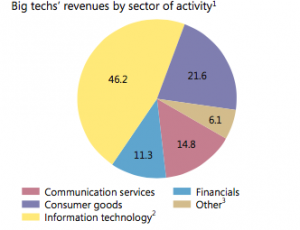
    Already commentators are focusing on the potentially rapid evolution of Facebook into a dominant financial services player. It’s early days yet and the BIS report points out that big tech currently only derives 11% of its revenues from finance as seen in the following chart:

    Given currency’s position as the commercial foundation of modern civilization and commerce there is a fascinating article in Wired which perhaps reveals the true concerns of traditional banking institutions, policy makers and regulators.  The following passage in the article was perhaps the most provocative:


    “And while Facebook’s ambitions appear unsubtle (at least to me), the biggest tech companies are all building more and more advanced and immersive ecosystems. So maybe it’s time to start asking: What is the functional difference between a company and a country?


    It’s not a crazy question: We’re already at a point where huge multinational tech monopsonies have so much power over the global economy that central bankers and regulators are starting to wonder if they even have the tools to set economic policy, like they used to in the old days.


    And the reason these big tech companies are different from other giant multinational corporations like Exxon Mobile or ConAgra or even, strangely, Microsoft is that their ambition really is to own all your interactions, not just your driving or your eating or your typing.”


    Wowzers. Facebook or Google achieving country-like status with control and influence over monster populations, or user bases, and revenues in excess of the GDPs of most countries on the planet.  No wonder the bankers are looking to wrest back control before it’s too late.  BIS head of research Hyun Song Shin does little to hide the fact that Facebook’s Libra has moved the risk dialsignificantly – “ ..there is a need for international cooperation on rules and standards. The recent proposal by Facebook to launch a digital currency, Libra, has underscored the importance of cross border cooperation.”  Yes, the regulatory stick is being waved already.  Indeed, even the US Senate Banking Committee is sitting up and taking notice; a hearing on Libra is scheduled this month while various European politicians have voiced concerns about the emergence of a Facebook “shadow bank” with a user base vastly bigger than Europe’s 600 million population. The euro under pressure from Italian mini-BOT proposals, plunging negative interest rates and pending Brexit trade chaos can ill-afford another existential threat.


    Traditional players won’t be the only ones seeing a threat. It is highly unlikely that Amazon, Google or Apple will stand idly by.  All three have rolled out their own payment options as their users have become comfortable with digital commerce. Interestingly, a country which has effectively gone almost cash-less is also moving quite rapidly towards a digital version of its currency.


    Sweden’s central bank, the Riksbank, is fully aware that only 13% of the population has carried out a recent transaction in cash.  Four out of every five purchases in Sweden are made electronically and the Riksbank can see where this is going. Hence, they have launched a pilot project to develop and test a technology solution for an “e-krona”.  This pilot is generating plenty of domestic controversy as a potential state-like interference from the Riksbank in private commerce. The future of the e-krona is more than uncertain but the digital genie is out of the banking bottle. Central bankers are clearly assuming big tech is going to enter and disrupt the financial ecosystem.


    Business owners will need to watch digital currency developments carefully and prepare for relatively quick adoption. Think back to all the lost revenues(and franchises) of retailers slow to embrace e-commerce and online payment facilities/technologies. Of course, there will be sceptics. None more famous than the world’s most powerful commercial banker, Jamie Dimon of  JP Morgan. As recently as November 2015 Dimon said Bitcoin, trading at $400 at the time, would not survive. Well, almost ten years after its launch Bitcoin is still with us and trading around $10,000. We would tend to agree with Dimon that the technology(blockchain) is more sustainable than Bitcoin but there was more than a hint of irony in February this year when JP Morgan launched its own cryptocurrency – “JPM Coin” –  for its clients.  The bankers’ message is clear.


    Digital currencies are coming to mainstream commercial activities. Big Tech is the catalyst forcing banking responses including actual crypto solutions. Businesses will need to pay attention as they most likely will have to be digital-ready quite soon….

  • Internet Trends of 2019 – How Did We Miss That?!

    Internet Trends of 2019 – How Did We Miss That?!

    There is one report worth a read every year. Veteran Wall Street analyst and technology investor, Mary Meeker, publishes an annual “Internet Trends” slide deck which has become a valuable source of information for business owners.

    It can be downloaded at www.bondcap.com and is just the 330 pages long(!)

    For those a little bit time poor we thought it might be helpful to flag a number of the key trends. Some of them might even have been covered previously in this corner.

    America is already great – the greatest it has ever been. Eight of the ten most valuable companies in the world are US owned and six of them are from the technology sector. As ‘Agent Orange’ in the White House threatens trade wars across the globe, readers should be mindful that only 30 years ago it was Japan who filled eight of those top 10 spots. Fingers crossed for the G20 meet this week!

    Technology is the new oil. The tech sector’s phenomenal ability to scale rapidly has ensured its position as the ‘fuel” to power almost all business activities. As recently as 1980 six of the ten largest companies in the world were oil companies. More than half the human population( > 3.8 billion) is now online but user growth is slowing to a single digit growth rate of 6%.

    The business future is East. The Asia Pacific region now accounts for 53% of global internet users with China and India combined making up a third of the global user base. However US technology companies are the leaders occupying 18 of the top 30 positions in the valuation tables for the global technology sector. China holds 7 of those slots but expect that to grow with its more than 800 million strong mobile user base!

    Advertising spend is chasing user behaviour changes. In 2010 US consumers spent 8% of media time on mobile with mobile ad spending at barely 0.5% of total ad budgets compared to TV time and spend at 43%. Fast forward to today and mobile user time and ad spend is at 33% compared to TV at 34%. Expect 2019 to witness mobile as the top recipient of advertising spend as time spent on mobile, estimated at a daily 226 minutes, will overtake TV at 216 minutes. Also, watch out for the likes of Amazon, Twitter and Pinterest to gain additional share of those advertising revenues from Google and Facebook.

    Humanity is returning to the caves. Early human communication was delivered via images/stories. Our brains are wired for images. Writing was a hack, a detour, but we are now returning to what is most natural. The principal delivery platforms of digital images, YouTube and Instagram, are gaining share of daily user time from Facebook and TV. Digital video consumption as a share of total watching time vs TV has doubled from 14% to 28% in just 5 years. Possibly more stunning is the fact that another image-based activity, interactive gaming, has become a social platform in its own right with total players now standing at 2.4 billion(!). Thank you Fortnite…..

    Video didn’t kill the radio star. Arguably, voice is on the come-back trail. Podcast usage has doubled in 4 years while the Amazon Echo installed base has doubled to 47 million US users in just one year.

    Banks beware. In the week that Facebook announces its own crypto-currency and Bitcoin rockets through $10,000 again the whole area of mobile payments is exploding. As European bank valuations plummet how would you value Alipay in China? This payment platform has more than 1 billion users and doesn’t just do payments; this is a full- blown financial services player providing loans, wealth management and insurance products to hundreds of millions of consumers and millions of businesses. Even closer to home, Monzo raised money this week pushing its valuation over £2 billion; and another European bank challenger, Revolut, has seen its user base double to 4 million in just 10 months.

    Cloud deployment is booming. Cloud service revenues for Amazon, Microsoft and Google are growing 58% year-on-year. The cloud has also been instrumental in allowing businesses scale up using ‘freemium business models’ – Gaming, Google G Suite and Zoom are good examples where excellent free user experiences drove subscriber revenues for additional functionality. Slack in the week of its successful IPO is also worth a mention as a business service following in the footstepos of Wix, Dropbox and SurveyMonkey. According to Mary Meeker we are only just getting started with freemium business models for business and the consumer. It was gaming which proved the model – just the 2.4 billion players later and yet we are only now writing about freemium models for enterprise/businesses. Perhaps those 330 slides of Internet Trends might be worth a closer look if you want to get a better picture of the digital future of your business……

    “Data is now fundamental to how people work & the most successful companies have intelligently integrated it into everyone’s daily workflow… Data is the new application.”
    Frank Bien – CEO & President, Looker, 6/19

  • How do you value your business on Planet ZIRP?

    How do you value your business on Planet ZIRP?

    In our previous article -“Does Frankfurt Have a Kremlin Branch” – we referenced a commonly used valuation metric, a company’s book value, as an illustration of  market worries. However, within hours of publishing the piece I read a fascinating article which raised the prospect of analysts and corporate financiers ripping up the textbooks on traditional valuation models and metrics.  The critical driver of this potential valuation anarchy is the incredibly low interest rate environment currently swaddling the financial markets.


    Josh Brown at the Reformed Broker blog has written a thought-provoking article – “When everything that counts can’t be counted” – describing the incredible divergence in valuations between traditional asset heavy (Value) companies and the new asset-lite market darlings (Growth). The rapid expansion of new franchises challenging older incumbents has been fueled by an abundance of capital available at almost zero cost. When the term ZIRP – zero interest rate policies – was first coined post the GFC the commonly held view was that this was temporary. How wrong we were. Despite employment levels close to structural norms, moderate global growth and asset prices close to all time highs the central banks of the world balked at 2018 market volatility caused by the first steps in the unwind of Quantitative Easing(QE).


    The Fed’s 2018 attempt to raise interest rates to normalised levels has been abandoned this year with monetary authorities around the world either cutting interest rates again or signalling the same.  As someone who started his financial career in Japan I would have shared some concerns that Europe faced a multi-decade experience of almost stagnant growth and interest rates close to zero. However, I was not expecting to read in Brown’s piece a question raised by reknowned investment author William Bernstein.  This big thinker confessed to wondering “What if the cost of capital never rises again?” This question has far-reaching implications for valuation techniques and unfortunately those who describe themselves as Value investors.


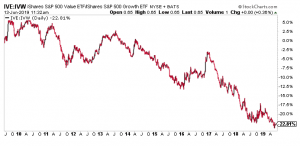
    JP Morgan’s research team has written to clients telling them that there has never been a worse time to be a value investor – “value is currently trading at the biggest discount ever”. Value investing is a strategy whereby investors look for stocks that are underpriced relative to the fundamental analysis of the companies worth. One analytical metric is book value which captures things like plants, equipment and facilities. In a sense, one is trying to discover how much would it cost to replace those assets. It doesn’t capture things like brand, intellectual property and other intangibles. Therefore, if you can buy the cheapest stocks in the market at or below replacement value the odds are in your favour over the long term that this hidden value accumulated over the years will crystalise as a decent return on your investment. That strategy has worked for decades on any long term historic view of the markets…..until now.  The story since 2010 has been very ugly for this strategy leading to massive underperformance vs growth stocks who don’t build factories but access almost-free capital to lease offices, develop IP, innovate and build user bases, brand and quasi-monopolies – think Uber, Netflix, Spotify, Amazon, AirBnB or PayPal.   See the 9 year ratio chart of a value stock ETF(IVE) divided by the growth stock ETF (IVW) for a striking illustration of this painful period for value strategies:

    This is not just a book value phenomenon. Results have been painfully similar for strategies utilising price-earnings ratios, cash flow multiples, dividend yields or a blend of them all. The value tortoise has been left behind the hare(or the hairy) strategies which ignore traditional valuations and now focus on the likes of market monopoly optionality, user base growth, recurring revenue, brand acceleration and mobile ubiquity.  In a ZIRP future of unlimited access to super cheap capital, real assets of older franchises will be under constant threat from new players and possibly remain permanently undervalued.


    Even a recession might not help as growth becomes scarce and attracts further capital relative to lower growth cyclical businesses. Clearly, over the years it has been a fool’s errand to forecast future market moves and in particular, interest rates which have been moving in only one direction for almost 40 years; US rates peaked at over 15% in 1981.  So, if we are stuck in permanent ZIRP mode what can companies and investors do? Here are two possibilities:


    1. Investors: Start to factor in long term zero interest rates and begin to think about the risks of hoping for a different outcome. Indeed, even the value wizard, Warren Buffett, has started to buy Amazon.


    1. Companies: Ensure investors see you are making a digital transformation. WalMart, Disney and McDonalds have been successful in highlighting the intangibles/user multiples of their franchises and escaping “value trap” status.


    The headline in this article asked a question. Unfortunately, there is no definitive answer but in an asset-lite world entrepreneurs/founders should be focusing on the following metrics when communicating with investors:


    1. Sales growth rate/momentum
    2. Incremental/marginal costs of producing additional unit of a good or service
    3. Growth of IP/engineering personnel cost vs growth of sales personnel cost. The latter needs to win that race.
    4. Recurring revenue(monthly, quarterly, annual)
    5. Growth in recurring revenue
    6. Lifetime value of customer – or user in today’s millenium vernacular. Customer is sooo yesterday!


    Ideally, managements should create proprietary multiples and ratios to track these metrics. These will be the basis for valuation discussions and we will write additional articles on sample companies which are using these metrics most prominently in their investor communications.  Sadly, for a cash flow returns evangelist like myself the absence of an actual cost of capital is making discounted cash flow models almost redundant! No doubt as soon I throw out my battered old HP12c calculator markets, interest rates and inflation may conspire to confound yet again.  However, Japan is our most studied ZIRP lab rat so far and that experience suggests we have more than a few years left of virtual valuation.


  • Every Bond Has A Silver Lining……

    Every Bond Has A Silver Lining……

    The non-profit research site ‘Our World in Data’ confirmed this week that there are now more people over 64 than children younger than 5. By coincidence there was a financial headline on the same day which also had demographic resonance. In financial markets dominated by FAANG acronyms and millennial focused growth strategies it seemed strange to see the country with the world’s most rapidly ageing population, Japan, being used as the case study to describe current global financial conditions.


    Of course, the headlines were focusing on the prospect of central banks, particularly the ECB, being trapped in multi-decade zero interest rate environments as experienced by Japan for almost 3 decades. Almost immediately, the talking heads on financial media seized upon the $12 trillion of sovereign bonds now carrying negative yields as a worrying signal for long term growth, inflation targets and possible recession. None of these scenarios are great news for asset prices or savers but a low GDP growth future is not necessarily a doomsday outlook.


    The word “Japanification” is often thrown into financial conversation as a cautionary tale of stagnation at a country level but misses two very critical variables. If one were to look at GDP on a per capita basis(think shrinking population) and adjust for inflation to get a sense of true purchasing power for the average citizen you might wonder what all the fuss is about.  The World Bank data tells us that since 2010 Japan has had the exact same GDP growth as the perennial ‘lucky country’, Australia (1.13%).  That’s more than double France’s efforts and intriguingly within 20bps of  the US and UK. Clearly, there are negative long term considerations for countries with large debt burdens and a shrinking worker pool to support a majority aging population in retirement. But, if one were to take a positive from this demographic challenge, there is a good chance populist immigration debates will change in tone over the next decade. It’s already happening in Japan which historically has had notoriously strict immigration controls.  So the social outlook is not all bad but there is also a whopping business opportunity for those listening to the longer term messaging from the bond market.


    Get ready to hear a lot more about the “Silver Tsunami” and the “Longevity Economy”. Merrill Lynch reckon the global spending power of those aged over 60 will be $15 trillion by 2020. Yep, that’s bigger than China’s current GDP. Quite apart from almost every global busineess trying to crack the enormous Chinese market it is staggering to read that advertisers spend 500% more on millennials than all other age groups. As this writer hits a sensitive age milestone rather soon I feel slightly offended that less than 10% of marketing dollars are aimed at the 50+ population. In financial markets the millennial marketing frenzy could be described as a “crowded trade”.  Inspired by that $15 trillion pot of silver there would appear to be a massive opportunity for strategic innovation which empowers older adults and gives them tools to continue to create and participate in the global economy.


    Very low or negative long term interest rates as signalled by bond yields can also help those innovators fund their businesses. Bluntly, savers will need to change strategies to build/preserve wealth and generate income. For those entrepreneurs out there with a product or service in health, leisure or finance which has a strong ‘silver strategy’ consider a crowdfunding campaign.  It is quite likely you will find enthusiastic funding support on such platforms given their investor registers will probably look remarkably like the market being targeted!


  • Food for thought ………………

    Food for thought ………………

    I met a recently semi-retired hedge fund manager for a coffee last week in London. We are not socially close so my expectation was that we would spend most of the conversation on Brexit,  financial markets and big winning trades achieved and planned for his personal retirement fund. What I didn’t expect was this Master of the Money Universe to speak passionately about climate change beginning to exert a significant influence on financial markets and his belief that society will need to act very fast to avert catastrophe for his children. This dystopian warning and its unlikely source did heighten this writer’s awareness of climate influence when reading financial press in recent days and it turns out that the hedge funder is not alone.


    A Forbes headline within days of our coffee quickly caught the eye – “ This Hedge Fund Superstar Thinks Climate Change Will Impact All Your Investments – And Soon”. Robert Gibbins is the founder of the top performing Autonomy Capital fund with $5 billion in assets and he sees climate change as a major threat to the economic stability of a large number of countries.  In fact, he structures every bet his fund makes around his belief that our future will be overheated and underwater. He is surprised at how almost no investment analysts attend science conferences on climate and yet,  with his fund “climate change is something we have to include in every single analysis, every investment”.  Further headlines in the past few weeks did give pause for additional thought as to why investment teams are not pushing climate further up their risk management rankings:


    National Geographic:     Midwest Flooding is Drowning Corn and Soy Crops. Is Climate Change To Blame?


    The Guardian:      Australia To Import Wheat For First Time in 12 Years


    BBC:  India Reels as Summer Temperatures Touch 50C


    Independent:  “High likelihood of human civilization coming to an end “ by 2050, Australian Report Finds.


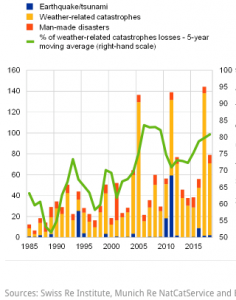
    The report referenced in the final headline may smack of hyperbole but it was co-authored by the former head of the Australian armed forces. The report stresses civilization collapse is a worst case scenario but is based on trends already identified in food production, water access and an acceleration in extreme weather events. Even the european Central Bank(ECB) was moved to publish a report in recent days highlighting how climate change can affect the financial stability of  institutions whose risk assets are exposed to vulnerable infrastructure/real estate and countries, sectors overly exposed to carbon emissions. The chart below identifies clearly some rather worrying trends on weather related catastrophes:

    No wonder President Michael D Higgins was moved to issue a two fingered salvo at the science-denial Commander in Chief of the planet’s largest military force. As the Toddler-in-Chief lands in Ireland it will be difficult for the government to play down Higgins’ observations on the Trump administration’s “regressive and pernicious” record on climate change and its solo boycott of the Paris Accord. At this moment the White House seems to rank its friendship with the carbon autocrats in the Kremlin and Riyadh over the farmers in the Mid-West. This may well change as food supply becomes a focus of financial markets in the coming months.


    Apart from crop failures in the US and Australia, there is the added complication of a pig swine fever which could ultimately wipe out 200 million pigs in China – that’s the equivalent of the entire pig stock of the United States. If the Arab Spring of 2011 is a distant memory it is worth recalling food prices were a big part of the social unrest unleashed and with the current state of geopolitics on a very fragile footing it is no wonder hedge fund superstars are factoring climate change into their risk analysis. With a leader-less Western alliance markets could be spooked quite viciously if another Libya or Syria hits the news feeds. Already we are seeing protests in Sudan turn deadly with headlines focusing on political transition tensions but, at a base level, soaring bread prices have been fueling unrest.


    This Handmaid’s Tale of a looming fertility crisis is like the TV series rather depressing but the good news is that climate is being pushed to the fore as a policy priority by the electorates in the recent European elections.

    Furthermore, an impetus to take action on carbon emissions and food production will reward businesses in the sweet spot of this wake up call. The Irish start-up environment features a variety of scale up opportunities in the food product, food technology and renewable energy sectors . Keen climate worriers could do worse than keep an eye out for EIIS opportunities and crowdfunding platforms promoting businesses essential to fight our generation’s World War III as D-Day hits its 75th anniversary.

  • Does Frankfurt have a Kremlin branch?

    Does Frankfurt have a Kremlin branch?

    In our previous article, “ Wealth Management – 10 Truths”, we wrote about the risks of managing portfolios with fewer than 30 single stock holdings. As a memory refresher, there is every likelihood that a portfolio with a small number of bets will not be sufficiently diversified. In layman’s terms a single event or risk factor could inflict disproportionate damage to even the most carefully selected narrow portfolio. With the daily implosion of the Deutsche Bank share price this writer has been experiencing flashbacks of a common feature of retail investor portfolios, specifically holding too many companies in a portfolio which are dependent on the use of other people’s money. If that sounds like a rather broad or vague description of a business please be warned that it is entirely deliberate.


    A former boss of mine when building a very successful fund management business used to use this phrase “use of other people’s money” as a key risk filter in his investment process. His thinking was that companies  which relied on other people’s money could experience terminal damage if one day people suddenly stopped providing additional funds or even worse, wanted the immediate return of funds already provided. Our memory banks should still recall the credit crisis of 2008/2009 but that use of  “credit” is possibly too narrow a term; the Chernobyl moment for the financial system was a meltdown in liquidity. In a nutshell, the normal transmission system of monies between financial institutions froze as fear dominated and thousands of banking entities tried to hoard capital. Unfortunately, banks were not the only entities whose everyday need for funds was critical. The credit freeze wrought havoc across a vast swathe of commercial franchises dependent on funding for their operations or the survival of their balance sheets. Hence, our earlier use of a broad descriptor for companies at risk and how that might be very relevant to retail investors today.


    We already mentioned Deutsche Bank(DBK) but it would be a mistake to believe that the absence of DBK in your portfolio means you need not read any further. Bluntly, if one of Europe’s largest banking asset pools is valued at less than 20% of its book value then there is a real possibility of some seriously disturbing headlines about that book to come. It would also be a mistake to think this is just a DBK problem. The worry signal for this writer is that the market value of Europe’s top 8 banks is approximately equal to that of JP Morgan with a fraction of the European bank assets ie. the market is signalling significant “issues” in the European banking system. Take your pick from the following:


    1. Italy has a massive debt problem which has not been dealt with in the QE era. Now political rumblings of a parallel currency (the Mini-BOT) could put Brexit in the little league of EU break-up threats.
    2. Interest rates at new lows in Europe(record lows in Germany) make it impossible for banks to make any significant profits plus a potential growth slow down which would bring asset impairment pain.
    3. Europe is, in fact, the largest trading bloc on the planet. It is the economic region most exposed to global trade and…. Trade Wars.
    4. Brexit… say no more or Boris.
    5. Lastly, and keeping with a Chernobyl theme, there is a worrying lack of reassurance about DBK’s $50 trillion(yes that’s trillion) derivatives book. Warren Buffett once called derivatives as weapons of mass destruction (WMD) and a quick check of unexplained losses at DBK in recent years does coincide with a Kremlin-esque silence from Frankfurt. The leakage of profits has been remorseless as €30 billion of caputal raised since 2010 has ended up with a bank valued at just €12 billion.


    The problem for retail investors with small numbers of holdings is that the absence of banks in a portfolio may not insure against lasting damage. Remember those companies who need other people’s money? Well then it might be worth checking the portfolio for the following kinds of companies:


    • Companies involved in insurance – think assets and liabilities not matching suddenly.
    • Companies with too much leverage/debt – way more than 2009!
    • Companies involved in real estate – global real estate at record highs and 2008 a distant memory…
    • Companies who service banks and insurance companies – fintech is hot, until it’s not?


    This writer’s experience of  retail investor portfolios is that the vast majority of portfolios are far more exposed to liquidity/credit risk than appearances would suggest.  It might be worth a re-check of the portfolio and identify exactly how many holdings use other people’s money or provide services to same. As my old boss used to also say “ I love investing in companies  who don’t need my money”.  Think food, beverages, petfood, razor blades, pizzas and toothbrushes. Then think about the difference between debt and equity and know the event risks associated with the former. Conversely, providing equity to a company selling goods/services on an everyday basis with little need of ongoing debt/liquidity facilities can be a fantastic wealth creator over time and over sudden liquidity shocks.


    For those looking at the long term, equity crowdfunding is a great way to diversify a portfolio and find franchises whose business models are less reliant on a creaking banking system and the kindness of strangers.


              “Every lie we tell incurs a debt to the truth”    –  Chernobyl: episode 1 –  May 2019.


  • Wealth Management – 10 Truths from Years of Experience

    Wealth Management – 10 Truths from Years of Experience

    The wealth management industry in Ireland is consolidating rapidly with recent deals announced or imminent involving the likes of Investec, Goodbodys and Merrion.

    This writer spent three interesting years working with a local wealth management division and would argue that the strategic change being forced upon the wealth management providers should also be replicated at the investing client level. Having witnessed thousands of interactions between clients and their advisors there are a number of outstanding truths which need to be emphasised for clients to get the best out of a wealth management service.  My top ten truths would be as follows:

    1. The Plan: For a long term sustainable relationship which will deliver optimum returns the client and advisor must agree a long term plan. And, then stick to it. In order to generate returns clients must stay exposed to market risk over the long term and avoid emotional short term chopping and changing of portfolios. Market volatility and emotions are a fact of investment life. The value of an advisor is to keep the client “on plan” and  provide reassurance that the investment portfolio is positioned long term to benefit from volatility and the compounding effect of growing income streams.
    2. The Fees: High fees will eat into the long term returns to clients. Total fees will be a combination of advisory fees and execution fees.  The advantage of putting in place an investment plan is that this will reduce turnover and additional execution fees which should be negotiated aggressively. The real value which is worth paying for is the advisory side where wise experienced counsel at times of turbulence will ensure the investment plan is followed. In a previous article we have highlighted that Fidelity’s best performing clients were those that actually were dead. Dead people don’t panic or trade.
    3. Trading: Clients should be absolutely sure they are an investor for the long term. Trading or timing the ebb and flow of market volatility is incredibly challenging, even for professionals. Time and income compounding are a client’s long term secret weapon. Timing trades for optimum exit and entry in the markets is expensive and in the vast majority of cases wealth destructive. Check out the disclaimers on most of the financial trading platforms and they will warn that circa 75% of clients will lose money. So, to be clear, that’s not a return on your capital – that’s not even a return of all your capital.
    4. Portfolios: It was soul destroying to listen to clients discussing their portfolio of 20 odd stocks with an advisor and seeking recommendations as to potential new stocks/ideas to buy and then which poor performing stock to sell and make room for the latest greatest stock idea. Let’s be absolutely clear that this kind of portfolio is not fit for long term investment purpose. It is not sufficiently diversified and therefore is prone to unnecessary emotional turmoil and decisions on the hoof. Academic studies would suggest a portfolio of a minimum 35 instruments will achieve 90% of diversification required and even then I would suggest the random assembly of 35 securities is sub-optimum from a cost perspective. From an advisor’s perspective it is also a regulatory nightmare, as any unique underperformance of this portfolio versus the firm’s recommended model can invite scrutiny and potential litigation risk.  For the vast majority of clients the optimum way to access the market is via funds or ETFs.
    5. Securities: As per the previous point there are real cost benefits to leveraging the market purchasing power of a fund or ETF. They can trade for almost no cost but individual stock trading will be far more costly to a client. Remember the key value is the plan and the advice. The instruments used to achieve the plan should be as low cost as possible.
    6. Asset Allocation: Often times I would hear clients query why they should pay advisory fees for a portfolio that uses instruments which passively mimic the market’s moves. Clients rightly should pay fees that are appropriate to an active management service but clients should also be aware the use of passive instruments can drive a very active strategy/plan. Think about the long term differences in performance of bonds/equities, Europe/US equities, Commodities/Real Estate, Startup Investing and one will understand that cheap instruments can power a very active strategy. The biggest driver of performance over time will not be a clients’ exposure to single stocks. The much more important consideration in terms of delivering the plan will be keeping asset allocation on track and rebalancing same periodically.
    7. The Advisor: A really good advisor will put in place a plan/strategy which can be explained easily and reviewed regularly to reassure a client that the portfolio constituents are delivering in line with benchmarks, comparable products. A really really good advisor will know that the value of a client relationship is long term retention of that client. So, a really really really good advisor may reward a client with his/her loyalty and adherence to the investment plan by lowering advisory fees in say year 4. For real thought leadership in this area check out the fast growing US wealth management firm, Ritholtz Wealth at ritholtzwealth.com
    8. The Family: A client who has a long term investment plan is more likely to share this information with family and offers the potential of a multi-generational relationship with the advisory firm. If a client is uncomfortable sharing investment arrangements with family it is often because the financial goals and plan are not robust. A client should reflect on that, and certainly before putting a succession plan in place.
    9. Risk Free: There is no such thing as a risk free proposition/product. Even if there was, the logical real returns outcome would be zero(or worse with inflation).  We often read reports of dubious investment schemes promising super-normal returns. However, there are real risks associated with supposedly low risk products in the current market. By an unusual conflation of circumstances the regulators/monetary authorities in current financial markets have created a vast market of supposed risk-free instruments (government bonds) which currently have negative yields i.e. the investor loses a small amount of money each year to own the bonds. Every wealth advisor is in the bizarre situation right now where these government backed securities are considered/instructed by the very same regulators/monetary authorities as low risk , much lower risk than say equities. For long term investors, a portfolio of these instruments would be a sure fire route to wealth destruction. Welcome to the bizarre world of Quantitative easing (QE) but clients should look to the long term and an investment portfolio’s ability to generate compounding income.  The only payments a client should make are to a good advisor.
    10. A prospective wealth management client should forget about the last 8 Truths if the 1st Truth is ignored.

    Finally, Investors who may be interested in supporting new Irish start-ups can view equity crowdfunding investment opportunities on the Spark Crowdfunding website here.