Author: Gary McCarthy

  • Shooting Down The Wrong Balloons

    Shooting Down The Wrong Balloons

    Being Freezbrury season perhaps the hot air antennae in Gravitas Towers are tuned a little too sensitively. But, seriously, Liz Truss and Chinese weather balloons hitting the front pages on the same weekend? What fresh hell have our prayers to St Bridget failed to forestall. Lizteria is busy telling the Torygraph echo chamber that she was brought down by the ‘left wing economic establishment’. Yep, that would be the City grandees, the Treasury, hedge funds, the IMF and that notoriously ‘woke’ bunch from the global bond market ALL agreeing KamiKwasi economics was batsh*t crazy. Not to be outdone on the crazy front, MAGA’s Marjorie Traitor Greene was equally busy, whipping up the cult by suggesting they grab their guns and shoot down a Chinese weather balloon from 12 miles below. The Biden administration finished the job with a USAF F-22 fighter jet but that didn’t prevent the usual Republican border-guard bloviating until…… the US Department of Defense let slip that just the three Chinese balloons had traversed the nation’s skies during the Trump Presidency. Cue, GOP crickets. Moving on from the ridiculous, readers should note there are a few other “balloons” out there which need debunking swiftly.

    We have been bombarded with the commentariat’s gloomy certainty of recession for months but not on these pages. One of the key ‘balloons’ in the recessionary roaring has been the dramatic number of job loss announcements in the technology sector globally. Indeed, Dell have kicked off this week with an announcement of 6,500 redundancies. However, technology is only a part of the global economy and perspective is needed. For illustration, Crunchbase data reveals 2022 tech job losses of 107,000 in addition to a 2023 total moving past 50,000 year to date. So, let’s say the last 13 months have seen more than 150,000 US technology roles lost but….. the latest Non-Farm Payrolls(NFP) figures for US job creation in just the last month(January) showed a whopping 517,000 new jobs added to the economy. Oh, and the US unemployment rate of 3.4% is the tightest job market seen since the lunar landing of 1969. The tech balloon might be bursting somewhat but we’d advise a wider planetary perspective.

    The IMF has already upgraded GDP activity forecasts for 2023 but the more intriguing forecast leadership is coming from money itself, specifically financial markets. And no, none of i) German stock markets just 4% away from record highs despite an energy crisis or ii) the FTSE at 4 year highs despite a self-sanctioning Brexit regime of greater severity than that imposed on Russia or iii) the tech-heavy Nasdaq rocketing by 10% this year already are the capital shifts which provide the most powerful signal. That signal is coming from the most recession-sensitive sector on the planet; the banks. While the gloomsters pound the press with tech terror the bank sector is making significant moves. And not just, in share prices. Yes, the European bank sector (Stoxx 600) is up a whopping 14% this year already but check out the Rothschild family who are forking out $4 billion to buy their bank back from public market investors. That doesn’t feel like recession-like risk aversion and it is interesting to note US markets are being led this year by recession-sensitive consumer cyclical stocks. The global luxury sector is often linked to the bank sector (and its bonuses) so check out the 18% gain for LVMH, Hermes, Moncler etc in January. So, it’s not just hot air. There is real money becoming more optimistic.

    Of course, the greatest risk to wealth is certainty. There is no such thing as certainty and the tragic earthquakes in Turkey and Syria today show how dramatically unexpected events can impact future expectations. However, a focus on where real money is travelling rather than chasing media headline ‘balloons’ will probably generate better returns than hot air and speculation.

  • Investing In The Real Deal

    Investing In The Real Deal

    I’m having the weirdest dreams these days. Last night I dreamed of a GB News TV chat show hosted by Jacob Rees-Mogg (now true) and Enoch Burke as a guest who refuses to leave the studio (very possible). Oh well, we live in hope or horror. Back in the real world, my daytime thoughts are dominated by three structural themes which will be overshadowed by short-term earnings results on Wall Street this week but which merit closer scrutiny. First, let’s move from the clouds to the earth, and I literally mean that.

    Arguably, not much has changed in 50 years in activities like flying(Boeing 747s), cars(internal combustion engines), education(Leaving Cert, A-Levels), power(coal, gas, nuclear, oil), healthcare(trolleys) and construction(Dublin house build costs). Clearly, there has been massive progress in other areas, or in the cloud. The digital revolution driven by Microsoft, Apple, Intel, Amazon etc. in a global ‘techtonic’ shift has invested trillions and generated multiples of that in wealth and productivity gains but possibly at the expense of innovation in real things. This was put well by Not Boring writer, Packy McCormick, as a post-Industrial Revolution shift “from shaping Atoms to the world of Bits”. I’d go a bit deeper and suggest a return to earth, or the metallic atoms in the earth. In fact, I highlighted the mining sector in a recent piece “Early Doors But Watch The Scores” and was intrigued by US mining company, Albemarle, and its communication this week with the investment community.

    We have written before about the enormous ramp-up in battery manufacture required to meet the demands of a shift to electric vehicles(EVs). In Europe alone, capacity must expand 5-fold by 2030 as the likes of Tesla, Northvolt, FREYR and VW roll out their battery gigafactories. However, these batteries need metals to make the chemistry work, lithium being the in-demand metal du jour. So, it was reassuring, if a bit amusing, that Wall Street media heavyweight, Barrons, described Albemarle’s projections as “amazing guidance”. The reality is that these mining companies must deliver lithium production/sales growth of at least 25% each year until 2030. Albemarle’s views are hardly ‘amazing’ but the company’s need to bump up their forecast of 2030 global lithium demand by 15% just 2 months after their last projection tells its own tale of acceleration. Let’s be very clear, the use of batteries and metals to store energy in a more efficient and cleaner global economy is a huge double investment in Earth.

    So, when you consider the value of the entire global equity market is circa $120 trillion would you be surprised the mining sector is valued at just $2 trillion, not even 2% of total value? If we put our heads back in the cloud you’d see that the US technology sector on its own is worth $15 trillion. The relative value of both sectors to the global economy could be due a re-set. And, I am reminded of my first boss on a trading floor roaring at me “they’re not fackin’ doooor numbers, they DO change”. Also, I seem to recall that the gold and equities markets were similar in total value as recently as 1980. I see change and I believe Microsoft does too. Here’s the next real deal.

    The explosion of interest in Artificial Intelligence(AI) generated text and images is no accident. Only yesterday, the most famous of these AI assistance tools, Chat GPT, was reported to have passed an MBA exam set by a Wharton professor. The possibilities, opportunities and threats presented by AI are very real. And that means deals. Note in just the last week that Microsoft (MSFT) has taken a stake in ChatGPT’s parent company, OpenAI, in exchange for a rumoured $10 billion investment. Me thinks Microsoft see change. So do Google. But maybe not in a good way, for them. The general perception is that AI text generation tools (in conjunction with MSFT workflow tools?) could be a threat to Google’s search engine and its enormous $150 billion annual search revenues. Of course, Google has its own(possibly superior) AI tools but it is fascinating to see its founders, Sergey Brin and Larry Page, re-engage with the company’s leadership to strategise next steps. You might think Microsoft and Google are on the defensive. Or on a relative basis, you might ask where is the next “bit” of opportunity for the giants of Web 2.0? It feels like we are at an interesting inflection point for big tech. But…. for certain pension plans the “real” deals and opportunities may already be over…

    First, a quick quiz question. Was 2022 a worse year for investors in the tech-heavy Nasdaq 100 index or for conservative investors in boring 30-year US Treasury bonds? Amazingly, the boring bonds lost slightly more with a 33% valuation implosion (vs 32.4% on Nasdaq). The point I want to make on pensions is not the obvious one. It’s just one calendar year, and they ain’t door numbers. Performance will return. However, the awful carnage in bond markets has permanently changed one particular type of pension deal. Defined benefit (DB) pensions which had a contractual stream of cash flows paid for by employer companies until death(like a bond) in a zero interest rate environment with minimal inflation were valued extremely highly(by actuaries). Many companies were prepared to pay huge amounts up-front to escape these multi-decade commitments ie. companies were paying pension plan beneficiaries/employees big lump sums to end the contractual relationship. Now, no more. Thanks to inflation and higher interest rates those deals have plummeted in value, many by a lot more than 33%.

    Apart from those pension deals, the bigger point is that, if inflation and interest rates settle down at a higher level than the levels experienced in the 2010-2022 period, then real assets like property, infrastructure, commodities and land will have to generate higher returns to justify lofty valuations. In fact, the 2010-2022 period is increasingly looking like a hiding place for lazy capital. And, thinking. Coincidentally, that period coincides with the governing reign of the UK’s Tory omnishambles and, as I write, currently reported to be in “hideaway” strategy session in Chequers. Oh, to be a fly (or red wine) on those walls to ponder clouds, rather than sunlit uplands, and earthy reality. Or, as Liz Truss would say, “ready to hit the ground from day one.”


  • Davos: Love Island Without Leaders

    Davos: Love Island Without Leaders

    My genetic weakness for celebrity-following often invites deserved ridicule. How could the World Economic Forum(WEF) in Davos and ITV’s Love Island dating clown show both be on my observational radar? Actually, who cares? The nonsense gap between the apparently influential WEF elite and wannabe reality TV influencers closes rapidly by the day. Arguably, political and corporate leaders have parked the “influence” card and settled for vacuous media profile instead. Leadership in terms of action and words of truth are in dangerously short supply. How else can the elite political and corporate leaders of the US and UK seeking Davos media screen time do or say nothing about ‘zero shame’ (or tax) Zahawi, Cruella ‘Holocaust’ Braverman, Marjorie ‘Traitor’ Green or congressman ‘Inventing’ George Santos(aka Kitara Ravache or Anthony Devolder) ???? The news of New Zealand’s prime minister, Jacinda Ardern, stepping down this week merely highlighted the acute shortage of straight-talking “nothing left in the tank” leadership in the world, and yet I’m optimistic. More intriguingly, it’s the Love Island viewer generation who have spotted the leadership truth crisis and have chosen to lead themselves. Consider the following developments….

    Female Health: In light of the shocking revelations of the non-policing of serial rapists within the London Metropolitan police force one could add “female safety” to this section. However, that scandal is only developing and one suspects actions for reform will be more drastic than the “partygate” police force anticipates. We need to go to Kansas to dream, and act. In a vote in August 2022, this strongly Republican state swung massively against constitutional change to restrict abortion access rights. November mid-term elections nationwide further defied Republican ‘red wave’ ambitions with President Biden’s Democrats achieving the best mid-term voting results by any incumbent party in decades. Given economic and cost of living struggles in 2022, it is no great surprise that the intolerant Taliban wing of the Republican party is being blamed for voter flight. Votes count.

    Brazil: Yes, the votes in the December Presidential election did count. Florida hideaway, Jair Bolsonaro, tried the Trump election denial playbook but the storming of Brazil’s government buildings on January 8th ultimately failed. Why? Brazil’s military, despite perceptions of Bolsonaro leanings, refused to get behind the protestors. Judicial action has been significant too. One of Bolsonaro’s key allies and former justice minister, Anderson Torres, was arrested on his arrival back in Brazil from….. Florida. And, arrests connected with the attempted coup have passed the thousand mark. This push back on right wing election denial and swift judicial pursuit is encouraging news for all defenders of democracy… unless you live in Mar-A-Lago.

    European Gas Consumption: The MAGA fanatics in the US have seized upon gas stoves as their latest war against “woke”. One would hope some day that a significant proportion of this cult will finally realise that none of critical race theory(CRT), unisex toilets, vaccinations, masks, cleaner energy, immigration or gun control are responsible for their unique positioning in the developed world; a stunning 3 year drop in US male life expectancy since 2019. Meanwhile, in Europe as a response to another fascist bullying attempt, gas consumption has collapsed by 20%. Yes, the warm winter has helped but Mad Vlad’s gambit that a hellish winter would force Europe to drop its support for Ukraine has triggered a remarkable shift to new suppliers, new fuels and more disciplined consumption at an individual and corporate level. With gas reserves above 80%, and winter days growing longer and brighter, Putin has accelerated Russia’s trading and military decline by decades, even generations.

    Brexit: Jacob Rees-Mogg has resorted to “generations” too. Except, in his case, he’s trying to sell the non-existent benefits of Brexit. Jacob as one of the chief charlatans of the Tory trade suicide squad is currently promising ethereal Brexit benefits to “future generations”. To today’s voters that might sound like “not in our lifetime”. So, watch this space as UK voters begin to shift views far quicker than their leaders, Tory or Labour. In fact, read the Daily Telegraph, the former Brexit champion, now leading with headlines and editorial comment dripping in remorse….

    “Britain is going to join the EU far sooner than anyone now imagines”

    “The Tories have made such a hash of Brexit that the project is probably now unsalvageable”

    And saving the best for last…..

    “If the first elephant in the room is that Brexit’s days are numbered, then the second is that the Conservative brand cannot possibly survive such an ignominious outcome.”  

    The business surveys and official (OBR and BOE) figures make it very clear Brexit is an economic own goal of criminal fraud proportions. And, despite political deer-in-headlights denial by both Conservatives and Labour, the Telegraph is definitely following, not leading, its readers. Polls by right-wing Brexit cheerleader, GB News, show that 55% of its own viewers would now vote against Brexit. As for future generations, how about a poll of polls showing a whopping 79% of under-24s would vote to re-join the EU. Nicely done, Jacob.

    The Wealth Gap: The future is luxury. Well, it is if your products are liked by the Asian middle-classes who will be two thirds of total consumer spend by 2030. This week luxury handbags and hooch giant, LVMH, announced a leadership/succession change and reached an incredible market value of $800 billion. So, all is good in the world of luxury? Yes, and no. A new report by Oxfam is receiving an uncomfortable amount of coverage if you’re one of the 1% and dancing in Davos. Of the $42 trillion new wealth created since 2020, just the 63% of that accrued to the richest 1% of the population. In the UK, circa 700,000 individuals(1%) are worth £2.8 trillion compared to 48 million UK subjects worth a total of £2.4 trillion. Unsurprisingly, the Tory government is losing in the PR battle over striking nurses, train workers, ambulance drivers, teachers etc. In contrast, popular support for the strikers remains robust. What is even more surprising is the Tory line that the past 13 years of  Tory(!) government mass-wealth repression and economic vandalism is Labour’s fault!! The UK is the most egregious example of elitist denial but closer to home there are worrying signs of complacency. Ireland is supposedly the GDP growth poster-child of Europe, and all advanced economies. However, the polls say left-wing Sinn Fein will win a general election by a distance. Apparently, things like housing and healthcare count with voters. You know, the real things…..

    The political and corporate elite might be dismissive of the younger generation’s love of reality TV and social media screen time. But, who’s really living in la-la land? And, who’s doing the voting? Maybe just wait and watch for a coupling of truthful answers and leadership in Davos. Sounds about as ridiculous as…..

  • Early Doors But Watch The Scores

    Early Doors But Watch The Scores

    In a week where we lose a Presley and a Beck one could be forgiven a little nostalgia. Where better to indulge the emotions than to watch a BBC re-run of the hugely under-rated “Early Doors” comedy which was first broadcast twenty years ago. The cameras never leave “The Grapes” hostelry in Stockport, absolutely nothing really happens but all the little razor-sharp observations of northern English life and its characters still manage to bring a warming effect to the viewer. That warming detail can happen in the commercial world too. Editorial feedback on our recent article “Four Pictures To Develop This Year” was that we did well to come up with four themes given there’s very little new happening. And yet, I’m seeing lots of little “scores on the doors” in these early 2023 days which could warm up investor outlooks in the face of the “most predicted recession ever”. First, let’s follow the money rather than the commentariat opinion pool which never requires an entry fee…

    Last year was unusual in that both stocks and bonds fell in price by double digit percentages as rising interest rates and inflation did their wealth destruction thing. So, you might think investors would be nursing wounds and continuing to reduce risk exposure. Ehhh, not quite. If you thought technology was suffering an investor ‘winter’ then check out the tech-heavy Nasdaq stock index booking 5% gains in January alone. It’s not just a technology comeback. The Brexit-broken UK still has a functioning stock market and the FTSE 100 just hit a 4 year high but surely Germany has been crippled by its disastrous Russian gas dependency? Again, the headlines haven’t changed but it’s the little things that count. The German blue-chip stock index, the DAX, is now in a “bull market” after a 20% bounce and was less than 9% from its all-time highs earlier in the week. Oh, and German imports of Russian gas have evaporated from 60% of total gas consumption 18 months ago to zero %. French stocks have also entered a 20% bull market phase and were just 6% off all-time highs this week. Thankfully, most asset classes (emerging markets, gold, debt, even crypto!) are on the rise but crucially, other prices are falling.

    Inflation might have been the buzz word of 2022. Arguably, the US Fed has been the most aggressive inflation hawk of all central banks but the US inflation data (CPI) in recent days showed a distinct change of pace, even direction. At a headline level the ANNUAL inflation rate was close to expectations but, for direction of travel, it was more instructive to look at the month-on-month inflation rates excluding costs of shelter(these costs lag by many months). That ex-shelter number was negative for the third consecutive month and is now only up 4.4% year-on-year. And, pricing falls are not just a US phenomenon. Global food prices dropped 1.9% in December from November and marked the 9th consecutive month of decline. Those little things like food, fuel and freight/container costs(Baltic Dry Index) are now all lower than they were prior to the invasion of Ukraine. Of course, prices falling everywhere and fast is not a great thing. It might even be recessionary. However, despite the perception that 2023 contains very few new themes we continue to watch a regional shift.

    The reversal of zero-Covid policy and the opening up of China is already boosting copper and iron ore prices but there’s another Asian player to watch too. India not only becomes the most populous nation on the planet in April but has also moved into 3rd place globally for creating billion dollar companies, aka unicorns. In 2022 India accounted for a 6.7% share of new global unicorns(source: CB Insights). Only the US and China create more unicorns if you exclude Jacob Rees-Mogg’s Brexit promises. Indeed, if we were to pursue Rees-Mogg nostalgia for Victorian times as a potential glimpse of the future please note that India’s current GDP growth rate of 7% has a long way to go to reach the 35% of total global GDP achieved before colonization. In reality, India doesn’t need to recapture that degree of economic influence to significantly impact global growth over the next decade. For further context, consider more recent history. India is effectively at the same GDP size as China was in 2007 ie fifteen years behind. The current Indian GDP of just over $3 trillion might be a little detail in an $80 trillion global economy but what if it was $11-12 trillion? That’s where investment bank, Morgan Stanley, believe India will be within a decade and would equate to the size of the EU economy as recently as 2015!

    Finally, if one were to expand our nostalgia for the early 2000s there is an additional little detail which resonates with today’s financial markets. The technology sector is revisiting TMT meltdown levels of despair and valuation declines but recall that back in 2000 (prior to meltdown) there was another sector experiencing a total buyers’ strike. That was the mining sector which could have been purchased on multiples as little as 4-5x cash flow. Note, those were not revenue multiples! So, news of the discovery of first-ever sizeable rare earths deposits in Europe(in northern Sweden) this week did prompt some thought and a reminder that the mining sector looks potentially very undervalued compared to a global economy engaged in a race for clean energy survival powered by batteries. Those batteries need metals, and need mining. But…. the entire global mining sector is valued at circa $2 trillion compared to an $80 trillion global economy. Given future technology(batteries) and mining(lithium, nickel, rare earths etc) are inextricably linked does it feel right that the global mining sector has roughly the same valuation as just one tech company, Apple? In fact, the US tech sector has a market capitalisation north of $14 trillion or 7 x the mining sector. Is it too nostalgic to suggest it is early doors in the battery revolution and worth digging further to investigate what the score might be by 2030?

    Money never sleeps, it is always on the move. To presume there’s not much new happening feels more like “The Grapes” than the real world. Keep digging for the little things, the opportunities or, as Nige the policeman in “Early Doors” would say, “Crime won’t crack itself”. And laugh.


  • Four Pictures To Develop This Year

    Four Pictures To Develop This Year

    A year ago I wrote “Three Market Charts To Look Up!” but this year I could ask a chat bot to write the piece. Almost. We’re not quite there yet but generative text powered by artificial intelligence (AI) is certainly capable of delivering quality pictures and prose. However, thankfully the AI chatbots like ChatGPT or DALL-E still need a prompt and, critically, some context. So, I thought I’d prompt some thoughts with pictures which might develop this year and also remind us of those three pictures from last year. Last year we highlighted i) increasing crypto adoption ii) the potential underperformance of growth stocks and iii) a Chinese economy hobbled by property woes. Well, two out of those three themes developed as expected while crypto grabbed lots of headlines but for mostly the wrong reasons. So here goes with four more picures which I believe will develop significantly in 2023:

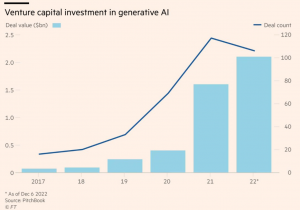
    Artificial Intelligence (AI): No surprise given our introductory paragraph. The excellent database resource, Our World in Data, shows annual corporate investment in AI doubling from circa $80 billion in 2019 to over $160 billion by mid 2021. More specifically, the explosion of interest in generative AI (ChatGPT, DALL-E etc) has seen VC investment increase by 425% to $2.1 billion since 2020. The VC data provided by Pitchbook is in the Financial Times chart below:

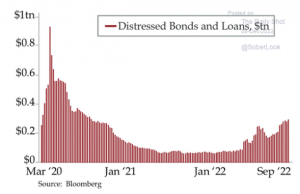
    Corporate Credit: The standout macro factor which drove markets last year was not actually Ukraine, Covid or inflation. Thanks to AI and powerful computing at macro research analytics firm, Quant Insight, we know that it was actually the cost of money which was the most powerful factor. Yep, rising interest rates affect our ability to borrow. For companies this can cause real problems if loans or bonds need refinancing. Interestingly, 2022 saw the fewest number of bankruptcies in 10 years. However, this week home goods retailer Bed Bath & Beyond told shareholders bankruptcy is now a possibility. And strikingly, the same Quant Insight analytics platform is seeing the macro emphasis move away from rates(interest) to credit(debt risk). In real world terms, the knock–on effect of tighter funding conditions will begin to reveal themselves in 2023 as companies with challenged balance sheets/indebtedness – aka ‘zombies’ – move into distressed territory. See the Bloomberg chart from the Daily Shot newsletter below:


    Housing: Of course, rising interest rates don’t just impact companies. The biggest item on an individual’s balance sheet is likely to be a house and as interest rates rise, so do mortgage rates. The push/pull effect of higher interest/mortgage rates can reduce the price of the assets being purchased, in this case houses rather than growth companies. The chart below from credit ratings agency, Fitch, indicates a more difficult 2023 for a number of major housing markets.

    Battery Production: In some ways, the best proxy for the planet’s race towards reducing fossil fuel dependence is the enormous investment currently being ploughed into production facilities for batteries to power a generational shift to electric vehicles(EV). China in 2020 accounted for 75% of global battery production capacity but that’s going to change. Europe intends to up capacity 5-fold by 2030 and the US isn’t just home-shoring semiconductor manufacturing. A whopping $40 billion of funding has been committed to US based battery production since 2021 and overall investment in the EV ecosystem(auto plants, charging networks, batteries etc) probably exceeded $100 billion in the past 12 months alone. Consultants McKinsey have published a lot of this data and the graphic below captures the serious acceleration in capacity expansion between now and 2025.

    As we have written before, there will be winners and losers in every calendar year but don’t lose sight of the bigger pictures. These multi-year developments don’t fit into neat annual forecasts but could fit into the longer-term investment portfolios of the curious.


  • I’m Adding Up 2023…. Not GDP.

    I’m Adding Up 2023…. Not GDP.

    Relax, it’s all sorted. Ignore your eyes and ears. Just pick up the Daily Torygraph and you’ll read that Rishi Sunak has worked it all out. Yep, as the UK economy and health service crumbles, the front page headline declared “Maths at the heart of PM’s vision for Britain”. And if you thought somebody in editorial had just lost their marbles you’d be nearly right. The next front page article in the Tory organ covered the potential return of the Elgin Marbles to Greece. Not to be outdone on the numbers front, Ireland’s Minister for Health, Stephen Donnelly, has been on the airwaves telling us hospital overcrowding is “likely to get worse” but that his “models” can’t something, something, something…. won’t help. Models, righto. I could scream population, demographic and hospital bed number changes(or not) but that would depress. Instead, I’m going to look at some numbers(data) and suggest the consensus number for 2023 could be misleading. Yep, the consensus view of a 2023 recession based on projected negative GDP growth doesn’t really add up, on lots of levels.

    Firstly, in pure numerical terms the IMF is forecasting 2023 global GDP growth of just 2.7%. The Western-centric commentariat will point out that the IMF is saying advanced economies will only progress at an anemic 1% pace, with some negative GDP quarters implicit in that number. Let’s be clear, this year will be tough on economic growth and there will be suffering at an individual and community level. However, we should not lose sight of that global 2.7% growth number. How about the most populous country on the planet? Not China any more….. on April 14th India and its 1.425 billion inhabitants will become the world’s biggest consumer market in people terms. Oh, and the IMF expects India to grow its GDP by 6.8% in 2023. So, we need to put our “global glasses” on and consider the bigger maths, like we did in our piece “The Best People Investment In The World”. We also need to think beyond GDP.

    The GDP metric measures economic output. But what about national wellbeing? New Zealand has been in the forefront of the Wellbeing Economy Alliance of nations(Scotland, Finland too) looking to expand its national ambitions beyond just financial metrics of success. Of course, the challenge is how to measure progress in battling the challenges of housing shortages for younger people, the climate emergency, income/asset inequality and healthcare access. Arguably, there have been further reverses rather than progress in recent years and yet 2023 could bring positive opportunities. I would be looking at two areas in particular.

    1. Income/Asset Inequality: The headlines will tell you that 2022 was a bad year for stocks. The S&P 500 was down 19% and tech stocks on the Nasdaq index had an even tougher time suffering a 33% collapse on average. Now, the world of investing is a bizarre behavioural exposure of human fallibility. If we walk into a shop with a 33% sale on, we are programmed to not miss out on a significant discount opportunity. However, in the stock markets we stampede into stocks at all- time-high valuations but run for the hills when stocks (see big tech) are on 50% discounts to previous price levels. So, let’s view financial market turmoil as a discount opportunity. The entry point for potential young savers is as good as it has been for years and could help close the gap with the richest 10% who are nursing significant investment losses.
    2. Housing: Interest rates continue to rise and are now beginning to impact the biggest and most interest-rate sensitive asset class in the world, property. The headlines in the US, Sweden, Canada, UK and China are, of course, a negative for existing house owners but for those struggling to get on the property ladder, perspective is everything. Similarly, on a GDP measure, falling property prices are not a positive but improved housing affordability would be considered a wellbeing ‘win’. One might begin to sense the maths involved in 2023. There will be winners and losers, but the ‘net” result could be a real positive.

    As an illustration of the potential of a positive ‘net’ result, we should note the big loser in 2023 was the technology sector. The Big Tech 5 alone(Amazon, Apple, Facebook, Google, Microsoft) lost almost $4 trillion of value during 2023, and Time Person of The Year 2021, Elon Musk, looks like he’s Twitter-driving Tesla to a $1 trillion valuation implosion. Tesla is down $800 billion already from its peak value and this week dropped ‘a Twitter’, or $50 billion of value, in just one trading session. A blue bird in the hand is worth…… who cares says most of the planet. Actually, most people care about the planet surviving and a tech re-set is not necessarily a bad thing. As always, in euphoric investment phases with almost free money(zero interest rates), there’s a danger investment capital can be wasted on poor returning assets, or even no-returns assets. So, the good news about a cooling of investment giddiness in “attention tech” is that “green tech” will not be crowded out and can actually benefit from a change in investment flows. In a previous article “Technology Winter? Dream On!” we wrote the following:

    “In late October €3.5 billion of debt funding was secured to build a hydrogen-powered steel plant in Northern Sweden. Operations at the H2 Green Steel plant are expected to start in 2025 and targets 5 million tonnes of steel production by 2030 with a 95% reduction in CO2 emissions. Exciting times and good to see Europe taking the lead on hydrogen but you ain’t seen nothing yet. Current estimates of the capital investment required for the global economy to shift from fossil fuels to cleaner energy over the next 30 years is in the region of $275 trillion. That’s more than $9 trillion every year for the next thirty, or more than the combined annual GDP of Japan and Germany!” 

    The enormous shift of capital from fossil fuels to green energy is possibly the biggest capital markets story of our lifetime. The numbers are staggering, but also critical to the survival of the planet. Just this week Ireland is issuing a sovereign ‘green bond’ worth €3 billion which will invest in climate-urgent projects. There will be many more in global bond markets in the coming years and much of it will end up in green tech. That’s a positive, and could indirectly lead to a comparative review of the wellbeing impact of our ‘attention tech’ sector. As teen screen-times rocket into double-digit hours per day usage, investment capital and ESG guardians would do well to consider the ‘sustainable’ credentials of the attention tech sector and view the damage already done. Mental health is an obvious casualty and difficult to quantify but what about democracy?

    Between 2017 and 2021 the number of people with democratic rights plummeted globally from 3.9 billion to 2.3 billion. So, it wasn’t just Jackie “no authority here” Weaver experiencing oppression…. Sadly, Handforth Parish Council probably won’t receive much media attention for its efforts to restore democratic stability but the good news is that 2022 was a very bad year for autocratic regimes. It feels like there are only so many untruths social media can carry….before citizens and reality pushes back. Consider the following developments:

    China: The official Covid-19 death toll for the Middle Kingdom since December is ….. 22. The only problem being that there are numerous media celebrities, musicians, actors and scientists who are dying at a supra-normal rate. President Xi’s authority was challenged by the November lockdown protests but the policy reversal to open up society looks like a potential healthcare catastrophe. Expect scrutiny of Xi’s authority to increase dramatically.

    Russia: The wipe-out of an entire generation of Russian military equipment as the Ukrainian invasion moves from a 3 day promise to a 313 day disaster has weakened Putin domestic credibility. However, as yet another oligarch falls out a hotel window(in India), one wonders how long before Russian history repeats itself and citizens remove their leader.

    Iran: It’s more than 100 days since anti-government protests began in Iran after the police detention death of Mahsa Amini. We haven’t seen demonstrations like this since the Islamic revolution of 1979, and the protestors come from all demographics. Five hundred deaths and two post-trial executions will keep 2023 very tense and it is unlikely that a proposed relaxation of hijab rules by Supreme Leader Ali Khamenei will put the freedom genie back in the bottle.

    US: The Republican party is now tearing itself apart, held hostage by right wing extremists refusing to vote for leader Kevin McCarthy as Speaker of The House. This Speaker position is the 3rd most powerful in US politics and not even the endorsement of the Mar-a-Lago Trumpolini can persuade the wannabe autocrats to tow the line.The Republicans will have to vote for a 7th time at least(this hasn’t happened in a hundred years) but not even Fox News can cover up the fact that the party of Trump is making a habit of election and democratic denial.

    It might seem strange to include the US in the list of developments above but Republican chaos is relevant to the fightback of liberal democracy as a concept. Not long ago Putin and Xi were sneering at the challenges experienced by liberal democracies, and measuring their own autocratic success by citing GDP growth. They also had their populist fanboys with the likes of Farage, Carlson, Orban and Trump eager to mislead. Indeed, Trump was not alone in Republican circles to display enthusiasm, even admiration, for more autocratic versions of government. Now that we know Trump is not very rich(tax returns), definitely puts America second(state secrets for sale) and is a serial loser(2018, 2020 and 2022 elections) there is a real chance truth and democracy can recover the lost ground of recent years.

    As a final thought, maybe truth making a comeback would be the biggest win of all. We shall see but we can begin the calendar year by stating that GDP growth should not be how we measure the success of 2023. A world with more freedom, improved share of wealth, massive green tech investment, cheaper housing and more disciplined investment would add up to a pretty good outcome for 2023. And, you don’t need Rishi ‘maths’ or Donnelly ‘models’ to work that out.

  • Technology Winter? Dream On!!

    Technology Winter? Dream On!!

    I will be writing a 2023 ‘trends to watch’ article but I have to confess to being blind-sided on that mission this week. I had previously thought it striking that an ‘old economy’ stock index like the Dow Jones was outperforming the broader economy index – the S&P 500 – in 2022 by a quantum not seen since 1933. Less surprising was the Dow Jones beating the tech-heavy Nasdaq index by the most since the TMT meltdown in 2000. These data points were teeing me up for 2023 thoughts along the lines of a rebalancing of the tech sector in the context of the broader economy, a pausing of tech giddiness and excess so to speak. And then I read, or should I say chatted? Let’s start with the reading…..

    First email of the week was a handy round-up of green technology and regulatory activity from Callaway Climate Insights. Given my tech thinking was in rebalancing mode I have been looking for positive broader economy offsets to weigh against the stream of poor headlines from the tech sector itself. What I wasn’t expecting was the ‘rebalance’ to be happening within tech itself. So, imagine my pleasant surprise to read that climate tech investment levels are on track to match 2021’s historic highs. More striking was climate tech’s increasing weight in overall capital deployment, at a whopping 25% of every venture capital dollar invested in the last quarter. It’s not just equity. Clean tech is being banked too.

    In late October €3.5 billion of debt funding was secured to build a hydrogen-powered steel plant in Northern Sweden. Operations at the H2 Green Steel plant are expected to start in 2025 and targets 5 million tonnes of steel production by 2030 with a 95% reduction in CO2 emissions. Exciting times and good to see Europe taking the lead on hydrogen but you ain’t seen nothing yet. Current estimates of the capital investment required for the global economy to shift from fossil fuels to cleaner energy over the next 30 years is in the region of $275 trillion. That’s more than $9 trillion every year for the next thirty, or more than the combined annual GDP of Japan and Germany! One would be tempted to say digital Big Tech could be swamped by that capital investment shift but then the chat, or chatter started…..

    Over the last 20 years I would read a variety of weekly blogs, newsletters, thought leaders etc every week in a deliberate attempt to gather a variety of views on different topics which have aroused curiosity with better minds than mine. For the first time ever this week there was ZERO variety. All of them were writing about the same thing, and in nearly all cases it was blowing their minds. The source of excitement was artificial intelligence (AI) chat software which has been trained to interact with users in a conversational manner and generate human-like written text. The chatbot is called “ChatGPT” and has been trained by an Elon Musk-founded venture, OpenAI, on a huge sample of text scraped from the internet.

    These text-generating AI tools have been around since 2020 but ChatGPT is super-easy to use and can deliver on the most astounding requests. How about asking it to write some code for you, or write lyrics for a song in the blended style of Adele and Cher, or write an essay on the impact of the FTX collapse on effective altruism? Just type in the request, then wait mere seconds. The answers have been mind-blowing, not always accurate but the productivity opportunities are off-the-charts. In just 5 days this large language model(LLM) has picked up 1 million users. For context, Instagram took 2.5 months, the iPhone 74 days and Spotify 5 months to reach the same user levels. I don’t propose to do an in-depth analysis of ChatGPT’s capabilities in this piece but the following are worth a read if curious:

    Ben Thompson at www.stratechery.com

    Packy McCormick at www.notboring.co

    David Peterson at www.angularventures.com

    Mario Gabriele at www.generalist.com

    I am skipping the ChatGPT capability details to make a broader point. This feels like a “moment” for AI and I’m not sure the world will ever be the same again. What happens to homework? Do I get to write the sequel to “It’s a Wonderful Life”?   What happens to copyright law? Or university essay assignments? Oh, and did I mention that AI is not just generating text(based on probability, context) prompted by human text? Text generated images, avatars and art are also possible now thanks to another AI technology tool called ‘stable diffusion’ and used in our headline image. The productivity opportunities are vast but the ethics and governance of AI pose significant challenges. As a creator I am half terrified. Who needs video scripts, investment pitches, government tender applications or market analyses when these can be generated on demand from a bot? That fear is for another day but let’s complete the AI tech circle on a more positive note

    Like the steel plants in Sweden, the broader economy can benefit from a dramatic technology shift as investment dollars move to new projects. Recall our recent article “Did You Xi A New War With China Has Started?” and you will know the Biden administration is very keen to on-shore semiconductor chip production and keep the US lead over China in more advanced chip technology. Which chips you might ask? Yip, the ones that power artificial intelligence(AI). And… if you’d been watching your headlines this week you’d see that TSMC’s $12 billion investment in an Arizona based chip manufacturing facility has now morphed into a monster $40 billion investment. You won’t see that on Fox News!

    As a final thought, and a reflection on my initial thinking on 2023, I am reminded of the work of Brian Arthur and the Santa Fe Institute on complexity economics. Rather than traditional equilibrium economics thinking with rigid winner/loser frameworks, Arthur’s words seem prescient:

    “Complexity economics sees the economy as in motion, perpetually “computing” itself— perpetually constructing itself anew. Where equilibrium economics emphasizes order, determinacy, deduction, and stasis, complexity economics emphasizes contingency, indeterminacy, sense-making, and openness to change…. We also see the economy not as something given and existing but forming from a constantly developing set of technological innovations, institutions, and arrangements that draw forth further innovations, institutions and arrangements.

    One senses a complex “computing” world is about to become a lot more complex. So, expect plenty of AI dreams and chat this Christmas…..


  • Elf Reports Unusually Good Market Behaviour

    Elf Reports Unusually Good Market Behaviour

    I know, I know ….putting the watchful Elf away in early December feels like a schoolboy parenting error. However, the Elf in this piece is not tasked with observing domestic discipline. This Elf is a financial markets elf and has been tasked with sounding more threatening than Priti Patel all year. Not easy, you say? Well, try the worst bond market EVER, miserable equity markets, IPO droughts, runaway inflation, crypto chaos, Big Tech bashed, China property tremors and an energy crisis sparked by a criminal invasion of Ukraine. Apart from the Ukraine tragedy, the other developments were more like deserved outcomes rather than threats. Harsh? Not really.

    The simple truth is that almost-free and plentiful capital eroded investment discipline and allowed mediocrity, even fraud, to hide in plain sight. The elf took away the goodies with hiked interest rates and a higher cost of capital. In some parts of the markets, investment capital has disappeared completely. The market ‘kids’ who have never seen a bond bear market in their entire professional careers – pretty much anybody born after 1972 with a primary degree – have run for the hills. Behaviourally, the average market kid’s state of mind can be described as one of new-found respect for the ‘elf of excess’ combined with a pathological fear of risking their careers any further and a belief that Santa may never come again.

    This fear manifests itself in one particularly telling behaviour. The kids, or fund managers, reduce risk by cutting investment positions and just hold cash. In fact, the widely followed Bank of America Fund Manager Survey in October was highlighting cash levels for fund managers managing over $1 trillion at the highest levels seen since 2001, even higher than during the Covid crash. The elf should be happy with this discipline but, for this writer, it sets up the possibility of a surprise Santa visit for us all this Christmas. Let’s consider the following

    Equity Markets: It’s tough in the maelstrom to break from the herd but the Warren Buffett motto to be “greedy when others are fearful” tends to work a treat whenever fund managers rush for the cash-out exits. Cue, the benchmark US index, the S&P 500, is up almost 12% from its October 12th lowest close of the year. But it’s not just equities decorating my tree of hope…

    Currencies: An aggressive monetary tightening by the US Fed has resulted in a super strong dollar which doesn’t really help emerging market economies buying already inflated commodities (priced in dollars). But some people haven’t read the Grinch script in November. The Fed might be trying to take away the punch bowl, but the US dollar has stopped rising. Actually, the US dollar has had its worst one month performance in November for 12 years. So what gives…?

    Inflation: Yep, better (less bad) inflation reports in the US and Europe are triggering “peak inflation” hopes and a bet that the Fed and other central banks may be able to rein in their interest rate hiking plans. Arguably, when oil prices are now below the levels prior to Russia’s invasion of Ukraine and container freight rates have fallen 75% from their highs, there is justification for saying these pricing points indicate recessionary times ahead. But consider the next three fairy lights….

    1. Market volatility(fear) measured by the VIX index is subdued.
    2. You will read financial jargon in headlines referring to “tightening credit spreads”. That’s a good thing because, in reality, these spreads measure financial conditions for companies. Goldman Sachs have a more straightforward “Financial Conditions Index” and it is showing a significant easing since November 10th which would alone add 0.5% to GDP in 2023.
    3. Banks are not big fans of recessions. They usually try to shrink their “book” of loans and definitely don’t try to add external (less familiar) books of business. So, what do we think of Canada’s RBC doing a $10 billion deal to acquire HSBC’s $100 billion Canadian loan book? Clearly RBC are banking on 2023 not being too scary.

    That’s the potentially good news but we can’t avoid the lagging drumbeat of job losses. In particular, the tech sector is enduring some real pain. Strangely, in percentage terms, the job loss announcements have been at very similar levels of shrinkage, typically from 13% to 15%. However, let’s consider the revenue growth rates of Big Tech (Microsoft, Apple, Google, Amazon and Facebook) just 12 months ago. The average revenue growth rate of these big five was 18.6%. Now, take a guess at staffing growth levels in the Covid-fueled years 2019 to 2021? Just, the 80% growth. Wowzers. So, some context is needed when we read these tech job loss headlines. It is entirely conceivable that headcount at many of the bigger technology players will re-set at a mid-2021 level. Painful at a corporate and individual level, yes. Economic armageddon, no.

    As a final thought, the concept of a disciplined re-set should be considered healthy, albeit requiring some pain. In fact, many essential services like health and transport have suffered from staff shortages post-Covid. As I write, Ryanair have announced 150 new technology-focused jobs. So, this re-set could actually help some sectors recover from the crowding-out effect of technology and remote-working opportunities. Back in 2011 famed venture capital guru, Marc Andreessen, wrote an essay “Software Is Eating The World” but did he envisage this pace? The elf will tell you eating too quick can give you indigestion but that doesn’t mean Santa has cancelled. Indeed, the data referenced above indicates there are still some serious believers….

  • The Best People Investment In The World

    The Best People Investment In The World

    Our planet welcomed its eight billionth human inhabitant in recent days and I was thinking about how population growth gets such bad press. Or maybe I’ve seen too much of the Daily Mail…? Anyway, back in the real world, one of the unsung successes of the last three decades has been the lifting of huge numbers of people out of poverty. According to World Bank and IMF data, the number of people in extreme poverty has almost halved from 1.125 billion to 698 million between 2010 and 2021. That means almost 9% of the planet is still living on less than $1.90 per person daily which is the extreme poverty measure. The numbers are still too high but, clearly, more people being able to live on more money is a net economic benefit as more consumers are added to the mainstream global economy. From an investors’ perspective, new markets and new consumers are an opportunity and, as illustration, I thought it would be helpful to think about the recent past, present and future

    The accepted wisdom these days is that we are now in a de-globalisation phase but there’s a danger we focus too much on supply chains, energy sources and internet security. We should remind ourselves that the break-up of the Soviet Union in 1991 happened in the context of the earlier 1989 fall of the Eastern European Iron Curtain and China’s Tiananmen Square protests. The IMF data suggests the opening up of previously closed economies quadrupled effective global labour supply between 1990 and 2005, with most of the increase happening after 1990. East Asia(China) accounted for almost 50% of the increase and arguably the largest investor and corporate returns were earned in these consumer (workforce) markets. It should also be made clear that the returns opportunities were early if you were to use Hong Kong’s Hang Seng stocks index as a benchmark. The Hang Seng has recently returned to 2006 levels(!) meaning returns to investors playing the East Asia story have been pretty much a zero since then. The IMF data also shows that South Asia(India) didn’t really move the globalisation/ labour dial in that period. However, change is in the air. The Economist front page is not the only signal that the China acceleration is over and there’s a new force on the Asian block…..

    On April 14th 2023 India is due to overtake China as the most populous nation on the planet with 1.425 billion citizens. More importantly, the UN in a report published last month stated that the incidence of poverty in India had dropped from 55% to 16% since 2006. That’s a whopping 415 million citizens who have exited poverty over the last 15 years. And, here’s the kicker for right-wing charlatans selling “trickle down” economic policies in the US and UK; India is experiencing a trickle-up acceleration of economic progress. The former jewel in the Victorian crown is breathing down the neck of the wannabe emerging market of Boris-stan (UK GDP $3.186 trillion) and currently boasts the world’s 6th largest economy ($3.173 trillion) with 1.5 million engineering graduates per year. The UK produces just 46,000 engineering graduates per year but India only has enough high quality engineering work for 3% of their own graduates, for now. That talent surplus is not a new phenomenon but has introduced to the world a stunning bench of management superstars. Check out the CEOs of Indian origin currently running Google, Microsoft, Twitter(pre Musk), Chanel, Adobe, IBM, Micron Tech, Palo Alto Networks, Mastercard and Pepsico. The present challenge and opportunity is watching where India’s relatively closed consumer market opens up. Unlike the China opportunity, where international investment capital(and debt) has already been deployed, India looks under-invested if you consider these three data points:

    • India is the second largest internet country in the world after China with 391 million users.
    • From 2017, India experienced a data explosion with a massive 4G telecoms roll-out. Despite average income per capita of just $2,000 per year, Indians now consume more gigabytes of data than those in richer economies; even more than digital tigers like South Korea and Finland.
    • The above shows India is more “open” digitally than ever before but venture investment funds are yet to pull the trigger. Crunchbase data indicates annual venture funding per capita is over $900 in Israel, nearly $1,400 in Singapore, $800 in the US and just over $200 in Ireland. And India? That would be $20….or a grand total of $28 billion. For those who are prone to hopium, that’s less than the peak valuation of crypto disaster, FTX.

    So, it’s beginning to feel like China is handing over the people value baton to India right now. However, if you’re looking for a very early opportunity – India is into its 15th year of bringing its people out of poverty – then there’s possibly only one more billion-person opportunity left. A bit of future thinking is required, but Africa is about to add an extra billion people to its 1.3 billion current population by 2050. More intriguingly, Africa will have the largest workforce available(more than India or China) in the world by 2040. However, this workforce will be unusually digitally developed in one critical area.

    Africa is massively under-banked. If India’s 4G roll-out launched a data revolution then we might look back at Africa as the community which launched digital currencies into main street way before the ‘degens’ and crypto bros were chasing doggy coins in their hoodies. Consider the following :

    • 84% of internet users in Kenya and 60% in Nigeria regularly made payments with mobile phones in 2021.
    • Safaricom launched the M-Pesa mobile wallet in Kenya in 2007. It now has more than 50 million active monthly users across the continent.
    • A recent ACI report showed that Nigeria is already in the top ten of global real-time transaction rankings in absolute terms, ahead of the US, Japan, and Brazil, while Kenya is among the ten countries expected to experi­ence the fastest growth in real-time payments.

    Strictly speaking we are still in electronic, or e-payments, territory and the challenge in Africa is how to handle offline payments. However, mobile money should still be considered the first phase of a real user case for digital currencies of the future and one can expect Africa to lead the charge. The beauty of future blockchain(crypto) technology is the removal of intermediaries(costs) and those costs continue to hold Africa back. Another Africa investment consideration is more basic. In fact, it’s basic materials, the sector.

    As fossil fuels face structural decline in a transition to cleaner energy, Africa’s mineral resources are increasingly viewed as critical to that shift. For example, the Democratic Republic of Congo(size of Western Europe) produces 70% of the world’s cobalt, a mineral essential in battery manufacturing. Furthermore, when one considers total African deposits of manganese, graphite, rare earths, nickel and lithium, we are looking at the bigger picture of 30% of the world’s mineral reserves.

    Of course, the history of Africa is littered with chapters of exploitation from the north. The post-colonial Western powers continue to operate mostly in their own interests but, in more recent times, it has been China who have been the dominant investment player in African resources. A more sustainable future would suggest investment in more than just minerals would increase indigenous wealth creation and political stability. We shall see, but if your investment style is to equate opportunity with areas lacking capital, then Africa is currently the best people bet in the world. Last year total venture capital investment in Africa was just $4 billion (source: Crunchbase), or just a quarter of what India received with approximately similar populations. You’d think this year would be pretty grim on the investment front given the drumbeat of gloomy headlines in VC world… but you’d be wrong.

    Data from Crunchbase showed US and Asian Q1 venture capital activity shrinking by circa 1%. But in Africa, not so much. In fact, African Q1 venture funding rocketed by 150%. In mobile-savvy Kenya alone, more money was raised in Q1 than it did in all of 2021. And…the contra-cyclical trend continued into Q2 with Africa posting another blockbuster quarter of 133% growth in venture funding. Hmmm… maybe we are not so early. Anyway, the bigger message still stands; follow the big people shifts, not the big money. As a proxy for value or opportunity think about those venture capital dollar rankings above and note current investment in Africa stands at just $5 per capita. Oh, and don’t tell Suella Braverman.


  • What The FTX Just Happened!!

    What The FTX Just Happened!!

    I fell for it. I even wrote about it. Only a few weeks ago I thought the news that crypto exchange, FTX, was raising money at previous valuation highs was a positive for the tech and Web3 sectors. The valuation then? Just the $32 billion which has now vaporised to zero with up to 1 million individual creditors. Enough has been written on the crazy-quick chronology of events leading to the blowing up of FTX so I will leave that to others. However, it would be a mistake to dismiss this as a crypto-specific misadventure for FTX investors and customers bamboozled by a new technology and fantasy-level opportunities. In fact, this isn’t really a technology story. It’s a human one containing lots of old and familiar lessons which I believe need repeating. But, a brief background might help.

    FTX was a trading platform which matched buyers and sellers of digital currencies and related/ derivative products(eg. Bitcoin, Ethereum, Dogecoins, Luna, tokens etc). Think of the London Stock Exchange(LSE), the Nasdaq or the New York Stock Exchange(NYSE) and you’d be thinking of very similar business models. Customers (traders) set up monetary accounts on these platforms to settle the purchase and selling of securities which the platform’s technology (“the exchange”) facilitates by matching buyers with sellers. On each transaction the counter-parties don’t just exchange the monetary consideration agreed, they also pay a commission to the platform/exchange for its matching services. However, FTX had one large customer, Alameda Research, which the FTX founders also owned. Alameda was like a Goldman Sachs dealing on the NYSE. It was an investment house, a trader, and many of FTX’s customers took the additional option to invest their digital assets with Alameda who were promising guaranteed returns of 15% plus. Okaaaayyyy. Let’s begin with the lessons.

    Fraud: The concluding chapter of the tried and trusted platform/exchange model above was that when customers tried to draw down on their accounts at the FTX exchange last week there weren’t enough funds to meet demand. Simply, customer assets which should have been segregated and kept safe on the exchange were not all there. The gap(the “hole”) between customers’ contractual assumptions and reality is in the region of $8-10 billion. Now, given the exchange wasn’t trading its own book/account or subject to a catastrophic operational issue, this mismatch between assets and liabilities suggests a likely fraud. However, before we jump into holier-than-thou admonishments and told-you-so crypto bashing cynicism we should note the heavyweight investment firms who fell for it too. Check out Singapore’s sovereign investment arm, Temasek, who did 8 months due diligence, or serial winner Sequoia, or Softbank, or Tiger Global, or Blackrock, or Third Point, or the Ontario Teachers Pension Fund. Yes, teachers’ pensions. So, these were the investors with big due-diligence/research teams and they were believers. The sad truth is that fraud is sometimes difficult to see irrespective of whether there is regulatory oversight or not. Does that mean investing is only for the big guys given the dangers of fraud? No, because there are more lessons in this tale.

    Finance: We have written so many times about the dangers of a business model dependent on “other people’s money”. Clearly, the financial sector itself is a classic dependant on external capital. That includes even the most conservative business models, even exchange-type platforms. Financial businesses should command greater scrutiny before investing because of the funding linkages in the financial world. Credibility, credit and trust are critical in the financial sector so the appearance of good practice is absolutely critical. The absence of conflicts of interest is also a must-have. FTX failed that test. The FTX management/founder team’s 100% ownership of its biggest counter-party, Alameda, was a red flag. Furthermore, both FTX and Alameda used their own currency/token, FTT, as assets on their balance sheets. Whatever your views on the “valuation” of digital assets there is very good reason why regulators are very strict about cross-shareholdings between financial institutions. The temptation for one or both entities to collude in inflating or supporting the price/value of an instrument issued by(created by) either party is way too strong, particularly in times of financial stress. Alarmingly, FTX and Alameda didn’t just share “equity”, or tokens, on their balance sheets they used these digital assets to secure credit from other trading counter-parties…….. lots more credit.

    Funding: Promises, promises, promises. Remember those 15% guaranteed returns we mentioned earlier? In a world of historically low interest rates(returns) double-digit returns could have been filed in the “too good to be true” category of promises by an investment firm….. unless the firm planned to fund those promises/returns in more creative ways. The first way is legitimate but hugely risky – employ leverage. This use of debt to increase the size of an investment relative to the original stake/equity has a long history of wiping out the entire capital of investors, companies and even banks. The second way to fund a promise you are struggling to keep is to use money that was never intended to be invested or borrowed to increase a bet. That’s usually illegal but can be hidden for considerable periods of time. Bernie Madoff did it for years, but FTX? We don’t yet know all the details but we do know that returning X % of an original investment is a lot easier when the value of an asset is rising. Now think about digital assets/crypto in 2022 and prices falling 60-70% from 2021 highs. That’s tough going but it gets worse. And, again it should have been an investment red flag. Digital assets don’t have yields, income, dividends, coupons etc. They are pure capital (gains) plays and yet FTX and its bad sister Alameda were promising double-digit percentage returns. Lesson number 3; promising returns on assets(digital assets) which have zero yields needs funding generated by lots of leverage, or lots of price appreciation, or…. lots of fraud.

    Founders: I haven’t mentioned yet FTX founder, Sam Bankman-Fried,  but he’s a critical element to the investor trust story. In fact, ask any experienced venture capital professional and they will immediately identify founder credibility as the key swing factor in an investment. Bankman-Fried had his own “SBF” nickname and the title “King of Crypto” but it was the other details in his bio which sucked people in. The shared apartment with friends in the Bahamas, the Toyota Corolla car, the crusade for effective altruism, the lobbying for sector ethics and regulation plus the rescue of distressed crypto businesses drove a particularly persuasive narrative. For me, anyway. However, I never really looked past SBF and checked out his co-founding team. I think I would have been a little underwhelmed. Would you? Lets see what you think of the following:

    • Chief Legal Counsel at FTX, Dan Friedberg, was previously in-house counsel for a fraudulent online poker site, Ultimate Bet
    • The Alameda CEO, Caroline Ellison, was apparently further conflicted as SBF’s girlfriend. Conflicts aside, at just 28 years of age, and effectively running a $10 billion crypto trading book you’d be expecting a bit more experience than just 1 year and 7 months as a junior trader at Jane Street Capital….
    • The CEO at FTX HQ in the Bahamas was Constance Wang. Prior to FTX she had just 2 yrs experience working at….. the calamity James of investment banking, Credit Suisse(CS). Her position at CS was even less inspiring – not a director, or even associate director, but an analyst in KYC in the private bank. Yip, KYC.

    Founders often reveal themselves in the calibre of the team around them. SBF surrounded himself with groupies (at best) who are likely to regret details of their actions in the FTX Chapter 11 bankruptcy filing.  It would appear the groupies were happy to lend their leader $3.3 billion from Alameda which SBF had secretly pumped with FTX client monies. Not exactly the circle of trust. Clearly, too many people including me were only looking at SBF with his floppy hair and flip flops. Reviews of investment processes for the professional institutions will be brutal.

    The Ontario Teachers Pension report will probably read “can do better” but might not stave off litigation. Such is the due diligence expectation of institutional research departments. For retail investors, the reality of the four ‘F’s lesson above is that fraud is a real risk in investment which even the big boys and regulators can miss. However, you can reduce risk by giving greater consideration to the three other ‘F’s in your due-diligence:

    • Finance and complexity is an attractive combination for fraudsters
    • Funding punchy promises with other people’s money can punch you
    • Founders with altruistic groupies may not be true

    As I write, the contagion from the FTX implosion continues. There will be numerous additional corporate casualties in the crypto universe and the blow to confidence in the digital asset/blockchain sector will be immense. That’s disappointing but I suspect the longer run post-mortems will be kinder to the technology than the humans.

    Indeed, the FTX artificial inflation of assets and complex cross-holdings/conflicts does remind me of the 2001 collapse of energy trading giant, Enron, which ultimately brought down the mighty Anderson accountancy franchise. So, how strange it is to see the lawyer who oversaw Enron’s bankruptcy proceedings to be appointed as the emergency restructuring CEO at FTX. Step forward John Ray III who actually thinks the FTX fraud is worse than Enron…

    “ Never in my career have I seen such a complete failure of corporate controls and such a complete absence of trustworthy financial information as occurred here. From compromised systems integrity and faulty regulatory oversight abroad, to the concentration of control in the hands of a small group of very inexperienced, unsophisticated and potentially compromised individuals, this situation is unprecedented”.

    Interestingly, he’s putting it all on the humans not on the technology. What’s new?