Author: Gary McCarthy

  • Will History Rhyme Or Fear For US?

    Will History Rhyme Or Fear For US?

    Sixty years ago a frail 46-year old man descended the steps of a modified Boeing 707 at Dublin airport. The American visitor was blessed with film-star good looks which disguised debilitating back pain and a potentially fatal Addison’s disease. He also hid his and a nation’s fears. The Cuban missile crisis of the previous year was a domestic reality check on the seemingly unstoppable global expansion of the USSR and totalitarianism. Elsewhere, but in the same hemisphere, the majority of South America’s sovereign states were about to embark on a dramatic shift from democracy to one-party rule. In Europe, the Berlin Wall was built overnight in 1961 and South East Asia’s dominos were already beginning to wobble with South Vietnam in the cross-hairs of Ho Chi Minh’s North Vietnam and Mao’s China. But, it wasn’t just political retreat as civil rights tensions brewed and extremist assassins plotted. Economically, the USSR was the fastest-growing economy on the planet, bar Japan, in the 1960s. Its GDP was approaching 60% of that of the US as the 2nd ranked economy in the world and on its way to beating the US in the space race with an unmanned lunar landing in 1966. And yet, John Fitzgerald Kennedy, 35th president of the United States, enjoyed approval rates at home of more than 80%. Oh how President Joe Biden could wish for similar approval rates this week. A warm Irish welcome will have to suffice, even rhyme with 1963, but do our fears rhyme too?

    As always, we look to flows of investment capital as data points and clues to what real money fears. The Financial Times this week referenced EPFR data to show global investors have pulled $34 billion from US equities funds so far this year. In contrast, European($10 billion) and Chinese equities($16 billion) have experienced inflows. Of course, the commentariat has been quick to suggest the recent collapse of Silicon Valley Bank and Signature Bank could be just the beginning of credit turmoil, possibly triggered by the falling values of office real estate. Others are even suggesting the recent agreement between Brazil and China to ditch the US dollar in trade deals means the greenback is in trouble and in danger of losing its status as the world’s currency reserve. I struggle to see those fears destabilising the US banking or monetary system. However, I am conscious of another economic metric. Currently, the US stock market accounts for circa 43% of the $96 trillion invested in equities globally (Source:SIFMA). The blunt commercial reality is that the US corporate investment pool is four times bigger than its next biggest challenger, China. Stock markets do not necessarily reflect economic cycles, politics or even GDP. They represent business confidence, innovation, returns on investment and…. the rule of law. And, I have a few fears. Two big ones actually.

    1. The rule of law: Whether Trump or his hundreds of co-grifters end up in orange jumpsuits is almost irrelevant, and certainly backward looking for equities markets. What is far more worrying is when the judicial system, and established law, is undermined. So, imagine how every corporate leader felt this week when a Trump-appointed federal judge in Texas invalidated the FDA’s approval of an abortion pill, mifepristone. Yep, it’s been on the market for 23 years but Justice Matthew Kacsmaryk has imposed a nation-wide ban on mifepristone sales based on a random sample of blogging views and his personal ‘expertise’. The denial of science and FDA expertise was worrying enough to drive the executives of 500 pharmaceutical companies to sign a letter condemning the judicial over-reach. This ideological attack on federal authority and decades of scientific evidence has the potential to put approval of all drugs at risk, and seriously impact innovation and returns in an already risky investment space. If one thinks it’s just the healthcare industry under assault, think again.


    1. Investment returns: Previous articles here have referenced attempts by Republican legislators to attack “woke” fears on the global climate crisis and ESG initiatives . The Republicans’ eager embrace of fossil fuel industry donations has triggered a flurry of anti-ESG legislation forcing state government bodies to cease business with investment firms who use ESG criteria as part of their selection process in deploying capital. Texas and Florida have been in the forefront of this “woke” backlash but as Blackadder might say to Baldrick, “there’s a tiny flaw in that cunning plan”. It turns out that retirees and taxpayers would end up paying more for capital to fund their pensions, infrastructure, government services, utilities etc. if there were fewer purchasers of state securities/debt. Funny ‘ol game, this investment thing. Sure enough, Kansas, Wyoming, North Dakota and Indiana have shied away from their original legislative plans to go full MAGA on investment managers trying to save our planet. More bizarrely, for the larger states like Texas and Florida, there is this Kafka-esque intrusion on all investment activities. As the more thoughtful legislators have quite correctly pointed out, forcing companies either to ignore ESG or to invest in fossil fuel energy can both be capable of damaging investor returns. Not surprisingly, big investment firms are calling out the lunacy, but uncertainty reigns and that’s not where capital wants to be.


    So, in a nation of threatened legal precedent and uncertain returns, the critical stock market component of confidence could be structurally undermined. A structural shift in confidence could have an impact felt over decades but there’s a part of me and history which provides some cyclical comfort. President Biden’s approval ratings are in the low 40 percents despite US full employment, US global technological dominance, US capital markets leadership, dramatically improved US ‘soft power’, the demise of its most significant military super-power rival and a strengthened NATO. What’s not to like or…… fear? Well, turn on Fear-Fox news and the borders are overwhelmed, apple pie and the 1950s are gone forever, inflation is never falling, family values are fading away(but not AR-15s) and business owners are drowning in regulations. However, the average age of a Fox news viewer is 68-years old and, if truth(!) really be told, they are not the future. In reality, the following developments are far more likely to impact the voters and surveys of tomorrow….

    US Manufacturing: The Biden Inflation Reduction Act was passed in 2022 and is looking like the most revolutionary economic policy seen in 60 years. Incentives to bring manufacturing capacity back to the US, protect the microchip industry and turbo-charge cleantech investment has resulted in $52 billion of investment in factories alone. Cue the Wall Street Journal headline “America is Back in the Factory Business”

    US Technology: Steve Jobs once said computers were “like a bicycle for our minds”. American innovation, immigration, and investment has delivered a global digital dominance which now accounts for 24% of the value of US stock market indices. But what about artificial intelligence(AI) or even generative AI? It is entirely possible we are staring at a potential Ferrari for our minds. There are plenty of fears out there about AI replacing humans but one suspects those that grasp the potential of human-prompted AI will deliver massive wins for humanity in healthcare, education, medicine, energy savings and retirement-care. With a bit of leadership the US is perfectly placed to capitalise.

    And voter approval polls can be cyclical too. Kennedy didn’t live to see Apollo 11 on the moon in 1969 but he did say the US would get a human there first. The benefits of that space race in accelerating computing power, business innovation and military superiority cannot be underestimated. One wonders could a new vision or target inspire? We shall see but for any of you who watched the shameful scenes in the Tennessee Statehouse in the past week there was an uncanny 1960s feel about the footage of young idealistic “Tennessee Three” legislators standing up for school children and what is right. The words, the look, the tone and the passion of Representative Justin J. Pearson are worth a watch. Then watch hopefully, not fearfully, for a Biden presidential vision to gather momentum and rhyme again.




  • The Best Currency To Build Wealth

    The Best Currency To Build Wealth

    What a week! The richest genius, in his own orange-tinted head, was arrested and fingerprinted in a dingy 15th floor Manhattan courthouse. On the streets outside, his tiny MAGA support cult railed against leftist conspiracies, socialism and woke liberalism. Oh, the irony of it all. Their cult leader isn’t very rich, even in a New York context, but the most delicious bit is the revelation this week of who is the richest of them all. Straight from a Disney mirror Queens scene,  American ‘freedom’ vanity has had to confront the stunning reality that the home to both the richest man and woman in the world is that over-taxed liberal socialist hellhole……France.

    Yep, Bernard Arnault the owner of LVMH and its 75 luxury brands is now worth over $200 billion, and the richest woman, Francoise Bettencourt-Meyers, as heiress to another luxury brand, L’Oreal, is sitting on an $81 billion fortune. You’d almost believe France and luxury are the real places to be. The country view is up for debate and cultural subjectivity but this writer believes the superiority of luxury as a wealth builder is on far stronger ground. I’ve been giving some thought to the wealth creation characteristics of the luxury goods sector and can’t help feeling we’ve missed out on one of the great currencies of the last 30 years.

    In the early ‘90s, as the Communist ‘Iron Curtain’ collapsed and opened up to global consumer markets, I used to watch with fascination Japanese housewives strolling around the glitzy streets of Ginza in Tokyo with their Harrods shopping bags. The concept of Tokyo ‘luxury’ in those days ranged from hundred dollar watermelons to million-dollar golf memberships but they didn’t survive the multi-decade decline of the Nikkei and real asset values. Interestingly, the Japanese currency, the Yen, did hold its value surprisingly well against all foreign currencies. However, as aging Japanese households moved into ‘savings’ mode, there was one other currency which retained its value – the Harrods bag. Well, not exactly. However, the luxury items bought on the streets of Ginza and carried with London-badged pride back to tiny homes reflected two key features of a currency. First, these luxury items were a store of value and also had exchange value as our previous article on Pachinko parlours demonstrated. And, secondly, there was an aspiration and a confidence/credibility embedded in these goods. Or should we say “tokens”?

    The crypto bros might disagree but currencies from Bitcoin to Dogecoin to digital assets like NFTs are dependent on their store of value, confidence and exchange value in secondary markets. It could also be argued that there is a youthful aspiration to decentralize finance away from central banks and the implosion-prone banks they are supposed to regulate. Furthermore, it is striking to me that the most developed initiatives in the world of NFTs and digital assets tend to reside within fashion and luxury houses like Nike and Gucci. We can speculate as to how digital and physical luxury goods evolve and interact over the coming years but the structural foundations of luxury businesses are instructive. Here are a few of the standout features….

    Brand: Luxury brands take decades to build and are protected fiercely. The confidence built on quality control, finite supply, image and limited access is critical to the premium pricing achieved by brand power.

    Growth: Our anecdote plucked from Asia in the early ‘90s is not accidental. The opening up of former communist consumer markets of the last three decades has added billions of potential new customers. A standout statistic for me is that two thirds of the world’s middle class will be in Asia by 2030.

    Asset-Lite: Given, the vast majority of the value of a company like LVMH, Rolex or Hermes is tied up in non-tangible assets like goodwill, brand etc the real asset bases of these companies are small. This can be helpful as brands in a portfolio like LVMH’s can drift in and out of fashion. In an asset-heavy business this cyclical shift can cause permanent exits from the market and the sunk costs of abandoned property, equipment, staff redundancies. Luxury brands can stay in the game for decades; think Balenciaga and YSL comebacks.

    Returns: In the wonky world of finance we would know that returns(on capital) are a far better driver of share prices than earnings or profits. I won’t apologise for my evangelism of returns measures as the best way to manage a business and create wealth – it’s in my quantsy DNA and Quest for alpha. The metric to use is the ROIC(return on invested capital), not earnings growth, not sales growth or balance sheet growth(debt usually). Luxury goods businesses, thanks to small asset bases, deliver fantastic ROIC way above market averages in the FTSE, Nadsdaq or S&P 500 equity indices. As illustration, LVMH delivers ROIC levels around 15% year in, year out compared to the S&P average in 2022 of 10%.

    Cost of Money: That 15% return on capital becomes very important in a rising interest rate environment like now. That extra buffer of returns for luxury goods companies means they are beating their cost of capital every year, not just the low interest rate years. That cost of capital “beat” translates into the miracle of compounding and wealth creation. For those wondering why some valuations fall further than others in times of turmoil, remember If you don’t beat your cost of capital you are actually destroying wealth. As a further aside, in an inflationary world there will be some savers who will escape the loss of purchasing power of their domestic currency and buy luxury goods to store their wealth. Just ask Turkey’s citizens suffering kamikaze Erdogan economics – just seven years ago 55,000 Turkish Lira would buy you a car, today you’d get a phone if you’re lucky.

    That last point on valuation is worth considering in funding land these days. LVMH’s annual revenues are over $80 billion and that supports a franchise valuation 4.5x higher at $440 billion. In 2019 LVMH revenues were $53 billion which approximates tech-like 50% growth BUT with returns on capital (ROIC) maintained each year at 15% on that journey. That returns piece is important and should be instructive to SaaS and tech cheerleaders wondering why valuations at 4.5x revenues are no longer on the table with investors.

    Returns are not a luxury. They are ultimately a business’s currency and an owner’s wealth compounder. Ask Bernard, not The Accused.


  • Should We Fear Transition?

    Should We Fear Transition?

    Lily Savage might laugh, I think. Paul O’Grady and his drag alter-ego, Lily, sadly went on a kinder dog-friendly celestial odyssey this week but his final week on earth probably won’t go down as humanity’s finest. So why laugh? Well, the House of Commons did when Deputy PM, Dominic Raab, mistakenly paid tribute to “Paul Grayson” while claiming him bizarrely as an “anti-woke” comic. What is it with parliamentary houses these days? Scotland has just found itself a new first minister, Humza Yousaf, after a transgender row brought down the incumbent, Nicola Sturgeon. But, it’s not just a UK house thing. Ireland is in a full blown housing crisis which not even 10% GDP growth can hide or solve. However, if you were relying on voter pressure on the governing parties, think again. New housing eviction laws are grabbing the Irish headlines but latest reports suggest the prime ministerial party, Fine Gael, is receiving more emails on transgender issues than on the new eviction legislation.

    What say Lily or even, Governor Bill Lee? Yes, the unfortunate Governor of Tennessee was gloating only a few weeks ago about being the first state to legislate and ban drag shows from public properties as a “child protection” measure. Fast forward to this week, the leading killer of children in the US struck again tragically in Nashville, Tennessee. No, neither pantomime nor Maureen Potter was the killer; just your every day 2nd Amendment-protected assault rifle. Humanity eh. And yet, the other big fear this week was the threat of artificial intelligence(AI) and the rapid advance of chatbot technology in the guise of generative AI’s latest offering, GPT-4. I have to say I’m with the bots this week. But many are not.

    Elon Musk and other tech leaders including Apple co-founder, Steve Wozniak, signed an open letter calling on developers to “pause giant AI experiments.” The petition, which more than 1,000 AI experts have signed, warns that artificial intelligence poses “profound risks to society and humanity” and asks AI researchers to put their projects on ice for at least six months. There is no doubt generative AI technology is evolving at warp speed. Only this week, the creator company OpenAI which brought us GPT-4 announced that it had partnered with 11 chosen “plug ins”. Think of plug ins as everyday services which have embedded OpenAI’s chatbot capabilities. Early partners/plug ins include OpenTable, Expedia, Shopify and Instacart. In simple terms, a human being can now not only ask/generate information from the chatbot but the bot can actually interact with live web data and take ACTION. In other words, the consumer/user can prompt the chatbot to find a nearby Mexican restaurant(search information) plus make the booking, or buy the skirt, or book the flight.

    Information generating automated action is a scary and imminent prospect. Clearly, control is an issue. But there has been another very dramatic shift in terms of control. Arguably, OpenAI and other AI plug-in platforms of the future have become overnight consumer services companies. Think back to the early analyses of ChatGPT in its race to 100 million users in its first 2 months of existence. The vast majority of commentary was looking at how knowledge workers(marketers, paralegals, recruiters etc) would use or be replaced by AI. Similarly, we speculated about which sectors and industries would have to move first or die. Now the questions and possibilities are far far bigger. Consumers are on the cusp of driving the evolution of AI as a demand-driven service. That’s a massive shift, but how do we feel about humans these days? Maybe Elon and the 1,000 signatories have a point; but it is early days and can really only be considered informed opinion. As always, we look to the data for firmer views and where those views are actually supported by significant capital. So, irrespective of the uncertainties ahead, financial markets are recognizing something BIG on the horizon. Check out the following developments:

    • The technology-heavy Nasdaq equity index has risen 20% from its lows in December, just when ChatGPT was first launched.
    • The famous Silicon Valley start-up incubator, Y Combinator, has recently updated investors on its first batch of 2023 hatchlings. A significant 51 of their total of 183 young growth companies are AI start-ups.
    • Nvidia may not be a household tech hardware name like Intel, Apple or Samsung. However, it is a critical designer/manufacturer of graphics processing units(GPUs) which are the core building blocks in AI development, language learning models etc. Nvidia’s share price is up just the 79% year-to-date and its market cap of $650 billion is bigger than tech sector darlings, Tesla or Facebook/Meta.
    • Goldman Sachs may just be an expensive source of opinion but their recently published AI research note had some very big numbers. Generative AI alone could boost annual global GDP by 7% over the next 10 years. Oh, and 25% of work tasks in the EU and US could be automated by AI.


    So, that’s where the big money is going. As for humanity, there will be plenty of mistakes along the way and almost zero visibility on how exactly businesses and sectors will look at the end of the decade. The only certainty is transition. And, not necessarily a fearful one. This writer’s suspicion is that it will be a good one for individual empowerment, productivity, reduced income inequality, work/life balance and healthcare. You know, the things humans used to care about…… before being dragged into distraction. Farewell Lily.


  • Change Is In The Air

    Change Is In The Air

    The Spring equinox arrived this week and you can’t help thinking of change. Well, at Gravitas, we are always monitoring CHANGE. But, this week could have prompted the thought that nothing changes. Banks are imploding again. The usual suspects Putin, Trump and Johnson break international and domestic laws with impunity but still keep their liberty. And, of course, if you’re a government in perma-crisis there’s always the old reliable, Rwanda, to keep Suella and the fans of fear happy. Or hysterical. We might not share those cackles but we can be upbeat. In fact, we can see big changes ahead. Back to the world of banking, I’m thinking something must change.

    A week ago we wrote about Sillicon Valley Bank’s (SVB) warp-speed collapse and since then we’ve had Zurich end-of-life care for Swiss giant, Credit Suisse(CS). The end was administered mercifully quick by Swiss regulators and a UBS shotgun proposal but, in truth, death took 15 years as CS fell into every banking bomb crater possible. Its demise has been very different to that of SVB but there are two core truths in both banks’ downfalls.

    1. Banking franchises are critically dependent on confidence.
    2. Banking business models dependent on other people’s money are fundamentally unstable.


    You might say ALL banks depend on other people’s money and then query whether we are suggesting all banks are unstable? The short answer is… yes. However, there is a heirarchy of stability in the banking system and the controversies in the resolutions of both banks’ collapses have been instructive. Think back to the rescue of SVB and you’ll note that the lingering controversy there is that the US Treasury protected ALL depositors whether they were insured or not. The bigger picture here for US authorities was to prevent a mass flight of deposits out of smaller banks. Indeed, JP Morgan reckon a trillion dollars has already moved but let’s assume the US Treasury will stem that bleed. But, hold the thought that providers of capital(depositors) earning a return (interest rate in exchange for risk) were effectively back-stopped by the US government. Now let’s take a look at the CS rescue and a Swiss steam-rollering of investors in $17 billion of specific debt instrument (bonds) called ‘AT1s’.

    The controversy about wiping out investors in AT1s was that in the UBS takeover of Credit Suisse shareholders were paid $3 billion for their shares. That might feel like a wipeout compared to a market value of $90 billion in 2007 but in a normal wind-up of a company the shareholders would have received nada. The normal pecking order in a wind up is that secured debtors(loans, senior bonds) get paid first, then unsecured lenders(lesser bonds), followed by shareholders(equity). So, how did the shareholders skip the payout queue? It appears that the Swiss authorities wanted to keep international shareholders(Saudis, Qataris etc) sweet. Clearly, the not-normal differing treatments of capital providers in the SVB and CS collapses have introduced uncertainty to capital heirarchies. But, my sense is that there is an even bigger existential uncertainty for the banking world. Is the traditional banking business model bust?

    In a world of super-fast communications(digital), ultra-mobile capital(deposits) and manipulation of information(social) the weapons to destroy that critical confidence bit in a banking business are all too obvious. It is also obvious in a super-fast digital world that banking deposits are almost too mobile and can, in times of fear, rapidly shift and move up the banking heirarchy to the global deposit giants like HSBC, JP Morgan and Bank of America. That’s a nightmare for traditional banking models who would lend/invest against the capital (deposits, investors) given to it. The quantum of potential timing mis-match between deposit withdrawals and asset sales has become too big. That requires a fundamental re-think on deposit taking. Should banks be utilities and paid for providing secure custody of customers’ money? And, as a corollary, should banks give up asset creation/investment in loans, property, mortgages etc? There is now a very real argument for change, and that investment and deposit-taking activities should be separated. I suspect we are moving in that safer direction rapidly and the next development is going to accelerate that move…

    The world of Artificial Intelligence(AI) continues to move at warp-speed too. The ground-breaking text generative tool, Chat GPT3, has now been superceded by GPT-4 which is more powerful but safer, they say. It certainly is fascinating to know a mere photo of your fridge’s contents can generate an amazing array of potential recipes and menus using those very contents. Well, some fridges. However, this interaction between text and imagery opens up a few potential issues. Anyone see photos of Donald Trump being chased by law enforcement this week in the streets of Manhattan? Funny, yeah, but for a MAGA cult follower it could end up being a violent trigger. Deepfake imagery and false information are a dream for bad actors wanting to stir fear, conflict or division. Now think about banking confidence and social media flooded with AI generated information and imagery which sounds and looks all too real. Irrespective of the dangers, it feels like AI change is moving at an exponential speed illustrated by the following developments:

    • GPT-4 has already been integrated into the applications and services provided by Stripe, Duolingo, Khan Academy, Be My Eyes and Microsoft(Bing).
    • Google is carefully watching Microsoft’s attempt to win back browser/search traffic (with Bing) and has opened up its own “Bard” chatbot for public use.
    • Bill Gates is on Twitter this week with a striking message – “The development of AI is as fundamental as the creation of the microprocessor, the PC, the Internet, and the mobile phone. It will change the way people work, learn, travel, get healthcare, and communicate with each other.”
    • For those who have discovered the presentational joys of Canva over Powerpoint you’ll be happy to hear the Australian design platform has just announced a host of AI tools at its Create event this week.


    That last development in design/creativity does raise some further existential questions about the future of Canva itself, copywriters, paralegals, marketing analysts etc. In other words, GPT-4+ could possibly replace them all. But perhaps the bigger question is what happens when AI creates AI which creates AI, and so on? Then we are almost into Star Wars: Attack of The Clones territory…. which brings us into space and the other big change we need to watch.

    We have previously written – Investing In The Real Deal about the relative value of the mining sector (circa $2 trillion) compared to the global total equity market value of $120 trillion ahead of a monstrous $175 trillion cleantech spend by 2050. That prompted a thought that the world of atoms(real stuff in the ground for batteries) might be due some valuation catch up on the world of bits(digital technology). So, in an evolution of that theme we started to think about technology infrastructure relative to information technology. And space was the inspiration. Or, should I say SpaceX.

    It looks like Elon Musk’s satellite and rocket business is about to raise some money from Saudi and Abu Dhabi investors at a reported valuation of up to $140 billion. Not long ago the SpaceX valuation was $100 billion, or approximately the same as Stripe’s. Of course, Stripe has been in the news with a $6 billion funding round, but at a very reduced $50 billion valuation. How times and valuations change. Furthermore, for private equity portfolio managers the relative outperformance of SpaceX over Stripe is a whopping 180%. That will focus minds, even those at the unfortunately timed Credit Suisse investment conference in Hong Kong this week. The conference actually went ahead but the title given to this conference? “Embracing Reality”. Dare we suggest the more stark reality to embrace is CHANGE…..

  • Who’s Banking In The Fast Lane?

    Who’s Banking In The Fast Lane?

    Ireland still managed to beat Scotland with five disruptive injuries in Sunday’s 6 Nations rugby showdown. Injuries are part of the game but so are substitutes who can step in to keep the team functioning. But…sometimes even the substitutes get injured and then we are into Donald Rumsfeld’s “known unknowns” territory. Ireland did survive a double-whammy loss in the specialist hooker position to win but it was hairy stuff. Now, think about the banking industry this past weekend.

    The Silicon Valley Bank (SVB) collapse is arguably a “known known”, the unknown bit just being the identity of the bust bank. That didn’t stop some pretty high profile venture cap(VC) and tech founders going into meltdown mode with striking similarities to an infamous Clare Devlin finger-pointing outburst in Derry Girls. How wonderfully appropriate does Sister Michael’s withering observation sound today: “Well, I think it’s safe to say we all just lost a bit of respect for you there Clare”. Also, probably safe to politely say that the VC world needs to brush up on its banking knowledge and credibility. To be clear, the US in an average year experiences 7 or 8 bank failures. In fact, we were due a few failures as there were none in 2021 and 2022. The banking system will be fine but there are a few new challenges for the sector. So, our analytical focus, amid the blizzard of commentary, is the ‘unknown unknowns’ which have emerged.

    First, let’s deal briefly with the known unknowns. The unexpected, albeit traditional, banking factors in SVB’s collapse did echo some of our experiences in the 2008-2009 credit crisis(GFC). I would pinpoint two areas which should generate GFC flashbacks:

    1. There was an operational/timing mismatch between what the bank’s customers deposited(liabilities) and what the bank invested in(assets) to generate a profit(excess return) and beat what they were paying customers for deposits. There’s a lot of tosh being written about long term assets being unsuited to quick cash-out/sales to pay customers withdrawing deposits. The reality was that the vast majority of SVB’s assets were in US Treasuries and other highly liquid bond securities which can be sold in a nano-second. Yes, the maturities of these securities were long-dated (eg 10 years) but had absolutely nothing to do with an inability to sell/cash out. The timing issue was far more fundamental than maturity of the assets. Thanks to rapidly rising interest rates these securities have lost value and in an ideal world the bank would be planning to hold them full term, and experience no loss. The timing of deposit withdrawal requests was unhelpful and causing losses but why the withdrawal requests?
    2. The customer base of SVB was massively concentrated in the tech and start-up sector. Think back to Anglo Irish and its army of property guru customers all with the same problems, and assets/loans. Back to California, and the customer concentration issue provided a new twist on balance sheet challenges for a bank. Yes, the customer concentration risk is a banking known but these customers were not big borrowers. They were minted with VC and funding-round cash. Unlike Anglo Irish, the customers’ borrowings(assets) were not the concentration problem. The cash was the problem, the unknown. A tech slow down, higher interest rates and shareholders/VCs demanding a commensurate uplift in rates of return(profit) was forcing SVB customers, all at the same time, to tap their cash deposits at an increased withdrawal rate. More disastrously, the vast majority of this cash came in to the bank in similar circumstances. The tech and VC “gold rush” through the Covid-19 pandemic can be seen quite clearly in SVB’s asset base tripling in size from $70 billion to $212 billion in the 3 years since 2019. Sure enough, when the reversal of this trend, from funding to spending, happened through 2022 and 2023 it was relatively symmetrical. Lots of customers doing the same thing at the same time, quickly. However, there’s quick and then there’s the warp speed of our digital world.


    In the 24 hours after SVB told the market that the challenges above were causing manageable losses(circa $2 billion against a market capitalisation value of $45 billion) and they planned to raise some extra capital, something extraordinarily unknown to the banking regulators and industry executives happened. Almost twelve years to the day after the Tohoku earthquake and tsunami, the banking system had its own knock-on nuclear moment. Those 24 hours saw $42 billion removed from SVB deposit accounts. As somebody who watched the GFC crisis unfold in 2008 from the inside, I can tell you that this is a different galaxy of operational speed and stress.

    The miracle is that SVB after this tsunami was only about $1 billion in cash shortfall when the FDIC stepped in to stabilise the banking system. But that won’t get any press right now. What will focus regulators and bank executive minds is that seamless, digital, mobile and customer-friendly banking can kill a bank at the touch of a button egged on by dubious influencers on Twitter. Was it only Friday we were writing about bad actors and “their perennial appearance on the wrong side of eventual truths”? Here’s hoping history will be very unkind. In the interim, regulators and the US Treasury will be reviewing how the customer rights’ pendulum may have swung too far in the direction of speed.

    We have often cited the compounding effect of so many new technologies on the speed of our world and regularly reference the Diamandis and Kotler book, “The Future is Faster Than you Think”. The uncomfortable truth is that things could become much much faster. Every bank in the world is looking at blockchain to cut out costs and intermediaries(read time) and crypto/digital currencies are a logical technology development in that race. Time to pause, and think about unknown speed? Then we may need to think about our second unknown unknown; where banking services and banks themselves go from here. You have read so many times our mantra about the dangers of a business model dependent on “other people’s money” and how everything can be fine, until it isn’t.

    As we write, Signature Bank and First Republic Bank are about to enter the banking graveyard despite the US government and monetary authorities guaranteeing all SVB deposits, irrespective of insurance coverage. We have also regularly suggested that we think of financial services as a feature rather than a standalone business in the future. Think Amazon and delivery. Once upon a time retail and delivery were separate. Then Jeff B said that’s BS. Now I’m seeing Apple get into buy now/pay later (BNPL) activities and I’m still wondering about Elon’s PayPal formative years and his 368 million Twitter-user platform. So, will the following be “unknown” in the banking world in the coming decades……?

    Global Platforms: Just as the US government realised this weekend technology (start-ups or not) impacts all businesses (payroll, security, data etc), we may need to think about global banking mirroring Big Tech and consolidating rapidly. A world with just 5-10 big banking platforms with very diversified customer bases looks like the required trade-off for increased operational speed and technological complexity(blockchain, digital currencies etc). The disappearance of smaller banks and customer focus(SVB was very much part of the tech sector success story) could curb innovation but….

    Global Capital: I could drone on about yield curve shapes and duration here but let’s be very clear. Forever and a day, the bank analyst orthodoxy was that higher interest rates would be good for banks and their profit margins. So why did SVB struggle? Remember all those cash deposits? In the good old days banks were able to sell customers new products(capital) in the form of loans to buy houses, cars, credit cards, holidays etc (assets). My personal view is that it is not just banks selling capital to consumers – think BNPL(Klarna), car finance(VW, Ford banks), crowdfunding(Spark), Big Tech(Apple Card). The other side of that capital availability coin is that banks face increased competition and are struggling to match assets(loan products) with their customer service liabilities (deposits). Traditional banking “assets” will increasingly become just a feature of various consumer platforms, be it Big Tech, social media platforms, e-commerce, metaverse or whatever. The other killer for the banks is that many of their non-traditional competitors are in the ‘fast lane’ of data analytics. Better data means not just better products, but better risk management. The irony of SVB’s unmatched connection to technology and failure is that even basic banking data would have foretold a highly combustible risk environment.

    SVB may be just the canary in the banking coal mine for massive concentration of banking platforms amid product/asset proliferation for consumers. We shall see, but we might just mention one other canary. In the musings above we referenced higher interest rates(true) and asset-liability mismatch (not so true). Yes, there was a timing mismatch at SVB but the assets (bonds, Treasuries etc) were easy to sell and raise cash. There is one part of the financial ecosystem which does, in fact, meet that definition of mismatch; real estate can’t be sold quickly. We note that specialist fund managers like Blackrock, Blackstone, M&G and Schroders have restricted investor withdrawals from some of their property funds. These are not traditional banks but I worry there will be a few banks who have serious concentration risk. I’m also worried about Credit Suisse trading at a value implying 85% of its book value is wiped ie the equity and bond holders are facing big losses.

    Anyway, who knew higher interest rates and the capital tide going out would reveal some naked cheeks? Actually, lots of people. But if you’re really cheeky, you’d ask those champions of smaller government, socialist scare-mongering and social division in the Tory and Republican parties why the two interest rate explosions so far – pensions and SVB – could only be sorted by sensible state intervention? Clearly, they are still in the slow lane……


  • Will ESG Kill Our Planet?

    Will ESG Kill Our Planet?

    Truth is under attack. The weapons blamed include a fragmented internet, social media platforms and dysfunctional political systems but let’s not go woke, let’s wake up. Deep breaths…but I’m now going to coin a US gun lobby phrase, “Guns don’t kill people – people kill people”. There it is, the scourge of modern political engagement – the data-demolished lie wrapped up in an undisputed truth. However, in the case of the battle for Truth I’m beginning to wonder are we going a bit easy on our fellow humans. Do we need to conjure up our inner-Suella and ruthlessly call out dreadful human beings rather than their linguistic weapons?

    They say don’t shoot the messenger (figuratively only!) but then I saw DUP MP, Gregory Campbell, in Westminster this week expressing his outrage at “multi-millionaire lefty (Gary) Lineker” for criticizing the UK government’s Illegal Immigration Bill. A quick glance at Gregory’s career of dinosaur-denial, LGBTQ intolerance, Brexit bluster and female healthcare repression suggests his “win” ratio in the history books will be challenging. And, that’s before we consider my personal favourite – his 2021(yes!!!!) social media outburst complaining about too many black people appearing on an edition of BBC’s “Songs of Praise”. Christ almighty. If only it was just BBC football commentators and religious programmes under attack.

    Worryingly, the truth about sustaining life on this planet is increasingly being challenged. However, there may just be a small sliver of hope that a simple life hack might work to save the day. I’m thinking we pay a bit more attention to the people rather than their words sowing doubt and ultimate destruction. Bluntly, we need to highlight individuals’ track records on important issues. Or, as it was once put to one of Gregory’s DUP colleagues, Sammy Wilson, when challenged on their years and years of abysmal analysis of all things Brexit…. “do you ever consider you’re working for the other side?”. Beautiful. Now, for the ugly stuff and the weaponizing of sustainability and ESG as a polarizing issue. There have been some worrying new developments in the world of ESG but the people involved will be as familiar as their perennial appearance on the wrong side of eventual truths.

    Presidential wannabe and Florida Governor, Ron DeSantis, has been in the forefront of the fight against “woke” ESG. In the past month DeSantis introduced legislation which will bar fund managers for state and local government investments from considering ESG factors. That might not sound as weird as his “Don’t Say Gay” legislation limiting LGBTQ discussion in schools or the emptying of books from school library shelves under the HB 1467 law. This legislation threatens felony prosecution for any inappropriate books falling into the hands of minors, and has resulted in libraries closing as thousands of books are reviewed and vetted under incredibly vague parameters. The cost to children’s education is impossible to calculate but the ESG cost is beginning to hit home. Texas and its fossil-fueled legislature began its assault on ESG in 2022 banning Citigroup, JP Morgan and Goldman Sachs from bond sales in the state. Now, according to a paper by University of Pennsylvania professor, Daniel Garrett, municipal borrowers in Texas are paying as much as $532 million more in financing costs due to its self-imposed buyer sanction. Before you say Brexit, say Kansas. And you really don’t want to wish you were back there any time soon.

    As a bottom 10 ranked Red state in the US for healthcare we already know Kansas is not great at keeping its citizens alive. Unless, they are unborn. The Republican conservative state attempted to reverse female healthcare rights on abortion through a constitutional referendum in August 2022 but suffered a humiliating 60% rejection at the polls. Undeterred, the state has found a new way to damage its citizens’ health, even kill them. Yep, the Kansas Attorney General, Kris Kobach, has proudly proposed “the strongest anti-ESG bill in the country” which will not only target investment companies using ESG factors but has gone full metal jacket on companies trying to do good. Kansas will require its retirement pension funds to sell shares of any companies who engage in “idealogical boycotts”. In other words, companies who have voluntarily chosen not to deal with non-compliant ESG counterparties in their supply chain could be removed from pension investment portfolios. The cost? Well, that will be incurred by pensioners and citizens already starved of healthcare funding. The budget division of Kansas (KPERS) sees pension returns being reduced by 0.85% per annum. That sounds like a small percentage but it amounts to $3.6 billion over the next ten years. The good news is the truth, or the numbers, are building. In Indiana a potentially similar anti-ESG rule was estimated to blow a $7 billion hole in the state budget over ten years.

    Republican strategists seem to think the ESG issue is an effective way to stir up the Fox cult but, like gun controls, the awkward evidence of destruction is increasingly difficult to ignore. Treasury Secretary, Janet Yellen, warned this week that climate change was already taking a significant toll on the US economy. The standout statistic for me was that the US economy in the past 5 years has experienced an average 18 disasters per year costing more than $1 billion. That compares to an average of 8 disasters per year over the last 40 years. Back in Florida, Hurricane Ian in October 2022 inflicted $60 billion of damage but Governor DeSantis was able “to put politics aside” and request Federal aid of more than $3 billion. Ahh… the hypocrisy. In 2013 post-Hurricane Sandy Governor D(or ‘Tiny D’ per the Donald) was one of 67 Republican Congressmen to vote against a $9.7 billion federal aid package for Sandy victims. However, if you’re looking human beings devoid of any principles let’s head to West Virginia.

    West Virginia Attorney General, Patrick Morrissey, wants to stop “the war on coal” and “overreaching federal agencies” and is gearing up for a run as senator or governor. To achieve his personal aims Morrissey is targeting ESG as “woke wars intensify” in his campaign materials. Now, check out the messenger. West Virginia has long been one of the worst hit states in the opioid crisis and Morrissey himself was a lobbyist for pharma companies in Washington DC in the 2004-2012 period. Healthy ambition, for Patrick. But, not for West Virginia which according to the Centre for Disease Control and Prevention(CDC) is the unhealthiest state in America, ranking worst for disease prevalence and mortality rate with the highest diabetes rates, highest drug overdose death rates and lowest life expectancy at birth. Oh, and if you survive childhood you can look forward to marrying early. Very early. The Republican dominated Senate Judiciary Committee of West Virginia has just rejected a bill prohibiting minors(under 16) from getting married. Depressing stuff.

    On a more upbeat note, the weaponization of ESG by power-hungry individuals brings a much bigger weapon into play. There is $35 trillion of capital following ESG principles and that quantum of financial power can exert real market pressure on malevolent politics. The hope must be that “freedom”, “safety” child “protection” and “health” will ultimately deliver the Truth rather than the personal ambitions of the likes of Gregory, Boris, Sammy, Ron, Donald, Suella, Marjorie and Patrick. The clue is that all these charlatans have already been on the wrong side of the data denial on multiple issues. However, this time the stakes are much higher. If ESG becomes a debate or a weapon, we are all dead.


  • Three Huge Pictures Of Interest

    Three Huge Pictures Of Interest

    I know it’s Lent but seriously???? The media wants us to worry about Stanley Johnson being given a knighthood by his disgraced son, Jeremy Corbyn flogging Bohemians’ football shirts and…. US right-wing presidential contenders frothing at the mouth about the threat to children from drag performances. And yet, there’s not a peep about the daily “Bakhmut” of 400 million US guns, or the jaw-dropping judicial revolt by Israel’s fighter pilots or the £80 billion loss to City prestige as ARM and CRH flee to New York. Perhaps the nonsense stuff is the flagellation our politics and media consumption deserves. However, behind the front page headlines far bigger sins are being hidden. Without even mentioning the usual “B” word, here’s another “B” which highlights the potential damage of missing the bigger picture; billionaire former New York mayor, Mike Bloomberg, has just warned that Bibi Netanyahu’s judicial coup in Israel is “courting disaster” and could make Brexit’s economic effects look like “bubkes”, or small beans. Wowzers! What else are we missing? We have a few thoughts and bigger pictures to consider this week….

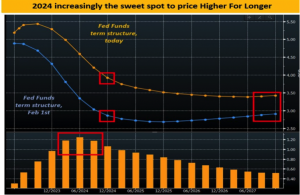
    Regular readers will know that the Gravitas mission is to identify CHANGE. They will also know that we believe the cost of money is the fundamental driver of business and asset values. That cost is commonly referred to as “interest rates”. And we see change, plus something new. Thanks to some interesting charts on the excellent Macrocompass.com blog, we can firstly see that bond market traders have adjusted their views since the beginning of February. The key change is that they now believe US interest rates in December 2024 will now be over 4%. Just one month earlier, investors thought the US monetary authorities(the Fed) would be cutting rates to 2.75% by end 2024. Here’s the change of view in graphic format:

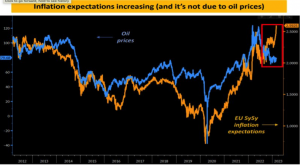
    This ‘higher-for- longer’ rates view is not just a US phenomenon. Europe’s bond markets are signalling the same, but with a twist. The perceived wisdom in markets is that stubbornly high inflation in recent data will force central banks to keep rates higher for longer. However, the source of that inflation might change. In Europe, the criminal invasion of Ukraine and rocketing energy prices have been consistently identified as the driver of inflation, until now. The following chart of long-term (5 year) inflation expectations has “decoupled” from oil prices ie energy costs are no longer driving inflation expectations in Europe:

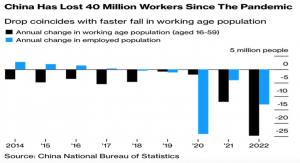
    So, if it isn’t energy prices what is the new inflation fear? Well, it could be the cost of labour, wages. That’s why the US jobs report (Non-Farm Payrolls) on Friday will be watched so closely. Despite deteriorating business activity data, the US labour market remains incredibly strong. The disconnect is unusual and the subject of much debate focused on Covid, Gen Z trends, early retirements, demographics etc. All these factors are potential drivers but then I spotted an amazing statistic; China has lost a whopping 40 million workers since 2020. For context, that’s the equivalent of the entire German workforce disappearing in a couple of years. That’s demographics in action, and Europe is not quite China, but perhaps the long-term inflation chart above is hinting at a future demographic tightness in European labour markets. Here’s the stunning chart from China’s own National Bureau of Statistics showing the worker evaporation:

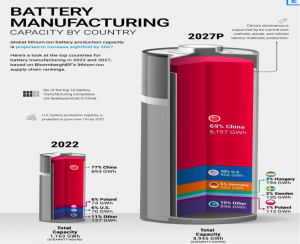
    It’s not just worker demographics undergoing structural change. How about work itself? And we’re not talking about work-from-home versus the office. Only last week we wrote “A Time To Rebuild?” and this writer increasingly believes the global economy is embarking on a massive infrastructure project. You may have previously read that China consumes more cement every two years than America consumed through the whole of the 20th Century(!). However, the next big build phase is not really cement-driven. It’s a global $275 trillion spend shift away from fossil fuels by 2050. And the charts are already exploding. Take the following one from Bloomberg showing the 8-fold increase projected for lithium-ion battery manufacturing capacity over the next 5 years:

    Let’s just say there are big global changes happening but we should be wary of simplistic(often negative) interpretations of what higher longer term interest rates means for business. The growing demand(and confidence) for money to fund capital intensive projects in cleantech is fundamentally a good thing for the global economy. Higher interest rates tell us that there will be competition for that capital. However, that’s not necessarily a bad thing either as it promotes capital discipline. So, keep an eye on the big pictures not the front page headlines.

  • Time For A Rebuild?

    Time For A Rebuild?

    Three days in hospital can focus the mind. Apart from some personal rebuild opportunities to look forward to, my post-op thoughts were mainly out-of-body. Sadly, not out of hospital. It was truly shocking to see many wonderful healthcare workers work within infrastructure so badly fit for purpose, and yet I’m optimistic. Maybe not yet for our health service, or “Angola”, as the ministerial department brief was once nicknamed. But further afield. We could go to “the world’s most exciting economic zone” which the Brexit Tory government now thinks is Northern Ireland but only because of its unfettered trading access to both the EU and UK markets. Imagine that! Don’t take too long imagining, the No.10 communications team are furiously back-pedalling that Brexit awks. No, I was thinking first of America, and I’m not the only one. Warren Buffett published his annual shareholder newsletter last week and declared that in his 80-year investing career “I have yet to see a time to make a long-term bet against America”. I’d place one US bet anyway.

    America is going to build again. Investors for the last 10 years have gorged on asset-light businesses in tech, SaaS and finance while shunning asset-heavy industries and sectors which require significant capital expenditure(capex). Something has changed. Yes, the Trump regime during its Washington crime spree talked about “infrastructure week” nearly every week. However, as Rupert Murdoch has just stunningly admitted, not only was it just talk it was also a Fox-fraud on the nation. But, not now. There is a real possibility we have entered what Wall Street would describe as a “capex supercycle”. The spending stars have aligned in three ways:

    1. The infrastructure of the US is extremely old, about as old as it has been since before WW2.
    2. A good article in the Variant Perception blog cites a Global Infrastructure Hub estimate that the ANNUAL infrastructure spending gap has reached $800 billion. That equates to the annual US defence budget which is experiencing an existential implosion of its biggest military rival in Ukraine.
    3. Prequin, the hedge fund research group, say infrastructure fund raising in 2022 was very strong despite overall market turmoil. In fact, fund raisings for infrastructure accounted for over 20% of all private market funding compared to an 8% long-run average.

    The data above suggests a good environment for infrastructure spend but it needs a catalyst. Or, a President. The Biden administration with its IRA and Chips legislation have dangled tax incentives in front of corporates and investors. And the headlines keep coming….

    • How Arizona Is Positioning Itself For $52 Billion To The Chips IndustryNew York Times
    • Ford Announces $3.5 Billion Investment in Michigan ElectricReuters
    • Red States Leading the US in Solar and Wind ProductionGuardian

    This mix of re-shoring semiconductor manufacturing, ramping-up electric battery production and investment in green energy( in unlikely places!!) is just the thin end of the wedge. Dare I say, a post-Covid world is more receptive to bigger, more managerial government, even in the US of A. Indeed, there’s a whiff of a Rooseveltian “New Deal” in the air and as the pensions and savers of the world seek yield-producing assets there is further good news. Government incentives, like Biden’s IRA tax credits, create competition for capital and investment. So, is it any surprise to see the following Bloomberg headline….??

    • Europe Banks On Its €72 Billion To Counter Biden’s Green Payouts

    We have written previously on the massive $9 trillion annual spend required to move the global economy away from fossil fuels but this is not just a government agenda. Corporates are moving fast. German gas giant, Linde, has just announced a whopping $7-9 billion spend on clean energy projects including converting 11 of its 13 plants to hydrogen energy. However, hydrogen is not just a northern European gig. Check out Spanish gas player, Cepsa, and ACE Terminals creating a hydrogen/ammonia supply line to Rotterdam. No tomatoes, Nigel. Sorry.

    Back in the real world, of course, this investment must make sense. That means assets and securities exposed to these structural trends should generate better than average returns for investors. If that becomes the case, and asset-heavy industrial stocks outperform, then other sectors could suffer. Interestingly, “Big Short” investor Steve Eisman was on CNBC in recent days warning about “the days of tech stocks beating the market are over”. Of course, lots of people are wary of tech after a difficult 2022 but possibly more intriguing, was to hear Eisman talk about his focus shifting to “green energy and infrastructure”. It might be time to rebuild your investment and pension portfolios too?


  • What Game Is Business Playing?

    What Game Is Business Playing?

    The UFO speculation of the past week did prompt a few random thoughts. First, there was the faint hope ET’s mates were coming to take Donald, Jacob, Vlad and Enoch away but no such luck. Then there were childhood memories of playing Space Invaders in amusement arcades and on ancient TV gaming consoles. And finally, I thought of Pachinko. What??? Lansdowne Road on Saturday and the Super Bowl on Sunday were the triggers, but I was thinking more broadly about the role of games in different societies east and west. Games may differ across the generations or individual countries but engagement and community-build are a constant. So, is money. Back to Pachinko and the Super Bowl…..

    The Super Bowl finale of America’s NFL football season is more familiar to most readers so we’ll start there with the numbers. NFL is the richest and most powerful sporting organisation on the planet. Annual revenues for the NFL in 2022 almost touched $18 billion and, for context, are three times bigger than the $6 billion earned by England’s Premier League(EPL) and its global audience. The Super Bowl itself was watched by 113 million people on Sunday and ranked as the 3rd most watched US TV show ever. Ever heard of Pachinko? If not, this game’s annual revenues might surprise.

    Estimated annual revenues of $200 billion are more than ten times those of the NFL! Pachinko is a ball game too but it’s a vertical pinball game played in Japanese gaming arcades. Players twist wheels to steer descending small steel balls into cups which trigger a prize-winning payout of more balls which, in turn, can be exchanged for cash or small prizes. Gambling for cash is illegal in Japan but this low-stakes, low-strategy game exploits a legal loophole and is 30 times bigger than the annual gambling revenue of Las Vegas, as well as twice the size of Japan’s export car industry. Arguably, this is an apples and oranges type comparison with NFL but perhaps the sheer size of the gap between sport and gaming/gambling is worth exploring. Three stories struck me this week….

    • Remember those Generation Z traders who got burnt on meme-stocks, crypto currencies, the Nasdaq tech implosion and NFTs? These retail (non-professional) traders have not retired hurt, but rather have stayed in the game. In fact, JP Morgan data this week shows that retail market orders as a percentage of market value reached an all-time-high of 23% in recent months.
    • Nobody needs reminding 2022 was a tough trading year. However, check out trading platform, Plus500, who released their annual results for 2022. They actually grew revenues by 16% and average revenue per user was in the region of $3,000. For wealth managers hoping for a 1% management fee this equates to the AVERAGE customer giving you $300,000 to manage. Oh, and now think about the estimated 450 million retail trading accounts globally.
    • The gaming or gambling spend is not just confined to financial instruments. Sport as a magnet for speculation and bragging rights is huge. So, it was intriguing to read reports this week about Paddy Power’s(Flutter entertainment) potential listing of its shares on one of the US stock exchanges. Of course, the US has recently legalised sports betting in many states so the commercial logic is strong. For illustration, and back to the Super Bowl, an estimated 50 million people bet up to $16 billion on anything from the colour of Rihanna’s dress to the number of mis-spells in the Orange Toddler’s tweets for Sunday night attention. Also, check out New York state who recently legalised sports betting and reported just the $1.8 billion of mobile sports bets in January alone.

    One might not be comfortable about the younger generations speculating on anything from doggy coins to dodgy tech but the older generations’ moral and wellness high-ground is on tricky foundations. Or…. should we say no foundations, or no homes. On these pages previously we have described the younger generations as the most asset-poor since before World War 2. So, it is not really surprising to see younger consumers speculate or just consume/enjoy the thrill of gaming rather than save for house deposits. However, there’s potentially a bigger point being missed. Games, whatever their costs or outcomes, have a community aspect in many cases. A shared experience of fun, loss, competition, fantasy and success is a core behavioural trait of human society. As the digital economy and Artificial Intelligence (AI) grows in complexity, business needs to think more deeply about how to engage consumers, and how gamification could be a huge assist. One final story this week caught the eye on that thought….

    Canadian tech giant, Shopify, provides a platform for retail businesses who want an e-commerce channel. In 2022 Shopify engaged 450 million users and processed $80 billion of sales but it sees the future shopping experience changing. Last week it launched a suite of blockchain-based tools to help retailers engage customers with crypto-wallet sign in facilities and loyalty discounts/benefits embedded in digital tokens. Those tokens are actually NFTs, but that word gets bad press these days. So, get used to word like ‘tokenomics’ and ‘tokengating’. Before that, maybe take a look at businesses like Shein and TikTok who are using task-completion/gamification strategies to drive world-beating engagement with young consumers. Whether it is steel balls or digital tokens, human beings are programmed to engage with fun, competition, community, experience and rewards. And businesses should be driven by the following number: the marketing/martech gurus, LXA, reckon companies using gamification see up to a 700% increase in customer conversion rates.

    Like our opening paragraph, the mingling of sport, games, tokens, space and the metaverse may seem random but the direction of engagement is very clear. Even an Arsenal fan knows there’s something up when a $3.75 billion bid for Tottenham Hotspurs’ empty trophy cabinet appears! Game on.


  • We Need To Chat About Massive AI Numbers

    We Need To Chat About Massive AI Numbers

    Hey Alexa, play Burt Bacharach “One More Time Around” ! Sadly, Burt has has run out of earthly time and has left us to join Siri, Google and Alexa in the cloud(s). Perhaps it appears sacrilegious to mix clouds and a music god with digital virtual assistants but I’m only human. We don’t do probability. Indeed, Bacharach over six decades did the improbable as perhaps the greatest musical assistant in history; writing more than 120 Top 40 hits in the UK and US charts. On the other hand, Alexa and her Artificial Intelligence (AI) buddies probably won’t see out the decade.

    There’s a new hit AI assistant on the scene, ChatGPT, and the Big Tech innovation departments are desperately trying to release their own hits. These new AI chat bots ironically are not voice-activated but respond extremely powerfully to text-prompted requests to write business plans, check and write software code, generate content marketing material, draft job adverts, summarise books, white papers etc. This article is not going to deep dive on the technology but rather is going to follow the early numbers and think about the probable impacts for business. First, let’s look at the money bit.

    If you needed convincing that AI workflow tools like ChatGPT are a big deal then this was the week of show me the money. If one can characterise these chat bots as re(search) assistants then ‘search’ as an online activity is facing a ‘code red’ in potential changes to online behaviours. If code red sounds a bit hyperbolic don’t blame me. They were the words of Google management. As the kings and 90% winners of the search world, one can understand why Google were keen to launch their own AI text-generative tool. So, say hello to Bard, launched this week. And say goodbye to $173 billion of value erased from Google’s market value in the two days(yes!) since a botched demo of Bard. Irrespective of whether this is an overreaction to a Bard wrong answer(it is in my view) or not, there is no doubt huge pools of investment capital are wondering how the whole world of search advertising, workflow productivity and content generation is going to evolve. In fact, it looks like there are at least 173 billion reasons to watch developments closely.

    It’s not just search under the microscope. Microsoft in their $10 billion partnership with Elon Musk’s OpenAI are launching a ChatGPT-powered version of their Bing web browser(search) but the opportunities on their Office, Teams and Power platforms must be enormous. It is no surprise to see Chinese search and AI giant, Baidu, join the bot battle with their own Ernie Bot but it would be a mistake to think all the action is on the tech supply side of things. The business world is already using these AI chat bots right now. In my own commercial environment I have seen business plans and job specs delivered with significant heavy lifting done by ChatGPT. I’m not alone. The careers focused network app, Fishbowl, just published the results of its recent survey. The headline figure that 27% of respondents had already used ChatGPT to complete tasks is pretty staggering but the breakdown by sector is even more instructive:

    • 37% of professionals in marketing and advertising have used ChatGPT to assist in their jobs.
    • 35% of technology workers have used ChatGPT. The time savings to check code are incredible.
    • 30% of consultants are using…. I could be cynical here.
    • But… healthcare and accounting professionals come in bottom of the user rankings with just 15% and 16% take up.

    The bottom rankings are a good illustration where AI large language models and chat bots have some work to do. Accuracy with numbers is an issue and the lack of current context(history) can be problematic given ChatGPT only uses data up to 2021. However, the ability of ChatGPT to generate a draft text or coded structure for a task or project is a game changer. Hence marketing and tech workers are all over this, and user numbers of over 100 million in the first 2 months since November launch smashes TikTok’s previous 9 month record. Exciting times, but it should be said that data bias and ethics will remain significant challenges for AI even as “accuracy” improves. The “truth” as George Santos, Liz Truss, “30p Lee” Anderson or Donald Trump would say “is going through some things” at the moment. So, as orange jump suits and political oblivion become a distinct reality, we can perhaps hope for a better truth future with AI. As always, investment capital will fast forward to the future almost instantly so get ready for more of the following:

    • Venture Capital: The longer term money is moving. VC data oracle, Pitchbook, reckons venture capital investment in generative AI has rocketed by 425% since 2020 with $2.1 billion invested in 2022 alone.
    • Retail Trading Capital: Activity in social/trading networks suggests AI is getting that crypto or metaverse vibe. The Reddit platform which spawned so many ‘meme stocks’ are seeing subscriber numbers explode on r/chatgpt. There are relatively few pure generative AI plays which are publicly listed but BigBear.ai and C3.ai are two who are enjoying big moves. BigBear is up just the 500% year to date. That gets noticed by CEOs and guess what?
    • Corporate Messaging: An early embrace of a hot trend or technology can do wonders for a share price in the short term, irrespective of actual future execution. Check out US media player, BuzzFeed, whose CEO announced the firm would start using ChatGPT to generate content for its platforms. The share price jumped 92% on the day and a whopping 300% over the week. Expect other corporate leaders to take note..

    The last example may suggest generative AI is just another Wall Street hot trend. It is not. Blockchain, crypto/digital currency, NFTs and Web3 will ultimately enjoy widespread consumer and business adoption but it is very early days for practical use cases. With ChatGPT and generative AI this feels entirely different and the 37% advertising/marketing user penetration is off the charts. The way we access information is about to change. That behavioural shift, in turn, changes search, marketing, advertising and sales. And that is why a $173 billion share price move in just a few days is a big big deal. It is clear the chat on business strategies has only just started….

    “But I’ve gotta try and get it right
     Or I’ll only end up like the others”  –   One More Time Around (1988)      –     Bacharach/Bayer Sager
    Burt Bacharach(1928-2023) RIP