Author: Gary McCarthy

  • New Masters Of Inflation Revealed!!

    New Masters Of Inflation Revealed!!

    The talk in the cold Forty Foot waters this morning was the Masters. And, not just the golf. The elephant in the Irish political room has revealed itself once more. Apparently, Secretaries General in the public service are our true Masters. That conclusion swiftly led to a ‘fantasy job’ group chat with my own idea for a new chair of Inflation Studies in Trinity College not just being shot down but described as “obsolete”. Ouch! Back at The Tower of Gravitas I trashed my Robert Watt intro e-mail quicker than a Liz Truss tank selfie and steadied myself for further investigation. Happily, the investigation did not need to be forensic, nor need to be passed on to Dame Dick and the Metropolitan Police, so the results can be revealed today rather than in the next decade. Let’s meet our new Masters of Inflation…..

    Wajih Ahmed: Who???? Wajih might actually be described as a Wall Street “Master of The Universe” but he’s not your typical bond, stock or currency guru. Firstly, he’s only 24-years old. Second, thanks to the super editorial content work by the www.efinancialcareers.com team, we also know that he graduated from university aged just 17 and joined Goldman Sachs one year later. This guy doesn’t do stock trading, M&A, bond arbitrage or crypto. Nope, he sits on an inflation trading desk and apparently that team has made just the $300m of trading profits in the last 3 months (per Bloomberg). The trading room chat is that European inflation bets and derivatives have been the big winner trades. Interestingly, you’ll note gold doesn’t feature as a trading winner despite its historical super powers in inflationary environments. Time to meet another new Master….

    Sam Bankman-Fried: In the world of crypto trading he might be better known as ‘SBF’ and he is the CEO and founder of FTX, a cryptocurrency trading exchange. Cryptocurrencies might also be the new reason why gold hasn’t really set the world on fire in 2022 despite spectacular inflation data around the world. There is no doubt crypto is siphoning off capital that would have previously moved into gold. Check out the latest Nasdaq survey which shows that 72% of financial advisors “would invest more in crypto” if there was an appropriate fund(ETF) available. This is music to SBF’s ears and also insanely profitable. The 30-year old American has a net worth approaching $25 billion and wants to give all his money away. I suspect he’s having more fun than the Goldman inflation trading desk too. SBF shares an apartment with ten of his mates in Bermuda, drives a Toyota Corolla and sleeps on a bean bag.

    So, apart from driving a Japanese car, I’ve a bit of catch up to do on these guys. However, on a much more serious note I’m not sure crypto will hang on to its recent gains if some recent developments gather pace. Bluntly, crypto remains a ‘risk asset’ and has benefitted from improved sentiment in financial markets. Right now, I see three risks – all part of the inflation story but with very different outcomes, and one of which is hugely difficult to model but could be very destabilising globally. Let’s deal with the easier ones first….

    Supply Chain Shock: The disruption of the Ukraine-Russia war is clearly having an impact but we should also be keeping an eye on two other developments:

    1. China: A zero Covid policy response has locked down 30 million people in Shanghai. This has resulted in typical 100 ship queues outside Chinese ports ballooning to a 500 ship armada.
    2. UK: Having flame-grilled Rishi Sunak’s prime ministerial hopes one can only wonder what the Great Misleader will do next. For starters, there are worrying reports of Article 16/Brexit trade truc(k)ulence coming and the embarassing scenes of lorry car parks in Kent are screaming for Downing Street distraction tactics. Sadly, those ”sunlit uplands” of Brexit fantasists not only “hold all the cards”, but also all the lorries.

    Financial Shock: Bond markets have enjoyed a 40 year bull market but the re-emergence of inflation has incinerated portfolio values on a seismic scale. Bond markets last week dropped another $960 billion in value. That’s a staggering $6 trillion vaporisation of value from the bond market highs of summer 2020. This scale of loss is ‘unprecedented’ according to all the commentariat. My concern is the derivative products which have been manufactured based on bond market assumptions (vs unprecedented reality) and the possibility of a financial ‘accident’ at a significant financial institution. One might recall Warren Buffett twenty years ago describing derivatives as “financial weapons of mass destruction”.  So, let’s hope bond market collapse is not the trigger.

    Geopolitical Shock: This is possibly the most explosive and also the most difficult to fix. Inflation for the poorest people on the planet becomes a life or death scenario. We have documented the Ukraine-Russia food chain impact previously but there are already very early signs of what hunger can do. The turmoil in recent days in Pakistan and Sri Lanka are not exclusively food related but it feels too coincidental for those with memories of the Arab Spring in 2010-2011. The tragic destruction of Libya, Syria and Yemen will take generations to rebuild, and I remain convinced Russia’s use of Syria as a test battle ground was a critical encouragement to Mad Vlad and his mass murder machine. A destabilised Pakistan and its 225 million people with nuclear weapons next door to a 1.3 billion person Indian neighbour with a worryingly nationalistic government and more nuclear weapons should keep us awake at night. In this instance, new Masters could be very bad news.

    On a more positive inflation note, there is evidence of economic activity slowing down. Additional supply chain shocks will add to that dampening effect. In fact, global GDP data and freight rates are rolling over. However, the big fear is global hunger and the growing probability of an attritional war in Ukraine. Again, our European Masters might be missing the big picture on painful energy supply decisions compared to global hunger shock waves. Wonder is it time for me to draft a ‘Gas Master’ role …..for the attention of…. Sir Humphrey of Humanity?


     

  • ESG: None of This is Serious….

    ESG: None of This is Serious….

    The title of this article was inspired by the just-published debut novel of Catherine Prasifka and my ongoing efforts to understand Generation Z a bit better. Or to question previous views? Surely, Gen Z are the one generation who are really serious about climate, sustainability, ESG etc? I would have taken that assumption as accepted wisdom until I read about a company this week which almost nobody over the age of 30 has ever heard of. Let’s tweak your curiosity with some data points which are truly mind-blowing before revealing the company’s name…

    • This company was established in 2008 and is about to complete a private funding round which will value it at circa $100 billion. That’s a bit more than Stripe….but it’s not another fintech.
    • Originally, the company made wedding dresses but has moved into fast fashion and is worth more than the global giant Inditex/Zara and H&M franchises combined.
    • The company is on track to do $20 billion of annual sales in 2022 and does NOT own a single retail store. As recently as 2020 (and pre-pandemic) the franchise was valued at $15 billion.
    • On an average day, the company adds 2,000 new items to its e-commerce store and ships its products direct to consumers in 220 countries.
    • This franchise does NOT sell to China.
    • The company’s app has overtaken Amazon as the top shopping app in the US and has almost 350 million downloads worldwide.
    • The fashion items sold are insanely cheap(many product lines are under $10) and timing from design/trial to wider market is just 5-7 days (vs Zara 3 weeks).
    • A super-powerful market intelligence operation and the latest data science/algorithms are combined with tightly controlled supply chains to ramp-up production almost instantly when the initial smaller batches of product show promise.
    • Then a TikTok army of video contributors, influencers(Katy Perry, Rita Ora, Addison Rae etc) and participation incentives creates a viral flywheel of more users, better data and better products which, in turn, generate more users and engagement.
    • US upper-income teens now view this company as the number 1 fashion e-tailer, and the number 2 shopping platform nationwide behind Amazon.
    • The consumer surveys are consistent – Gen Z’s favourite clothes shopping place is an online platform so…..

    Cue the drum roll and the big reveal; it’s Shein (pronounced She-in) and it’s…..Chinese based and owned. Yes, the combination of speed/freshness, style/influencer and, critically, affordability are the unsurprising behavioural drivers for the Shein+Gen Z love-in but, but …. what about the “purpose driven” younger generation and their sustainability anxieties? Specifically, and leaving aside the awkward question of Chinese ownership, I would have thought the following issues merited pause for thought….

    • Information on Shein’s secretive supply chains and production facilities is very limited and has ensured Shein’s positioning at the bottom of most ESG/sustainability rankings. Think labour conditions, safety, wages etc
    • Then think about a franchise whose marketing model is designed to generate turnover, fresh demand, obsolescence, waste etc. The fashion industry in aggregate is already responsible for 10% of carbon emissions and consumes 100 million tonnes of oil annually. Fast fashion is hardly a sustainability poster child, and Shein is not helping in a world where the average consumer throws away 60% of new clothes in the same year they were bought.

    Awks, but maybe we should save our ESG/sustainability queries for the institutions and private equity houses funding Shein. It was striking in this week’s Irish Times interview with the young novelist Prasifka that the context, in her words, to writing about twenty somethings is that “it feels like there’s no real way to acquire assets or money or political power or stability”. My personal view is that this touches quite profoundly on why we misunderstand Gen Z behaviours. If the current external world is not exactly screaming opportunity, stability or control why wouldn’t a younger person go down the crypto or NFT rabbit holes, or expand their digital lives in the metaverse, or change their clothes or Web3 avatars on a frequent basis? Seems pretty human. But I do hope Gen Z  don’t give up on this world and its current leadership generation….

    It is easy for us to query the sustainability of Shein in the life of a purpose driven twenty something but there is a far bigger ESG leadership question right now. And without a convincing answer, it’s possible many of our brightest and youngest will conclude None of This ESG stuff is Serious. So, let’s ask that question. Will Europe stop buying gas to fund Russian death squads in Ukraine? Seems pretty human too.

  • Pension Alert: Tokyo Butterfly Flaps Its Wings!

    Pension Alert: Tokyo Butterfly Flaps Its Wings!

    Wowzers! I didn’t realise until today that the Japanese Yen has lost more value than the Russian Ruble this month. The currency market a bit esoteric for you? Think again. I doubt it is a coincidence I have seen a marked pick up in pension queries in recent weeks too. Both developments are connected to the same wealth threat, inflation, but Japan itself could be the even bigger threat to your pension. So, without sounding like Fr Ted, I do think it important to look far far away to understand the second-order effect of inflation rates not experienced for over 40 years in developed economies. And, it’s big in Japan..

    The Land of the Rising Sun and its population of 125 million is an economic and manufacturing powerhouse ranked 3rd in the world by GDP. However, this $5 trillion economy is particularly dependent on imports of raw materials and energy and that has attracted the attention of financial traders. Bluntly, traders smell blood as a Japan economy powered by its export sector would struggle if rapidly inflating input costs killed profitability, jobs, corporation taxes, banks etc. Here’s a taste of what’s been going on….

    • Yen/USD exchange rate moved through the 120 level for first time since 2016.
    • The Yen kept moving towards the 123 level with the biggest one day move seen in 20 years.
    • As the Yen lost value, so too did Japanese government bonds(JGBs).
    • The Bank of Japan(BOJ) had to intervene in the JGB market and announced it would buy “unlimited” amounts of the benchmark 10-year government bond.

    Of course, bonds have been falling in value(and interest rates rising) all over the world since the beginning of the year but why are the BOJ so antsy? It’s all about debt; Mt Fuji quantums of debt. Japan’s government has been borrowing money for years to try to stimulate growth in the economy, and ironically generate some level of inflation. However, runaway inflation leads to rapidly rising interest rates(falling bond prices) and can cause real pain(rising payments) for those who are heavily in debt. Here’s the Japan debt story…

    • The government debt of Japan is estimated to be over $12 trillion.
    • That’s a debt/GDP ratio heading towards 250% . Yep, Japan is the most indebted country on the planet.
    • Now there is a mitigating factor in that the BOJ has purchased/owns almost 50% of the $12 trilllion government debt market(JGBs). Sound weird? You’d be correct. The Japanese government owes its own central bank an amount of money greater than the GDP of the country. And people think NFTs make no sense!
    • This is not the forum to debate the fiscal gymnastics involved in maintaining confidence in the Japanese currency and its government bond market. However, let’s just say the BOJ is extremely keen to avoid sudden bond and currency market moves.
    • This is a delicate BOJ balancing act which, arguably, has closed the JGB market. As an illustration, there are days when there is not single trade executed in the $12 trillion JGB market. Nada, zilch. Best not to think about that too much but imagine a commercial activity 4 times the size of the UK economy not even seeing a lollipop change hands.

    Clearly, a Japanese financial market with too much volatility is not good news. It would signal the BOJ has lost control and then we are into ‘Japocalypse’ territory. I have used that cautionary descriptor numerous times over the years and thankfully Japan has coped with the 2008 credit crisis, the 2011 earthquake/tsunami and the Covid-19 pandemic. But, they all have been deflationary events rescued by global central banks pumping money into the economy. Now, we are in a situation where supply is the problem, not consumer or corporate demand. Inflation has not been seen for 40 years which means pension funds have been sticking to roughly the same investment strategies over that period. I’m conjuring up recent images of Russian tanks being destroyed by silent air-borne drones and wondering do pension strategies have the right equipment, or generals for that matter?

    Japan is no butterfly in the context of the world economy but its financial ‘wings’ are probably not watched too closely by pension investors on this side of the world. Persistent inflation could quickly change that. The currency and bonds of Japan have been typically safe-haven investments so the following assets and activities will see unprecedented investor flight and disruption if Japocalypse emerges as a real risk.…

    • Global Debt Markets: Japan, despite its massive debt pile, is also the world’s second largest provider of external capital(creditor) globally after China.
    • Life Insurance: Japan is the second ranked life insurance market globally behind the US.
    • Property & Casualty Insurance: Ranked 4th in the world.
    • Currency Markets: The Yen is the third most traded currency in the world after the USD and euro.
    • Stock Markets: Total value of stocks traded in Tokyo stock exchange is almost $6 trillion and ranks 3rd globally.

    The markets and instruments above will be dealing with inflation for the first time in 40 years. Some inflation is a good thing but not too much. So, it’s all about balance… except with your pension. Bonds really hate inflation as your quarterly pension update will confirm very soon.


  • Globalization Stuck In The Mud Or In Full Retreat?

    Globalization Stuck In The Mud Or In Full Retreat?

    Ok, hopefully this particular attempt to link the horrors of Ukraine and commercial freedom won’t incur the disgust of 500 million Europeans. I wasn’t invited to the European Council meeting anyway but ‘Global Britain’ and Boris Johnson would probably have had loftier ambitions. Oh well, welcome to the new world order. Or should I say disorder? It is not just Russian tanks about to get bogged down in the melting Raputitsa mud of Ukraine.

    Globalization has stalled, and is possibly in retreat already, as the consequences of a shocking European war of aggression reverberate around the world. However, it would be a mistake to think de-globalization began by cutting off the 11th largest economy in the world, Russia. It’s not just about Russia, it’s about much more. Here are a few illustrative headlines pointing to the stresses building in the world order over recent years….

    • China’s trade war with the US resulted in loss of $550 billion –   The Economic Times
    • Facebook, Twitter and Whatsapp blocked in Turkey after arrest of opposition leaders – Independent
    • How Beijing humbled Britain’s mighty HSBC – Reuters
    • Germany extends ban on Saudi arms sales – AP News
    • As Britain bans Huawei, US pressure mounts on Europe to follow suit – Reuters

    Note how these headlines are not new but, in aggregate, appear to challenge the traditional positive drivers of globalization. Since 1991 the global economy had benefitted from increased competition, new markets, international capital, shared technologies and political tolerance. However, when capital, talent and technology are free to move it can lead to significant regional shifts in wealth. The world was a winner but there were losers too…. Ask the American rust belt or the UK’s fading industrial base. So, when the financial crisis shocked the global economy in 2008 and triggered an evaporation of trust between banking institutions something rather more significant happened. Sovereign nations in a battle for financial survival and to support their domestic economies adopted a more inward-looking approach. The following striking data seems to confirm this too….

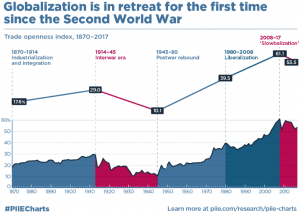
    In 2020 the Peterson Institute for International Economics (PIIE) published a report showing globalization in retreat for the first time since World War II. More interestingly, PIIE had used a measure called “global trade openness” to illustrate that the “slowbalization” had begun more than 10 years earlier. Global trade openness is calculated as the ratio of world exports to world GDP and shows globalization peaking at 61.1% in 2008 but falling to 53.5% by 2017. Here’s the PIIE chart:

    Arguably, globalization is not just measured by trade. There are cultural and political integration dimensions to the concept too. So, these dark days in Europe are certainly not helping to move the dial in a positive direction, and all eyes will be on the following areas:

    Food:

    Previous articles here have highlighted the significance of Ukrainian and Russian agricultural output in the global food chain. However, we also mentioned ammonia-based fertilizers which are dependent on gas inputs/feeds. Fertilizer prices have quadrupled while grain prices have doubled. This margin crush massively disrupts the yield management strategies in agriculture everywhere. Note this is not just a Ukraine-Russia output issue. The global future planting season is now at risk. And be aware that the entire planet operates on a 90-day food supply basis.

    This crisis won’t take long to manifest itself and we should note the words of Tony Will, CEO at fertilizer giant, CF Industries – “My concern at the moment is actually one of a food crisis on a global basis”. Check out the daily headlines of individual countries banning exports of certain foods – see Indonesia, Serbia, Hungary, Egypt, Algeria etc. The hoarding has begun and the poorer countries will suffer first.

    Finance:

    Countries planning to do bad things will note the Russia experience: gold confiscated, bank accounts frozen, stock exchanges shut, credit cards blocked, payment services suspended, yachts seized and central bank reserves frozen. International outrage at Russian war crimes has allowed for little debate on these moves other than noting that the UK government wants to criminalise Ukrainian refugees without paperwork but give peerages to Russian oligarchs with dubious (news)papers. However, a more serious consideration needs to apply to the final sanction in the list above.

    The freezing of central bank reserves and exclusion from the US dollar reserve currency ecosystem will have a long-term impact on international finance. Leaving aside rogue states, all nations will note that the US and China relationship is fraught. Now consider that China is the largest trading partner for the majority of nations. It is not inconceivable that these countries could see a Taiwan crisis coming down the tracks and potential US pressure to choose sides. Who’s your dollar daddy now? Watch out for interesting FX moves in US dollar currency pairs(Saudi Riyal?) and increased sovereign wealth interest in central bank digital currencies(CBDC).

    Technology:

    If countries are forced to choose geopolitical sides on trade partners whither technology? Readers will probably already know about security concerns in the West re Chinese technology platfoms. Leaving aside TikTok personal data or Huawei 5G national security issues, the past 12 months have seen China’s own government make life very difficult for its technology sector. So much so that JP Morgan last week highlighted, like us, the implosion of China technology share indices by as much as 70% from their 2021 highs. Thankfully, we didn’t call China tech “uninvestible”, like the US investment bank’s research unit, as the Chinese authorities are suddenly showing some soothing tech love and have pledged equity market support. The 65% jump in the share price of e-commerce giant, Alibaba, in just one week’s trading might amuse investment bank analyst-bashers but should really raise strategic alarm bells.

    Technology, the great global connector, is very much a political instrument these days. Possibly more. It is striking how unwilling the West is to unleash cyber damage on Russia. Perhaps there is a realisation that super-power weaponry has extended to mutually assured technology destruction? The bigger question for me is how the internet and other technology platforms could fragment and reflect sovereign security concerns. We note China’s alignment with Russia so far and India being curiously quiet (but probably distraught to see how badly Russian military equipment is performing on the Ukrainian battlefields) and start to think about an internet decoupling. What happens to marketing strategies, digital commerce and Silicon Valley valuations if two thirds of the planet’s middle class are not just located in India and China by 2030, but on an entirely different digital ecosysyem?

    The above watch-list may feel a bit like a Twitter doom-scroll but crisis and risk aversion has historically prompted new thinking and innovation. Indeed, World War II brought us penicillin, radar, jet engines, flu vaccines and computers. So, as we digest the risk list above, we should also think about the search for regional alternatives with global impact. Two areas in particular could see acceleration with a global benefit:

    1. Energy: The acceleration by governments to reduce dependency on fossil fuels and increase investment in green alternatives can only be a good thing for a planet experiencing a climate emergency.
    2. Africa: The forgotten continent. We tend to obsess about the populations and opportunities in Asia and there is no doubting the benefits of globalization over the last 30 years in integrating 2 billion people into the global economy. However, of the estimated 2 billion person population growth expected on this planet from 2020 to 2050, a whopping 1.2 billion will be added in Africa alone. That’s the equivalent of another China or India being added to the global economy.

    We have challenges ahead but we should be careful to measure globalization in terms of trade alone. The planet and its people should be a primary consideration in any re-set of globalization. They also could be our opportunity as we might be about to find out in Ukraine. What chance the melting mud plains of Ukraine and its fiercely brave defenders force a mass Russian troop surrender? Just thinking…..

    Pierre Zakrzewski RIP

  • Web3 Earns Another Stripe

    Web3 Earns Another Stripe

    Jeff Bezos famously said that there was one statistic which inspired him to start Amazon. While researching internet investment opportunities in 1994 for hedge fund, DE Shaw, Bezos spotted that web usage was growing at 2,300% per year. This “startling” growth prompted an urgent brain storming session on a business plan that would “make sense in the context of that growth”. Soon after, Wall Street lost a 30 year old investment analyst, the internet gained an online book store and the rest is trillion dollar e-commerce history. Fast forward to today and I’m wondering is there another growth “context” which is receiving serious attention from other big thinkers like Bezos?

    The big thinker accolade is not my parochial bias but the latest Fast Company rankings which have declared Patrick and John Collison’s Stripe as the “most innovative company in the world”. The online payments business is already the most valuable private company in Silicon Valley with an estimated valuation rocketing towards $100 billion. Yes, the internet and e-commerce has been a fantastic growth ride for Stripe on its mission “to grow the GDP of the internet” but that’s not exactly what has caught my eye. I’m more interested in what the “most innovative company in the world” wants to do next. So, let’s take a look.

    First, some history. Stripe back in 2018 abandoned its support of crypto payments citing volatility in the space. Then there was some newsflow in October 2021 that a Stripe cryptocurrency team was being built and that they would be focusing on solutions for businesses using Web 3 building blocks eg cryptocurrencies, tokens, blockchain, smart contracts, DAO communities, NFTs etc. However, on March 10th if felt like Stripe was going ‘all in’ on the Web 3 opportunity. The tweet from Stripe co-founder John Collison was definitive:

    “Stripe now supports crypto businesses: exchanges, on-ramps, wallets and NFT marketplaces. Not just pay-ins but payouts, KYC and ID verification, fraud prevention and lots more.”

    Stripe has often spoken about its goal to build a “Global Payments and Treasury Network” and it would now appear that cryptocurrencies and Web 3 infrastructure are part of that vision. Indeed, a recent blog from what is frequently described as the best writing company on the planet clearly stated a Damascean revisit of the crypto space: “Crypto is going mainstream”. So, as cryptocurrencies and technology stocks endure an early 2022 battering, what has prompted this Stripe strategic reversal? My own sense is that the clue is in the “mainstream” blog reference. Bluntly, the understanding and adoption of blockchain, crypto, Web3 etc is experiencing exponential growth of the Bezos variety. The following developments illustrate the seismic shift in expectations….

    • Regulation: Often considered a growth inhibitor, regulation in this instance should now be considered an endorsement. So, look no further than the US Federal Reserve for a change in view. The Fed is now working on more meaningful rules in the crypto asset arena and has given the striking reassurance that it does not view cryptocurrencies as a financial stability concern.
    • Marketing: Only a few years ago Facebook and Google would not allow the advertising of cryptocurrencies. Now the home of the LA Lakers is no longer the Staples Centre but the Crypto.com Arena and The Miami Heat are playing at the FTX Arena. Furthermore, Twitter is facilitating Bitcoin and Ethereum payments on its platform.
    • Adoption: Web3 and its blockchain-based currencies are no longer the exclusive domain of GenZ and Reddit communities. A survey by Fidelity Digital Assets suggests more than 50% of institutions – hedge funds, family offices, asset managers etc – have invested in cryptocurrencies. This entry of long-term players is as good a signal of “mainstream” adoption as you’ll ever see. Indeed, the growth of stablecoins as an alternative “deposit account” for investors has rocketed 100-fold from $1.5 billion to $150 billion in less than 5 years.

    I could go on and on about 5-fold increases in active crypto users or an NFT market challenging the annual $50 billion size of the mainstream fine art market but really the Stripe move says it all. Follow the adoption and deal making statistics. They will tell you a lot more about growth than the daily valuation gyrations of Bitcoin or CryptoPunk assets. Indeed, the day after Stripe’s crypto return announcement YugaLabs, the creators of the Bored Ape Yacht Club NFT collection, acquired the CryptoPunks and Meebits NFT collections IP from Larva Labs. It’s early days yet but reports of secondary market trading activity in both collections rocketing by 1000% is triggering some Bezos flashbacks here. However, the broader point is more powerful and, if I could try to match Stripe’s clarity of communication, I would put it like this:

    • When a niche technology goes “mainstream” like the web in the mid-‘90s the user growth rates are in the THOUSANDS OF PERCENT…… ANNUALLY.
    • Stripe has been described as THE MOST INNOVATIVE COMPANY on the planet and now sees crypto/blockchain as “going mainstream”.
    • The best writing company in the world has CLEARLY CHANGED its view. Should you?
  • Putin About To Max Out His China Credit Card?

    Putin About To Max Out His China Credit Card?

    We did wonder in previous scribblings whether China might be the surprise catalyst for peace in Ukraine. Well, we could be about to find out. The Financial Times’ Demetri Sevastopulo is a long way from his Dublin home town and TCD alma mater but has just published a scoop on Russia asking China “for military equipment and other assistance”. The request in itself is not a huge surprise given both nations as recently as February 4th were proclaiming a friendship “without limits”. However, that was before Russia invaded Ukraine 18 days ago and the world changed. China too. The following developments in China’s universe suggest there might, after all, be limits to their friendship with Russia…

    • Shenzhen: The technology hub city, Shenzhen, and its almost 18 million residents has just gone into lockdown after a spike in Covid-19 infection rates. Foxconn, a key component supplier to Apple, has temporarily shut its operations and global supply chains will nervously watch for any impact on the operation of the world’s 4th largest container port. Of course, Russia, cannot be blamed for this specific development but it only increases the pressures on the Chinese economy which is facing some real challenges..
    • Credit/Lending: The $50 trillion Chinese property market just experienced a fall in mortgage lending in February for the first time in…. 15 years.
    • House Building: China’s top house building firms are seeing sales in the first 2 months of 2022 tumble by between 25% and 45%.
    • Chinese Bonds: Bonds issued by Chinese firms overseas and denominated in US dollars are collapsing in price and suffering credit downgrades by the ratings agencies which, in turn, has prompted more selling. Ugly stuff but there’s more…
    • Chinese Stocks: The main Shanghai Composite index fell almost 3% today but the technology-focused Hang Seng China Enterprises index is being truly hammered with a 7% slap down and volatility not seen since 2008. Chinese technology stocks have now lost $2.1 trillion of value from their peak and it’s not just happening in China. The US listings of these same companies have endured an epic 72% collapse from their 2021 highs on the Nasdaq.

    The Beijing authorities will be acutely aware that “China risk” is being priced by international investors very differently to a year ago. I don’t propose to list the reasons for this shift over the past 12 months but be absolutely clear that Russia “going rogue” is forcing investors to consider the less unthinkable prospect of China going rogue over Taiwan, Hong Kong, trade or technology. We mentioned events on the London Metal Exchange (LME) in a previous article but it is worth revisiting to highlight three things:

    1. Incredibly, the LME market for trading nickel remains closed.
    2. The entities who are holding the enormous($12 billion) loss positions are a mix of Chinese banks, a Chinese nickel producer, Tsingshan, and its “Big Shot” owner, Xiang Guangda. The banks who want to collect their “winnings” include JP Morgan and BNP Paribas.
    3. And…here’s the kicker – the company which owns the LME and decided to shut down trading in nickel is Hong Kong Exchanges and Clearing ie subject to significant Chinese political influence. Just to be clear, an exchange should NEVER be a counter-party risk.

    The financial reality is stark. China is under pressure despite its perceived strength in global trade. Its two largest trading partners by far are the EU and US. So, it won’t have escaped the notice of seasoned Sino-watchers that Chinese banks are terrified of sanctions and being excluded from US dollar payment systems. Hence, Chinese banks have been reluctant to finance the Beijing promised ‘purchases” of Russian goods and Chinese manufacturers have also refused to supply Russian airlines with aircraft parts. You do wonder whether the supply of “military equipment” is in any way a realistic expectation for Putin? Then again.. Kyiv was supposed to fall in 3 days. In Beijing the geopolitical calculations over the coming days will focus on three things:

    1. China’s critical property market does not need a global economic slow down to increase investor risk aversion.
    2. President Xi is preparing the way for an unprecedented 3rd term as leader of the Chinese Communist Party and President.
    3. The surprisingly aggressive use of financial and technology sanctions by the liberal-democratic West against Russia appears to have triggered financial markets to consider ‘de-globalisation’ and the prospect of other bad actor nations being cut off from technology or financial ecosystems. China features in every one of those risk analyses.

    A pragmatic approach from China and its perceived influence in brokering a Ukrainian peace would be a double-whammy win for President Xi. A recovery in the global economy would be good, but a recovery in “China risk” pricing would be even better. The Putin credit card can’t come close to competing with that. So, here’s hoping that card is declined.


  • The Financial Shock Waves Of Conflict Are Coming…

    The Financial Shock Waves Of Conflict Are Coming…

    Unless you’re Priti Patel or Kevin Foster at the UK Home Office, each morning most people wake with thoughts of a human tragedy worsening by the hour. Sadly, fears are now growing that the destruction of Ukraine could turn into a long-term attritional conflict. My hope is it won’t but we might need the global financial system to send some distress signals. Already, I am seeing financial market developments which take the breath away. So, let’s take a look at these emerging financial shock waves and consider their potential positive impact on peace prospects. Here are the events which I am watching most closely……

    Commodity Markets: Russia and Ukraine are giants of the commodity markets and early market analyst attention focused on energy(gas prices) and food(wheat prices). However, it is the metals markets where all the headline action is happening. Arguably, the market is “broken” given the London Metal Exchange (LME) took the extraordinary decision to cancel all trades in nickel today after the price doubled to $100,000 per tonne in just 24 hours. The interesting bit is not the price move but the early indications of the counterparties in trouble. Reports suggest the China Construction Bank struggled to meet margin calls of hundreds of millions of dollars and that a Chinese metals tycoon nicknamed “Big Shot” is on the hook for multi-billion dollar losses. Apparently, even “Big Dog” of Downing Street would struggle to argue he was not a party to this trade.

    Bank Stocks: According to the Financial Times as recently as 2 months ago Russia’s largest retail bank, Sberbank, was Europe’s second most valuable bank by market capitalisation behind HSBC. Sberbank and its 102 million customers have just seen its share price collapse by more than 99% as sanctions cut the bank off from access to the US dollar. The worry from here is that a big Russian bank like Sberbank or VTB gets into trouble. Recall the lessons of the 2008 financial crisis(GFC) and know that assets(long term) and liabilities(short term) all look good and ‘matched’ until they’re not. Now consider the Russian ruble which has lost 50% of its purchasing power in less than a fortnight. These are dangerous times for the global banking system. Nobody wants to get caught with the credit hand grenade and banking memories are still fresh from the Lehman Brothers implosion.

    Financial Plumbing: The nickel market might appear a little niche for you and, if so, you can skip this section except to say and know that there’s lots of weird stuff happening in hidden corners of the financial system, in the plumbing so to speak. My check list of weird starts with 10 year US bond yields at levels almost the same as those of 2 years maturity in a year when the Fed is expected to hike interest rates 5-7 times. Meanwhile, euro 10 year real swap rates are hitting record lows of MINUS 195 bps. Let’s just say the cost of money is seeing some strange gyrations which leads us to the more critical issue, access to short term funding. Remember the GFC liquidity freeze in 2008? Well, one metric which measures funding stress is starting to move – FRA/OIS spreads are widening which can be an indication of banks NOT TRUSTING each other.

    The intention of highlighting the above is not to scare but to indicate shock waves moving through the financial system and there might actually be good news to come of it. As written in previous articles, my belief is that Russia is in a race against time before the Kremlin regime goes broke. There are many amongst the commentariat that believe China will support Moscow by giving access to new payment systems, credit card ecosystems, buyers, markets etc. I disagree.

    On March 12th seven Russian banks will be disconnected from the SWIFT messaging/banking system which is seen as an important date. It isn’t. March 16th is much more important being my mother’s birthday and the day $100 million of interest payments are due on Russia’s foreign bonds(debt) denominated in euros and dollars. If the Russians default on those payments it could kick off a rush by creditors to seize Russian assets overseas. And this is where chaos might ensue and force Chinese hands. We have already seen Chinese firms in trouble in the commodity markets. However, two markets of even more Chinese relevance could be massively disrupted by a Russian default:

    1. Chinese companies have clocked up a staggering $27 trillion of debt. It won’t take long for market traders to work out that if one “rogue” nation can default then an increasingly belligerent Beijing regime (think Hong Kong and Taiwan) could be next. Disruption of Chinese debt markets would not be welcomed by the Politburo for one other very big reason…
    2. The Chinese real estate market is estimated by Goldman Sachs to be worth over $52 trillion. The travails of the Evergrande group and its $300 billion debt pile are well known so the Beijing authorities are already acutely sensitive to real estate market weakness. They will know debt market problems will quickly become property market distress.

    It won’t just be me watching the trading screens in Dublin on March 16th . The epicentre of the global aviation leasing industry is in Ireland and already there are press reports of Russian lack of co-operation with requests to release aircraft sitting on Russian territory. But guess who has been increasing its exposure to aviation leasing/finance in recent years? Yep, China. And that might not be a bad thing…

    Perhaps it’s a coincidence but on a day when a Chinese bank and a Chinese nickel producer both get into serious financial difficulty it is interesting to see President Xi has made some calls. Specifically, he spoke to European leaders, Scholz and Macron, urging “maximum restraint”. Yes, China will try to back Russia in its political machinations, but if Xi is beginning to worry about financial shock waves hitting Chinese commercial interests then Vladimir Putin will have made another dreadful strategic miscalculation.

  • Ten Days That Changed The World

    Ten Days That Changed The World

    “Everyone is f***ing stunned” according to the Kremlin sources of respected Russian-born American journalist, Julia Ioffe. Apparently, no one in the Putin regime expected a full-scale war or the sanctions currently raining down on Russian oligarchs and economic interests. It is not just expectations in the Kremlin which have changed. All is utterly changed except for the human tragedy of war. Of course, we hope for conflict to end as soon as possible so we are watching the following tectonic shifts in global geopolitics and finance very closely….

    Leadership:

    United States: The US media once again has been inexcusably slow to pick up on global shifts. The reality, despite domestic polling, is that President Biden has managed to put together the most unified global response to a rogue regime since 9/11. Even more striking, is that he has let the EU take the lead with attention grabbing headlines re yacht seizures and suspended Nord Stream 2 projects. However, be under no illusion the biggest “shock and awe” weapon deployed so far was the freezing of Russian central bank overseas assets. We will return to the weaponisation of finance later but the simple fact of financial life is that 60% of most central bank reserve assets are dollar denominated and that requires the use of the New York Federal Reserve and access to the US banking system. No Joe, no go.

    Europe: Brexiteers must be wiping their eyes. These headlines about Moldova, Sweden, Finland and Ukraine itself seeking EU membership were never in the red Brexit bus script. And there’s more. Historic first time decisions to supply military weapons and Germany’s massive planned increase in military spend are extraordinary developments and show the power of a $10 trillion economic and political community taking action. In contrast, the UK has been completely sidelined with an embarassingly cack-handed response to the plight of Ukraine refugees and a suspiciously slow imposition of sanctions on Russian oligarchs and banking assets.

    Ukraine: It has been said so many times this week that Ukraine voted for a comedian and got a leader. Sadly, the UK and US got The Suspect(thanks John Crace/The Guardian) and the Orange Toddler respectively but there’s a renewed hope that credibility and the concept of leadership has received a massive re-weighting in geopolitics. President Zelensky has not only displayed personal bravery and “walked the walk” but by reason of his credibility he has been able to persuade the West to help his nation in ways which nobody believed would be politically possible. Those individuals who have trotted out bare-faced lies on behalf of Johnson, the GOP and Trump can forget about their leadership ambitions from this moment onwards. Credibility delivers, spoofing just doesn’t “get it done”.

    Weaponising Finance:

    We wrote about SWIFT last week as the “G-mail of banking” and a rather blunt stick to use as sanction. However, it has become quickly apparent that there is a far bigger stick to use thanks to globalisation. In the global banking system financial assets, irrespective of ownership, reside in various international jurisdictions and currencies. And if it’s a Russian owned asset it faces three new problems:

    1. The assets can be “frozen” and therefore not accessed by Russian owners. This financial sanction has been applied to Russian oligarchs and banking entities in Europe, UK(kinda!) and the US.
    2. If the asset is equity in a Russian company that’s also a problem. International investors who have decided Russia is “uninvestable” are frantically trying to sell those bonds and shares. This has forced the Russian regime to frustrate those efforts by closing the Moscow stock exchange. The last time that happened was in 1917 which was also a rather dangerous time to be an “owner”.
    3. Even if one could sell an asset one needs to find a buyer. And that’s proving difficult. There’s not an institution in the world that wants to be seen facilitating or participating as a buyer of Russian assets. That even includes supposedly exempt oil and gas assets. Check out this morning’s news that Srgutneftgas, the Russian oil producer, has failed for the third consecutive session to sell its Urals crude product via its regular tender. Even at record discounts, there are NO buyers of these oil assets.

    As mentioned previously, the buyer of last resort in this instance, the Russian central bank,  has been crippled by US sanctions. The Putin treasure chest of $600 billion built up over the years and sitting in various financial institutions is estimated to have more than $400 billion of its emergency funds in deep sanctions freeze.

    Russian Implosion:

    All eyes are on the destruction of Ukraine but actually it has become a race against time for the Russian economy too. For context, the Russian economy is roughly the same size as Spain’s with $1.4 trillion of annual economic activity(GDP). JP Morgan believe the collapse of Russian GDP in Q2 could be as severe as 35%. If we consider the global economy as a daisy-chain of connected activity the evaporation of GDP at that scale puts the financial shock value into US sub-prime territory circa 2008. My own sense is that the damage could actually be worse as the isolation of Putin begins to move into North Korean mode. Consider the following developments:

    • Global trade: Yes, Russia exports lots of items but you need transport. And the biggest logistics player on the planet, Maersk, just said “Nyet”.
    • Global services: Propaganda can only do so much but when the average Russian viewer realises football, Formula 1, tennis etc have left their their TV channels the sense of isolation and disappearance of multinational advertising/sponsorship will be very real. Apple, Microsoft, Mastercard, McKinsey and Accenture are not just leaving sport. They are leaving town.
    • Corporate destruction: A combination of trading suspensions and buyer boycotts has resulted in the shares of Russia’s largest companies cratering by more than 80%. These companies will have debt too and that will still have to be paid just as interest rates have doubled to 20% in Russia. That equity-debt pincer movement is lethal for companies and their balance sheets. Also, it is fascinating to see news in the past few hours of Lukoil, Russia’s number 2 oil company, breaking ranks and calling for an end to the fighting in Ukraine.

    It is not a huge surprise to hear Russian authorities making plans for martial law and capital controls but this misses one rather awkward point. The war of aggression in Ukraine is estimated to be costing $20 billion per day; that seems high but a cratering ruble, higher interest rates, domestic stock market carnage and higher-than-expected military equipment losses/ abandonment on the battlefield will probably get you close to that average daily cost number for the first 10 days of aggression. So, if the Russian central bank has only $200 billion of reserves(not in dollars either) rather than the originally planned $600 billion plus of emergency funds then every additional day that tanks are parked outside Kyiv is critical to the sustainability calculations for the Russian state.

    Media Revival:

    Another feature of how Ukraine is winning the messaging battle with the Kremlin can be explained by a fresh approach by NATO and its allies. Rather than let Putin build a ‘Donbass oppression’ narrative the US and its allies have shared relatively large amounts of information about military build-ups, weaponry and activity which has established credibilty and helped Ukraine win international support. In this respect, media has been ‘used’ intelligently but there has been a more interesting and more proactive shift in approach in recent days and it originated very close to home.

    The interview by David McCullagh on Irish broadcaster, RTE, with the Russian ambassador to Ireland has been a viral social media hit but is well worth viewing again and again. McCullagh employs a very simple tactic in eviscerating the misinformation attempts(lies) of the Russian ambasador and this interviewing ‘set up’ should be used by all serious media going forward. Bluntly, McCullagh quoted back the lies, or wrong info, spouted by the ambassador in recent weeks and asked how his new statements could be credible.

    Watching the pitiful attempts in recent days of the likes of Farage, Wallace, Trump, Pompeo, Raab, Patel and Johnson to distance themselves from previous episodes of misinformation should be an opportunity for all media to refuse to give credibility to any new statements from these individuals. Enough is enough.

    Right Wing Politics Unmasked:

    It wasn’t just Vladimir Putin who unmasked his true self in recent days. The murky, greedy and shabby politics of the Conservative party in the UK and the Republican party in the US have been laid bare. Russian money has been synonymous with these political groupings for years and the lack of curiosity about Putin’s true intentions re election interference, NATO destabilisation, social media conspiracy, cybercrime and Brexit must have consequences. And not just for the poor Ukrainian population. Frankly, the information about malevolent Russian intentions has been available publicly for years so it should be made clear that lack of curiosity, obfuscation and disguised funding was as good as complicity. Any corporate entity with connections to the Murdochs, Fox, GOP and Conservative Party funding platforms could be forced to “socially distance” from the populist virus quite soon…

    The Bill:

    Apart from the human cost which cannot be measured, financial markets are beginning to “wobble” about the ultimate economic costs. Wobble might be the wrong word as some of the market gyrations have been seismic. For example, the Moscow stock market had a “17- sigma” event this week ie the probabilities of the Russian market collapsing at this speed and quantum should not happen in the “lifetime of the universe”. Furthermore, word from the all-important bond market is that moves in certain German bunds, US TIPS, Russian bonds and overall price volatility have secured their places in the financial history books. On a more fundamental level the cost of Putin madness can be seen in the “tax” imposed on the global economy in two very obvious ways….

    1. Oil prices rocketing towards $120 hurts all economies.
    2. Wheat prices up 40% in a week shows the impact of Ukraine and its status as “the breadbasket of Europe”.

    The Benefits:

    It’s difficult in the darkest hours to see the positives but hold two very important thoughts. Firstly, the world has truly come together again to stand up to Putin. The international muscle memory of taking pain for the greater good during Covid-19 has clearly helped leaders message that they must do “the right thing” now or the later consequences will be much worse. Secondly, this re-education of populations away from short-termist lies, promises etc can only be a good thing ahead of seriously tackling an even greater global challenge; the climate emergency is now and the just published UN IPCC report pulls no punches about “a brief and rapidly closing window” for action. So, difficult choices to reduce dependency on Russian fossil fuels and to urgently seek climate friendly alternatives to $120 oil can only be a good longer term development for our world.

    Indeed, President’s Zelensky’s now famous words could be applied to our own potential extinction event…. “The fight is here. I need ammunition, not a ride.”


  • Ukraine Will Test ESG Frameworks

    Ukraine Will Test ESG Frameworks

    This is not difficult. Forget about “whatabouts”, “other sides”, “internal disputes” or any other modern media weapon of mass instruction. The leader of a country with a GDP approximately the size of Spain’s has ripped off the mask. Vladimir Putin’s speech to Russian and international audiences on Monday night was truly frightening. As Russian tanks roll into Ukraine, the leaders of the free world have been left in no doubt. Putin not only sees Ukraine as “a failed state” but seems intent on reversing the “Communist give away” of other states in recent and ancient history.

    Before I fall out a window, why stop at Ukraine? Apparently, Lenin was wrong to let Poland and Hungary go too. My only regret is that we didn’t get to see Tucker Carlson on Fox News try to query the Russian sale of Alaska to the USA by Tsar Alexander II in 1867. The world has just about been able to stomach the Russian war crimes in Chechnya and Syria, the Crimean annexation in 2014 and the murderous use of a nerve agent (Novichok) on UK sovereign territory. However, this time it feels like appeasement and all the prayers in Salisbury Cathedral won’t cut it. I use the word “appeasement” quite deliberately. Previous attempts to sanction or prevent rogue Russian actions have stopped short of real pain for fear of disrupting the following:

    • Russia provides Europe with 35% of its annual natural gas needs and more than 20% of its oil.
    • Russia does about $350 billion of exports per annum with 50% of that going to the EU. Significant other Russian exports include wheat and precious/semi precious metals like palladium.

    Energy prices in an already super-inflationary environment are clearly a European vulnerability. However, here are the numbers which are really worth watching as the Russian Duma approves the use of military forces “outside the territory of Russia”. We need to think about what the world would look like if Russia controlled all of Ukraine and its assets. So, here goes…

    • Russia and Ukraine combined would account for 30% of the world’s wheat exports and 79% of sunflower oil exports.
    • The same combination would account for 30% of global barley exports and 17% of global corn exports.
    • Countries like Egypt and Turkey have a 50% to 70% dependency on these two countries for critical grain products, and an acute awareness of ‘Arab Spring’ food protest history.

    If we just consider Ukraine on its own as an agricultural player there is no doubting the relevance of the “bread basket of Europe”…

    • Ukraine is the largest arable land area in Europe and 4th largest producer of potatoes in the world.
    • 5th largest rye producer in the world.
    • 9th largest producer of chicken eggs in the world.

    And the scary one…… the biggest producer of the fertilizer-critical product, ammonia. Yes, Ukraine can meet the food needs of 600 million people but its industrial impact should not be under-estimated:

    • Ukraine is the 3rd largest iron exporter in the world.
    • 4th in the world for Titanium exports.
    • 8th in the world for exports of ores and concentrates.

    If today feels like Russia has significant economic leverage, what will it feel like next year? Maybe ask the people of Lithuania or Estonia. Better still, ask all these investment funds basking in the new product euphoria of “ESG” and “Sustainability” products. Bluntly, the investment mandates to adhere to “do good” principles have met their very first state criminal accountability test. There’s approximately $50 trillion of investment funds around the world claiming a purpose to steer corporates and states towards a greater good. Game on.

    Let’s start with European football. There appears to be some hesitation from UEFA officials about whether the Champions League final will be played in St Petersburg. Good grief. Would it be too much to ask the expensively assembled teams of ESG and Sustainabilty research talent at these investment funds to check urgently with the corporate sponsors – Heineken, FedEx, PepsiCo, JustEat, Gazprom(!), PlayStation and Mastercard – as to their current thinking? Football should not be the only sporting target. It would appear child abuse(doping) should be added to the Russian Olympic charge card after the distressing scenes witnessed on the ice rink in recent days. The latest chat is that the Champions League final would be moved to London, or ‘Londongrad’ as it is better known to KYC-aware bankers. Oh dear, or should we say “Oh Boris”….

    At least Germany seems to have grasped that Russia and Putin will not stop at Ukraine. Hence, Berlin has announced the suspension of the Nord Stream 2 gas pipeline project. That move is overdue, but still MASSIVE. On the other hand, the response of the Boris Johnson government in London was not. The sanctions announced in recent hours on 5 Russian banks and 3 oligarchs who have been on US sanction lists since 2018 was rather underwhelming. Clearly, ‘Big Dog’ and Priti Patel are waiting for Russia to invade the UK itself. However, back in the real world ESG funds do not have to wait for the London Met, Sue Gray or the publication of the buried Russia/Brexit report to hold corrupt parties to account. The “G” bit in the ESG title is the clue. Investors in ESG products should expect stewards of their investment capital to be considering the following actions to address governance concerns:

    1. Any debt or equity instruments directly linked to the Russian state or Putin-related entities should be sold/removed from ESG portfolios. The US has just banned the sale of Russian sovereign debt in Western capital markets.
    2. Follow the money. Those non-Russian entities facilitating the commercial interests of Russia, Putin and his kleptocracy should also face potential removal from ESG portfolios, or worse. Think about Mastercard and its sponsorship of a St Petersburg UEFA final. Then think about BP and its 20% shareholding in Russian oil player, Rosneft, with its $2 billion annual dividends going to BP profits.
    3. Weaponise banking. My own personal view is that Russian banks should be refused access to the global bank payments network, SWIFT. The counter-argument is that this punishes ordinary Russians. Perhaps there could be a more focused weapon. Banks could refuse to process transactions which occur outside Russia ie make travel and overseas spend for Russia-connected individuals incredibly difficult.

    Perhaps I wish too much. However, there is one consistent theme throughout Russian history. No foreign armies have ever removed a Russian leader. The people themselves have always taken action…..

  • The Busy Fool Phase Of Brexit

    The Busy Fool Phase Of Brexit

    It’s never a good look when a full-blown World War III stand-off involving the Russians doesn’t scoop the “porkie of the week” award. Of course, the Kremlin accusation that the Ukrainians would choose this week and the massing of 150,000 Russian troops on its borders, rather than any week over the past 8 years, to attack the Donbass region sets the bar pretty high. However, the ‘Comical Ali’ award this week, and possibly for the ages, goes to Conservative MP for Dover, Natalie Elphicke. Brace yourselves.

    When quizzed about massive trucking logjams in her home county(or car park) the irony-free MP refused to blame Brexit and went on to claim the extra red tape, £100 million of additional costs and 650 new administrative positions as Brexit benefits because….this waste of time and money has created jobs. The choice of “Comical Ali” as a reference is no accident. The entire Brexit regime is under threat. Indeed, I note Tory grandee, Michael Heseltine, writing in The Guardian today has suggested that “If Boris goes, Brexit goes”.

    My own sense of things is that there is an increasing whiff of desperation surrounding the Johnson government. The outcome of “partygate” investigations and the likelihood of a PM exposed as a parliamentary liar will not just potentially bring down a government but will put Brexit lies under additional scrutiny. Lies or opportunities you might ask? Didn’t Jacob Rees-Mogg, the newly appointed Minister for Brexit Opportunities(actually wincing while I type that), just state that evidence Brexit has damaged trade is “few and far between”? The infamous Rees-Mogg nanny needs to have a word. The evidence is landing with Tomahawk missile-like ferocity and the following data points particularly caught our eye:

    • The Office for National Statistics(ONS) has published trade figures showing a 12% fall or £20 billion wipe-out of exports to the EU in 2021 compared to the last stable period of trade prior to Brexit stockpiling(2018). The hardest hit sectors were clothing/footwear down 60%, vegetables off 40% and cars “they need us more than we need them” down by 25%.
    • Government cheerleaders have been keen to blame Covid and supply chain chaos for the struggling trade figures but the “evidence” does not stack up. Where better to seek answers than business itself. The British Chamber of Commerce has just published the results of a 1,000 firm survey. The responses are damning; 7 out of 10 businesses say the Brexit trade deal is bad for business. Even worse, just 12% of firms agreed Brexit was helping them. Many companies cited increased costs, paperwork and time delays as negative operational factors. Any business owner who swallowed the “sunlit uplands” lies must feel like a busy fool today. One might even consider selling one’s business but there is another damning data point to consider…..
    • My former quants/analytics colleagues at Quest(Canaccord) are highlighting that UK publicly quoted companies, in aggregate, are as cheap as they have been for the past 10 years. As mentioned in our last article, when valuations are falling it reflects uncertainty about the future from an investor’s perspective. This relative “cheapness” of UK equities relative to US and European equities should not be a metric to celebrate in Whitehall or Downing Street. On the contrary, the UK is “on sale”. I have no doubt Jacob Rees-Mogg’s hedge fund partners can confirm that for our readers too. Busy fools cost money and margins. Hence valuations fall. And the busy stuff continues….

    Brexit is estimated to have required a civil service army of 50,000 new officials to police Global Britain’s voyage into trading tragicomedy. For foolish context that’s more than the entire central bureaucracy of the EU in Brussels (thanks to Simon Jenkins at the Guardian for that gem). You couldn’t make it up, unless you are a Tory MP rolled out to do the daily media rounds. One must keep fools busy it seems.

    It would be easy to slip into despondency but perhaps there is a glimmer of hope. As Michael Heseltine points out, if Johnson can lie about parties there’s a good chance people will begin to question some core Brexit dogma. For me, the single market is the standout trading opportunity which could be revisited as a Brexit-light compromise. In the end, the majority of UK citizens will likely grasp that agreements to increase trade are better than ones that don’t. As a final thought, given Brexit and Trumpism have mirrored each other in levels of deception, do not underestimate the impact of people seeing the Trump business empire implode very soon and discovering that the Donald’s career was crime, not business. Just smell that growing criminal desperation and enjoy the Comical Ali moments in the Trump and Brexit worlds. Things are about to get very real.