Author: Gary McCarthy

  • Inflationary Emotions

    Inflationary Emotions

    Emotions can just creep up on you. Particularly, if the event is unfamiliar. I didn’t think watching my son’s final football match as a schoolboy would hit so hard but, then again, I had no prior experience. First world problems, eh. However, in the wider world it looks like we are about to experience a relatively unknown financial phenomenon for anyone born after 1982. The headlines featuring ‘inflation’ are not new and we certainly have seen them appear fleetingly before – recall Iraq invading Kuwait in 1990 and $140 oil prices in 2008. However, a sustained period of inflation or, more specifically, the perception of non-transitory inflation could be an enormous emotional test case for the vast majority of business leaders and financial traders who frankly have never seen sustained inflation before. First, we should look at the data and then we can consider the likely emotional responses.

    The US, the world’s largest most technologically advanced economy, is experiencing inflation rates of 7.5% which have not been seen for 40 years. When one starts to hear market rumours of emergency Fed interest rate hikes(yes, hikes not cuts) over the coming weekend then you know we are into unfamiliar emotional territory. Readers might be aware of reasonably rough stock market performances so far this year but in an important pocket of the debt markets, the municipal bond market, is having the worst start to any year on record. And, it’s not just the US seeing record data points.

    The most inflation-paranoid country on the planet, Germany, is seeing wholesale prices for raw materials and intermediate products rocket by 16.2% year-on-year. Meanwhile, the world’s largest container shipping player, Maersk, is predicting another year of bumper profits due to continued backlogs in ports and other bottlenecks. This is not just a business or markets problem. It’s a political problem with both the UK and Irish governments desperately trying to intervene directly in energy markets to placate voters in recent days. In some ways, the data points and actions above are reactive or defensive. What I believe might be a more powerful and dangerous emotional response would be the anticipation and opportunism of a long period of time where prices of goods and services continue to rise. Let’s start with two numbers and think about the emotions of various stakeholders.

    First, the stark reality of a 7.5% inflation rate is that the purchasing power of a $1 million savings pool loses $75,000 of value each year. That’s almost like giving away a Tesla each year! Second, if your business is experiencing wholesale cost rises of 16% then $1 million of sales is about to see $160,000 of annual gross margin evaporate. And, that’s before the workforce start to get agitated which is one of the four key stakeholder responses worth watching very closely. Keep an eye on the following:

    • Supply chains: Maersk is already talking port backlogs but what if businesses try to beat the price rises by pre-ordering, ramping up inventory? This is entirely rational but could cause havoc and, in turn, fuel further price inflation.
    • Interest rates: Monetary authorities have a delicate balancing act to consider. Raising the cost of money will dampen economic activity but also increase the economic burden of servicing the monster levels of debt around the world – just the $226 trillion according to the IMF. There is also another tricky issue to consider. This feels like a supply(shortage) problem rather than a frothy demand situation so interest rates are possibly not the best policy response or fix.
    • Pensions: The army of advisors and portfolio managers who have confidently constructed portfolios over the years are about to meet a strange phenomenon. Bond markets have been on a “bull run” for 40 years so what happens if bonds actually “lose” money….for years. The variations on a classic 40%/60% mix of bond and equities are not equipped for a full-scale stampede out of anything that feels or looks like a bond. Think real estate, municipal bonds, infrastructure funds, utility stocks etc. I can still remember trader clients crying on the phone during a nasty 1994 bond reversal so the prospect of an additional 26 years of trader “confidence” being obliterated is very real, and scary.
    • Wages: Finally, the labour force will have its say. Income inequality is currently hitting levels not seen since the 1930s. Closing the gap between labour and capital is a healthy thing but one can only shudder at what the next Boris or Donald will falsely promise.

    Please note these are what I would describe as “anticipatory” responses. That’s the problem with inflation – it is the perception of the future which changes behaviour which, in turn, drives prices higher again. This has been the traditional fear of central banks. If one is “behind the curve” the consequences are difficult to reverse. However, on that pessimistic note I do believe the passage of 40 years has brought some new positive factors to the situation.

    Globalisation: The incredible levels of inter-connection in the global economy of course leaves it vulnerable to external shocks(see credit crisis 2008, Covid 2020) but this also means it can be very quickly responsive to supportive actions. Supply chain issues may be more transitory than you think.

    Technology: The inflation fighting capacity of technology is possibly best captured by variations of Moore’s Law which tells us the power of technology doubles while dropping in price on a regular basis. A Google mate and mentor of mine recently gave me a fascinating book “The Future is Faster Than You Think” (P. Diamandis & S. Kotler) which suggests there is a wave of technologies in existence(AR, AI, blockchain, 3D printing, digital biology etc) which are now converging to change our lives very very quickly. For the purposes of this article, if we think about hospitality labour shortages(inflationary) I can think of at least two companies I have met recently whose technology will transform the cost base of bars and restaurants.

    Climate Emergency: Yes, BP and Shell announced $25 billion of profits in the past week. However, I do recall a theory put forward by a former colleague and Irish Times scribe, Chris Johns, on how high energy prices can backfire on the fossil fuel industry. He strongly believed Saudi Arabia’s attempts in the post-GFC years to lower oil prices with massive production was to kill off investment in alternative energy sources and delay the day of reckoning for fossil fuels. The current energy price crunch should be considered a potential impetus to drive further investment in planet-friendly fuels. Note France have just announced the build of 14 new nuclear reactors. Expect the shift away from fossil fuels to accelerate if high prices persist(and then collapse).

    The days and weeks ahead will be interesting to watch and anxious ones for business owners and financial traders. However, my sense is that the short term price/market action will be more violent than the inflation outcome. The 1970s inflation playbook is out of date but no doubt will feature in the binary forecasts of the commentariat out there. There will be more emotion too.

    Funnily enough, just after that final match mentioned in my introduction I went home and listened to the theme music of Clint Eastwood’s 30 year old classic Western “Unforgiven”. Like Eastwood’s deconstruction of the traditional vision of the American West, inflation might be about to rip up the 1970’s inflation playbook too. One final observation for the value investors out there; the gunslinger protagonist of the movie, William Munny, “a man of notoriously vicious and intemperate disposition” sold his property and disappeared with the children…. “some said to San Francisco where it was rumoured he prospered as a dry goods merchant under a different name”. Sold property, bought stuff. Hmmmmm.



  • I Will Survive: Banks or Boris?

    I Will Survive: Banks or Boris?

    Hoo boy. Boris Johnson singing “I Will Survive” to his new communications chief was not on my Monday morning bingo card. My money is on a Doors soundtrack soon enough but let’s turn to real money and financial services. As Revolut announces a further push into the personal finance space in Ireland I couldn’t help thinking of the survival chances of traditional financial players.

    A recent personal interaction with a large European player in the pensions space was instructive. My simple transaction request in the middle of last month apparently missed the January “roll” but I was reassured that it would make the next “roll” on the last day of February. No, seriously. There are no words, just a wall of capital flooding into fintech. The numbers are staggering and should scare the hell out of incumbent financial players. Check out the following developments:

    • Fintech funding acceleration: Global fintech funding reached $132 billion across 4,969 deals in 2021. That’s a 168% increase on 2020. In fact, $1 out of every $5 of venture funding went to fintech in 2021(source: CB Insights).
    • Unicorn creation: It’s not just Wayflyer grapping $1 billion valuation(unicorn) status. Actually, in the world of fintech the pace of unicorn creation is mighty – CB Insights have reported 157 fintech unicorn “births” in 2021 which equates to more than three a week!
    • Finance-as-a-Service: We deliberately mentioned Wayflyer earlier. Its ’edge’ and part of its service is marketing analytics expertise for e-commerce companies. However, it is in reality a financing company which provides funds in an innovative way to help grow businesses. Its funding decisions are super-quick, require only 6 months of trading by the customer and pay-back is based on revenues which can slow or accelerate depending on growth trajectory. Imagine having that type of arrangement with a traditional banking entity!
    • Capital critical mass: The value of fintech start ups reached $3.5 trillion in 2021 (source: Dealroom.co). For context, that’s a bigger capital value than the entire publicly listed energy sector! There are now more than 433 unicorns(> $1 billion value) in fintech. To this writer, fintech has reached investment critical mass. The really big money has decided fintech is going to squeeze out most traditional players. And the big capital centres are seeing the future too…..
    • New York crypto: The Big Apple is currently the crypto capital of the US. More than $6.5 billion, or 46%, of total crypto funding went to New York in 2021(source: CB Insights). But, it’s not just traditional US financial centres ramping up the fintech revolution…
    • London leading: The UK is an easy target for derision when the PM is described as “not a complete clown”. That’s the new communications chief, not me. Back to the non-parody world, the UK fintech story is undeniably impressive and, in a rare visit of credibility to London, can be supported by facts. UK fintech investment grew 617% (that’s almost 7-fold) to £27 billion in 2021(Source: Bloomberg).

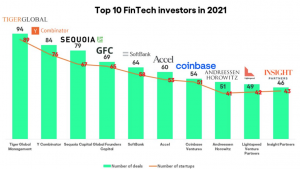
    Yes, it is entirely possible there will be poor investments made and capital destroyed. I note that sales of superyachts are tracking fintech funding growth rather too closely for comfort – CB Insights reporting a 77% surge in 2021. However, one can’t help noticing some very credible VC players rapidly increasing their fintech profile. The chart below (source: Medici) highlights Tiger Global, Y Combinator and Sequoia doing almost two fintech deals….. per week.

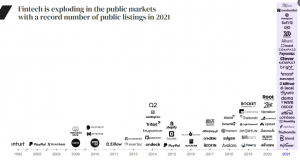
    And there are exits too. Last year’s IPO explosion was helpful for fintech listings in this logo graphic from Capital IQ:

    Of course, there will be winners and losers, just like there were in the TMT 2000 days. However, the sheer size of the $3.5 trillion fintech revolution makes it a racing certainty the Amazon or Google of future finance will emerge from this pool of talent and technology. I’m also sure the next significant technology “roll” for the pensions clown show will be The End.

  • Three January Lessons For Start-Ups Raising Money

    Three January Lessons For Start-Ups Raising Money

    It’s not just the first few days of a Freezbrury challenge focusing the mind on temperature. The January readings are in and it would be foolish to ignore a potential cooling effect in the start up funding world. The capital markets for large public companies have definitely become more volatile which, more often than not, can have a trickle-down impact on confidence. Lets’s take a look at the temperature readings:

    • Hot funds: Poster child of the technology boom, the ARK Innovation fund, is going to need a bigger boat. The Cathie Wood-managed fund added to its woeful 2021 performance (-22%) with another 20% decline in the first month of 2022. It was not alone, just a bit worse than…
    • Hot Assets: Cryptocurrencies had a poor January with Bitcoin losing 19%.
    • Hot Styles: Growth as a style had a rough month with a 9% fall which, not surprisingly, was replicated by the tech-heavy Nasdaq index with a similar plunge. But it’s not just technology taking pain….

    Younger companies, represented in IPO ($IPO) and Small Cap ($IWM) indices, slumped by 20% and 10% respectively. Note these moves are happening in a single month of trading activity which, in the context of market history, is pretty violent stuff. However, the good news is that these market swoons are not based on any collapse in corporate sales or earnings. In fact, overall economic growth and earnings are growing at almost all-time-record speeds. Get your head around this little data point; last week Apple reported its Q4 revenues which were stellar ($124 billion) and equated to generating $15,000 worth of sales….. per second…throughout the entire 4th quarter. So, nothing wrong right now. But what about the future? That’s where valuations play their part.

    Multiples of sales, cash flow, earnings etc used to value companies, big or small, have been on a steady march higher for years. These valuation multiples have been driving markets as well as the operational performance/growth of the companies. This is known as multiple expansion and it has been punchy. Last year was a bumper year of performance for private and public markets but some re-tracing of performance and multiples should hardly come as a shock. As an illustration, broader software company (SaaS) valuations have adjusted from a peak of 17.5x next-12-month revenues in November 2021 to about 10.5x in the final weeks of January 2022(source: TechCrunch). More intriguingly, and breaking a four year winning streak, revenue growth was not the strongest driver of share prices(correlation) in 2021. It was free cash flow which had a much higher correlation with share price performance ie profitability was the investor focus. So, for those raising funds in the coming months your credibility can be boosted by recognising the following:

    • Valuation multiples have decreased in recent months, particularly for loss making companies. Investors are looking at rising interest rates(and discount rates) and will expect founders to be cognoscent of wider market developments, and the impact on valuations.
    • Founders might be better advised trying not to maximise valuation and war chests, but rather focus on raising funds based on actual cash needs. Bluntly, the valuation today is not what matters but a sensible cash burn and route to execution and exit should be the founder focus.
    • Story telling is critical. Founders must place a laser-like focus on the problem the company solves and the rationale behind why customers will pay for the company’s service or product. And, the numbers in the story do matter – both on the top and bottom line. Note investors are shifting the focus to when/if there’s a return on capital so projections on margins, unit costs and cash flow are more likely to receive additional scrutiny in the coming months.

    There is no need for founders and fund raisers to panic. Market pull-backs after a massive up year are actually a healthy development, and do help bring additional discipline and scrutiny to the investment process. That’s the investor shift to watch and then polish your story accordingly. The good news is that there’s lots of capital out there so do not be afraid to take the plunge. Good story tellers will always defy the temperatures….


  • Web 3 : What Will All Tomorrow’s Parties Look Like?

    Web 3 : What Will All Tomorrow’s Parties Look Like?

    I know, I know – we’re all sick of parties already. What a ghastly post-pandemic legacy for the UK’s Tory government. The staggering incompetence and corruption of this truth-free cabal will be swiftly judged by historians but today I’d rather focus on real talent and how we must be careful not to judge initiative too early. When recently watching the fascinating Apple TV+ documentary on the ‘60s band, The Velvet Underground, I couldn’t help thinking of the critical importance of timing, the sheer power of community experimentation and…….Web3. Let’s go back to 1967 and explain that thought progression further.

    Firstly, timing is everything they say. Well, Lou Reed might concur given himself and his Velvet bandmates chose to release their eponymous debut album featuring ‘All Tomorrow’s Parties’ in March 1967. Legal snags caused delays and commercial distribution only happened in June which was the exact same time as the Beatles had released Sgt. Pepper’s Lonely Hearts Club Band. The ground-breaking droning sound of Reed and Cale was no match for the glamourous experimentation of Lennon and McCartney; two hugely innovative groups, but only one early winner.

    The Velvet Underground album, with the famous Warhol-designed yellow banana sticker and instruction to “Peel slowly and see” on its cover, sold barely 30,000 copies in its early years. But here’s the community kicker…. the musical pioneering genius, Brian Eno, said in a 1982 interview that “everyone who bought one of those 30,000 copies started a band.” Arguably 30,000 music factories were born but there was one factory in particular which should resonate with the Web3 curious right now.

    Andy Warhol was not only The Velvet Underground’s manager. His studio, “The Factory”, became the hip hangout venue for artists and musicians of the counterculture decade. Anyone from Salvador Dali to Mick Jagger to Truman Capote could show up as Warhol worked day and night producing experimental lithographs and paintings of everyday consumer items(Campbell’s Soup cans, Coke bottles etc), movies and music. By 2012, and a full 15 years after his unexpected death, Warhol’s work accounted for a whopping one-sixth of global contemporary art sales. While the financial world grapples with the surreal concept of digital images (NFTs) being worth millions of dollars it would be wise to recall the big Warhol ideas which were initially written off as drug-fueled madness. Try these for starters:

    • Warhol assembled his community of “superstars” at the Factory, in many cases long before they were famous, and coined the prophetic epigram “In the future, everyone will be world-famous for 15 minutes.”   Anyone thinking Twitter, TikTok or Instagram ‘influencers’ right now?
    • Mass producing images of everyday items like cans and bottles earned Warhol millions to the consternation of traditional art experts. Anyone thinking Bored Ape Yacht Club or CryptoPunks?
    • Warhol documented his life with an audio tape recorder and a Minox camera before social media and smartphones were invented. Now imagine what today’s digital natives will create with personal avatars and virtual worlds where they will spend the majority of their time. Anyone thinking Decentraland ?

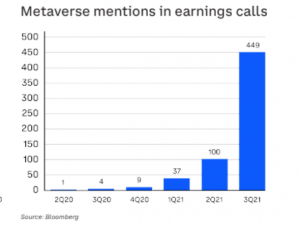
    The influence of Warhol and his Factory community on American and global pop culture has been enormous and I’m thinking the Web3 creative community is poised for even bigger impact despite current commentariat scepticism. It has been a tough few weeks for financial markets, technology stocks and cryptocurrencies but it would be a mistake to think that the pace of change will stall. What is striking in recent months is the increasing mention of the ‘metaverse’ in the quarterly earnings calls between companies and market analysts. This chart from Bloomberg captures the shift in curiosity rather well:

    Only yesterday Microsoft CEO, Satya Nadella, stated that the metaverse “is the next wave of the internet”. He went even further saying “the next wave of the internet will be a more open world where people can build their own metaverse worlds”. Hmmm….mass consumerism meets mass creativity; building your own world, real estate, identity, clothing and art. Warhol would be intrigued but not too surprised. However, current mainstream thinking might not be ready just yet which means there will be opportunities for bold thinking. Some pretty big names are already making moves if the following headlines are any guide:

    Brevan Howard’s Hedge Fund to Start Buying Cryptocurrencies – Bloomberg

    Facebook and Instagram may help you create and sell NFTs – Engadget

    Crypto Exchange BitMex to buy 268-year-old German Bank – FX Empire

    Coinbase announces NFT marketplace partnership with Mastercard – Fortune

    What is less obvious, as we view developments right now, is where people will ultimately hang out in the metaverse, what currency/token will be mass-adopted and which ‘identities’ they will use. Recall the Warhol ‘look’ – the hip clothes, wigs and self portraits – and his daily efforts to impose the image he wanted of himself on the world. Think of the metaverse world where many might feel they can look and feel better than in real life. That feels like a slightly unnerving future but there will be inspiration too. Indeed, The Velvet Underground in their short time together went on to become one of the most influential bands in rock history and  are credited with inspiring the punk and new wave movements. So, once again there’s a good chance history will rhyme. The parties will probably be interesting too…

    ‘And what costume shall the poor girl wear

    To all tomorrow’s parties

    Why silks and linens of yesterday’s gowns

    To all tomorrow’s parties’                              

     All Tomorrow’s Parties – The Velvet Underground & Nico

  • Mayo, M&A and Mayhem…

    Mayo, M&A and Mayhem…

    So, Mayo hit the lottery jackpot and that wasn’t even the biggest deal of the week. In fact, it was another mayo, Hellmans, and its owners, Unilever, who stole the show with a punchy $68 billion bid for the consumer goods division of GlaxoSmithkline(GSK). As the son of a  mayonnaise manufacturer once upon a time, there’s a danger I might lack the dispassionate eye required for this M&A story. However, I would not be alone. There were a record $5.7 trillion of M&A deals initiated in 2021 which is the boomiest it has been since 2007 and a certain Tiger Taoiseach promised “more boomer”. Why the emotion? Bluntly, a big deal can be a seductive fix for an ambitious or fearful CEO despite the abysmal odds of success. In fact, the Harvard Business Review suggests the failure rate of M&A sits between 70 and 90%. Here is a quick list of some of the things which can go wrong in a deal:

    • Departures of key people, culture clashes
    • Misunderstanding the key drivers of the target company’s success
    • Missing a structural change in one of those success factors
    • Motivation of the buyer

    The last factor is not something which goes wrong but is usually hidden behind financial models, management speak and the dreaded “Three S’s”. These “S’s” were red flags my former boss, Terry Smith, used to scorn and actually banned from use in his own board room when considering deals. Indeed, Terry has not been shy in recent weeks about Unilever’s loss of focus and, as the UK’s very own Warren Buffett with a stellar performing $40 billion fund, he’s always worth a read or listen. Terry’s three linguistic terms of M&A fury are….. “strategic”, “scale” and “synergies”. I can only imagine the speed of the Bovril hitting the fan in the Mauritius-based Fundsmith research office when Unilever’s defence of its poorly received M&A move cited a “strong strategic fit” with the target GSK unit. Oh dear.

    Smith was already on the war-path in his recently published annual letter to Fundsmith investors (highly recommended reading by the way). As Unilever’s 10th biggest shareholder, his frustration at the poor performance of the shares focused on a management “obsessed with publicly displaying sustainability credentials at the expense of focusing on the fundamentals of the business”. This extremely rare occurrence of challenging ESG signalling zoomed in on mayo again and delivered quite the zinger – “The Hellman’s brand has existed since 1913 so we would guess by now consumers have figured out its purpose(spoiler alert – salads and sandwiches).” Oooft!

    Let’s just say the Unilever management struggling with an underperforming share price are under pressure which should put motives for M&A action under even more scrutiny. While I do not wish to dive into the ESG ‘virtue signalling’ debate in this article there is certainly some investor head scratching going on right now. The FT has referenced a Credit Suisse research report which has highlighted the uncomfortable fact that US companies with high ESG scores performed worse than lower-rated companies last year. Clearly, sustainability is not a one direction bet and complicates M&A thinking even more. Here’s a few other issues worth keeping an eye on:

    Global brands:

    Unilever is a classic example of a company with a collection of global brands which have been built up over decades. My concern now is how quickly companies and their products or services can grow at warp speed from local to global in a matter of years, not decades. Slack and Twilio reached $100m of annual revenues within 3 years and 5 years respectively. Yes, these are technology products but one can’t help thinking Gen Zers, influencers, social media virality and technology itself can speed-up brand growth massively. Conversely, older brands might be perceived as possessing shallower “economic moats” than Warren Buffett would have defined.

    Executive Incentives:

    It is a perennial problem for company remuneration committees. What do we value, how is it measured and how do we pay the management for delivery? Sadly, quite a few of these measurements/metrics can be flattered (and problems hidden) by a ‘transformational’ M&A deal of significant scale. It won’t be missed by the many daily lottery losers around the world that the 10 richest men(yep) on the planet doubled their fortunes through the Covid-19 pandemic (source: Oxfam) from $700 billion to $1.5 trillion. That equates to the GDP of Canada, or the 10th biggest economy in the world. Now think about Apple and its CEO Tim Cook. Since he took over the reins from Steve Jobs in 2011 the Cupertino giant has grown its market value from under $400 billion to $3 trillion.

    Tim Cook’s reward for $2.6 trillion of wealth creation and 100 below-the-radar M&A deals in the last 6 years is a net worth of $1.5 billion. Of course, Cook has been fabulously rewarded but as a percentage of wealth creation it’s 1/2600th of the total gain for shareholders. One can be absolutely certain that the post mortems of the circa $10 trillion worth of M&A deals done in 2020 and 2021 will ultimately reveal wealth destruction but deliver monetary ‘rewards’ to executives on a different planet to Tim Cook’s experience. Perhaps it’s wishful thinking to think executive incentives will face increased challenge from Harvard-type data inside the board room. History rhymes, repeats and all that but history also shows income inequality at 1930s extremes and a decade to which most governments will want to avoid comparison. Better the board acts rather than trigger the mayhem of government intervention me thinks…

    Regulation :

    There are clearly ESG/Sustainabilty risks attached to many products (energy, food, transport etc) and services(gambling, finance etc) which could mean M&A due dilligence misses a potential structural shift. However, financial history shows that certain sectors go through consolidation phases when under regulatory attack. Think tobacco, telecoms and utilities. One wonders could sustainability/ESG factors be both deal risks and drivers of M&A trends? Maybe Unilever is more worried about food sustainability risks than they have publicly admitted and …..possibly the funds selling Unilever shares over the past 12 months share those fears?

    Who knows the answer to that question or the impact of brand speed, executive incentives and regulation on the current frothy levels of M&A activity. However, expect these questions to grow in significance and perhaps send the eventual answers on a post card to Mauritius, or maybe not!


  • The Old Economy Is On A Roll !

    The Old Economy Is On A Roll !

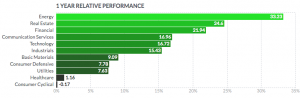
    What a strange world we live in. Party leaders don’t seem to remember parties and apparently ‘dead money’ sectors don’t want to die. Market analysts will not want to be compared to the credibility bonfire that is Boris Johnson and the Prime Ministry of Sound but who wants to hazard a guess as to the best performing industry sectors over the past 12 months? If you had volunteered tech or healthcare you’d be wrong. However, if you’d ignored climate crisis, the work-from-home revolution plus a tech invasion of financial services and hesitantly picked banks, bricks and barrels you’d be spot on. Dead money and leaders, eh! At least Fred West knew how many people were in his garden. The data, like the Downing Street garden parties, is damning. Clearly, oil, real estate and financial firms are very much alive in the following chart (source: Finviz) highlighting the relative performance of the major industry sectors compared to the S&P 500.

    It is easy to be dazzled by the fantastic success of new economy companies and the huge financial milestones hitting the headlines on a daily basis. And…who could not be impressed by the following this week:

    • Irish hospitality technology start up, Flipdish, hit unicorn status and a $1 billion valuation after a Tiger Global led (again!) funding round.
    • Changpeng Chao or “CZ’ is the founder of Binance, the world’s biggest cryptocurrency exchange platform, and now the richest man in Canada with a net worth approaching $100 billion.
    • The FT has reported Chainalysis research showing almost $41 billion of NFTs were sold in 2021. That compares to a 2020 total NFT sales of just $250 million and a global art market of circa $50 billion and built over centuries!

    However, the headlines generated by the leaders of the “old economy” are worth keeping an eye on. Consider these snippets and wonder if there might be even more ‘catch up’ to be done on the dazzling tech and Web3 sectors …

    Ford’s market cap tops $100 billion for first time ever – Barron’s

    Berkshire Hathaway may be on its way to becoming the next trillion-dollar company – CNBC

    Crikey, when Henry Ford and Warren Buffett are still featuring in financial headlines we need to pay attention. More specifically, we need to watch those companies which embrace new technologies, irrespective of their age. In Ford’s case the market is excited by its positioning in the electric vehicle (EV) revolution and once tech-shy Buffett/Berkshire Hathaway is one of Apple’s biggest shareholders these days.

    One can’t help thinking of Domino’s Pizza and how its adoption of the internet drove one of the best performing share prices of the past two decades; even better than that of the internet king Amazon! So think pizza and positioning. Then, take a closer look at old economy stocks which might have been buried by the commentariat a tad prematurely…..

  • Who Will Win DeGeneration Game?

    Who Will Win DeGeneration Game?

    I’ve caught another viral bug this week – Wordle. Don’t worry, the apparent typo in the headline is neither a symptom nor an error but will mean different things to different generations. Generation X might think of a TV game show, Bruce Forsyth, Larry Grayson, conveyor belts or catch phrases like “Didn’t they do well?” and “Shut that door!”. At the other end of the gaming-age spectrum, millennials and Generation Z will spot the “Degen” word-play and think of ‘degenerate’ (reckless) traders of crypto and ‘meme’ stocks, or frenzied auctions of Bored Ape Yacht Clubs, Pudgy Penguins and Cryptopunks in the NFT world, or crypto scepticism and FUD(fear, uncertainty and doubt), or mantras like “HODL” (hold on for dear life) and “YOLO” (you only live once). But…why do I conflate gaming and trading? Let’s dig a bit deeper into Generation Z and why Wordle won a viral audience.

    Generation Z is the first generation not to know what life is like without a mobile digital screen to connect with the world. That might seem like an additional feature of Gen Z life but then consider the following:

    1. Generation Z are more optimistic about buying their own homes than millennials but the reality is that home ownership is still a long way off for Gen Zers.
    2. More than half of Gen Zers work a “side hustle” ie opting to juggle more than one source of income.
    3. As “digital natives” one might think Gen Zers are ideal candidates for remote working, hot desking etc. That would be a wrong assumption. Forbes reports that 90% of Gen Z desire and value a human connection in their professional environments.
    4. A 2019 report from 5WPR found that two thirds of Gen Z men say gaming is a “core component” of who they are.

    This writer’s sense is that digital connectivity is not so much an add-on feature for Gen Zers but rather a “compensation” or substitute for deficits experienced at home, at work or socially. The desire for “human connection” referenced above, or community, seems a powerful driver for Gen Z. If we go back to a simple online word gamed like Wordle its virality could possibly be explained by the following factors:

    • Shared experience
    • Community platform
    • Competitive
    • Fun
    • Global/Diversity of players
    • Simple user experience/technology
    • Friendships are maintained/built in digital spaces

    When we consider the Web3 world of crypto trading, NFT collections and metaverse experiences all these factors, except for simple user experience, are applicable. However, for the purposes of today’s article I want to focus on the concept of community and the rapidly growing importance and value of building communities. Only this week a predecessor of Wordle was purchased for $12.7 billion. Game publisher, Take-Two Interactive, and owner of ‘Grand Theft Auto’ will have noted the significant player communities on Zynga’s word game ‘Words With Friends’ but I’m sure the true target is Zynga’s more famous farm management game, Farmville. Ok, deep breath.. we need to talk about digital “real estate”.

    There have been a few articles in recent times, as well as Zuckerberg visions of our future, where it has been suggested that the mix of an individual’s experience of the physical and digital worlds will change significantly. Arguably Gen Z is already there when you consider screen user times of up to 10 hours a day. However, take that data a step further and consider a future where home ownership and workplace is less certain for Gen Zers. It is possible that digital real estate will be a way of joining a community and enjoying a form of competitive exclusivity, fun and shared experiences. Sound mad? Think again, think new communities and check out the following developments and headlines from recent days…..

    • Metaverse Group, a real estate company focused on the metaverse economy was reported to have bought a piece of land in Decentraland, another virtual platform, for $2.43 million.
    • In February 2021 Axie Infinity, known to our readers here, sold nine of their ‘land’ parcels for the equivalent of $1.5 million.
    • It’s not just new Web3 companies buying into the trend. PWC has also dived in with a purchase of real estate in The Sandbox, a virtual gaming world, for an undisclosed amount.
    • The Seattle NFT Museum is due to open in weeks and will feature digital works on loan from NFT owners and artists/creators.

    The last development might seem like a “real world” initiative but actually it touches on the point of validation, even celebration. This hints at the potential need for digital real estate where trophies, wins, fun and passions can be safely shared with a like-minded community. There is no doubt the NFT and crypto trading world is populated by many who wish to define themselves, have fun, meet people and occasionally gloat or even spend $200,000 on a CryptoPunk profile picture. City wide boy Lambo(rghini) meet crypto(currency) king. The commentariat might scoff in these early Web3 days but you do get the sense there will be digital, connected worlds eventually. The numbers are getting interesting too…

    Early metaverse real estate pioneer, Decentraland, has seen its ‘population’ of registered profiles grow by 3,300% to 800,000 and the value of its token, MANA, has rocketed by 4,100% to a market cap of $6.5 billion – thanks to www.readthegeneralist.com for those data points. And for those querying the descriptor ‘real estate’ a virtual stroll through Decentraland will reveal buildings, casinos, bars, shopping malls, concerts and red light districts(don’t ask!). Indeed, Samsung who are sponsoring the Seattle NFT museum opened their “837X” presentation at the Consumer Electrics Show(CES) as their “launch in the metaverse”.

    As cryptocurrencies continue to fall in value this week get ready for a renewed level of scepticism on Web3 and its associated platforms, tokens and technologies. However, before you join the Casssandra commentariat re-read the factors and motivations listed above which drive Generation Z. Then check your own average daily mobile screen time for the past 7 days. There is no denying that most pf us already share a significant part of our daily lives with the digital world. Then is it too mad to think our experience of the digital world is due a super-speed Moore’s Law upgrade in the coming years? I suspect not. In fact, if people like Packy McCormick at www.notboring.co are correct about us all being part of “The Great Online Game” then the winners will be those that actually play…..and learn. Game on. What a wonderful Wordle we play in !


  • Three Market Charts To Look Up!

    Three Market Charts To Look Up!

    I’m not sure Three Kings Day is going to deliver any epiphanic moments for financial market watchers but I’m keeping an eye on three things. As always, the cost of money is the real driver of markets but I’m going to assume the key Central Banks will continue to be Omicron cautious about hiking interest rates. So, let’s take a look(up) at a few charts knowing that the data rarely lies….

    Digital Currencies: It has been a tough start to the year for cryptocurrency traders but I am watching the overall size of the market. As the digital currency market grows it makes it more and more difficult for asset managers, banks and regulators to ignore. So, check out the $18 trillion worth of cryptocurrencies traded on exchanges last year and the whopping 873% growth compared to 2020 activity levels(source: CryptoRank). We have heard of banks being “too big to fail” but could digital currencies now be an asset class too big to avoid?

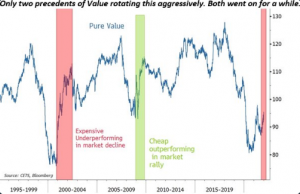
    Growth: Growth stocks have had a fantastic run since the last financial crisis. The technology sector and FAANG stocks have been significant drivers of the “growth” style but long-suffering value investors had a pretty good 2021 with a decent recovery in old economy energy, financial and mining stocks. All fine so far, but my risk radar pings a bit louder when there is a sudden violent rotation from growth into value ie technology(Nasdaq) clobbered and cheap low-growth stocks holding up well. The last 3 days of trading have seen a very aggressive switch out of growth. In fact, this is the strongest style/factor shift since 2009 and almost as big as that seen when the dotcom bubble burst in 2000. In both instances growth stocks gave up market leadership for a significant period. Just sayin’……. See the chart(source: Bloomberg).


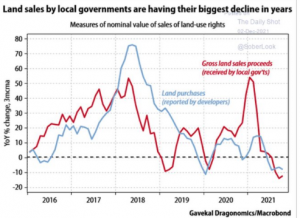
    China Property: The travails of Evergrande and its $300 billion debt pile attached to its property development empire are well documented. However, there is an increasing sense that this is not a company specific story. The Chinese authorities have an impossible choice between reducing building activity to stabilise property prices and slowing overall economic activity with damaging political implications. Industry estimates suggest that there are between 65 and 80 million empty residences in China. The lead indicators for future development activity are land sales by local government (need revenues!) and land purchases by developers. Both have now plunged into negative growth territory per the chart below (source: Gavekal/Macrobond):

    These are not necessarily the biggest investment considerations in the world today. There is no doubt that inflation fears, Russia/Ukraine tensions and Omicron pandemic disruption are capable of significant impact. However, the three charts above have the potential to gather momentum and impact broader markets very quickly. Watch carefully.

  • Themes for 2022: Don’t Look Up, Look Fast

    Themes for 2022: Don’t Look Up, Look Fast

    The Omicron variant caught up with me on New Year’s Eve. Thankfully, isolation rather than illness is my lot but it is somewhat unsettling that a third calendar year will still be dominated by a global health crisis. If only there was just one global crisis. Yes, that sounds a little over-anxious given financial markets are at all time highs, Apple is now a $3 trillion company and global GDP is about to hit $100 trillion for the first time. So, is this just solitary confinement clouding my 2022 thoughts? Yes, and no, or should I say Netflix. I had a different article and set of 2022 themes ready for publishing before I watched the black satirical comedy “Don’t Look Up”. Then my pace of thought changed.

    Leaving aside a plot and satire possessing all the subtlety of a sledge hammer, there was an overwhelming sense of speed in the movie; the comet hurtling towards earth, the 6 month countdown clock ticking faster than executive thinking and the rapid evolution of a universal truth into a polarised ideological/political position with calamitous consequences. The climate change crisis is the obvious 2022 analogy but “speed” can also be applied to other themes which require attention. In previous articles I have listed themes as forecasts for particular calendar years but, as always, the big risks and opportunities are multi-year themes. Specifically, themes which reach an inflection point and then accelerate dramatically can generate a stark range of outcomes.

    Think of the mobile data ecosystem steered by hardware, software and cloud storage and then think of Apple. It took 42 years for Apple to become a $1 trillion company, a further two years to get to the $2 trillion mark and just 16 months to add its next trillion dollars. Oh, and Blackberry just unplugged its iconic handsets this week. Game over. However, there are other ecosystems out there which have only just moved into acceleration phase. For me, the standout unexpected thematic accelerations of 2021 were in two areas:

    1. Web3: The entire ecosystem of cryptocurrencies, NFTs, blockchain and DeFi/DAO formation exploded onto our screens in a big way. Who saw a year ago the cryptocurrency universe reaching a $3 trillion market capitalisation, the corporate embrace of NFTs from Nike to Sotheby’s to Visa, and one of the FAANG stocks going full metaverse with a Meta name change (Facebook)? Game on. And, for those querying an ‘acceleration’ please note that Bitcoin has been around since 2009, just two years after the iPhone appeared.


    1. Business formation/funding: Companies raised a record $12 trillion (source: FT/Refinitiv) in 2021 by selling stock, issuing debt/bonds and accessing new loans. No surprise then to see the total value of IPOs smash previous records with $600 billion raised globally. Global M&A also had its hot streak with $5.6 trillion worth of deals breaking the 2007(!) record of $4.55 trillion. Indeed, it was difficult to ignore the trickle-down effect as central bank liquidity sloshed through the financial system. Global venture capital investment in start-up businesses hit $160 billion per quarter in Q3 which is a pace 2.3x faster than 2020 and the US saw 1.4 million new businesses registered in the first 9 months of 2021. But ….the most eye-catching speed statistic for me was the 335 investments completed by Tiger Global in the past 12 months(source: Crunchbase). That’s basically a deal done every single day of 2021. This Tiger mix of fast cash, premium valuations and a hands-off approach to investment has forced the VC industry to re-think its entire business model.

    So, those were my “fast” 2021 themes but what about “fast” 2022? I’m thinking a bit of old economy, a bit of new economy and a bit of truth. Let’s start with the old.

    Old Economy:

    When truck companies like Rivian and Lucid have yet to deliver trucks but are gaining $100 billion valuations you know the market is speeding up its thoughts on future electric vehicle(EV) penetration. Tesla is already a trillion dollar company but at least it’s on track to delivering 1 million EVs annually. However, our 2022 focus is more likely to be what powers these EVs and what will be needed if consultants, McKinsey, are correct in estimating one in every four vehicles purchased in 2030 will be electric. Every time I look at these projections, I’m thinking one thing….

    Batteries – the world will need to pay a bit more attention to the batteries powering EVs and the raw materials used in their production. ABB, the Swiss-Swedish, engineering giant reckons global battery production capacity will need increase 6-fold in the next 10 years. In Europe alone gigafactory capacity will need to expand 16-fold! Raw materials and the mining sector are critical to battery production and I’m seeing supply projections for lithium, graphite, nickel and cobalt which might be a half, or even a third, of what demand projections are telling us. Forget about non-fungible-tokens (NFTs) what about Not-Fueling-Teslas? Expect the market to accelerate its focus/anxiety on production capacity, new battery technologies, new mine openings and perhaps new chemistry(rare earths)….. 

    New Economy:

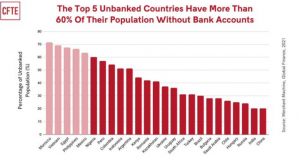
    Of course, there is a technology aspect to old economy battery production but the next theme is very much of the future. It has been a criticism of cryptocurrencies, NFTs, tokenomics etc that they are solutions in search of a real world problem. Indeed, Bitcoin in its relatively long 12 year history has a smallish utility value to date compared to its usage on trading platforms. So, here’s a problem crying out for a decentralized finance (DeFi) solution which cuts out intermediary costs, assists verification, assigns title and builds trust – how do you include more people in the global financial system? There are 1.7 billion people who are still ‘unbanked’. The following graphic from Global Finance shows some startling numbers and surprising representatives in the unbanked rankings….

    Perhaps I am being overly optimistic but there has been a massive talent shift into the Web3 world where lots of applications and business models are effectively in experiment mode. We have written before about the play-to-earn game Axie Infinity. The gaming platform doesn’t just have almost 3 million monthly users and a $6 billion token universe it also has a thriving “scholarship/academy” programme. It really is early days yet and my sense is that crypto wallets like Metamask will be built upon to bring millions into the banking system. I was surprised to learn that there are now 21 million people like me using Metamask. However, for perspective, note that this is the equivalent of just 0.7% of Facebook’s monthly users or the number of internet users back in…. 1996. Early days but we live in hope 

    The Truth:

    We did mention hope so we really have to touch on truth. We could adopt the approach of most stakeholders in “Don’t Look Up” and just not look but there‘s something up….and it’s very big. The United States remains the most powerful economy in the world and its percentage share of global GDP and capital markets is unchanged from 20 years ago despite the emergence of a $16 trillion Chinese economy. Technology has been key to this retention of US global leadership but it also poses an existential threat to the nation. If that feels alarmist how do we square the following?

    1. Geopolitical risk consultants, Eurasia Group, have just stated that for the first time in its history US “political instability” features in their top 10 list of global risks.
    2. A just published IPSOS poll shows 64% of Americans think democracy is “in crisis”. Other polls show more than 80% of both Republican and Democrat voters believe democracy is going “in the wrong direction”.

    You might ask where technology fits into this crisis but you don’t have to look very hard. As the US tears itself apart over voting rights, election results, female health, vaccines, masks, the January 6th assault on Capitol Hill etc. there is a glaring absence of a “shared truth”. Social media and traditional media platforms have been instrumental in burying the truth in a wall of noisy misinformation. It is simply staggering as the evidence of illegality snowballs that there is any debate over the Capitol Hill riot on January 6th a year ago. The comet hurtling towards US democracy is that an attempted coup failed but there will likely be another attempt. In the meantime the media continues to give air time to an orange-tinted mob boss who feeds the “Big Lie” to his cult.

    The repeated airing of a belief that an election was won and stolen is dangerous. Incredibly, an ABC poll has found a majority of Republican voters believe those involved in the Jan 6th attack on the US Capitol were “protecting democracy”. Enough is enough. If the US body politic cannot agree on a shared truth about January 6th and subsequent accountability, what hope is there of dealing with world crises like climate change, rapidly growing income inequality or additional global pandemic emergencies. Well, there is some hope. We talked about speed earlier and the following developments suggest we might be surprised in 2022 by the pace of change which is brewing beneath the surface of corporate and political life.

    • Social Media: Twitter founder, Jack Dorsey, has stepped away to focus on Web3 and Facebook under anti-trust scrutiny has already changed its name to Meta. One senses these social media platforms and their leaders see the wind changing. Certainly, their algorithms face serious challenge. Any algorithm or business model which prioritises the spread of misinformation and lies is likely to face sustainability issues. Apart from the chances of a break-up of Facebook, the $53 trillion of investment capital (per Bloomberg) which apparently is guided by “sustainability” principles can carry a very big stick when it comes to global threats like public health/pandemics and climate change.


    • Government: Governments around the world have had first hand experience of fighting disinformation while trying to protect their citizens from a deadly virus. So too might UK voters one day wonder about a world-first decision to reduce trade and influence based on misinformation and fantasy. However, some governments are beginning to fight back. Sweden has launched an agency dedicated to defending the country against disinformation, propaganda and psychological warfare. Expect more governments to understand the socially corrosive effect of allowing truth to be trashed by those trying to influence with corrupt and often lethal intent.


    • Accountability: There might be some who are sceptical about government driving change but there are other powerful instruments to be used. Start with the rule of law. Those who use disinformation to cause harm must be made accountable. There is increasing evidence that the US Department of Justice will be in a position to charge not just the 700 or more rioters on Jan 6th but also members of Congress, US cabinet officials, White House staff and even the former guy with an attempt to block a “peaceful transfer of power”. More interestingly, it looks like members of the right-wing media will be in the crosshairs of law enforcement. Check out the request of the House January 6th Committee to interview Fox celebrity broadcaster, Sean Hannity. The increasing text evidence of complicity of Fox and its stars in a coup attempt should focus the minds of corporate advertisers using Murdoch-controlled media assets. It is very possible $53 trillion of investment capital could render Fox ‘unsustainable’ as a commercial proposition.

    One final thought on accountability, sustainability and influential capital. Or maybe it’s a question for corporates who on a daily basis profess their dedication to sharing the values of their customers. When the leadership of a political party condones illegality, funds illegality, misrepresents the truth and fails to report illegality does that party itself become a criminal entity? All senior corporate executives and their major customers should be acutely aware that there must be a tipping point where trillions of dollars of sustainable capital could suddenly decide that any perceived embrace of an organization engaged in criminality is, in truth, unsustainable. Look up. The truth is on our screens every day. When customers and investment money start to run, they will run very fast. Oh, and the total word count for this article at the end of the last sentence was 1984. Says it all really.

    “The party told you to reject the evidence of your eyes and ears. It was their  final, most essential command.”   –    ‘1984’    George Orwell.

  • Drool Britannia…Who Rules The Waves Today?

    Drool Britannia…Who Rules The Waves Today?

    During this craic-free week you could be forgiven for letting the mind drift to a land of parties so good that nobody can remember actually attending them. But no, the piercing cold of the Dublin Bay sea waters in the shadow of Joyce’s Martello tower was the prompt for a more serious reflection on maritime power rather than merry delinquency. Dominant power, in fact. Just over a century before Johnson & The Jobsworths bloviated into Downing Street, the British Empire at its peak accounted for more than a fifth of the world’s population and a quarter of its land mass. How did that happen – the empire, not the lockdown party? Look to the sea again – the critical instrument of Britain’s power and control of such a large territory and economy was its investment in the most advanced naval force and supporting infrastructure in the world.

    When Britannia ruled the waves warships, ports and strategic defences like the Martello towers were used to exert control and protect global supply chains. Fast forward to today and one could argue that corporates rather than sovereign states are the new masters of global supply chains. Two companies in particular caught the eye in recent weeks and provided an insight into how much the global economy has changed in some respects but also how little has changed. Let’s start with change and a new global empire, Amazon.

    Amazon is best known for its e-commerce dominance and its hugely profitable cloud services, AWS. However, Amazon is quietly but massively increasing its investment in logistics infrastructure in order to bypass pandemic supply chain chaos. Did you know that Amazon’s own delivery service delivered more packages than FedEx in 2020? Amazon is now shipping 72% of its own packages, up from 47% in 2019, according to SJ Consulting. Returning to our maritime theme, the Bezos behemoth spent $61 billion on shipping in 2020 by chartering private cargo ships which gives Amazon the flexibility to avoid the most congested ports. And now it’s trying to control the earliest part of the logistics chain by making its own 53-foot cargo containers. Yep, manufacturing. Now consider the following and wonder whether this is a tech business….

    • Amazon has increased its fleet of delivery vans to over 20,000
    • Off the roads the company has invested $1.5 billion in an airport cargo hub
    • And in the skies fifty 767 cargo planes have been purchased by Amazon

    The key point is that Amazon is trying to cover all the bases in the supply chain. It also is flexing its economic muscle if recent UK headlines are to be believed – UK hauliers ditch container work in favour of Amazon ‘gold rush’. So, Amazon which is making huge margins in cloud computing infrastructure appears to be pretty keen on some ‘old economy’ logistics infrastructure too. Surely, the margins can’t be as attractive? Then this headline popped up this week…..

    Maersk enters strategic logistics partnership with Unilever

    This writer used to scribble about this Danish container shipping stock back when the TMT bubble had just burst. In those days my fascination was that only a couple of hundred shares of the stock traded each day despite Maersk controlling the world’s largest container shipping fleet, more than 30 ports, significant oil and gas fields, a 10% stake in Danske Bank and a remarkably lucrative relationship with the US Marine Corps. It was the most remarkable asset/sum-of-the-parts story in the market and nobody seemed to care. They do now.

    Maersk’s market value/share price has increased seven-fold and along the way has ditched all its non-core assets. Maersk is now the dominant container shipping logistics player in the market with more than 700 ships in its fleet. The 4 year deal with Unilever is striking because in Maersk’s own words “we are excited that Unilever has chosen our logistics expertise and our technological platform NeoNav to provide an overview of the links that make up its ocean and air logistics operations.”

    This deal is about more than ships. There’s technology involved too despite the traditional modes of transport used. And that prompts a further thought. Amid the frenzy for tech stocks there are a number of “old economy” sectors which are generating market excitement and attracting influential capital. Let’s not forget that the 2021 Time Person of The Year has been announced and he’s an “old economy” manufacturer of automobiles with a trillion dollar franchise. Yep, the richest man in the world, Elon Musk, built a car company. Whoodathunk! I’m thinking the Vikings might have known.

    Transport and logistics still remain key components of the global economy. Technology helps but transport infrastructure assets like shipping and ports remain critical and it is interesting that both Maersk and Jeff Bezos share Danish/Viking heritage. Possibly more interesting is how the UK in less than 100 years saw its influence and empire dramatically shrink but then decided that a voluntary world-first trade reduction treaty was a good idea. To add insult to this self-inflicted pain, the nation of  Drake and Nelson who ruled the waves have turned to the likes of Williamson, Hancock, Johnson, Truss, Dorries, Raab, Rees-Mogg, Gove and Patel to run the bath in dinghies….and fail miserably.