
Author: Gary McCarthy

  • Generation Z: Changing Values And Valuations!

    Generation Z: Changing Values And Valuations!

    And I thought government advice to do pantos with no kids would be the most confusing thing this week. But no, the wider world continues to bewilder and generate even stranger headlines than my favourite tabloid one of recent days – “Sweet Jesus, Mary and Joseph… and the wee Donnelly.” Back to my line of duty in identifying change/risk… I’m thinking about Generation Z a lot these days. Every business is too. But let’s kick off with some interesting developments and probable confusion.

    The Turkish lira may be collapsing but Salt Bae, the Turkish celebrity TikTok chef, has embraced the world of inflation rather enthusiastically. Wagyu beef ribeyes encrusted in 24-karat gold leaf are being gobbled up by London diners at $1,000 a pop. No seriously – they eat them, they don’t collect them. On so many levels I struggle with that but then I came across another Turkish artiste. Meet celebrity digital designer, Murat Pak, who has just finished the largest primary sale by any living artist in history.

    Over the past weekend Pak sold 266,855 pieces in his “merge” collection for between $400 and $525 each to realise total auction proceeds of over $106 million. I’d use exclamation marks but having viewed some of these digital art works I’m tempted to charge for punctuation in my own online endeavours. Do take a peek. You’ll see what I mean and possibly share my confusion. These digital art works are non-fungible-tokens(NFTs) which certify digital ownership. But there’s more, lots more coming.

    Total NFT annual sales in art, collectibles, luxury goods and gaming are currently hitting $20 billion. That sounds like a big number but then consider the gaming industry alone is a $180 billion annual revenue monster which is three times the size of the art world. Bluntly, NFT penetration of real life experiential activities is only just beginning. If we include the $1 trillion retail fashion market then the total addressable real life market is closer to $2 trillion. Now we’re talking trillions but that’s old news to cryptocurrency followers.

    Cryptocurrencies like Bitcoin and Dogecoin might be suffering some volatility of the downside variety in recent days but it seems inevitable that the crypto universe will expand again. The most recent high water mark for the value of the total crypto complex was $3 trillion. Now if we add in the potential NFT addressable market of $2 trillion we’re already talking about a universe larger than Japan’s annual GDP. I mention a sovereign nation deliberately because it has been suggested in some commentariat circles in recent weeks that we should think of crypto/NFT total values in terms of GDP. That almost makes sense from a broad economic activity/monetary circulation perspective but I believe we are going to have to re-consider how we quantify GDP soon enough.

    Forget Leprechaun economics and multi-national boosted GDP. What about Squid economics? The impact of Korea on Generation Z culture has been phenomenal. Back in 2019 Parasite became the first non-English language film to win the Academy Award for Best Picture. However, the true trail-blazer was Korean pop music or K-Pop which started out in the early ‘90s as slickly choreographed dance routines, eye-catching outfits and polished lyrics. The K-pop band, BTS, are possibly the biggest band on the planet and an entire industry has grown up around this musical genre. Spotify has reported K-pop downloads rocketing by 1800% since 2014 but it might be Netflix who are truly smashing it with its Korean cultural contribution.

    Its hit survival drama, Squid Game, has been watched by a whopping 142 million people and its value to Netflix has been quantified at over $900 million. No wonder the Korean Ministry of Culture has been investing heavily in cultural exports, or as they call it “Korean Wave”. Squid economics or not, audiences are clearly enjoying different things these days. And yes, fashions and behaviours change. However, it should be noted that two thirds of the world’s middle class will be living in Asia by 2030. Many will have been born after the end of the Cold War and that feels like a significant cultural and demographic inflection point. It should also be noted that changed and unfamiliar behaviours are not just a Generation Z phenomenon. Time to look in the mirror Boomers.

    Older generations might sneer at the €3 billion of venture capital coming into crypto investments in the past month alone but there are far bigger pools of more mature capital potentially venturing into euphoric territory. For every Bored Ape Yacht Club or CryptoPunk digital image selling for $200,000 there’s potentially a real world chart out there which should cause pause for thought. Here are three real life images which caught my eye in recent days:


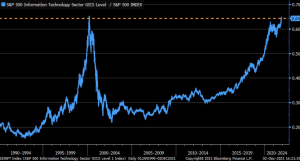
    1. The publicly listed technology sector is the real life equivalent of a Salt Bae steak. More specifically, the valuation of the technology sector relative to the rest of the market is now back at the peak TMT bubble levels of March 2000. Pets.com meet Bored Ape meet Tech 2021….chart courtesy of Bloomberg:


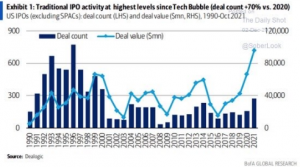
    1. IPO activity is also back at bubbly 2000 levels in terms of deal value. It is important to note that in a typical IPO transaction there are people actually choosing to sell at that moment in time. That happens every day but the risk dial tends to move when activity deviates from historical norms. US public listings alone have generated more than $1 trilion of IPO proceeds. See the Bank of America graphic below and note that if you included special purpose acquisition companies (SPACs) then the deal count would be considerably higher:


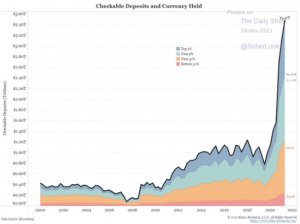
    1. Perhaps all this activity is part of the global search for “yield” by savers struggling with rock bottom interest rates and inflation eating into the purchasing power of their cash deposits? Clearly, central bank support of financial markets has increased investor confidence but, as previously mentioned, investor behaviours can be difficult to rationalise these days. Cash might be defined as a low risk savings option but, with possible negative interest rates and inflation, savings capital can still suffer serious damage. However, the next chart highlights a staggering behavioural split between rich(older) and not-so-rich(younger). The top 1% of US households in this Daily Shot/Bloomberg graphic have gone full “tin hats on” in their cash deposit accounts but actually could be running huge capital destruction(inflation) risks:
     

    So, arguably there are similar pockets of unusually risky behaviour in both Gen Z and older age cohorts. Dare we say these generations are more alike than we thought? Think again. A 2020 global survey by WordPress found that Gen Z consumers want brands to be “fun”, “authentic” and “good”. We will return to “fun” but the “good” bit resonated in recent weeks as this survey highlighted that 72% of Gen Zers are more likley to buy from a company that contributes to social causes. Anyone for tennis? In China?

    Not the Women’s Tennis Association(WTA) who have just pulled all tournaments from The Middle Kingdom. I use the medieval name deliberately. The WTA concern is the welfare of sexual harassment victim and top ranked professional tennis player, Peng Shuai, who has been silenced and has probably lost her right to travel freely.  My concern is that no major consumer brand with Chinese commercial interests seems to give a toss. The moral gymnastics required to keep both China and $50 trillion of sustainability/ESG influenced capital on board will eventually end up with some broken brands. And…Gen Zers just won’t play ball(!).

    Gen Zers won’t work like older generations either. Covid-19 let the genie out of the bottle – fun and work-life balance are possible if you work for yourself it seems. The US Census Bureau is reporting record-high figures for new business formation through the first 9 months of 2021 and this begs the question as to how could investment behaviours change to reflect life priorities(climate, brands, do good) and fun? We shall return to this question in a later article in more depth but will leave you with one inter-generational commercial clash which prompted some early thoughts.

    Some readers may have read about an attempt by 17,000 people to band together to buy an auctioned copy of the US Constitution. They raised $40 million and narrowly lost out to Citadel hedge fund titan and retail trading hate-figure, Ken Griffin. Cue total consternation and confusion as to how the cryptocurrency denominated(Ethereum) money raised could be returned to individuals. But now, those same tokens ($PEOPLE) are pricing higher than prior to auction. I won’t try to rationalise that scenario but three things struck me about the potential future of investment:


    • Traditionally, investment has been conducted through centralized institutions like Blackrock, Citadel, Goldman Sachs etc. The US Constitution auction at Sotheby’s was contested by a Decentralized Autonomous Organization known as a ‘DAO’ in Web3 circles. Almost like an investment “flash mob” this non-hierarchial group was formed with one mission. My sense is that there will be more of these. Why?


    • Fun and community experience is a big part of Gen Z thinking. Financial return might be the wrong way to initially think about a Gen Z purchasing decision but the subsequent scarcity value of being involved in a social-values mission could be extremely high. FOMO meets values credibility.


    • When I look at league tables for the performance of asset classes in 2021 I see almost everything on fire – oil, commodities, food, equities, venture capital, crypto etc. And gold, the ultimate inflation hedge? Yep, it’s actually down this year. We should consider the possibility that entire asset classes or sectors could be ignored by Gen Zers in the future. Who wants to be a billionaire? Maybe those who avoid gold, China, fossil fuels and water guzzling food.


    All a bit revolutionary for you? Well. Let’s go back a bit to the ultimate anarchists. Steven Johnson , author of Where Good Ideas Come From, flagged that the pirates of the 17th and early 18th – century were pioneers of trialling new models of governance and wealth sharing. Before each voyage there were “articles of agreement” and a very egalitarian share of future profit among the crew. These mini-constitutions pre-dated both the American and French Revolutions by nearly a century but were clearly ahead of their time in terms of separation of powers, insurance and leadership change. Indeed, after the January 6th Insurrection in Washington you might argue some of these later documents of democracy need updating. However, the more important point is that we should watch the evolution of these Gen Z DAO initiatives carefully. They could be an early window into our financial future, our values and our valuations.




  • Power To The People

    Power To The People

    Life can be so awfully cheap. The tragic loss of refugee lives in the cold waters of the English Channel last week was a sharp reminder to politicians who should know better that “migrants” are real people with families, futures, fears and dreams. We too know better. As Jack Dorsey stepped down down from his Twitter CEO position this week it was Stripe’s Patrick Collinson who noted Dorsey’s successor, Parag Agrawal, and the current CEOs of Google, Microsoft, Adobe, IBM and Palo Alto Networks all grew up in India. I’m thinking pretty impressive, and not Priti Patel. The UK Home Secretary is a shameless immigration scare-monger but, to borrow an Obama phrase, I feel the arc of history can be bent “toward the hope of a better day”. Here are a few snippets which might steer this hope….

    • Patel launched a fast-track visa scheme in the summer to entice Nobel laureates and other prestige academic talents to the UK. This was intended to be the talent apex of the new UK point-based immigration system. Well, the results are now in and apparently these new  “I’m a Celebrity, Get Me Into Here’ visa auditions attracted precisely zero applicants.


    • Further down the talent pyramid the newsflow is equally challenging. More than 1 million UK job vacancies remain unfilled with the hospitality, construction and logistics sectors particularly badly impacted. From truck drivers to butchers to fruit pickers, the “sunlit uplands” story of Brexit is in danger of becoming a childish denial ritual involving Tory Teletubbies and a macabre spit-roasting of Peppa Pig.


    • And, it’s not just a short-term challenge. A survey by think-tank, Autonomy, who specialise in the future of work found that one in four workers were considering quitting their jobs in the next few months, and as many as 41% of workers were considering leaving their jobs in the next 12 months.

    This is not just a Brexit or UK phenomenon. If anything, people trends are even more pronounced in the US. A record 4.4 million Americans quit their jobs in September. That’s a whopping 3% of the total workforce jumping ship in just one month and has been termed “The Great Resignation”. I’m not so sure. I think it’s a structural rather than a behavioural trend. The FRED(St Louis Fed) data suggests the movement is primarily happening at the lower end of the wage scale. Yes, minimum wages are moving higher but it might be too late to keep the current talent pool on board. Here are a few factors to consider….

    • Millions of workers have upskilled with on-line courses and received certification.


    • The creator economy and work-from-home optionality is providing alternative sources of income. Meanwhile, workers in healthcare, hospitality, retail and food services won’t have missed the fact that the white collar work force has just gained enormous flexibility as to where and how they do their jobs.


    • More individuals are setting up their own businesses than ever before. The US Census Bureau said that by Q3 of this year there were nearly 1.4 million applications filed to form new businesses. That’s a pace 40% higher than the pre-pandemic year of 2019.

    These are very real structural shifts in the labour force. We should also consider factors in older liberal democracies which could be driving both labour dynamics and populist immigration politics. The awkward truth in some societies is that there are significant social/healthcare issues which are affecting employability. Let’s start with those that possibly can’t hold down regular employment:

    • In the past 12 months the US saw 100,000 drug overdose deaths. What multiple of this number in the general population are dependent on drugs? Fox News won’t have the answer but their audience numbers might be a reasonable starting point….


    • The Pentagon reports that a whopping 24 million of the 34 million Americans in the 17-24 age range are ineligible to serve in the military. Of this staggering 71% failure rate, a full 27% of young Americans are too overweight to join with a further 32% having disqualifying physical and mental health issues.

    We also know that life expectancy for white males in the US is now on a reducing trajectory for the first time in decades and at a pace not seen since WW2. Then consider those that opt for retirement after a lifetime in the labour force. Every day in America 10,000 people turn 65. Say it slowly, ten thousand every single day, and then think about pension plans and stock markets which go up nearly every year. In fact, the total flow of investment funds into equities in the last 12 months hit $1.1 trillion which is more than the combined inflows of the last 19 years! The wealth share disparity between capital and labour is at levels not seen since the 1930s and suggests something is about to give.

    Modern economies’ labour forces are undergoing massive structural change. The solutions are not easy and require significant innovation in the immigration policies of liberal democracies. So, we must be wary of populist political opportunism. Building Trumpian walls and inflating Priti dynghies smacks of hot air and fascist jackboots from previous centuries. We can do better and the terrified refugees from Iran, Kurdistan and Afghanistan deserve “the hope of a better day”. Indeed, the message for traditional low-wage businesses is possibly even more stark; they’d better hope there will be better immigration policy days ahead or they will perish too.

  • The Lord Of The Tools

    The Lord Of The Tools

    Writers love feedback. After my recent article on market euphoria over electric vehicles(EVs) it was fascinating to field so many queries as to the best ‘picks and shovels’ to play the EV gold rush. It also prompted additional thought. I will expand on that original question a bit later but first I want to highlight a few other ‘tools’ which caught my eye this week. We’ve had a pretty decent sporting week so let’s start on the pitch.

    Cryptocurrencies might be experiencing some turbulence in recent days but, just like the EV revolution, there is no doubt digital currencies will be a part of our Web3 future. However, the challenge for crypto and Web3 franchises is how to generate consumer curiosity, awareness and ultimately engagement. Clearly, sport is one of the the most powerful tools to engage the wider public. Check out the announcement by the LA Lakers basketball franchise of a $700 million deal with Crypto.com for the naming rights on their Staples Centre home. Say hello Jack Nicholson(he might use other words…) to the Crypto.com Arena for the next 20 years and then marvel at the $1 billion spend by this Singaporean crypto outfit on various sporting partnerships with the likes of Paris St Germain, Formula 1 and UFC. Game on but it’s not just sport.

    The gaming world is possibly the closest Web2 version of what Web3 and the metaverse might commercially look like. Think of all those ancillary revenues generated by selling customized characters (“skins”), aspirational tokens for super-powers/boosts and access to new virtual worlds or gamer communities. We are already reading about consumer giants like Nike prepping for digital versions of their products which customers will proudly wear in the metaverse. And it might not be cheap; Epic Games have just partnered with luxury house Balenciaga to bring high-fashion Fortnite “skins” to the game.

    Of course, the competition will be hot to attract consumers to particular metaverses or virtual properties. Ground breaking graphic design software is an obvious resource for gaming companies to use or even buy. So, it was no huge surprise to see gaming development giant, Unity, splash out $1.6 billion on Weta Digital which was co-founded by Peter Jackson of Lord of The Rings directorial fame. Jackson had incorporated Weta Digital to house the software developed in the productions of  Avatar, Avengers and Fellowship of The Ring. The “tool” thinking from acquiror, Unity, is clear. Unity is the development partner of choice for 70% of the top 1,000 mobile games on the market and they have swooped on Weta’s cutting-edge technology to provide more tools for games creators. It feels like the race is truly on to deliver enhanced experiences in the new digital environments promised by Web3 but don’t assume the basic digital tools will remain untouched. Passwords? Try again…..

    Password trauma may soon be a curse of the past. We note with interest that authentication developer, Stytch, has just achieved unicorn status. Investment house, Coatue, is leading a $90 million Series B funding round this week at a $1 billion valuation for Stytch. The company also announced its first biometrics product which is another important step in its mission to kill the password as a means of digital access. Any tools which reduce online friction and make digital consumer life easier will be in serious demand. To tweak a well known mantra of Stripe it feels like the ‘GDP of Digital’ is expanding rapidly. If one needs convincing, as cryptocurrencies wobble, check out these real world developments of recent days:

    • 40 major UK retailers have partnered with digital wallet fintech, Mode, to give online shoppers cash-back rewards in….. Bitcoin. That’s right…crypto cash back(!) and  Boots, Homebase and Ocado have been referenced as partner brands in this customer loyalty initiative.


    • Nigeria’s central bank has just rolled out a digital currency, the e-Naira, which has prompted half a million people to create their own digital wallets.


    • The Republican party might be defecating all over the US Constitution these days but a rare copy of the original Constitution document was just purchased at a Sotheby’s auction for $43 million. The story is not the price but the under-bidder; a digital community or Decentralised Autonomous Organization (DAO) teamed up to try to buy the rare Constitution copy and raised $41 million in crypto-based money from 17,000 “investors” in a matter of days. Intriguingly, Sotheby’s  recognized the Ether/Ethereum bid as official money in their auction guide. The attempt to buy one of just 13 original copies of  the US Constitution may have fallen short at Sotheby’s but expect more DAO philanthropic action in the coming years.


    • No doubt Christie’s and Sotheby’s will be happy with the whopping $2 billion of art auction sales transacted in recent days but there might be even bigger days ahead. Morgan Stanley reckons the non-fungible token (NFT) market for ownership of digital assets is set to grow to $300 billion by 2030.


    • Harvard Business Review gave an interesting analysis of the NFT space: “Owning an NFT effectively makes you an investor, a member of a club, a brand shareholder, and a participant in a loyalty program all at once. “ No wonder adidas, Starbucks, Coca-Cola etc are ramping up NFT activity. But also wonder at all the tools which are typically used to support investors, brands, clubs and communities? Big bucks to help Starbucks me thinks.


    And if you’re still with me at this point, my answer to the greatest EV tool opportunity out there would be chemistry. Batteries are the critical battle ground for EV supremacy and the best batteries are the most efficient ones. Global battery dominance will be driven by the greatest scientific break throughs in chemistry . What a delicious irony it would be that a DAO would find and buy the rights to potentially ground-breaking science and become the Lord of The Tools!

  • Five Things To Blow Your Truckin’ Mind

    Five Things To Blow Your Truckin’ Mind

    Excuse the expletive near-miss but does anyone else feel like screaming today? More sleaze debates in Westminster, more NPHET ‘models’, more COP26 cop-outs and more Trump gang arrests would suggest the media at home and abroad is on endless repeat mode and George gLee is about to scare Santa away. However, I’m going to try and focus on some newer developments and keep on truckin’ as Eddie Hendricks once sang. In fact, I’m going to run with the trucking theme and highlight five data points which should blow your mind and prompt potential positive thoughts, even opportunities. Here we go.…

    1. Rivian, the US electric pick-up truck manufacturer, was mentioned in a previous article here as an interesting new listed company(IPO) in New York. Well, the $75 billion valuation of this electric vehicle(EV) play had interested this writer because the company had yet to generate a single dollar of revenue. Now, I’m fascinated; Rivian’s share price and valuation has doubled to $150 billion in a less than a week of trading and has surpassed the value of the largest auto company(by revenues) on the planet, VW. It’s not just Tesla capturing investors’ minds. The whole EV sector is on fire.


    1. Consultants McKinsey estimate that by 2030 there will be $4 trillion in annual vehicle sales and Goldman Sachs just upped their estimate of EV penetration of that market by 43% . Goldman now believe EVs will account for one in every 4 vehicles purchased in 2030. So if EV sales are going to rocket what about the raw materials needed to drive this revolution? Lithium is a critical component in lithium-ion batteries and UBS estimate demand for this raw material alone will increase by a factor of….. 10. Think that’s demanding? Try Nickel – demand is expected to increase 14-fold. And now try thinking about supply. Current supplies of graphite, nickel, cobalt and lithium might be half, or even a third, of what demand projections are telling us. Then factor in that the average time to develop/open a mine is about 7 years.


    1. Even if the raw materials are secured, the race to build EV battery gigafactories is truly on. Swiss-Swedish engineering giant, ABB, reckon current global battery capacity at 450 Gwh will need to increase to 2857 Gwh by 2030. That’s a 6–fold increase in battery production in less than 10 years with Europe alone requiring its gigafactory base to expand by a factor of 16x !


    1. As the auto industry grapples with supply chain issues in 2021, particularly in semi-conductors, one wonders about another politically significant raw material in EV battery production. Permanent magnets are the hidden enablers of much of today’s technology from robots to laptops to satellites. These magnets are made possible by chemistry and heavy elements known as “rare earths” which feature in 95% of all EV motors. By value and volume these rare earths do not sound significant at €6.5 billion and 5,000 tonnes(EVs) respectively. However, the EU currently imports 98% of its demand from China and EV usage is expected to rise from 5,000 tonnes to 70,000 tonnes by 2030. Whisper “Taiwan” carefully. The strategic value of controlling the rare earth supply chain is enormous so it is no surprise to see the US and EU scrambling for alternative sources.


    1. In a week which witnessed iconic firms like GE, Johnson & Johnson and Toshiba announcing corporate break-ups it is interesting to note Big Tech going in a different direction. Google is way off piste from search ads as it pursues opportunities in its self-driving car project, Waymo. Indeed, analysts believe Waymo could be worth $30 billion to Google which isn’t far off the value of Amazon’s 20% stake in Rivian. It is striking that Big Tech is showing strong interest in an old economy industrial sector like autos but then technology loves disruption and the internal combustion engine(ICE) is well overdue a revolution. It is staggering to think that ICE technology has really stayed much the same since its “modern” iteration was created in …. 1876. The shift in investor focus from ICE to EV is stark. Proud US giants of the global auto industry ,Ford and GM, delivered 11 million vehicles in 2020 and have a combined market value of just over $170 billion. This week two EV manufacturers, Rivian and Lucid Motors, achieved a combined value of $240 billion with total vehicle deliveries in 2021 heading for a grand total of……..1000 units.


    Blows my truckin’ mind anyway.

  • Rip Up Those Business Books!

    Rip Up Those Business Books!

    Ooooh a penny for the thoughts of the late Jack Welch on events over the last few days. Welch steered the General Electric(GE) conglomerate to being the most valuable company on the planet as recently as 2004 and cemented his position as a global thought leader on management. His 2005 book “Winning” was a best-seller and has been a staple of many MBA reading lists but the history books might have a different executive summary of GE today. In time, we might see business texts change too. The debate is not really about winning management or execution but something more fundamental which I come across in lots of business plans and investment documents – losing. More specifically, losing sight of what is the core business, service or product in a company.

    GE didn’t just lose sight of its core business. It lost almost $500 billion of value from its $600 billion peak in 2000. The core industrial business, co-founded by Thomas Edison in 1892, had become a global manuafacturing giant of appliances, jet engines and medical equipment by 1981. Then “Neutron Jack” took over the CEO role and made 600 acquisitions but crucially not all were in its core manufacturing activities. The acquisition of media(RCA/NBCUniversal) and financial(Kidder, Peabody) assets brought GE into sectors where business models were less robust. Another famous US business leader, Warren Buffett, put it rather well:

    “When a manager with a reputation for brilliance tackles a business with a reputation for bad economics, the reputation of the business remains intact.”

    Sure enough, it was Buffett who provided emergency funds to save GE in 2008 when its financial services division, GE Capital, almost brought down the entire company. The company has been in retreat ever since. This week’s announcement of a break-up of GE’s last remaining businesses in health, energy and aviation marks the end of a decade of balance-sheet firefighting. Previous exits from media and finance did little to help the share price and the last of America’s original “blue chips” was dumped from the Dow Jones Index in 2018. Lots of losses, lots of lessons.

    Perhaps the most staggering fact for future business books will be GE’s market value at final break-up was just over $120 billion. For context, that’s less than the amount Tesla dropped in value in just one trading day this week. And, if one were looking for another business text book head-scratcher then check out the IPO this week of electric vehicle(EV) maker, Rivian.

    The Rivian IPO will generate a valuation close to $75 billion but currently the company has zero revenues just like its $72 billion EV competitor, Lucid Motors, which is already listed and delivered its first car only last week. In fact, the combined value of these two EV players (with ZERO revenues) at almost $150 billion beats GE’s current market value, 130 year history of actual revenues and its 2021 revenue run rate of $75 billion. Who needs core business revenues these days! Well, actually all businesses need to communicate the prospect of future revenues and I believe there are some GE lessons to be learned for start ups in pre-revenue mode. The following thoughts should help the drafting of business plans, financial projections and valuation guides:

    • The core business must clearly describe a problem, a solution to the problem, how that product/service solution clearly helps a prospective customer and how much that customer will pay for it. Then clearly tell the story of how there will be more customers every year and that in X years all these customers and their payments will be valued at Y. I recently saw a Pixar guide to storytelling and this tried-and-trusted formula struck a chord:

    Once upon a time there was________ . Every day ________ . One day _______ . Because of that _____ . Because of that ______. Until finally _______ .

     Arguably, GE would have saved its shareholders years of pain in financial services if the strategic storyline had required it to describe massive leverage, cheap pricing of risk and the inevitable capital destruction.

    • In an investment pitch there is nothing wrong per se with describing a variety of solutions, products or services but if they have different business models and customers then make sure not to “crowd out” the core business projections and confuse the reader. Be very clear in your narrative that these lines of business are not core but have “option value”. This also communicates where the ‘focus” of resources and management time will be. The troubles at GE’s media and financial divisions demanded massive amounts of management time and attracted a steady stream of negative headlines. At what cost? Who knows but a focused GE might have blazed a trail in electric vehicles (EV) which would have been far closer to its proud manufacturing legacy.


    • It has been said that almost every company is now a “technology” company. That seems reasonably accurate from the perspective of how a company delivers its products or services. However, in an investment pitch a company must be crystal clear about who is going to pay them. If we look at GE’s history it started out in life as a traditional business-to-business (B2B) manufacturing operation(appliances, engines, x-rays) and then added business-to-consumer (B2C) services(media, finance) in the Welch era. It would be easy to conclude that GE was much better at B2B than B2C and then recommend start-ups to choose one or the other. However, in a digital economy there are many ‘platform’ business models which do both B2B and B2C eg subscriptions paid by users and aggregate usage data analytics paid for by businesses. It is striking in many ‘platform’ investment pitches that one of the two types of end-payers(B or C) is described in more detail and that storyline is better developed. There is nothing wrong with one revenue channel requiring more development but make sure there is a clear strategy outlined to redress the imbalance.

    Of course, even the most detailed business and financial plans will be scuppered by future events. Yes, current orthodoxy trumpets laser-like focus, revenues, fly-wheels and more revenues but here’s a few reminders of how non-core initiatives can eventually be winning ones:

    • Amazon: The core Amazon business is e-commerce and delivered almost $50 billion of revenues in Q3. But …..the “option” of launching cloud services (AWS) in 2006 has turned into a trillion dollar franchise with annual revenue run-rates of $70 billion growing at 40% with 30% margins. Wow.


    • Google: The best performing “FAANG” company (FaceB, Apple, Amazon, Netflix and Google) of 2021 delivered $53 billion of core search/ad revenues in Q3 but is still growing at 44%. There’s lots to like in the wider group from Cloud Services to Android but the standout “option” channel must surely be YouTube which Google bought for $1.65 billion in 2006, an amount which now equates to about 20 days of YouTube revenues. YouTube’s revenues alone are likely to pass those of fellow “FAANG” Netflix in Q4.

    Note both of these companies remain dominant and focused in their original core activities which have financed other opportunities. Bluntly, they had the cash to lose if the “option” didn’t work out and they avoided large and time-consuming M&A activity. Sadly, GE and its long-suffering shareholders embarked on far more costly options which took years to exit. Lesson learned, know what is core.


  • Markets: Dazzled And Confused?

    Markets: Dazzled And Confused?

    Financial markets are never easy to trade, or even to rationalise. However, the current environment is a proper head wrecker. My senses are being bombarded by very strong financial signals but they tell very different stories. Let’s start with the good stuff and I don’t even have to mention crypto currencies or metaverses. Dare I say that the real world and real money are dazzling all on their own. Check out the following:

    • The S&P 500 equities index hit an all-time high for the 62nd time this year
    • The Dow Jones index broke the 36,000 mark 22 years after Glassman and Hassett’s ‘Dow 36,000’ hit the book stores.
    • Despite COP26 talk, oil prices are back at levels not seen since 2007.
    • Logistics bellwether and shipping giant, Maersk, tripled its profits in Q3 and is looking to expand its services.
    • Savills have reported that the total value of global real estate reached an all-time high value of $326 trillion in 2020.
    • US Private equity exit values through Q3 2021 are an estimated $638 billion and are already 50% higher than the next highest annual figure.

    So, financial assets and businesses are telling a positive economic story. Of course, central banks pumping $10 trillion of capital into the global economy will have a significant positive impact but deep down in the plumbing of the financial system things are beginning to creak. In particular, I am watching interest rate markets and the debt instruments which reflect changes in rate expectations ie the cost of money.

    My former debt market trading colleagues tell me they are seeing some really extraordinary moves. One doesn’t need to understand fully the following products or markets but believe me if they are experiencing “multi standard deviation” events then you can take it the moves are massive and not seen since 2008. Note that wasn’t a great year for the plumbing of the financial system. Anyway, consider these seismic moves:

    • Australian 2 year bond yields made the biggest one day upward move in 20 years.
    • Canadian, Swedish, British and US 2 year and 5 year bond yields have experienced 2 standard deviation moves in the last 24 hours.
    • Ahead of Federal Reserve “taper” statements, US swap spreads and TIPS instruments experienced supra-normal pricing moves 

    Arguably, a “hot” economy and asset market would lead to higher interest rates so why the confusion? Well, it’s probably the ferocity of the moves and the rapid action of the smaller central banks from Poland to Brazil who are hiking rates in quick succession. Typically, that would spook equity markets but not this time. So, we now have a situation where the equity/real asset markets see no risk while the money/debt/bond markets are seeing ghosts of inflation past not seen for 40 years. In fact, many of today’s traders have never experienced a bond bear market. The 40 year bond bull run to almost-free money has been very very good for the asset rich. However, the millennials and Gen Zs of today might have a very different perspective.

    That generation are definitely not asset rich. In fact, US thirty somethings are the poorest they have been for more than 70 years. The prospect of owning a house is minimal(sound locally familiar?), they have no savings and existing financial assets are at all-time high valuations which implies relatively low long-run returns (<5%). Something needed to change. It did. As well known macro commentator, Raoul Pal, put it on a Twitter thread:

    “Then the pandemic hit and everything changed. We gave them free money and they collectively said “feck it” let’s take risk because their stake was free…..But they didn’t buy our precious gold miners, or our discounted value businesses. Why? Because they don’t care about 10% returns. The only way to level the playing field was to take MASSIVE risk.”

    So here we are. In the US alone, 86 million millennials had the opportunity to dip their toes into financial markets for the first time. They didn’t look at the Financial Times, CNBC or a Goldman Sachs research report. Nope, they went to /wallstreetbets on Reddit, watched Davey Day Trader, talked TikTok and celebrated on Instagram. They also had fun. In fact, they still are having fun. Just this week I rolled my eyes, shook my head and confessed to confusion. How else can I rationalise the following:

    • Avis, the rental car competitor of meme stock favourite Hertz, saw its share price rocket 250% in one day.
    • A crypto trader in spoof cryptocurrency, Shiba Inu, grew his $8,000 stake to $5.7 billion in just 400 days and laid claim to the “greatest trade ever” badge.
    • Sotheby’s sold a non-fungible-token(NFT) of a CryptoPunk pixel image at auction for $11.8 million.
    • Another meme stock favourite, Bed Bath and Beyond(BBBY), doubled its share price after its earnings report – not a takeover bid!
    • In El Salvador after just 54 days of official currency status, more citizens now have Bitcoin wallets than traditional bank accounts. 

    You can shake your head, scoff at millennial nonsense and talk about risk. However, this generation might not care so much. In fact, the Boomers seem to have stopped caring too as stocks and property assets rocket in the face of tightening money conditions. Maybe the Boomers and the Gen Zs are on the same page after all? I ’m sure there’s a TikTok dance out there for history, rhyming or repeating……


  • Time Is Money, No Really!

    Time Is Money, No Really!

    I don’t know. Maybe it has been the three funerals in three consecutive weeks which has tipped me into a bout of introspection. Thankfully, the departed souls had wonderfully long lives filled with love, laughs and living but time and the passing of time has definitely been on my mind. It was hardly a surprise then that the three stories which resonated with me most this week were time related. They also involved money, lots of money.

    Sequoia may not be a household name but in the world of venture capital(VC) these are the gods of early funding capital. Founded in 1972, Sequoia’s almost 50 year investment history is peppered with winning bets on the likes of Apple, Google, Oracle, YouTube, PayPal and Zoom. The companies which Sequoia backed are now worth over $3 trillion. However, that misrepresents the actual returns to the Californian firm’s venture capital partners and its investors as the traditional VC fund terms forced them to liquidate positions too early.

    The VC industry business model up until this week was “beholden to a rigid 10-year fund cycle pioneered in the 1970s” according to Sequoia Partner, Roelof Botha. That meant Sequoia exited investments within 10 years and were unable to compound their returns by re-investing in these great growth companies. As Microsoft, in its fifth decade of existence, reported 22% revenue growth this week it possibly was no accident that Botha characterized the rigid application of 10 year investment time limits as “the business equivalent of floppy disks”. VC fund structures were simply outdated.

    The Sequoia solution is to run a permanent fund structure which will allocate capital to a series of sub-funds. The strategy is clear; Sequoia want to be able to “follow” their best bets and re-invest capital in more mature enterprises. The financial message is also clear; more time means more money. And, not just in this world…..

    Of course, Facebook and Mark Zuckerberg need a new strategy or the appearance of one given the shocking recent press coverage. The headlines this week have focused on a change of corporate name to “Meta”, a $10 billion investment in the Web3 metaverse and an explicit statement that Facebook is now a metaverse company. We have previously written about the accelerating migration of investment capital from the social media dominated Web 2.0 to a more decentralized Web3. Zuckerberg seems keen to focus on this new world, the metaverse, which can be delivered to users through virtual reality(VR) and augmented reality(AR). However, let’s open our own eyes and not lose sight of the commercial end game here.

    Those who saw the ‘Social Dilemma’ documentary on Netflix will know how social media’s algorithms are designed to keep people coming back to the platform. The commercial social media equation is simple – more time, more data, more money. But….the execution of this metaverse strategy will be less simple, and possibly contradictory, as the essence of Web3 is decentralization rather than monopolies. Warren Buffett had a folksy term for monopolistic profits – “widening the moat” – but I wonder what he really thinks of Tesla’s trillion dollar valuation and implied electric car monopoly?

    I am still a little staggered that, in a little more than 9 months, Elon Musk’s net worth has grown by more than Warren Buffett’s life-time wealth built over 91 years. The Tesla founder is now the world’s richest man with a fortune rocketing towards $300 billion and yet there’s a part of me thinking we might need another 90 years to find out whether Tesla did actually build that ‘moat’ from its current 2% share of the world’s auto market. I suspect it won’t but, for now, it seems investors and markets are willing to imagine new worlds and new products in super-quick time. In this instance, shrinking investor time horizons are generating huge inflows of funds and wealth for founders who tell great stories. That’s the reality of financial markets today – time is money. As for the future? I don’t know.


  • Tiger, Tesla, Trillions And Tantrums

    Tiger, Tesla, Trillions And Tantrums

    Something has changed. Elon Musk’s personal wealth of $250 billion just surpassed the market value of the 130 year old Coca-Cola Company. Think Coke is a bit retro? How about Covid vaccine discovery hero, Pfizer? Yep, Elon beats saving humanity too. Welcome to the trillion dollar world of Tesla where manufacturing 2% of the world’s cars generates a higher market valuation than all the other auto companies and their 98% market share combined. For those who have spent considerable parts of their careers looking at equity valuation models, fundamentals and competition, a few Tesla tantrums in recent months would be understandable. Staggeringly, Tesla has added $900 billion to its valuation since April 2020 which also equates to a 900% return through the entire 18 months of Covid-19. Crazy, maybe. However, today we are going to focus on transition rather than tantrums.

    Change has been the critical prompt for almost everything I write so why introduce the concept of transition? I think the short answer, without the mindfulness, is that there is a psychological element to what is going on right now in financial markets, venture capital and business itself. The world has experienced a traumatic pandemic event where no country, class or age group was spared daily living impacts. Pandemic vaccines and recovery have been a catalyst for more optimistic behaviour or possibly more than that…. Some might sneer at the YOLO (you-only-live-once) creed in the crypto trading world but explain the following in many developed economies:

    • Stock markets at all-time highs
    • Home prices at all-time highs
    • Salaries at all-time highs
    • Quit rates/resignations at record highs
    • Price expectations/inflation at all-time highs
    • Digital assets at all-time highs
    • Job vacancies at all-time highs

    The mood music is clearly not subdued. Moving away from buoyant mainstream financial assets, it is not just options trading in Tesla( $16 billion of option premia paid in one day this week!) which are signalling confidence. Real world behaviours are telling the same story. Check out the explosion of funding for fintech companies and then look at the real hot spot in the sector. Have you seen the ‘BNPL’ acronym yet? That’s ‘buy now, pay later’ for those still bemoaning the loss of a local bank branch presence. Klarna is Europe’s most valuable private tech company and is one of many BNPL platforms extending short term credit to consumers. Now Stripe has entered into a strategic partnership with Klarna to accelerate ‘finance-as-a-service’ in the retail sector and get this, PayPal took a serious look at buying Pinterest! Things are moving so fast the option of employing a ‘wait and see’ strategy may not be open to companies in certain financial sectors.

    Consider the world of venture capital(VC) and its traditional model of deploying a fund’s capital over a period of years. Now think again. I have referenced the www.notboring.co newsletter previously on crypto themes but they recently raised a small fund of circa $8 million to invest in start ups. That was in Q2 when they did 20 investments. In Q3 they trebled the pace and did 60 investments! So, the original $8 million fund has, in effect, been deployed in just 2 quarters with the average investment being in the region of $100,000. Tiger Global is doing 3 deals every two days(yes!) and has just raised another $8.8 billion. The Tiger “edge” is sheer speed, and they are prepared to accept a higher price/lower return from start-up founders to speed up execution. Clearly, this gives Tiger access to the hottest deals and poses a major problem for your average VC fund who has relatively little to offer on brand/influence, price or ticket size. Think Tesla tantrums and mutiply lots to get a sense of current VC angst!

    The speed of psychological shift in the consumer credit and venture capital worlds might surprise but this writer senses the biggest surprise is to come. Facebook will be in the headlines this week for lots of reasons but there is a far bigger existential crisis brewing for Web 2.0 tech giants like Google, Twitter and Facebook. Only a tiny portion of creators and content generators earned incomes on Web 2.0 social media platforms. The centralised nature of the technology gave the power to big tech platforms. Not so Web3. Blockchain technology, digital currencies and decentralised finance(DeFi) are shifting the balance of power towards creators. One can’t help noticing the velocity of deal-making picking up rapidly in recent weeks with the following developments, in particular, catching the eye…

    • BlockFi to launch new product suite with $420 billion private wealth firm, Neuberger Berman.
    • Facebook to invest $10 billion in metaverse.
    • Citi announces crypto infrastructure plans.
    • Bakkt share price trebles after Mastercard announces partnership to support crypto payments for merchants.
    • Favoured NFT blockchain, Solana, market cap has increased 6-fold in 6 months to $65 billion.

    The Web3 ecosystem is building rapidly and Elon Musk might be the ‘transition’ clue – a creator of rockets, cars, batteries and internet satellites who used his own manufacturing platforms and built a $250 billion fortune from the industrial economy. Now think of the combined $5 trillion market value of Apple, Facebook and Google and a potential wealth shift to creators. Could 20% go to just one individual and create a trillionaire? Who knows, but we do know Coca-Cola delivers 2 billion physical servings of its iconic drink every single day. Now think of the profit margins on 2 billion daily digital servings. We are not there yet but Web3 will ultimately grow into a once famous slogan– “It’s the Real Thing”.

  • Not-Fast-Thinking Risks Missing The NFT Banking Asteroid

    Not-Fast-Thinking Risks Missing The NFT Banking Asteroid

    I missed it again. In July I wrote about venture capital funding chasing hyper-growth stories in “Thinking, Fast and Faster” but now I think there’s a bigger speed story which was missed. And, I’m not thinking of William “Captain Kirk” Shatner rocketing into space. Even that galactic event distracts from the more significant global story; let’s just say the reports of a secret launch of hypersonic missiles by the Chinese must have kept the Pentagon busy over the weekend! Anyway, back on planet earth another universe is emerging and the news flow is moving very very fast. Most people have heard of cryptocurrencies and Bitcoin but there’s more. Lots more. Welcome to the Metaverse or Web3.

    Web3 will be the next generation of the internet. Web 1.0 was the read-only version of the internet in the 1990-2000 period where the user was limited to reading information provided by content producers. Web 2.0 was first used as a term in 1999 and can be considered the social or interactive web. The social web and its apps allowed for user-generated content. Think YouTube, Instagram, TikTok etc. However, these apps or platforms sit on centralized servers controlled by the likes of Google, Facebook and Twitter. User data is their business and you are their product. Web3 is different – it is decentralized thanks to blockchain/smart contract technology. These networks cut out lots of intermediaries and unnecesary costs in e-commerce and the good news is that the benefits accrue to the network participants. Those benefits can be captured by cryptocurrencies or tokens and that’s where things are hotting up.

    It is probably wrong to focus on the price of cryptocurrencies and tokens currently. That is not my focus in this article. The critical point is that digital currencies and tokens are an integral part of a decentralized Web3 and global capital is beginning to shift. As always, opinions are cheap but real money data from the financial markets can be instructive. So, please reflect on the following headlines as recognition of a potentially new business model for the internet:

    First Bitcoin Futures ETF Will Soon Trade on The NYSE – New York Times

    Bank of America Initiates Crypto Research – Bloomberg 

    Standard Chartered CEO: Cryptocurrencies have a future, role to play – South China Morning Post 

    The final headline seems brave from a Hong Kong based newspaper given China’s recent crypto trading crackdown. However, the real eye-brow raiser is the SEC’s decision to allow a Bitcoin based ETF to trade on a US stock exchange. It may not be the ultimate seal of approval for crypto currencies, and financial markets are no strangers to woeful misallocations of capital from Tulips to Ninja mortgage loans. But….what would add to the credibility of a new internet business model would be to see real businesses rather than financial players making moves. This past week did not disappoint.

    As recently as 2018 Stripe actually abandoned its support of Bitcoin four years after being an early crypto adopter in the payments world. Now the company has announced that it is assembling a new crypto engineering team to chart its future in digital assets. The choice of language in the announcement was interesting and points to a bigger picture, or universe, as Stripe explicitly states its goal “to build the future of Web3 payments”. Given Stripe is already committed to growing the “GDP of the internet” this seems like a pretty big clue that the internet as a place of business is about to change. It’s not just the new digital whizz kids spotting change. Even the oldest companies and services are expanding their horizons.

    Sotheby’s has been trading art, jewelry and collectibles since 1744. One would have thought that a business dedicated to centuries of physical authenticity, provenance and legitimacy of ownership would have little interest in the upstart world of digital assets. Wrong. Sotheby’s has launched its own “Metaverse” which will be a market platform for digital artists, collectors and token enthusiasts to gather and trade. The latter group would specifically be looking for access to Non-Fungible Tokens, or NFTs as they are known. Note there is more to these tokens than digital images.

    NFTs are unique digital identifiers used to certify authenticity and ownership and, unlike a cryptocurrency, cannot be replicated. Blockchain technology again underpins the use of NFTs and it is no great surprise to see giant crypto trading platform, Coinbase, launch a marketplace for NFTs too. In fact, within 24 hours of the launch announcement, more than one million people had joined the Coinbase waiting list for the new platform. In some ways, I see NFTs as an even bigger “currency” than actual cryptocurrencies so we should remind ourselves of some of the key characteristics/functions of such tokens:

    • Unique identity
    • Ownership/validation
    • Audit trail/time stamp
    • Smart contract/automated execution
    • Decentralization/privacy
    • Unique additional data eg. Image, text, video etc

    Current headlines and eye-popping trading values for Beeple art NFTs, NBA Top Shots and CryptoPunk tokens are great examples of high value “unique additional data” but that almost misses the point of Web3. The intriguing business application for me is all that low value data which can be stored on an NFT/token but which can also deliver the other commercial necessities like ID, validation and automation. Think about the following businesses and all the intermediary costs involved in delivering a commercial service or product:

    • Education
    • Content Production
    • Professional Services/Consulting
    • Healthcare
    • Travel
    • Environmental/Sustainability Certification

    Watch carefully to see which sectors above start to look at blockchain-based/NFT service offerings. However, we have deliberately avoided mention of the very sector which is perhaps most plagued with inefficiencies and intermediary costs. Amazon’s Jeff Bezos used to say “your margin is my opportunity” and it is striking to see that more than half of all technology funding from venture capital now goes to fintech companies(source: Bain &Co). Clearly, the disruption of financial services is a very big “bet” right now but I do wonder whether the relatively slow adoption of technology in finance will now be overtaken by an entirely new technology ecosystem?

    I keep thinking of the core NFT features – identity, privacy, authenticity, automation/execution and storage of unique data, images, text etc. – and all those toll-takers and intermediaries taking their margin in the banking sector. Big Tech was the centralized elephant in the Web 2.0 banking universe but the banks survived. In a decentralized Web3 the threat is very different and banking really feels like a sector which is tailor-made for an asteroid strike from the NFT Metaverse. Think much faster.


  • Five Funding Pitch Tips For Start-Up Founders

    I must confess to a bout of envy as I wallowed in the dark early morning waters of the Forty Foot this week. What exactly was there in the 2022 Budget for me? Media headlines touting “something for nearly everyone in the audience” were about to add to my sense of missing out when I spotted another headline – Global Startups Raise $158 billion in Q3, All-Time Record. Can you imagine being a founder of a startup right now, failing to get a single dollar of that $158 billion wall of money and still looking for funds?  Slightly dispiriting, but most definitely not a cue to give up.

    On the contrary, having been involved over the years with thousands of investor relations presentations, secondary share offers, IPOs, bond issues and start-up funding rounds the critical constant is to keep telling your story.  However, in this fast and furious funding environment your story needs some weaponry to fight for the attention of investors. Here are five tips which are very relevant to current trends in the funding world:

    Writing: You may know that Stripe is possibly the most valuable private company in the world. But… did you also know it has earned a reputation as the best writing company on the planet? For a company which focuses on numbers, Stripe has built a phenomenal writing culture. The company doesn’t really do slide decks but shares ideas with carefully crafted memos. I look at funding pitches every week and it is striking how often the core value proposition is presented in different and potentially confusing ways across various investment documents and slide decks. It may sound tedious but it is really worth spending serious time writing and re-writing the narrative around the core problem your company is solving and why your customer will use your solution. This attention to writing should extend to emails dealing with investor queries. The clearer your writing, the clearer your message will be. After all, investors need to be confident a founder can communicate and lead internally and externally.

    Social Media: If writing is not your natural strength there is no better way to build proficiency than by writing more frequently. Social media is for many companies a critical business development tool. I can’t help noticing that the more successful funding rounds tend to be accompanied by a promoter’s/founder’s deliberate use of social media on a frequent basis to communicate the company’s core message. More specifically, the messaging will be consistent across all platforms – LinkedIn, Twitter, Facebook, Instagram etc – and require very few words. A thoughtfully worded introductory paragraph with relevant images, graphics, data or video can be hugely effective and build confidence in your own writing and communication skills. Also, investors are fully aware that a business using social media effectively is likely to scale more quickly than those that don’t.

    Data/Measurement: We have deliberately avoided the use of financial ‘jargon’ in this piece but you may have heard of KPIs – Key Performance Indicators. Let’s just call it measurement. In any competitive environment the road to improvement and success needs regular monitoring and review. It is no accident that we referenced data and graphics in the previous tip. However, in too many investment pitches there are very few references to the key metrics which management will use to monitor the progress of the business. Investors are more likely to engage if there is a visual presentation of metrics which matter to management and potential shareholders.

    Valuation: Of course, valuations in certain pockets of the startup world are raising eyebrows. We have previously written about various valuation methodologies and we don’t plan to debate or sanity check any current markers. However, it is worth thinking about time for a moment. The world, particularly technology, is accelerating rapidly. Businesses are scaling to $100 million revenue levels in super-quick time. As an illustration, Slack which was recently acquired by Salesforce.com went from $1 million to $100 million of revenues in less than 3 years. So, let’s assume the future is going to develop a lot faster for your business and its revenue forecasts. However, they are just projections and for the purposes of valuation this speed is a double-edged sword. The risk which investors are acutely aware of is that your business could be replaced by a much faster growing competitor (or competitors) which might not even exist today.  Do not under-estimate the time spent building databases, pilot products, winning partnership/distribution deals etc. Also, consider the funds needed to get to this point, and even inflate to current market rates. This investment of time and money has a value and could be a barrier to swift entry from competitors. Therefore, it is important to provide a good narrative and quantification of what was required to build the business to this stage. Call it the “replacement value” of the “assets” of the business. This can be a helpful metric in valuation discussions with investors and is worth re-iterating given investment pitches these days can be overly weighted to “guesstimates” of future revenues.

    Alignment of Interests: We have already placed an emphasis on the consistency of message across all communications but there is one other area where I have noticed some slippage recently. Lots of investment pitches these days default to the “journey” story. That’s fine but investors need to feel that all stakeholders are on approximately the same journey of uncertainty and risk. What can jar with investors is a promoter team earning a “return” much earlier than the providers of investment capital. Be careful to strike the right tone with starting salary levels. It has been noticeable in recent months to see some business plans with very ambitious promoter salary plans. A more effective message is to tie salary uplifts to future progress made in the forecasts of the business plan.  Then all stakeholders feel their interests are aligned… to the business plan and growth.

    The tip list above is not an exhaustive one but is predicated on one particular aspect of the current investing environment; the sheer pace of activity. We have recently written about one venture capital fund, Tiger Global, which is closing 1.5 investment deals…. per day. Yep, that’s more than a deal a day. It would seem that investor attention spans are shrinking rapidly. A promoter’s or founder’s critical task is to save an investor time when communicating either at a pitch meeting or on email. Writing matters. Make it count and don’t give up. Better still, get some help.