Category: General

  • TRUMPOCALYPSE NOW

    TRUMPOCALYPSE NOW

    Apologies for the apocalyptic header but a 4th wave of George gLee has left some emotional scars this week. We will survive. Donald Trump’s business empire will not. The Manhattan DA’s office has just charged Trump’s CFO, Allen Weisselberg, and the Trump Organization with fifteen felonies. Despite Trump family claims of a “witchhunt”, the discovery of two sets of books in the Trump accounts looks like a red hot smoking gun for fraud and tax crimes. Don’t watch Trump. Watch what other people do.

    We have written so many articles on the business model risks of dependence on “other people’s money” and how it can be called at exactly the wrong time. Now is that time. This will be a blockbuster version of a real estate collapse, on a global scale which will sadly touch the shores of Doonbeg and Turnberry.

    Imagine the awkward scenario for local banks and professional advisors providing services to the Trump Organization. They all have client due dilligence(KYC) and money laundering (AML) obligations. Updating the status of a client/customer to ‘criminal’ ends those relationships immediately. Other commercial relationships could end in days with fatal business consequences. Think about the lenders of billions of dollars to the teetering Trump empire. Count 12 in the New York indictment is the zinger – “FALSIFYING BUSINESS RECORDS IN THE FIRST DEGREE”.

    Every loan covenant requires the maintenance of truthful books and records. Now every Trump bank lender will be demanding to see the books. There’s a good chance those lenders won’t see the books or won’t like what they see. Some won’t even wait given the recent Archegos stampede for the exits leaving Credit Suisse with a $5 billion hole. Oh to be a fly on the wall at a Deutsche Bank board meeting right now! And forget about restructuring loans and repayment schedules.

    The Trump Organization cash flows are about to be grabbed by the….. KYC and ESG. We have previously written about the big new financial sticks in town; you must know your customer (KYC) and if due dilligence reveals a poor actor then the trillions of investment capital dollars signed up to sustainability principles(ESG) will force hands. Closer to home, Davy and Teneo can tell a tale or two about the new world order and how no relationship is sacrosanct. Now get ready for the following:

    • Corporate bookings at Trump properties (and their cash flows) will evaporate.

    • Trade creditors/suppliers will hardly be reassured by the soothing words of an Orange Toddler still believing he will be back in the White House in August and a multi-decade track record of stiffing creditors. Expect Trump properties to encounter operational issues.

    • The emergence of stories in the media about professional advisors, politicians and corporate donors being far more aware of Trump illegality over the years. Trump has destroyed lots of careers (his lawyer, his CFO, White House cabinet figures etc) in recent years but expect some significant commercial casualties where wilful blindness and greed combined. Ask EY in Germany how their Wirecard experience is going.

    • Whistleblowers. A cash-strapped Trump won’t be able to promise rewards for silence. Indeed, the recent attempt by former Attorney General , Bill Barr, to re-write his malign influence was pathetic but instructive.

    There is plenty of debate as to whether the Don himself is charged or serves time. In some ways, at a national level, that is irrelevant. The murderous 6th January Capitol Hill riot was perhaps the nadir of American democracy. A re-set is required with a return to fact-based political, social and economic discussion and negotiation. That could be a wish too far but a few early initiatives would help.

    Perhaps, the best way to ensure the Russians never place an agent in the White House again is to show the enablers that criming in plain sight will eventually destroy the leader and then you. The banks might act first but watch the followers. GOP leaders(?), political donors, media executives and corporate board rooms will be plotting their own distancing strategies. Hopefully, most will fail and will be confronted with the two most basic questions or truths about their wilful negligence:

    1. In 1987 the New South Wales police board refused a casino licence to Trump because of his alleged “mafia connections”.
    2. In a world of increased regulation(KYC) why did so many banks in New York view Trump Org as ‘toxic’?

    These are basic risk questions. Those that ignored them are about to feel some real pain as loan agreements and hotel bookings are cancelled, and billions of dollars go up in smoke. Cancel culture eh! How woke is that!!

  • Brexit Goes Full Dead Parrot

    Brexit Goes Full Dead Parrot

    I almost spat out my gloriously British manufactured Weetabix this morning. Not even Piers Morgan can be blamed. Nor Meghan Markle. Nope, the latest head swivel moment from the British establishment was provided by Lord Frost of Allenton, chief Brexit negotiator and current cabinet office minister for EU-UK relations and still……..Brexit. The gift that keeps on giving, unless you are a British business owner.

    Check out the latest UK trade figures for January from the Office for National Statistics (ONS):

    • UK exports to the EU collapsed by 40.7% in January, the first post-Brexit month.

    • EU imports to the UK fared slightly better, dropping just the 21.6%.

    • Standout calamity areas for exports were Food & Live Animals (-54%), Beverages & Tobacco(-40%), Chemicals (-41%) and Machinery (-34%).

    • Let’s not forget those fish, Nigel. Exports of Fish & Shellfish imploded by 83%.

    • Meat and Dairy exports fell by 59% and 50% respectively. For context, the UK food industry is far bigger than any of the usual high profile export sectors – Autos and Aerospace – touted as Brexit negotiation ‘leverage’.

    • Clothing and Footwear exports were down 68% and 76%. Cool Britannia.

    • For further context, the overall value of UK exports to the EU were the lowest since 1997. An almost 25 year re-wind.

    • Finally, if one were looking for causation explainers bear in mind that UK exports outside the EU actually increased by 1.7%. Imports from non-EU countries dropped by 12.7%.

    Clearly, there has been a trade shock. It could be temporary but like any problem it is important to identify the actual problem if one plans to sort it. Step forward Lord Frost with some reassuring words and an insistence that the Brexit trade parrot is not dead…..

    Lord Frost, as always with Brexiteers’ keen eye for the facts, requests that “caution should be applied when interpreting these statistics”. This should be the moment to take the anti-nausea tablets to save my Weetabix and most of British trade but too late, the “Frostie facts” have been casually spewed onto Twitter. The trade expert in the cabinet wants us to note “evidence of stockpiling late last year” removing the need to move goods in January. Hmmmm…… just a wild guess here, but wouldn’t the food, fish and live animals(even parrots) be a little dead by January?

    Next up, was the trusty Covid-19 deflection tactic and Lord Frost’s expert analysis of “Covid lockdowns across Europe bringing reduced demand for goods overall”. Michael Palin couldn’t have said it better. But reality bites again when one checks the ONS data and sees with the naked eye that it’s only trade with the EU which is dead or dying. Yep, UK exports to non-EU destinations actually increased. How awkward is that…? Best to move on and hint at trade disruption as a temporary thing.

    Sure enough, Lord Frost wants business owners and employees to know that “the latest information indicates that overall freight volumes between the UK and EU have been back to their normal levels for over a month now”. Excellent news until you realise Lord Frost is counting trucks. The most basic of business surveys will tell you that EU goods are coming into the UK but that the trucks are returning to Europe empty.

    Brexiteers might argue to a Python audience that UK trade is merely “stunned”. However, the latest unilateral attempts by the Johnson government to extend grace periods for trade with the EU reveal a more panicked longer-term reality. Prepare for more denial and cage banging but the data is rather damning. Indeed, the Guardian’s Philip Inman has gone full John Cleese mode and put it rather well….

    “As an act of self-sabotage, Boris Johnson’s willingness to negotiate the thinnest of Brexit deals was always going to rank alongside the greatest economic debacles of the past century”

  • Trends Check: Keep Calm and Worry On …….

    Trends Check: Keep Calm and Worry On …….

    I just read an article referring to today’s date as “December 42nd 2020”. Do you blame them? The early days of 2021 still see Dryrobes, George Lee, lockdowns, NPHET and Brexit regularly flying up the Twitter trending charts. Sadly, Covid-19 remains omnipresent but, thankfully, the Donald has been cancelled by Twitter and replaced with our very own Don, or Donie O’Sullivan. Democracy almost failed last week on Capitol Hill but Cahirsiveen’s gift to CNN was on the spot to bring some sanity to the chaos. Now, it’s our turn.

    It would be easy to pinpoint Covid as the source of most of this chaos but that would be almost Fake News. In reality, there are a number of markets and geopolitical trends which have been around for a few years now, even decades. However, one of the better descriptions of the pandemic’s impact was that it had hugely accelerated established trends. For illustration we thought it no harm to re-visit 10 trends we identified in December 2019 PP (pre-plague) and monitor the development or death of same.  The link to the full 2019 article is at the end of this piece but for explanatory convenience we will show those early views in bold text followed by our current thoughts and potential new trends gathering momentum. We will review in the same order as last year so here goes…..

    Debt: Global debt has just topped the $250 trillion mark according to the International Institute of Finance (IIF). It’s rather scary to think that in the ten years since the credit crisis of 2008-2009 the world has piled on another $70 trillion of debt. This debt mountain is incredibly sensitive to rising interest rates. Hence, central banks led by the Fed have had to abandon attempts in 2018 to return interest rates to more normal levels. Central banks are now stuck in a Japan-style debt trap with additional credit creation achieving less and less stimulatory impact on economies. Now, frustrated and worried central banks are pressuring politicians to introduce fiscal policies to break out of this stagnation spiral. Unfortunately, politics at a global level is increasingly polarised.

    The same IIF is now saying global debt reached $277 trillion in 2020. Another $27 trillion…. Hoo boy. Of course, trapped central banks didn’t see Covid coming but have played a critical role in supporting the global economy. However, the pressure is now on governments to deliver fiscal stimulus themselves. Let’s just say that debt number could be $300 trillion by the end of 2021. The pandemic was a definite accelerant.

    Democracy: Levels of income inequality not seen since the 1930s presents the potential danger of history repeating itself. Democracy is under pressure. The Freedom House think tank published a report in 2018 highlighting that year as the 13th in succession where democratic freedoms were in decline. A total of 68 countries witnessed a tightening of civil liberties and political rights whereas only 50 countries registered progress in these areas. As 2019 comes to a close the strong-arm tactics of Trump, Putin, Xi, Orban, Erdogan and Prince MBS do not provide reassurance that authoritarian trends will reverse any time soon.

    Democracy had a bad year where most bad actors named above got away with further repression. The only bright spot was the repudiation of the Trump regime at the ballot box but not without the deadly events on Capitol Hill. Arguably, the pandemic cost Trump the presidency and halted a dangerous erosion of US democratic institutions.

    ESG: There is grounds for optimism that businesses and investors see “doing good” as a prerequisite for wealth creation. It almost sounds like common sense but the ESG investment framework covering Environment, Social and Governance factors is gaining traction rapidly with $30 trillion worth of investments now employing ESG metrics in their investment processes. That $30 trillion number will grow and standardised metrics to measure and audit ESG will be the next challenge for business and investor alike.

    2020 was a huge year for ESG. The value of funds now employing ESG investment frameworks has exceeded $40 trillion during 2020 and will no doubt attract more follower funds in 2021. However, we would be wary of attributing all this enthusiasm as a pandemic appreciation of the need to save our planet. It was extremely helpful that technology stocks which score well in ESG frameworks had fantastic share price performances. Despite global economic chaos, the technology-heavy Nasdaq index delivered 43% returns to investors in 2020. Profits, or performance, always helps trends find new friends…..

    Trade: President Trump is now saying phase 1 of the China-US trade negotiations might not conclude until after the 2020 US elections. Who knows what will come out of Trump’s mouth next but expect 2020 to again be dominated by trade tensions in the EU with Brexit, and in Asia-Pacific with China. The rise of populist politics and trade protectionism are the two sides of a no-win economic confidence trick. Closer to home, Boris Johnson’s bombastic certainty of concluding trade deals with Europe by the end of 2020 will be particularly painful to watch unravelling.

    One of the few areas where there is bi-partisan agreement in US politics is trade with China. Ironically, despite the Orange Toddler’s tariff tantrums, China’s global trade surplus hit $460 billion in November. The surplus with the US alone was up 52% in November!! In this instance, China’s faster economic recovery from pandemic than the West has accelerated this sensitive surplus. Needless to say, trade tensions will continue into 2021, as will Brexit chaos but we will spare you the Johnson narrative.

    China: The most important macro story apart from debt in the world today is China. It’s arguably the engine of growth which services the planet’s debt. By the end of this year Chinese consumers will have purchased goods worth more than $5 trillion, exceeding that of the original consumption super power, the US. So, financial markets will now have to pay much closer attention to the role of Chinese consumer confidence in the global economy. Think of how many decades financial research and trading teams have agonised every first Friday of the month for the US Non-Farm Payrolls. Get ready for Sunday night China economic reports but before that keep an eye on bond default newsflow. There have been four or five relatively significant blow ups in recent weeks, even involving State Owned Enterprises (SOEs). Do not underestimate the potential impact on consumer confidence if the all powerful state can’t save its own.

    Our fears on debt defaults were unfounded so far. Debt defaults in the first 9 months of 2020 actually fell 20% to $13 billion according to Bloomberg data. The pandemic, in this case, may have stalled the trend rather than accelerated things .  China remains the biggest structural macro story in the world apart from global debt levels.

    Tech Tension: Technology has been a dominant driver of markets since the credit crisis. Some companies now have user bases which would be in the top 3 populations of the world if they were sovereign states. Think Facebook and Alipay with 2.5 billion and 1 billion users respectively. As Microsoft and Apple’s combined market value now exceeds that of Germany’s entire stock market at $2.25 trillion it is tempting to think this is a high water mark for tech valuations. Two developing stories/trends suggest the tech sector could meet some growth challenges. First, Facebook’s power and abdication of responsibility on publishing false information to huge numbers of people is moving towards a 1911 moment. That date is neither a typo nor hyperbolic. For the historians, that’s the year when the Standard Oil refinery monopoly was broken up. Second, the rise of ESG is ultimately not compatible with corporate deference and fear of China’s wrath. The recent China anger incidents involving the NBA, Apple and Google suggest corporates may have to decouple from Chinese internet and broadcasting platforms. Yes, the internet could splinter and anyone following the Huawei case with fears over 5G security might be forgiven for thinking a “net split” is not just a possibility but inevitable.

    Covid has possibly diverted attention away from the China tech/security threat but the 9/11 moment for democracy in America last week has possibly accelerated the 1911(Standard Oil monopoly) moment for Big Tech. Google and Facebook now face anti-trust litigation from the Federal government. But, these cases were announced months before the Senate run-off races in Georgia. If you are wondering why Google, Facebook, Amazon and Twitter have moved rapidly to neuter far-right conspiracy personalities and channels just think how many future Senate Committee heads(Democrats) were hiding under their desks in Washington last week. The role of social media disinformation in the awful pandemic death tolls in the US will also focus executive minds but it might be too late for Facebook.

    Content is King: Even with a potential internet split, original content continues to be the critical asset for every media platform on the planet. We mentioned monopolies earlier but has anyone noticed that Disney has quietly assembled a portfolio of content assets with enormous power? Even before Star Wars opens in cinemas, Disney has accounted for $1 in every $3 spent in cinemas in 2019! The battle for content has exploded to unsustainable levels with almost 500 originally scripted TV shows produced this year. In 2012 that number was less than 300. And the costs are rocketing. One statistic we read recently was that for each $1 of a Netflix subscription the user was receiving $1 billion of content. It’s not just entertainment content. Think about the $5 billion valuation of Manchester City implied by the recent private equity investment made by Silver Lake Partners from Silicon Valley. Live sport is hot but $5 billion for a franchise which can’t fill its home ground…?

    Production of content clearly suffered in 2020 but the uncertainty facing cinenas has accelerated the adoption of streaming services.  Remarkably, Warner Bros. have said they will debut ALL its movies in 2021 in cinemas and on its HBO Max streaming service on the same day! And check out Disney Plus. The ‘House of  Mouse’ only launched its streaming service, Disney Plus, just over a year ago but has reached subscriber numbers of 86 million already. For context, Disney planned to hit the 90 million subscriber mark by year FOUR in its initial communications.

    Energy: Climate change is for some top hedge funds now a critical factor in every investment selection. The climate crisis headlines multiply each week and this means continued pain for fossil fuel investors. Apple’s valuation is now bigger than the entire US Energy sector. Furthermore, for fossil fuel dependent economies like Saudi Arabia and Russia it is striking that their levels of sovereign interference have increased in recent years in the likes of Yemen, Syria and Ukraine. There is a suspicion that this projection of international power is an attempt to disguise significant structural weakness.

    Irrespective of pandemic hits to economic activity and energy consumption, the climate/ESG trends look set to continue to keep energy in the ‘unloved’ corner of the market. It is staggering to think that Tesla’s market value now exceeds the market cap of the entire US energy sector! However, it is worth bearing in mind how well “unloved” tobacco served its investors over the last three decades. Debt levels and long-term capital investment required do not make the tobacco and energy sectors comparable but there will be pockets of excitement along the way. Note LNG prices are rocketing in Asia to all time highs as unusually cold weather bites.

    AI: We have been inclined to highlight the risks/areas to avoid but Accenture tells us there is a $14 trillion opportunity in AI across 16 industries in the years out to 2035. Health, finance, logistics and agriculture all look particularly suited to AI innovation and it is striking to see an out-of-favour sector like finance now attracting the largest chunk of venture capital money via European fintech.

    We were told a pandemic vaccine was years away. It was delivered in 9 months. If ever the population of the planet was given a striking lesson on the power of AI this was it. The ability of AI to crunch huge numbers of varaiables and predict results in delivering a life or death solution for humanity will massively accelerate further AI investment in healthcare, education and finance.

    Inflating Value: And that leaves us finally with another potential positive albeit it is difficult to argue this trend is established just yet. However, we can include this in our list with a speculative health warning! For years, value investing has been clobbered in performance terms by growth and momentum investing strategies. Yes, it might be difficult for oil to make a come back but other commodities could bounce back sharply if inflation picks up. Whisper it very gently but there is data/evidence to support wage inflation picking up in Europe. Wages are growing at the fastest pace in a decade and Europe remains the largest trading bloc in the world. A stronger Europe would be a very positive development. No doubt, investors stuck in value strategies will be watching hopefully for an end to their performance misery. The rest of the world should hope for the same too.

    We are whispering again. However, for most of 2020, investing using value factors was a disaster. The FT was reporting at the end of October that value stocks were having their worst run in two centuries. Of course, economically sensitive stocks tend to sit at the value end of the investment spectrum so Covid allowed tech share prices to literally ‘Zoom’ while economies went into deep freeze and cheap stocks became even cheaper. Fast forward to today, and an earlier than expected vaccination, super low interest rates and fiscal spending from governments has thrown huge amounts of money into the system. There’s even chat of another ‘Roaring ‘20s”. Ireland borrowed €5 billion for 10 years last week at a negative interest rate, Tesla is racing towards a $1 trillion valuation and Bitcoin has just hit the $1 trillion mark too. Go back to that $27 trillion of new global debt in our first comments and then think about lots of capital chasing an unchanged number of opportuities and assets. We watch, we worry. But first, value investors could ride that inflation comeback extremely profitably.

    So, it would seem almost every trend has survived the pandemic, in many cases accelerated. However, did Covid kick start any new trends worth watching? We think three are worth keeping an eye on:

    1. The pandemic has shone a tragic light on income inequality and poor education. The death rates in the poorer sections of society are significantly higher than average. Governments will act. The next version of The Donald could be far more competent and dangerous.


    1. Hong Kong has attracted geopolitical attention for some time but there’s a far more critical flashpoint developing in the Sino-sphere: Taiwan. More critically for the global economy, Taiwan is the epicentre of global semiconductor production. These chips are the real “oil” of the global economy. Watch and worry as tensions rise over China’s inevitable plans to control Taiwan.


    1. Work-from-home is now accepted as the future. Expect more strategic decisions by companies to facilitate that shift. However, we might also expect to find in the coming years that early hopes of similar or superior worker productivity were unfounded. After all, we are only human, and the pandemic has surely shown us that we do crave social contact not just screen contact.


    Yes, we are human. We can’t forecast the future as there is always change around the corner. So, know the trends, keep calm and know some of your worst worries may never materialise.

    Our original December 2019 article is here: https://gravitas.sparkcrowdfunding.com/top-10-trends-to-watch-for-2020/


  • Ten 2021 Surprises To Trump A Crazy 2020?

    Ten 2021 Surprises To Trump A Crazy 2020?

    Well, how do you top 2020 for surprises? You probably don’t but the early days of 2021 can hardly be described as normal. Spiralling pandemic infection rates, new lockdowns and continuing White House madness are depressingly familiar developments. However, let’s dream a little positivity. Like last year, this exercise in listing potential surprises is not intended to be short-odds probabilities. The idea is to think about the possible and, for a brief few moments, not the pandemic. Our list last year managed to have a 4/10 hit rate but only if you accept that Kim Jong Un “died” for about a week!

    Anyway, 3 out of 10 probably justified the read a year ago but this year we are making it more difficult by only listing positive surprises. So, buckle up, relax the brain and be mindful of Willie Wonka’s advice that “a little nonsense now and then is relished by the wisest men.” A refresher of our 2020 list is in the link at the end of this article but for now let’s dream of 2021 possibilities…….

    1. North Korea and South Korea sign a peace agreement on Easter Sunday engineered by China’s President, Xi Jinping. Xi’s diplomatic efforts are rewarded with a Nobel Prize which prompts a legal challenge from Donald Trump’s crack(ed) legal team claiming their client was the true peacemaker.

    2. Boris Johnson resigns as Prime Minister on Good Friday. Crucified by the financial pressures of maintenance payments for six(or seven) children, Johnson is forced to re-enter the private sector to boost his income. In June, Johnson signs a 50 million pound deal with the newly launched Trump TV Network to host a weekly variety show from London.

    3. Climate change increases its economic influence. Financial assets following sustainable investing criteria(ESG) reach the $80 trillion valuation mark driven by new EU disclosure rules coming into law in March. UK assets score poorly under new frameworks due to “political risk” with many FTSE 100 shares trading at 30% discounts to EU peers.

    4. Covid-19 vaccination programs reach the 1 billion injection mark by June. Infection rates decline rapidly through the year and the virus mysteriously disappears by August.

    5. Donald Trump goes to prison on a money laundering conviction. Melania Trump sues for divorce and wins a $50,000 settlement with the agreement of banks and creditors conducting a fire sale of Trump assets.

    6. Commercial real estate and urban hospitality sector valuations soar as new surveys by big business reveal significant productivity declines where majority work-from-home options are available.

    7. Vladimir Putin is forced from office after a Russian oligarch revolt. The Biden administration’s plans to ban Russia from the Swift banking payments system as a sanction for the hacking of US government institutions is believed to have been the critical catalyst in Putin’s removal. Joe Biden goes on a triumphant diplomatic tour of Europe, including a week-long stay in Ireland, which pushes his Presidential approval ratings back home above 80%.

    8. Irish digital payments company, Stripe, attains a $200 billion valuation in its last private fund raising before a planned Q4 IPO. This valuation exceeds the combined market capitalisation of all the companies listed on the Irish Stock Exchange. Google is also rumoured to be considering acquiring Stripe before IPO.

    9. Ireland tops the GDP growth table in Europe once again with a 10% increase driven by migration of financial services operations from London to Dublin.

    10. Bitcoin trades above $50,000 in December. It turns out RTE’s intrepid science correspondent, George (g)Lee, has been a keen investor and owns a cryptocurrency portfolio valued at more than $1 billion. He retires from RTE to the relief of the nation.

    We did say dream but you never know! Last year’s list is here for the curious.

    https://gravitas.sparkcrowdfunding.com/2020-vision-or-10-more-surprises/

    Happy New Year!

  • Media Sector: Call for the Dead

    Media Sector: Call for the Dead

    I think the greatest single enemy is the misuse of information, the perversion of truth in the hands of terribly skillful people. Not my words. That is a direct quote from the greatly missed John Le Carre. He should know, a former spy who went on to become the greatest espionage storyteller ever. His very first book, “Call For The Dead”, was on the cusp of being published sixty years ago and how that title seems to resonate today. The battleground is different – a viral threat has replaced hydrogen bombs in the narrative – but information is still critical to self-defense in a global public health crisis. However, there’s a big problem.

    Information socialism has arrived. Thanks to social media everyone is now a broadcaster – the ‘elitist’ barriers of licenses and legal responsibilities have been torn down. Like a 1950s Soviet collective farm, accountability and positive incentives die. Of course, this is fertile territory for bad actors wishing to manipulate the truth. Sadly, truth is not the only victim of these actions. The US is breaking records in a bad way every day in its battle with Covid-19. More than 300,000 dead and a death toll run-rate approaching 25,000 per week has been a tragic result of chronically poor information. Criminal even.

    The undermining of the US election result has been all too easy for the Trump campaign. There are now more than 50 million Americans who believe the election was rigged thanks to the malign efforts of campaign lawyers and enabling media personalities at Fox, OANN and Newsmax. The echo chamber of social media and the targeted sharing of misinformation has merely completed the trust destruction cycle. It’s frustrating and …….deadly. Who knows how many lives could have been saved if US government messaging had represented the truth? We now know truth was not the goal thanks to the staggering New York Times’ reports of White House interference in the communications of the CDC, the very institution tasked with protecting the health of US citizens in a pandemic.

    The protective benefits of social distancing, masks and reduced social contact was lost in a toxic political environment fueled by the social and traditional media all too willing to please their target audience bases. The consequences have been tragic in human terms but there is an even bigger challenge ahead. The arrival of a Covid-19 vaccine is a huge positive but the corrosive media influence on trust remains a huge threat. Providing individual broadcasting rights to conspiracy theorists and anti-vaccine campaigners could undo the benefits of a vaccine. One suspects a Biden administration will demand more responsible media behavior. Already, we are seeing some interesting moves.

    Fox News was forced to broadcast explicit 3 minute clips during various top-rated shows debunking the false accusations that Dominion vote counting machines were manipulated. Furthermore, both Google and Facebook are now facing commercial anti-trust litigation. Facebook, as we predicted a year ago, is actually fighting federal initiatives to break up the company. The fight for truth might be staging a comeback but more fundamental cultural shifts are probably required. Traditional media has strayed from its original role to provide information. Today’s traditional broadcasters compete in a consumer market where information socialism and ‘infotainment’ are inextricably linked. The following are probably the four most truth damaging trends:
    1. Broadcasters now strive to deliver messages which their customer bases expect, irrespective of accuracy.

    2. The arrival of Fox News in 1996 promised to give traditional middle America a voice. In effect, Fox successfully broadcast “the other side” to challenge mainstream media messaging.

    3. Competitive pressures forced mainstream media to provide ‘balance’ and air the other side to every issue. But not every issue merits this balancing and has resulted in rampant “false equivalence” in almost all media. Think Hilary Clinton emails ahead of the 2016 election.

    4. Finally, the disastrous evolution of “both side-ism”, “ balance” and “false equivalence” has produced an army of opportunistic broadcasting personalities who command huge air-time irrespective of their relationship with reality. Historically, broadcasters took responsibility and vetted contributors based on their qualifications, credibility and independence. That barrier to broadcast has been obliterated – welcome to information socialism.

    Who knows what will be the tragic wake up call for traditional media but one senses there will be an event and a truth commission which will leave its mark. The consequences of the Iraq war and Trumpian complicity in pandemic deaths and Russian cyber intrusion are still up for potential debate but a failed vaccination program could be the ultimate Call For The Dead.

  • China Syndrome: Supply Chain Reaction?

    China Syndrome: Supply Chain Reaction?

    Anyone remember the China Syndrome movie? Showing my age here but that 1979 nuclear disaster thriller starring Jane Fonda and Michael Douglas did spring to mind this week. Yes, we are currently enduring our own global pandemic disaster but it was the developing story of a potential vaccine which prompted the movie tangent and China reference. By now we are all aware of the encouraging efficacy of various vaccines in development by Pfizer, AstraZeneca, Moderna and other pharma players. However, this week we were reminded of the practical obstacles to delivering billions of delicate vaccine doses for the world’s population.

    Forget the logistics of getting the vaccine to the vulnerable. How about just making enough vaccine? Pfizer just told us that the volume of vaccine produced by year end will be half what they originally expected. The unexpected hurdle was the inability of Pfizer’s supply chain to meet the rapid scale up in demand for raw materials in the manufacturing process. This will be resolved but is a potent reminder of the critical role supply chains play in the global economy. Yes, a pandemic vaccine is a crucial story in the near term but merely reflects a sudden spike in demand. However, two other stories in recent weeks have potentially far greater impact on global supply chains in the coming years.

    First, let’s talk semi-conductors. These tiny building blocks for electric circuits are the brains of almost every smart device and data centre on the planet. Now Apple has just launched Mac laptops with new proprietary, M1, chips. We won’t bore you with the technology battles between the chip giants Intel, Samsung, AMD and ARM but, upon further industry reading, one market share number jumped right off the page. It didn’t even feature any of the companies listed earlier. Rather, it was one company and one country.

    Taiwan Semiconductor(TSMC) of the same island nation is the critical company in the supply chain for semiconductors. TSMC is known as a foundry – the manufacturer(not designer) of semiconductors in fabrication plants, or fabs, for almost every major player in the global economy. But here’s the jaw dropper; TSMC has just reached 54% global market share and will probably grow after Intel’s controversial July decision to place a monster 2021 order with TSMC. You might have read that data is the new oil. We are not so sure. The supply of semiconductors appears to be economic power in its purest form. And Taiwan is the new Middle-East. Now think about that and the last 70 years of peace and harmony in the cradle of civilization, if only.

    Then think about current US-China tensions and extreme Sino-sensitivities over Taiwan’s independence. Apple has already asked its manufacturing partner, Foxconn, to shift product assembly from China to Vietnam. The problem for Taiwan is that China leans heavily on the island’s chip manufacturing capacity too but recent Huawei limits/sanctions complicates things. China’s leaders are unlikely to tolerate increased US influence in its back yard, and the worry is that Taiwan is a political challenge to Beijing’s authority in the region.

    Ben Smith at EpsilonTheory.com puts it well – “there is no future where China can both maintain its existential interests and allow the world’s principal supplier of semiconductors to remain outside its direct political control.” Smith goes so far as to say that Taiwan is “the most important country on earth”. This is not exactly music to the ears of supply chain risk managers. What are the chances of a 2023 “chip shock” in the South China Sea fifty years after the 1973 Yom Kippur oil shock? Place your chips now.

    On a less speculative note, there is another massive structural story developing in supply chain management. ESG and sustainabilty risk compliance is gathering momentum. Nasdaq has just announced it will require all companies listed on its exchange to have at least one woman and one diversity/minority representative on company boards, or face delisting. That may feel like a relative slow-burner as Nasdaq is allowing a multi-year transition phase. Elsewhere, the drum beat of ESG, environmental and sustainability compliance grows louder with more immediate pressures.

    BMW has already publicised its efforts to pressure companies in its supply chain to demonstrate high standards of ESG compliance. Furthermore, Covid-19 has focused minds on supply chain vulnerability with a recent HSBC survey in Canada flagging that just 8% of Canadian listed companies(issuers) currently rate their suppliers on ESG.

    The sustainability/ESG revolution might not provide the shock headlines of a potential South China Sea conflict but there will be some high profile corporate casualties on this journey. Indeed, the collapse of Sir Philip Green’s Arcadia retail group this week rightly focused on the huge job losses and the spectacular riches distributed to Green’s family while Arcadia’s pension fund struggled. However, behind the headlines there lies a tale of retail failure largely fueled by strategic short-termism and a glaring miss of sustainability and ESG issues in its supply chain. Now back to China.

    China’s positioning in the global supply chain was estimated at 28% of global manufacturing output back in 2018. Given it’s the only major economy to actually grow in 2020, one can expect that share to move towards almost one third of global activity. Sadly, headlines on Hong Kong, Uighur repression and environmental pollution have also grown. The likelihood of a collision between ESG and Chinese supply chain sustainability compliance is almost inevitable but it might begin with a relatively innocuous headline. Watch carefully.

    All who watched China Syndrome knew it was a fictional “near miss” for the nuclear industry. However, just 12 days after the movie’s release there was a real-life nuclear accident at Three Mile Island, Pennsylvania. Just saying.

  • Three Huge Trends To Earn Their Stripe

    Three Huge Trends To Earn Their Stripe

    Wowzers! The latest market chatter is that Irish fintech, Stripe, is about to raise more funding which could push it towards a $100 billion valuation. Billions, both the TV show and the monetary equivalent, feels so yesterday. Just think, the giants of Irish public markets – AIB, Bank of Ireland, CRH, Kerry and Ryanair – would currently garner a combined market capitalisation of just over €50 billion. We are witnessing decades of traditional franchise building being overtaken by tech-powered businesses which are moving at hundred billion dollar warp speeds. A touch hyperbolic, you think? Well, think Tesla….

    Elon Musk, the founder of the electric vehicle manufacturer, is now richer than Bill Gates thanks to a Tesla valuation increase of more than $100 billion in the last….. 10 days. Warp speed might be the $400 billion increase achieved over the past 300 days. However, let’s try and slow things down by exploring the trends driving these huge valuation shifts. Tesla illustrates two trends rather well.

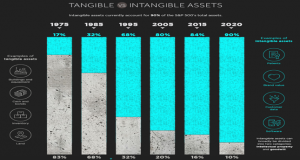
    First, investors are now heavily weighting their valuation processes towards intangible assets like IP and goodwill. Tangible assets in physical items like inventories, factories and land just don’t possess the growth and scale-up speeds implicit in mass-adoption IP. Tesla is still just a manufacturer of physical stuff but has managed to achieve a $550 billion valuation which exceeds the combined value of all the other auto manufacturers on the planet. How does a tiny Tesla 0.6% market share translate into capital markets dominance? Check out the chart below from the excellent Visual Capitalist analytics site which highlights the huge asset shift to intangibles within the S&P 500 index.

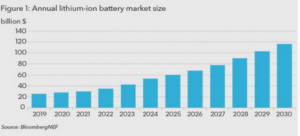
    Thirty five years ago less than one third of assets were intangible. Today’s 90% figure gives a clue as to what is driving Tesla and technology company valuations. Specifically, investors are attaching huge value to Tesla’s lithium-ion battery technology and the next chart illustrates that emerging trend/opportunity. The lithium-ion battery market is expected to more than quintuple by 2030 according to Bloomberg.

    Despite these two favourable trends many still struggle with the Tesla to-infinity-and-beyond valuation. Well, maybe not infinity but how about space? China has just launched a lunar expedition and the DiaperDon has added a Space Force to the gargantuan US defence budget but there are more immediate commercial initiatives afoot. Elon Musk’s primary wealth vehicle might be Tesla but his rocket company SpaceX is possibly the stellar trend to watch.

    Space is the new data frontier and SpaceX has launched more than 500 Starlink satellites to ultimately beam high-speed broadband from orbit to anywhere in the world. Infinity indeed. Current plans entail a constellation of up to 12,000 satellites in low-level orbit and one does wonder why this project is generating less attention than Tesla.  For a more detailed and prescient analysis of SpaceX’s strategy Gavin Sheridan’s recent article in The Currency is worth a read. More intriguing is Sheridan’s view – held impressively since 2015 – that Teslas’s fleet of electric vehicles have a role to play in this broadband network. The mind boggles but there is no doubt investors are going to hear a lot more about galactic opportunities in the next decade.

    Prepare for daily trillion dollar valuation shifts too as these three trends accelerate.

    Or as Captain Kirk said, “Set phasers to stun”.

  • Three Big Little Lies

    Three Big Little Lies

    Feel better this week? This writer’s own sense of things is that good news often comes in threes. What’s not to like about a potential Covid-19 vaccine, a law-abiding US President-elect and commensurate increased pressure on the UK to comply with international treaties in Brexit negotiations? Anyway, less of the rhetorical questions; the week also threw up three awkward answers which might not tally with the current feel–good narrative. Indeed, we are reminded of the King of the Swamp Castle’s words in Monty Python’s ‘Holy Grail’ movie – “This is supposed to be a happy occasion. Let’s not bicker and argue about who killed who”. So, let’s address those deaths first.

    Despite almost 250,000 Covid-19 deaths in the US, more than 70 million voters didn’t think the shambolic pandemic performance of the Trump administration was a presidency killer. Yes, international reaction to a Biden victory has been very positive but there are real concerns about such a huge number of people keeping faith with Trumpian ‘values’ and the enabling behaviours of the craven GOP political leadership. The good news is that demographic trends indicate a GOP in decline – take your pick from youth votes, female votes, increased education and minorities population growth. They are all travelling in a dangerous direction for the GOP but a huge turnout has delivered a misleading 70 million voter number.

    The truth in the data is that the demographic voter margins are widening, even accelerating. Perhaps, the biggest shock of the week was how close(initially) Trump came to winning. The ugly reality in the US is that voter suppression, gerrymandering and an outdated electoral college system is the GOP’s survival strategy and keeps up the big little lie that almost 50% of the country is in the MAGA cult. The worry going forward is that disputing a clear-cut 2020 election win is only the beginning of GOP desperation strategies. Prepare for a GOPocalyptic vision for the US; current control of the Senate and the US Supreme Court could lead to further and far more blatant destruction of democratic intent.

    The UK is also smashing all the wrong records in its pandemic containment strategies but has added economic hara-kiri to its challenges. The economic intent and understanding of UK Brexit voters plastered on buses in 2016 is rather different to the realities of today. The big little lie in UK is that a population of 65 million souls can leverage greater trade opportunities than a 600 million person market with the rest of the world. The Confederation of British Industry(CBI) has recently totted up the cost/benefit of EU membership since 1973. The CBI reckons total costs/contributions of £215 billion over 45 years have delivered an annual return value of £70 billion or £3.25 trillion. Total expenditure on Brexit since 2016 is already at £203 billion, per the CBI, with a return value of…… ? Take your pick from trade wreckage, international ridicule, Kent borders and lorry parks, break-up of the Union and loss of travel rights. Sadly, Ireland will have to share some of the pain but also needs to rid itself of its own big little lie.

    The Irish pandemic response has received positive reviews in the main and the economy has shown amazing resiliency thanks to a multi-national sector heavily exposed to technology and healthcare. However, we have previously written about the K-shaped nature of our economic recovery. The SME sector employs more than 1 million people and has suffered huge hits to revenues and balance sheets. The government has made plenty of noise about a €6.5 billion package of financial support for SME firms. Up to €2 billion of that was intended to be a flagship scheme of loans 80% guaranteed by government with 20% of the risk taken on by our three banking horses of previous apocalypse – AIB, BOI and Ulster. So how’s that working out? Well, the Department of Business, Enterprise and Innovation has published some figures.

    Remember that €2 billion of available funding and the very obvious SME distress for all to see? For context, the country has about 250,000 SME firms. Now the big little lie. Well, you’ve seen the big numbers – 2 billion and 250,000. Now try the little ones – 43 million and 743 respectively. Yep, a grand total of just €43 million has been approved for distribution across just 743 loans in the SME sector. Clearly, something is terribly wrong with this funding solution – previous writings here would query debt instruments and traditional banking platforms as an unattractive combination. However, do not be fooled into thinking reluctance to borrow equates to an absence of need. For context again, we note Central Bank deputy-governor, Ed Sibley, stating that Irish SMEs face combined losses of up to €11.7 billion in 2020 alone.

    Government support for SMEs is not working and is now in big little lie territory. The silence on alternative thinking and solutions is deafening. In fact, if you listen very very carefully you might just detect the distant sound of coconut claps and the deluded knights of Kildare Street crying “Run Away! Run Away!”

  • Biden Our Time For A Landslide?

    Biden Our Time For A Landslide?

    The UK media loves battles. However, they really are scraping the bottom of the barrel (or Channel) these days. Of course, the Viagra-by-Video readers of the Daily Mail and the Spitfire Brexiteers loved the thwarting of a tanker hijack by the Special Boat Service(SBS) earlier this week. Even better, if there is footage of night-vision goggles, 40 commandos, ropes, rapelling, choppers, high seas and thermal imaging to accompany a “Storm the Andromeda!”  headline and a swift 9 minute victory for “ruthless, military precision”. But before Elgar’s wind section could strike up a triumphant Rule Britannia soundtrack one tiny detail emerged which slightly changed the tenor of the threat faced.

    Apparently the 42,000 ton tanker was under threat from seven desperate stowaways who had smashed some glass and threatened to kill the crew if they were locked in their cabins. No bombs, no chemicals, no AK47s, no knives, just desperation and incredibly poor timing – the huge tanker was just passing the Poole HQ of the SBS. Indeed, the one-sided nature of the battle did remind me of Captain Blackadder in the WW1 trenches pining for earlier British campaigns “where the kind of people we liked to fight were two feet tall and armed with dried grass.” While we can laugh at this fictional wish for an easy victory the thought of the same in the context of the US election is far more serious and threatening for both the domestic media and the Republican side.

    The prevailing narrative right now is that Joe Biden is winning by a big margin(8- 10 points) but that the gap is closing and currrent polling is failing to capture the “hidden” bloc of Trump voters which delivered victory in 2016. I might be presenting myself as a hostage to voting fortune here but I’m racing towards a non-consensus view that the election will be a landslide delivering not just the White House to Democrats, but also the Senate. Predictable wins don’t provide ‘drama’ or viewers for the media and Republicans still need their voters to turn up and avert a Senate disaster. “Loser” is a uniquely American insult and explains why the perception of a tight battle is essential to motivate voters on the probable losing side. Why probable? Here’s a few data points…

    In the 2016 election 138 million votes were counted out of 250 million eligible voters. That’s more than 100 million voters who didn’t show up.

     Early voting tallies are staggeringly high. Already, there are close to 75 million votes cast which is more than 50% of TOTAL votes in 2016 and more than the 63 million won by Trump.

     Texas early votes are now heading towards 90% of total 2016 votes. Dawson County in Georgia is already over 100% of the 2016 total.

     Latest polls from “swing” state Wisconsin put Biden a whopping 17 points ahead of Trump.

     At current voting rates there will be a turnout of close to 65% which would equate to more than 160 million votes cast. That’s 22 million more votes than a 2016 national total which Democrats actually won by 3 million votes.

    Boat parades, super-spreader rallies and millions of “hidden” Trump votes strike us as more Blackadder than Bloomberg. The data does not lie and we referenced Wisconsin deliberately. A Trump win by a tiny 22,000 votes in 2016, the state is now in the grip of an acute Covid-19 crisis, desperate mail voter suppression by its state Supreme Court and economic challenges. The pandemic is not just killing Americans in record numbers, it is killing consumer confidence and the GOP in many swing states. To add insult to pandemic injury, China has won the trade war(US farmers and Wisconsin lost) and has returned to relative economic normality. America hates losers. However, do not assume a Biden landslide is a “win” for Democrats …..or financial markets.

    Clearly, an undisputed win for Biden will avoid a constitutional crisis but an extreme winning margin could create serious social unrest among shocked GOP voters fed a daily diet of “winning” from Fox, Breitbart and OANN broadcasting platforms. Also, markets can behave in very counter-intuitive ways despite perceived political positives.  The excellent John Authers touches on that point this week in his Bloomberg article, “Trump Was Great For Mexicans, Terrible For Coal”.

    Yes, coal and oil stocks have had a horror Trump show but the Mexican peso, cash flows south of the border and trade(NAFTA re-jig) have gone well. Also, the technology sector would hardly be considered close to the hearts of the MAGA cult but has boomed. However, consider this a collector’s item; this column would not hold Trump responsible for these outcomes. Structural trends and capital flows don’t really run on Presidential cycles. So consider the following two structural trends as likely headwinds for markets in a Biden administration:

    1. China geopolitics/trade – there is an unusually bi-partisan view in Washington that China is a threat which must be confronted. Trade has been the initial salvo in this confrontation but digital(internet) decoupling is very much a possibility as data security grows in criticality and follows Huawei and Tik Tok headlines.
    2. Google is already facing the biggest antitrust case in a generation but might be only the opening act in a global political move to challenge the supra-sovereign power of Big Tech.

    The technology sector is potentially in the cross hairs of both structural risks above and currently accounts for 25% of the S&P 500 by weighting. We don’t have any crystal balls but change can spook markets. Narrow political wins rarely achieve much change, ask Donald. A landslide Biden victory will bring its own pressures for change. Think of five “T’s; taxes, technology, trade, temperatures(climate) and treaties. The final one is a bit cryptic but might be the most divisive and explosive.

    By treaty we don’t just mean sovereign treaties between nations. We mean a legal framework for multiple citizens within a nation, like say…. The US Constitution. Trump and William Barr, his Attorney General, have trampled all over it. The Supreme Court is now in “originalist” conservative hands thanks to a Senate with an outdated composition. As things stand, North Dakota with a population of less than 1 million has the same number of Senator representatives as California with 40 million. Landslide elections can signal a societal backlash, and big change. Watch the voting turnout, not Fox news or even financial markets.

  • No Funding Limits As Lockdown Bites

    No Funding Limits As Lockdown Bites

    Here we go again; Lockdown II, and like many sequels, lacking any originality. I’ve heard some refer to this as a ‘Lazy Lockdown’, as in lazy thinking. Certainly, the one-size-fits-all travel restrictions for both urban and rural areas smacks of convenience rather than initiative. Anyway, the good news is that some business sectors have had time to prepare and hopefully battle through the latest challenges. This is a positive reminder of how commerce and capitalism finds a way forward. Not so, permanent government and the HSE who seemingly made no new plans for the seasonal return of Covid-19 and the surprisingly (not) consistent spike in non-Covid hospitalizations through the winter months…every year. Seriously, who knew? There is no sign of a fix to that perennial procrastination problem but there is better news in the business world.

    We mentioned previously that commerce and capitalism finds a way. Specifically, capital has an unusually stubborn ability to flow into the economy whatever the challenge. The return of confidence and capital is critical in every downturn but what is striking about this global crisis is the huge variety of funding sources emerging; a powerful mix of the old and the very very new. Let’s start with the older funding methods first.

    We have often stated that if one wanted to gauge levels of business confidence then watch what managements do rather than what they say. Well, companies have been writing some serious cheques as merger and acquisition activity has had its busiest summer in 30 years. Data firm, Refinitiv, has reported Q3’s combined value of transactions at more than $456 billion. The technology sector alone accounted for $226 billion of the action. Interestingly, another traditional source of deal-making capital is also making its presence felt. Year to date, private equity houses have accounted for 15% of all M&A activity per Refinitiv. We haven’t seen that level of Barbarian gate-crashing since the pre-2007 credit bonanza. It is safe to say high yield (junk) bonds still have a big fan base but it’s not just Wall Street private equity tapping that enthusiasm.

    One of Ireland’s most successful (if not the most) proponent of high yield debt funding is Paul Coulson and the Ardagh Group. And, they are sounding confident. Even after two decades of deal making and a massive $5.5 billion debt load they have announced plans this week to plough another $1.8 billion into their drinks cans business. It is not just entrepreneurs with multi-decade track records receiving serious backing from the financial markets. Two young Irish companies, Wayflyer and LearnUpon, have just received almost €70 million of funding from specialist start-up financing houses in the past few weeks. One might say these are the “new” banks for smaller businesses but even the old banks are finding new missions. Check out the Big Daddy of them all, the ECB.

    The EU is launching a series of 10 and 20 year bonds to fund the social needs of Member states following the pandemic and its consequences. What is extraordinary about this €100 billion programme is that the risk is SHARED across Member states and marks a departure from individual states seeking funding from financial markets. The first bond was auctioned by the ECB this week looking for €17 billion of capital. The demand was enormous with the issue more than ten times oversubscribed. Yes, almost €250 billion of demand(or a quarter of a trillion euro) wanted to fund this new experimental funding instrument. That is not the end of the new. We save the most revolutionary move until last…

    We know our future is digital. But, our money? Check out the announcement from payments giant , Paypal, this week. It plans to allow users to “buy, hold and sell cryptocurrency” directly from their Paypal accounts. Yes, cryptocurrencies have been around a while but really only at the margins of everyday commercial activity. The initiative from PayPal is massive because they are massive. They have 346 million accounts globally and are annualising processed payments of close to $1 trillion. Now, one can conceivably pay for your coffee or anything else with a cryptocurrency at any of the 26 million retailers who sit on PayPal’s payment systems. Revolutionary stuff.

    All of the above points to an expansion of funding channels and capitalism finding solutions to current business problems. This also signals a confidence in the scientists and an eventual vaccine for Covid-19.

    Business funding is not a new thing but is always evolving, and often funding recovery. Indeed, look back to the 15th century and you will find the Medici bankers of Venice financed the Renaissance. History gives us plenty of hope. Sadly, ignorance of history (and recent winters) can do just the opposite.