Category: General

  • Internet Trends of 2019 – How Did We Miss That?!

    Internet Trends of 2019 – How Did We Miss That?!

    There is one report worth a read every year. Veteran Wall Street analyst and technology investor, Mary Meeker, publishes an annual “Internet Trends” slide deck which has become a valuable source of information for business owners.

    It can be downloaded at www.bondcap.com and is just the 330 pages long(!)

    For those a little bit time poor we thought it might be helpful to flag a number of the key trends. Some of them might even have been covered previously in this corner.

    America is already great – the greatest it has ever been. Eight of the ten most valuable companies in the world are US owned and six of them are from the technology sector. As ‘Agent Orange’ in the White House threatens trade wars across the globe, readers should be mindful that only 30 years ago it was Japan who filled eight of those top 10 spots. Fingers crossed for the G20 meet this week!

    Technology is the new oil. The tech sector’s phenomenal ability to scale rapidly has ensured its position as the ‘fuel” to power almost all business activities. As recently as 1980 six of the ten largest companies in the world were oil companies. More than half the human population( > 3.8 billion) is now online but user growth is slowing to a single digit growth rate of 6%.

    The business future is East. The Asia Pacific region now accounts for 53% of global internet users with China and India combined making up a third of the global user base. However US technology companies are the leaders occupying 18 of the top 30 positions in the valuation tables for the global technology sector. China holds 7 of those slots but expect that to grow with its more than 800 million strong mobile user base!

    Advertising spend is chasing user behaviour changes. In 2010 US consumers spent 8% of media time on mobile with mobile ad spending at barely 0.5% of total ad budgets compared to TV time and spend at 43%. Fast forward to today and mobile user time and ad spend is at 33% compared to TV at 34%. Expect 2019 to witness mobile as the top recipient of advertising spend as time spent on mobile, estimated at a daily 226 minutes, will overtake TV at 216 minutes. Also, watch out for the likes of Amazon, Twitter and Pinterest to gain additional share of those advertising revenues from Google and Facebook.

    Humanity is returning to the caves. Early human communication was delivered via images/stories. Our brains are wired for images. Writing was a hack, a detour, but we are now returning to what is most natural. The principal delivery platforms of digital images, YouTube and Instagram, are gaining share of daily user time from Facebook and TV. Digital video consumption as a share of total watching time vs TV has doubled from 14% to 28% in just 5 years. Possibly more stunning is the fact that another image-based activity, interactive gaming, has become a social platform in its own right with total players now standing at 2.4 billion(!). Thank you Fortnite…..

    Video didn’t kill the radio star. Arguably, voice is on the come-back trail. Podcast usage has doubled in 4 years while the Amazon Echo installed base has doubled to 47 million US users in just one year.

    Banks beware. In the week that Facebook announces its own crypto-currency and Bitcoin rockets through $10,000 again the whole area of mobile payments is exploding. As European bank valuations plummet how would you value Alipay in China? This payment platform has more than 1 billion users and doesn’t just do payments; this is a full- blown financial services player providing loans, wealth management and insurance products to hundreds of millions of consumers and millions of businesses. Even closer to home, Monzo raised money this week pushing its valuation over £2 billion; and another European bank challenger, Revolut, has seen its user base double to 4 million in just 10 months.

    Cloud deployment is booming. Cloud service revenues for Amazon, Microsoft and Google are growing 58% year-on-year. The cloud has also been instrumental in allowing businesses scale up using ‘freemium business models’ – Gaming, Google G Suite and Zoom are good examples where excellent free user experiences drove subscriber revenues for additional functionality. Slack in the week of its successful IPO is also worth a mention as a business service following in the footstepos of Wix, Dropbox and SurveyMonkey. According to Mary Meeker we are only just getting started with freemium business models for business and the consumer. It was gaming which proved the model – just the 2.4 billion players later and yet we are only now writing about freemium models for enterprise/businesses. Perhaps those 330 slides of Internet Trends might be worth a closer look if you want to get a better picture of the digital future of your business……

    “Data is now fundamental to how people work & the most successful companies have intelligently integrated it into everyone’s daily workflow… Data is the new application.”
    Frank Bien – CEO & President, Looker, 6/19

  • Food for thought ………………

    Food for thought ………………

    I met a recently semi-retired hedge fund manager for a coffee last week in London. We are not socially close so my expectation was that we would spend most of the conversation on Brexit,  financial markets and big winning trades achieved and planned for his personal retirement fund. What I didn’t expect was this Master of the Money Universe to speak passionately about climate change beginning to exert a significant influence on financial markets and his belief that society will need to act very fast to avert catastrophe for his children. This dystopian warning and its unlikely source did heighten this writer’s awareness of climate influence when reading financial press in recent days and it turns out that the hedge funder is not alone.


    A Forbes headline within days of our coffee quickly caught the eye – “ This Hedge Fund Superstar Thinks Climate Change Will Impact All Your Investments – And Soon”. Robert Gibbins is the founder of the top performing Autonomy Capital fund with $5 billion in assets and he sees climate change as a major threat to the economic stability of a large number of countries.  In fact, he structures every bet his fund makes around his belief that our future will be overheated and underwater. He is surprised at how almost no investment analysts attend science conferences on climate and yet,  with his fund “climate change is something we have to include in every single analysis, every investment”.  Further headlines in the past few weeks did give pause for additional thought as to why investment teams are not pushing climate further up their risk management rankings:


    National Geographic:     Midwest Flooding is Drowning Corn and Soy Crops. Is Climate Change To Blame?


    The Guardian:      Australia To Import Wheat For First Time in 12 Years


    BBC:  India Reels as Summer Temperatures Touch 50C


    Independent:  “High likelihood of human civilization coming to an end “ by 2050, Australian Report Finds.


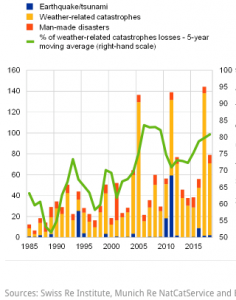
    The report referenced in the final headline may smack of hyperbole but it was co-authored by the former head of the Australian armed forces. The report stresses civilization collapse is a worst case scenario but is based on trends already identified in food production, water access and an acceleration in extreme weather events. Even the european Central Bank(ECB) was moved to publish a report in recent days highlighting how climate change can affect the financial stability of  institutions whose risk assets are exposed to vulnerable infrastructure/real estate and countries, sectors overly exposed to carbon emissions. The chart below identifies clearly some rather worrying trends on weather related catastrophes:

    No wonder President Michael D Higgins was moved to issue a two fingered salvo at the science-denial Commander in Chief of the planet’s largest military force. As the Toddler-in-Chief lands in Ireland it will be difficult for the government to play down Higgins’ observations on the Trump administration’s “regressive and pernicious” record on climate change and its solo boycott of the Paris Accord. At this moment the White House seems to rank its friendship with the carbon autocrats in the Kremlin and Riyadh over the farmers in the Mid-West. This may well change as food supply becomes a focus of financial markets in the coming months.


    Apart from crop failures in the US and Australia, there is the added complication of a pig swine fever which could ultimately wipe out 200 million pigs in China – that’s the equivalent of the entire pig stock of the United States. If the Arab Spring of 2011 is a distant memory it is worth recalling food prices were a big part of the social unrest unleashed and with the current state of geopolitics on a very fragile footing it is no wonder hedge fund superstars are factoring climate change into their risk analysis. With a leader-less Western alliance markets could be spooked quite viciously if another Libya or Syria hits the news feeds. Already we are seeing protests in Sudan turn deadly with headlines focusing on political transition tensions but, at a base level, soaring bread prices have been fueling unrest.


    This Handmaid’s Tale of a looming fertility crisis is like the TV series rather depressing but the good news is that climate is being pushed to the fore as a policy priority by the electorates in the recent European elections.

    Furthermore, an impetus to take action on carbon emissions and food production will reward businesses in the sweet spot of this wake up call. The Irish start-up environment features a variety of scale up opportunities in the food product, food technology and renewable energy sectors . Keen climate worriers could do worse than keep an eye out for EIIS opportunities and crowdfunding platforms promoting businesses essential to fight our generation’s World War III as D-Day hits its 75th anniversary.

  • Making America Great Again – Was Trump Necessary?

    Making America Great Again – Was Trump Necessary?

    Donald Trump’s signature slogan “Make America Great Again” would suggest that the world’s foremost sovereign power has suffered a dilution of its global influence.  Not for the first time, a pillar of Trumpian policy may not reflect actual reality.

    As recently as 2006 US companies’ market share of the operating systems(OS) which power mobile technology struggled to reach 10% globally. Today that figure, thanks to Apple’s IOS and Google’s Android, is sitting comfortably over 99%.

    Yes, private enterprise in America totally controls the functionality of perhaps the most revolutionary consumer device in the history of the planet.  The mobile phone’s ability to empower individuals to engage in media, finance, retail, education, travel and even health care activities is a concentration of consumer influence beyond the dreams of business 25 years ago.

    And, to this writer, the development of such market power, rather than the 1991 collapse of  the USSR,  marks “Peak U.S.A” .  Then again, that might have changed this week.

    In response to proposed US government sanctions against Huawei, the giant Chinese mobile company, Google has warned that Huawei mobile phone users may lose its operational support for its Google Maps and YouTube applications.

    Early financial market reaction focused on potential commercial damage to technology suppliers to Huawei and potential retaliatory action from China against the likes of Apple. Clearly, this US government initiative cannot be unrelated to the ongoing trade war/negotiations bewteen the world’s two largest economies.

    Irrespective of an ultimate trade agreement between both nations, this development should serve as an uncomfortable reminder to businesses and other countries that there are concentration risks associated with U.S. domination of the global OS ecosystem and the potential loss of valuable customers who fall foul of a somewhat erratic U.S foreign policy.

    Ironically, the populist backlash against globalisation led by Donald Trump could reverse peak global power for business interests in America.  This has implications for Ireland too.

    The consistently excellent commentary by John Kennedy on the Irish tech scene in Silicon Republic recently highlighted Ireland’s critical positioning as the place where companies with global ambitions tend to concentrate their scale-up efforts. He puts it well here –

    “Ireland has cultivated a crucial role at the heart of the global tech and internet world as the place to do business and hack growth.

    As Brian Halligan, co-founder of HubSpot, put it once, Dublin is seen in leadership circles as the scale-up capital of the world.  When Google came to Ireland in 2003, it was as a sales outpost for a handful of Googlers. Today, Google employs about 8,000 people here and is growing across a plethora of roles and functions, including sales and engineering. Similarly, Facebook came to Dublin in 2008 with a small outpost in mind and today it is hurtling towards 5,000 people. If you study companies such as HubSpot, which last year surpassed the 100-engineer mark in Dublin, it is clear that engineering is moving closer to the sales function because it is vital that products and actual customer success stories occur thanks to greater empathy by the people who make the products as well as those that sell them”.

    There is a danger that there are countries and companies watching developments from a strategic perspective and begin to put in place plans to reduce exposure to U.S. technologies.

    Ireland as a scale up base for companies could also be perceived as having an unhealthy dependence on investment from America and….. goodwill. Dublin’s political ability to take a principled stand on foreign policy initiatives is rather limited and in this upside-down Trumpian world it is difficult to know who actually is currently a U.S. political ally.

    Indeed, it has always seemed a little strange that the U.S. spends more on its military than the next 12 ranked countries combined – ten of whom are American allies!

    Now, former friends watch nervously as a succession of authoritarian leaders parade through the White House accompanied by fawning praise from the Donald.

    The global reality is that American power and influence through its technology and military has never been higher. It’s weaknesses are captured by any quick analysis of long-term domestic/social trends in health, education and income inequality which have triggered a flawed political backlash against globalism and the technological hegemony it currently enjoys.

    The Huawei story has possibly let the genie out of the bottle and given businesses pause for strategic thought.

    A reversal of U.S. dominance in technology and a de-risking by companies of concentration risk could have negative impacts on previous scale-up plans and development costs as companies factor in the potential requirement to cater for competing technology platforms and more complicated regulatory and market access conditions.

    Globalisation and scaling up is about to become tougher. However, the Chinese word for “crisis” features two characters signifying “danger” and opportunity”.

    If Huawei is forced to go alone on its OS platform then a reasonable question might be whether its Irish R&D centre, with circa 100 staff , is about to grow quite significantly?

    The thornier question might be… will America be pleased? Welcome to Trumpistan.

  • How ‘Digital Savvy’ is your Company Board?

    How ‘Digital Savvy’ is your Company Board?

    At the recent Dublin Tech Summit this writer was struck by a Ryanair recruitment stand proudly proclaiming its status as  “A data company with 450 aircraft”. 

    For a company which physically transports 120 million passengers through the skies each year the data company descriptor might strike some observers as somewhat stretched. However, there is no escaping the fact that even the most traditional businesses are increasingly dependent on digital expertise to grow and remain competitive.

    Indeed, the Ryanair story would have been very different without a powerful website capable of scaling up and processing more than €7 billion of flight payments each year.

    For many businesses the successful adoption of technology is a must but it might surprise readers to learn that digital expertise at board level is in short supply in a number of sectors.

    The MIT Sloan School of management recently published a paper , “It Pays to Have a Digital Savvy Board”, which revealed the findings of a machine learning analysis of the digital know-how of all the boards of U.S. – listed businesses.

    The definition of ‘digital savvy’ was based on directors’ understanding, education and experience of the impact of emerging technologies on business success. And, they measured this competency by analyzing data from surveys, interviews, corporate communications and the bios of 40,000 directors.  The results were striking.

    Just 24% of listed companies in America with more than $1 billion in revenues had digital savvy boards, and those businesses significantly outperformed other companies on key financial metrics such as revenue growth and market cap growth.

    The analysis also discovered the magic number for digital savvy status was “3” i.e. it takes three members of the board to deliver a statistically significant impact. 

    The financial metrics speak for themselves; companies with three or more digital savvy directors delivered 17% higher profit margins than companies with two or fewer, 38% higher revenue growth , 34% higher return on assets and……34% higher market cap growth. 

    The effects of digital savvy boards were consistent across industries, although the percentage of such boards varied by industry. Think about Ryanair again, and then wonder at the challenges facing retail (just 24% savvy) and transport(8% savvy) in the table below…

    It is incredible to think that the extremely challenged retail industry in the Amazon era is so poorly resourced at board level. It is also interesting to note that specific technology knowledge is not the critical assist but rather experienced insights on transformation decisions and trends.

    The MIT Sloan report summarizes this type of digital experience in the board room rather well:

    “….rather than focusing on the basics of the technology itself, digitally sophisticated board members use their insight about trends and transformation to help managers explore the bigger picture the business is facing competitively. As one of the directors we interviewed put it: “Digitally savvy directors change the risk conversation from evaluating the project risk of particular initiatives to the business model risk of not doing something new.”

    Clearly, this study was conducted with large businesses but inevitably best practices will filter down to smaller companies. Particularly, venture capital practitioners will tell you how critical the founder is to their evaluation of a funding prospect even ranking higher than a fantastically innovative product or service. Start-ups looking to raise funds on Spark Crowdfunding should take note!  

    On the basis of the MIT Sloan findings above it is worth careful consideration for founders of start ups to impress upon potential investors how they access independent digital savvy counsel. 

    In fact, what could really impress is a founder who has put together a digital rich advisory board.

  • With the current pace of change, where will our children work?

    With the current pace of change, where will our children work?

    More than 60,000 candidates will sit the Leaving Certificate next week. The parents of these children will understandably be anxious as to how they fare in the race for prized places in third level education but such anxiety is possibly a wee bit misplaced.

    As recently as 1980 just 20% of secondary school leavers went on to third level education, but that figure is now well over 60% suggesting opportunities to maximize career potential have risen exponentially for our children. Possibly not.

    A cursory glance at financial markets would suggest that educational uncertainty should now be replaced by career uncertainty.

    The S&P 500 is a market index whose constituents are 500 of the largest companies in the US ranked by market capitalisation, or value in layman terms. This index is not set in stone and is subject to the forces of creative destruction. Companies drop off the list for one of two reasons; they can be the subject of corporate activity – buyouts, mergers, acquisitions –  or they can fall below the market cap threshold and replaced by faster growing companies.

    In the 1960s companies on average could expect an average tenure in the S&P 500 of 33 years. That average tenure shortened to 24 years in 2016 and is forecast by consultancy, Innosight, to shrink to an incredible 12 years by 2027.

    The acceleration in longevity decline is not the result of increased corporate activity but by the rapid evolution of technology and the structural destruction of many industries. Think railroads of the 1950s, newspapers and retailers in the 2000s. This the challenge facing the graduates of tomorrow – trying to avoid career paths which meet sector obsolescence.  Energy is the future, right? That depends….

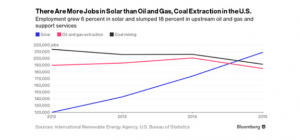
    Despite Mr Trump’s love affair with “beautiful clean coal” there is a structural shift in employment in the energy sector which might surprise.  The number of US jobs in solar energy overtook those in oil and natural gas even before the current President came to power. The chart below is fairly striking:

    Readers might also be surprised to know that despite Trump’s big oil support, Iran tensions, healthy global growth, record market(S&P) highs and the post-Fukushima decline in nuclear power, the largest quoted oil company in the world, Exxon Mobil, has experienced a 25% decline in its share price since solar took top jobs spot in 2015.

    Very often a multi-year slippage in the relative value of a sector in an index can signal a structural decline for an industry(sector). Take a look at the long term charts of  companies in retail, media, telecoms and financial services’ sectors and you will see more losers than winners. These are the victims of creative destruction wrought by new digital technologies.

    A current check of the weightings of sectors in the S&P 500 is also instructive.

    The technology sector accounts for more than 25% of total S&P 500. No doubt many of these companies will have their own risks of technological obsolescence but spare a thought for the financial sector which once accounted for more than 20% of the index. It currently sits below 15% and that’s when financial conditions are at the most benign this planet has ever experienced.

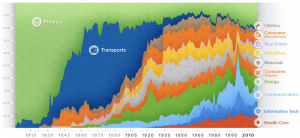
    A quick tot up of S&P structurally exposed sectors like energy, utilities, financials, retail and communications can readily account for more than a third of the market right now. This figure may resonate with market historians who will know that transport(railroads) accounted for 38% of the US stock market in 1900. Today it is 2%.

    The following stunning graphic from Visual Capitalist illustrates the shifty in sector significance over 200 years:

    Clearly, humans are not great at forecasting the future but it is safe to say technology will be a significant part of the lives of the leaving class of 2019.

    Perhaps the more pragmatic approach is to build knowledge and skills rather than commit to a specific industry. More particularly think about working with technology rather than in technology.

    A recent Accenture report highlighted the challenge for employers meeting a skills crisis but also provided a reasonable guide to under-graduates as to where employers will look in the future:

    “To many, the response to the skills crisis is simple: train more engineers; raise the number of arts graduates. But creating larger cohorts with certain skills is not the answer. Two things stand out in our analysis:

    • Creativity, socio-emotional intelligence and complex reasoning are the skills that are rising in importance across every work role. These skills are not taught in today’s learning systems. They are acquired through practice, experience and often over long-time periods.
    • The blend of skills required by each worker is becoming more complex. There needs to be a greater emphasis on broadening the variety of skills within each worker.”

    Another useful guide to the skills required of the next generation is to look at the founders of start ups in today’s world. They tend to be creative thinkers, technology-savvy and articulate communicators of their vision. Furthermore, the sectors where start ups are focusing can give a good guide to our children’s future. For the anxious parents out there you might consider going to a few EIIS start-up presentations and getting a sense of the skills and sectors which are likely to feature in your own childrens’ careers…..


  • Beyond Meat or Beyond Technology

    Beyond Meat or Beyond Technology

    Last week the NASDAQ exchange witnessed the most spectacular company IPO debut since 2000.  There would be a temptation to seize upon the words “IPO” , “NASDAQ” and “2000” before writing a cautionary comment on a market overheating and revisiting the fearless greed of twenty years ago. However, there’s a significant flaw in using Beyond Meat’s 160% first day share price spike as a prescient data point. While there is no doubt that young technology companies are attracting the vast majority of investor funds these days, Beyond Meat has challenged that narrative as a straight forward food company.  This meat substitute business is a cursory reminder that consumer businesses selling every-day products can generate enormous returns for investors.


    Just ask the 20,000 pilgrim investors in Omaha for the Berkshire Hathaway AGM last weekend. Many attendees will have fond memories of great returns generated by investments in Coca-Cola, Heinz, Kraft and Dairy Queen accompanied by Warren Buffett’s wise words, “ Above-average returns are often produced by doing ordinary things exceptionally well.”  This is worth bearing in mind when one hears of retail investor frustration at missing out on “hot” technology funding rounds. In an Irish context the numbers would certainly indicate professional investors are ploughing most funds and analyses into technology stories – KPMG in its Venture Pulse report for Q1 2019 found $67m of the almost $69m raised by companies was concentrated on technology applications in healthcare and finance.  This sort of environment can “crowd out” companies seeking funding in more traditional sectors who at first glance might not conjure up visions of the next Amazon. However, to paraphrase the Sage of Omaha, the time to become greedy is when the majority are fearful. And, perhaps the place to become greedy is more likely to be on crowdfunding platforms which consumer focused franchises are increasingly using to fund their growth.


    At Spark Crowdfunding it has been noteworthy to see a number of these franchises complete successful funding rounds on the platform. In fact, consumer businesses approaching Spark Crowdfunding for potential campaigns account for a significant 70% of overall interest. For private investors there is a real possibility that current trends/fashions in the professional venture capital world are leaving some consumer gems on the investment table. Readers may aspire to being an early investor in an Amazon story but you might be surprised by a couple of consumer stories which have generated superior returns to Amazon and other titans of technology. Fancy an energy drink or a pizza?


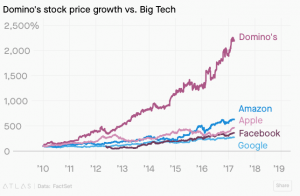
    Let’s go back almost a decade ago to 2010 and you had the chance to buy shares in Amazon, Apple or Google. All would have generated very large returns from circa 300%(Google) to over 800%(Amazon) but not even a bonus 400% from a Facebook IPO in 2012 would catch a simple pizza story. Yep, Domino’s Pizza shares purchased in 2010 would have generated a 2000% return as per the stunning chart below:

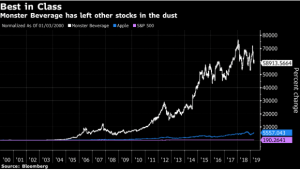
    If you wanted an energy drink to go with your pizza then you could have ignored the TMT frenzy in 2000 with an investment in Monster Beverage Inc. That investment would have generated returns just shy of 60,000% and is, in fact, the biggest winner in the US stock market this century and ten times the returns on the almost 6000% produced by Apple.  Here’s the energized performance of Monster Bev in the chart below:

    The predictive power of a valuation is pretty much zero as human beings are not very good at forecasting the future. So, if the professionals are chasing hot technology and even hotter valuations there’s an opportunity for retail investors to unearth some real consumer gems with real growth futures at an early stage and lowly valuation. The future is almost impossible to predict but the Impossible Burger has arrived and with reasonable certainty we can say human beings will continue to eat and drink…..