Category: General

  • Taking Back Control In A Brexit Clown Car

    Taking Back Control In A Brexit Clown Car

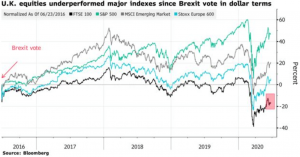
    Ooooohhh that was quick. Can it really be four years since the UK voted to leave the EU? Well, we are nearly there. In January the UK will leave the EU, with or without a trade deal agreed, and three Prime Ministers later we shall all agree this is “Taking Back Control”. Or, maybe not. Financial markets are probably the best data points to measure how much control is expected to be achieved. The charts are less than flattering. One chart in particular caught the eye in the past few days; Bloomberg has highlighted the serial underperformance in all four years of the UK’s flagship index, the FTSE 100:
    spark-crowdfunding-brexit

    Yes, the performance is being measured in US dollar terms but then the 20% decline of the once proud Pound Sterling tells its own story of faded glory. It’s not just this writer flagging the ‘downgrading’ of the UK’s economic influence in global financial markets. As Boris Johnson shuts foreign aid departments and spends on new yachts and government jet re-sprays, one could only gasp at the following Financial Times headline in the recent days:

    Pound is becoming emerging market currency, says Bank of America analyst

    The analyst, Kamal Sharma, didn’t pull any punches – “trading conditions in the pound and the big swings in exchange rates make it a better match with the Mexican peso than the US dollar…..We believe sterling is evolving into a currency that resembles the underlying reality of the British economy: small and shrinking with a dual deficit problem”. The prospect of the Great British Peso would prompt giggles if it were not so serious. The delusion that Boris Johnson’s government are going to masterfully execute a post-Brexit trade deal is becoming more stark by the day and in danger of entering fantasy territory. Look no further than the latest gems from Johnson’s cabinet.

    The embarassing policy U-turn on school lunches was apparently inspired by Daniel Rashford rather than the footballer, Marcus Rashford, according to health secretary, Matt Hancock. In fairness, Hancock will need a dose of Harry Potter magic to resurrect his career after the contact tracing app debacle. Not to be outdone, the doppleganger for Alan B’stard in the cabinet, Dominic Raab, reached into the fantasy vaults and credited Game of Thrones with the inspiration for taking the knee in the Black Lives Matter protests. Clearly, the Secretary of State for Foreign Affairs has his finger on the global pulse. What could possibly go wrong with a complex Brexit negotiation?

    The exceptionalism of the UK and US has been an accepted positive feature of geopolitics for decades but the twin challenges of CV-19 and globalism in trade have revealed a more malign, nationalistic application. As the Donald announces restrictions on H-1B visas for high skilled personnel and Boris considers a paint job for “Air Farce One”, both countries are breaking all the wrong records in containing a global pandemic. Exceptionalism now means exceptional incompetence. But, where does that leave “Brexit Means Brexit”?

    The honest answer is nobody knows but we will know a lot more before January. The Japanese have just given the UK government 6 weeks to negotiate a post-Brexit trade deal. The mind boggles. As we watch the UK Prime Minister being mauled on a daily basis in Westminster by opposition leader, Keir Starmer, and his forensic demand for answers/truth one wonders how the detail-oriented Japanese will cope with the sheer vacuousness of the Number 10 clown car during negotiation. The tragic cast of Gove, Raab, Rees Mogg etc. in the same Brexit chariot of delusion only adds to very real fears of a bad Brexit.

    Financial markets have already voted. Global investors in currencies and equities have priced real economic damage rather than the fantasy that Harry Potter magic or Tyrion Lannister cunning will appear at the trade negotiation tables. It will all become very real if the debt markets take fright. UK national debt levels are now more than 100% of GDP. If bond markets move, they will move very very fast. There will be no time for test drives and eye-sight checks. Just a sad Chernobyl reminder of how lots of little lies can incur a very large debt to the truth…..


  • Ten Big Lessons From The House of WireCard(s)….

    Ten Big Lessons From The House of WireCard(s)….

    In 25 years of writing financial commentaries and research notes I have only received two abusive phone calls from ‘offended’ companies. The first was from the investor relations department of Anglo Irish Bank. In that instance, our caution on there being any value in Anglo’s shares crystalised swiftly, as did the conclusion of that desperate call. The second call was from further afield in 2015 and only an early chapter in a shocking financial implosion beginning to hit the headlines in recent days.

    The second caller claimed to be from a German investment fund which owned shares in a “hot” German payment processing technology play, Wirecard AG. My offence was to publish a list of long and short positions in a fund I was running at the time. One of the shorts listed was Wirecard and my “bet” was executed using a derivative instrument, a CFD(remember them!!), which would earn profits if the Wirecard share price fell in value. The weird thing about the call was that, between expletives, the caller’s defence of the company seemed too close to the script coming from Wirecard’s own investor relations department. The other weirdness was that, after the call, my search for the details of this German fund came up with nothing. So did the bet.

    The share price rose another 10% over the next few weeks. Wirecard was now a losing position in the fund. That’s a lonely place in the investment world where portfolio managers tend to only talk about their winning positions. Despite excellent analyses by Dan McCrum in the FT and an independent research house, Zatarra, on accounting ‘funnies’ at Wirecard, I was forced to cut my losses. And so, that’s where my personal Wirecard story and my chances of being in a Teutonic version of The Big Short movie ended. But the Wirecard machine in 2015 was really only picking up speed. Here are a few milestones reached before implosion this week:

    • More than 300,000 corporate customers wooed onto its e-commerce payment services platform and its “Beyond Payments” tag line….

    • Almost 6,000 employees in 26 countries

    • A peak market valuation of €25 billion which exceeded the combined market capitalisations of Germany’s largest two banks, Deutsche Bank and Commerzbank AG.

    • 2018 entry into the Dax 30 index of Germanys top publicly listed companies.

    • A digital partner of choice for all the top global payment players – Visa, AMEX, Mastercard, Google Pay, Apple Pay.

    • Wirecard Bank also secured a banking licence.

    But the tag line “Beyond Payments” resonated for all the wrong reasons this week as Wirecards’s auditors, EY, stated that €1.9 billion of “cash” was missing, beyond payment so to speak. This number neatly equates to the entire acccumulated profits reported by Wirecard since 2012. The market reaction has been vicious; the Wirecard share price has collapsed by 80% in 24 hours and the CEO/founder has resigned.

    The courage of short sellers who endured commercial pain and FT journalists who experienced serious litigation threats was ultimately vindicated but there are serious questions to be asked of the investment community and regulatory authorities who ignored multiple warning signs or “red flags”. Sadly, many of these same questions have arisen before on the post-mortems of the Enron, Anglo and Madoff scandals. However, it is no harm to highlight a few lessons to be learned and hopefully assist earlier discovery of the next fraud. Here’s our lesson list based on what we know so far:

    1. The financial world is swamped in regulations and compliance procedures to protect investors, particularly retail investors. Wirecard’s fraud happened in full view of professional portfolio mangagers and regulators. Fraud is a fact of financial life, diversification is too.

    2. Overly defensive national regulators should be a risk “red flag”. The German regulator, BaFin, threatened criminal proceedings against the FT journalists and briefly banned short selling of the shares….

    3. Equity analysts still try to curry favour with big companies by publishing favourable analyses. Out of 25 analysts covering Wirecard, just 2 analysts had a “Sell” recommendation. What “analysis” were the other 23 doing given the company’s multi-year track record of information blocking, even with its auditors….

    4. Heavy acquisition activity is a great way to hide fraud and keep invesment bankers happy with juicy advisory fees. Wirecard was flashing warning signals in the accounting world years ago with dubious profits funnelled through Dubai, Singapore and….. Dublin.

    5. Short sellers who make profits on falling share prices don’t usually receive good press. However, they are an essential part of the investment process in shining a forensic torch on financial statements.

    6. Big fraud stories tend to happen in clusters particularly during economic shocks. Luckin Coffee didn’t grab the same headlines as Wirecard but a 93% share price implosion and $12 billion spilt out of that China cup in recent months.

    7. Short selling strategies are very very difficult. Wirecard was a multi year story with huge pain points along the way; the share price quadrupled from when it first caught my eye in 2015.

    8. Fraud “in plain sight” is possibly going to be more prevalent going forward. Thanks to social media, free money/capital, disinformation campaigns and litigation, bad actors can fight facts and the rule of law for a very long time. Look to the recent political world for some startling examples of ‘total denial’.

    9. Finance is a global system. Call it a “supply chain”. Interruption can be very damaging. The increasing move against globalism is possibly not in investors’ favour if national regulators hide problems behind national flags.

    10. The German authorities have dropped the ball badly on Wirecard. Confidence in the regulator, BaFin, is shot and questions will resurface about the health of Deutsche Bank and its enormous derivatives trading book. BaFin is Deutsche Bank’s regulator but will anybody believe their assurances as to Deutsche’s stability right now?

    The Wirecard story has plenty more startling revelations to come. I have no doubt. The movie is also a certainty. There are lots of fawning enablers, dopey regulators and corporate dirty tricks on the money side and a few brave journalists and analysts on the truth side. This story will hopefully end with a positive message that some individuals were, in fact, beyond payment and trusted their senses. Even their dress sense. It turns out that those with a keener eye for fashion and a knowledge of the Theranos “Bad Blood” debacle might have picked up a clue. It seems that CEOs, male or female, sporting black turtleneck sweaters are probably now a “red flag” for investor fraud…..

  • Which Floor Will You Work On?

    Which Floor Will You Work On?

    High profile developer Johnny Ronan had a tricky PR week with a Bewleys collapse and a questionably toned and timed holiday video. But…it could have been worse. Not that long ago Johnny’s PR efforts were devoted to convincing Dublin City Council of the benefits of high rise office buildings. The Council were not persuaded. Now, in a Covid-19(CV19) world, that decision may have been a blessing in disguise.

    As back-to-work health and safety protocols come into effect you do wonder about elevator capacity restrictions (potential max 4 persons for skyscrapers) and the practicality of very tall buildings. Anecdotally, one hears about HSBC calculating a potential 2-3 hour wait for its 5,000 personnel in 20 Canada Square, Canary Wharf. The brutal truth for managers of that facility is that possibly only 10% of its workforce would be able to get to their desk in a reasonable time.

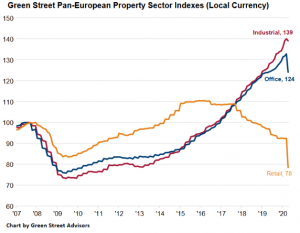
    It will not be just retail properties dealing with a new reality. However, the chart below of European property price indices from Green Street Advisors would suggest a 6.6% fall in the office sector might not capture the full impact of CV19 compared to the 15% hit in the retail sector.

    The consultants, Teuben and Bothra, estimated the size of the global professionally managed real estate market at $8.5 trillion. Savills thought the total commercial property market(retail plus office) was $30 trillion in 2015. Let’s just say there’s a lot of investment capital staring down the barrel of a design disaster if CV19 precautions remain an ongoing feature of working life.

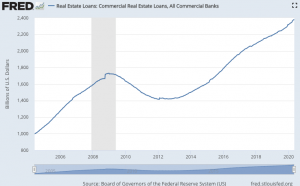
    The US and its Federal Reserve Bank have pretty good data on the risks involved. Here is a chart showing commercial real estate loans from all US banks hitting $2.4 trillion which is a 50% higher exposure than the 2008 crash period. Now, think about all the non-bank providers of debt capital who were chasing yields over the last decade of almost-zero interest rates. Think hedge funds, private equity, pension funds, sovereign wealth funds……

    Meanwhile, the daily drum beat of “forever” work-from-home announcements from the likes of Facebook, Shopify and Twitter would suggest office leases and valuations are due some challenging reviews.

    Of course, there are challenges everywhere in business but now and again a fortuitously delayed decision or a stubborn policy stance can make things a lot easier. It would appear, at this surreal pandemic moment in time, that Dublin and Johnny Ronan might have just dodged a high rise bullet….

  • Torn in the USA

    Torn in the USA

    The USA is very important to Ireland. It is our single most important trading partner, accounting for 31% of our total exports. However, the commercial relationship is far more embedded than just traded goods. The CSO tell us we import almost €50 billion worth of services from our American friends on an annual basis. Well, we did. In the middle of a global pandemic it is understandable to wonder about the future. Or maybe not.

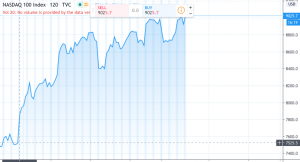
    As a technology focused economy one can only be encouraged by the massive rebound of the tech-heavy NASDAQ 100 index in US equities markets over the past month. The Nasdaq is now within 7% of all time highs. Check out the following chart from Tradingview.com:

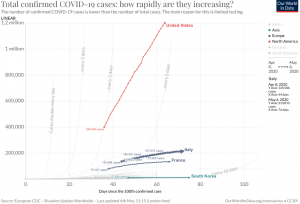
    It is quite incredible to witness such market enthusiasm when one considers the latest PMI economic activity indices from the likes of France and India plummeting to single digits from expansionary norms above fifty. Perhaps, as Warren Buffett reiterated this week, it is wise not to bet against America. And yet, there’s something not quite right. Despite President Trump’s best efforts, it is extremely difficult to ignore the inexorable march of C19 across the US. Here’s a chart of C19 case growth in the US over the exact same one month period as that covered in the Nasdaq chart:

    There are a few other things that are not quite right in the US right now. Take your pick from the following:

    • 30 million US jobs lost in the last 6 weeks

    • The US Treasury expecting to borrow $4.5 trillion to support a C19-crippled economy

    • The State of Illinois, already burdened with a huge debt mountain, forced to cancel a bond sale

    • Armed demonstrators bedecked in Confederate and Nazi paraphernalia storming Michigan’s state capitol

    Of course, there are other countries where tensions are rising as the economic costs of pandemic lock-downs bite. However, not every country accounts for 50% of the world’s capital markets. And, not every country is cursed with a leader so unsuited to lead. President Trump believes he needs an economy back at work to win another term in the White House. The election is all that matters to Trump and he is not shy about letting the world know where he sits on the wealth vs health debate. Unfortunately, without a vaccine, one can’t bend nature to your electoral will, or call the Kremlin.

    A polarised political climate, a dysfunctional media, woeful education standards and severe social inequality are all revealing themselves in this tug-of-war between public health protection and wealth preservation. There is a real risk that a failure to control the Covid-19 virus in the US could have explosive social repercussions. The truth is that the virus is the only new element in the social decline of the US. Arguably, the USA is searching for its true heart. Somewhere along the way ‘patriot’ , ‘true American’, ‘war’, ‘religion’, ‘heartland’, ‘great’, ‘united’ and ‘homeland’ all lost their true meaning in a cultural battle waged by chyrons, charlatans and cheerleaders.

    Thirty six years ago next month Bruce Springsteen released a rock album flagging the betrayal of America’s working class veterans of the Vietnam war in the recessionary early 1980s. It was an uncomfortable truth but it’s time had come. With no little irony, over the last few decades the awkwardly critical lyrics of the title track, “Born in the USA”, have been ignored by multiple politicians who have used the song during rallies, campaign events and victory celebrations. The album is often credited with popularizing heartland rock in the mainstream which raises another awkward question. Will the multi-decade political hijacking of the “heartland” ultimately rip Main Street USA apart? If so, those Wall Street charts and our trade figures will probably look very different.

  • Store Up Some Fuel Thoughts

    The recently deceased actor, Brian Dennehy, once asked to stay the night in our house and we turned him away. True story.  However, context and logistics are everything. Of course, we would have loved to tell the tale of hosting a Hollywood legend except there were already 25 Irish teenagers staying in our house during that J-1 summer of 1989 in Montauk, Long Island. So, it is no surprise that Dennehy’s death and oil prices (with a minus) over the past week did jog the memory and highlight all over again the importance of space irrespective of the opportunity.

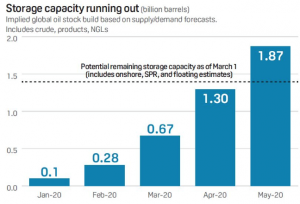
    As US oil futures plunged into negative territory in recent days we were reminded that if there is no storage available you can’t even give away a bulky commodity. In fact, some contractual parties in the futures market were prepared to pay somebody, anybody $35 for each barrel of oil to be taken off their hands. Just think, if one could have taken delivery of a million barrels of West Texas oil there was a whopping $35 million payment to accompany that load. The problem as the following chart from energy consultant, Platts, shows is that the US market has maxed out on storage capacity:

    Yes, that looks like we are rapidly approaching a stock build of almost 2 billion barrels of oil with storage capacity for closer to 1.5 billion barrels. The main driver of the stock build is CV-19 and the evaporation of oil demand. Think back to 2019 and daily oil consumption of 100 million barrels per day. Current estimates suggest we might be consuming 25 million barrels less, each day! To halt production would be very expensive hence the stock build and furious prayers to the Donald, Allah and Saint Christopher, the patron saint of travel. Hopefully, the rest of the world can follow China back to some sort of post Covid recovery phase but the decline of oil pricing power has been a multi-year trend.

    Here are a few further thoughts on the decline in influence of carbon fuel producers:

    1. For consumers of energy, as individuals or as businesses, a collapse in fuel prices should be viewed as an enormous tax cut.
    2. In 1980 the oil sector accounted for 30% of US equity markets. It now accounts for less than 3% while the technology sector represents more than 23% of the market. Who said data was the new business fuel?
    3. Rogue states and despotic leaderships dependent on commodity markets can be vulnerable to sovereign debt implosions and civil unrest. Russia and Saudi Arabia are more fragile than perhaps financial markets and investors appreciate.
    4. Storage has hurt the oil markets temporarily but on a longer term view storage will be equally important to the emerging renewable/electric/battery powered economy. There is still much to be done to improve battery/storage technologies. One can reasonably expect material science/chemistry graduates to be the hot talent property of the future.
    5. US shale oil production has exploded in recent years. Investment, employment and GOP election coffers have all benefitted. Oil prices, even if they recover back to the $30 levels, make shale oil an uneconomic proposition. US oil producing states are mainly Republican voting states but jobless voters can be fickle. It might be tough for them to stomach a Democrat President but it seems the current White House incumbent believes they can stomach disinfectant. So, anything is possible in the November election.

    As always, human beings are not great at forecasting the future. However, it is a racing certainty that the oil markets have not exhausted their ability to deliver further shocks in 2020.


    Enjoyed this blog? Then why not check out our other great content by clicking here!

  • Corporate Change Is Not New, Just Accelerating…

    I have to confess I haven’t been sleeping great the last few days. It is probably only natural that a changing world is causing the mind to race a little. Pink moons, or not, the nights can be dark for many in these uncertain hours. Some might think of lithium. I’m thinking of equilibrium. Balancing so much uncertainty and change is a mental challenge but perhaps we were already doing that? Just at a slower pace. Let’s think slowly about change for a few moments.

    Amazon started out in life more than 25 years ago as an online marketplace for books. An online marketplace, who knew? The Amazon monster has been blamed for the obliteration of many retail businesses since but would it surprise you to know that prior to the CV-19 shut-down employment in the US retail sector was at an all-time high?  Change, yes. Destruction, not so much.

    Microsoft is 45 years old. The software giant is now at the forefront of a work revolution. Thanks to cloud hosting services, many businesses have been able to operate on a remote basis in the current shut down. But hot desks, work-from-home and 4-day weeks are not new concepts as companies compete for talent and efficiencies. In fact, productivity has been a major challenge for developed economies for the last decade. Microsoft itself, in 2019, trialled a 4-day week in its Japanese operation and achieved 40% productivity improvements. Expect more “trials” and rapid change after this crisis.

    Away from work, Netflix is 23 years old and streaming an enormous channel of high-quality content to our homes and mobile devices. It spent $15 billion on creating content last year and is forcing change at the very largest media giants. Disney will be relieved they had embraced the streaming revolution as cinemas and theme parks now lie empty. Their Disney+ streaming service just signed up their 50 millionth subscriber since November. So, they achieved in 5 months what it took Netflix 7 years to do.  Change can literally mean survival.

    Clearly, the education, fitness and healthcare industries have their own revolutionary protagonists. And don’t forget the EV revolutionary, Tesla, and it’s 17 year journey. Just a quick reminder that Tesla’s market value was higher than Ford, GM and BMW combined before CV-19! So, let’s be very clear that change is constant but can suddenly accelerate into more universal adoption. The prizes can vary from supra-normal profits to survival.  The costs can vary from increased integration/education costs and investment spend to bankruptcy and liquidation fees.

    CV-19 is an accelerator period not unlike WW2. Science, healthcare and security will be uppermost in people’s minds and exact a cost from business. But not all costs are bad. Change can be frightening but very often good for all in the long run. In two instances an acceleration of change would be a very good thing. For far too long urbanization has been a driver of wealth creation. But at what cost?  CV-19 has laid bare the risks in neglecting two huge public health issues: adequate access to housing and healthcare.

    Perhaps the biggest change to come is a reversal of urbanization as corporates embrace remote working arrangements and a diversification of their greatest asset, talent.  Be under no illusions, workers are recalibrating their values and their lives right now too. Change is guaranteed, much of it good. You might even sleep better too. Good night, John Prine.

    “ When I was a mailman, writing songs was my escape from the regular world, and now writing songs is my job. And I’ve always been one to avoid my job.” – John Prine (1946-2020)


    Enjoyed this blog? Then why not check out our other great content by clicking here!

  • Health And Wealth

    I am sitting in the ‘West Wing’ of my home office. Rooms, corners, even furniture pieces have been given new names to inspire a sense of space in The Emergency but the brain remains unmoved. That must change. There are potentially even greater socio-economic transformations ahead. Was it only a few days ago the political leaders of the UK and the US were attempting to calculate a public health and economic trade-off in their Covid-19 containment strategies?

    Thinking at the highest levels of the oldest capitalist democracies on the planet was actually trying to figure out was there an ‘acceptable’ human cost to ensure economic activity was sustained. The outcry was predictable but possibly misplaced. Yes, a failure to “flatten the curve” would lead to much higher death tolls. But, this raises an existing uncomfortable truth for many societies. Ageing populations, income inequality and dysfunctional insurance frameworks have challenged public health systems for years and resulted in unnecessary loss of life. That death toll rises every year and will continue to do so without fresh thinking. Clearly, this curve wasn’t steep enough to care enough. However, a global crisis has focused minds both globally and locally.

    Ireland, fresh from elections dominated by images of hospital trolleys and homeless statistics, has impressively responded to the Covid-19 pandemic with the rapid deployment of funds, medical resources, beds and even properties. All is utterly changed, and in record time. In the UK the railway system has been nationalised by a Conservative government. In Ireland the caretaker centre-right Fine Gael government is effectively nationalising private medical facilities. Arguably, capitalism is due a re-set. At the epicenter of this socio-economic inflexion point is the fundamental right of a country’s citizens to access healthcare and safe living conditions.

    A full-blown crisis has unleashed a massive effort to ensure limited medical resources can meet the needs of a supra-normal demand. It is a war. And wars can leverage combined intelligence to deliver huge efficiencies and innovations. Ventilators are the key weapons in the Covid-19 battles waged in all hospitals but they are expensive. As the likes of Dyson and GM apply their engineering expertise to mass-produce these life-saving devices one can be reasonably hopeful that the pricing point for such equipment will permanently fall for future generations of the sick. Closer to home, a drive to make our health system more efficient and capable to serve more patients has accelerated the embrace of technology.

    Wellola was a recipient of Spark CrowdFunding investor support and is now delivering a Covid-19 communication portal to allow patients remote access to GPs. Similarly, the Mater Hospital is using software robots to input data and save nurses hours of administrative work. It has taken a crisis to force decisions and change working practices and technologies in healthcare. The benefits will last beyond this crisis and highlight the dangers of dysfunction and utilitarian capitalism.

    The US is fast becoming the poster child of how a profit-based healthcare system can struggle to deal with a universal crisis.  Apart from 60 million citizens excluded from its health insurance system, we have witnessed extraordinary bidding wars between state and federal entities for the same urgently required medical equipment. It remains to be seen how the huge private hospital industry in the US deals with the expected surge in the numbers of Covid-19 patients requiring acute treatment but it is likely to be ugly. After the tiny orange finger-pointing is over expect a social and political backlash against a healthcare industry designed for dollars and not for disaster. The ultimate capitalist society will possibly have to consider another way to look after all its citizens.

    Indeed, as students ponder public exams being taken remotely, I am reminded of a literary figure from my own school days. Charles Dickens created the Thomas Gradgrind character in ‘Hard Times’ to illustrate the coldness of utilitarianism. One might hope the words of Gradgrind will echo in Washington political lobby chambers in the coming months…

    “Some persons hold that there is a wisdom of the Head, and that there is a wisdom of the Heart. I have not supposed so; but, as I have said, I mistrust myself now. I have supposed the Head to be all-sufficient. It may not be all-sufficient…”

  • Ten Rising Valuations

    On the odd occasion over the past week, I will admit to a tinge of regret over the timing of a 100-day alcohol-free challenge. It doesn’t last long. A quick glance at any news footage swiftly calibrates my thoughts as to the true challenges in our utterly transformed Covid-19 world.

    The human, economic and social losses are already dreadful and we have no idea when our lives might return to a more normal rhythm. The not knowing is tough. However, that day will come and a very sobering ten days has prompted a search for positive thoughts. Ironically, as financial markets fall in value there are welcome signs of other socio-economic essentials gaining in value. Here’s our top ten:

    1. Value of Science: Science and facts have recovered their essential role in decisions of critical importance. In this era of social media dependency there has been an alarming consequence of individuals “choosing” their own sources of information. Widescale disdain for science and subjective selection of “facts” has facilitated a dangerous conflation of opinion and fact. Unfortunately, it has taken more than 10,000 deaths, horrific ICU scenes and a global economic shut down to disabuse the “just a flu” view. The facts and real doctors have overwhelmed the spin doctors. Now the hope going forward is that expertise is once again valued rather than sneered upon.
    2. Value of Leadership: It is unfortunate that Ireland’s two most important trading partners are burdened with dysfunctional political environments and chronic fact-free leadership. The “herd immunity” gymnastics of Boris Johnson and Dominic Cummings have cost the UK precious days of Covid-19 containment. There is a real danger of needless additional loss of life and a painful realisation that a leader’s casual acquaintance with the truth in a crisis is extremely damaging. Indeed, the consequences of Donald Trump’s daily delusions could be even more catastrophic for US citizens. In contrast, the informed and realistic public messaging from Merkel, Macron and Varadkar has illustrated what leadership can be, but laid bare the risks of entrusting power in the hands of mendacious journalists and reality TV stars.
    3. Value of Planet Earth: We haven’t figured out anywhere else to inhabit. One would be hopeful that mass exposure to the threat of a global socio-economic collapse will focus minds on preventing similar threats in the future. Climate change is a scientifically documented threat to all inhabitants of our planet despite what Donald Trump and other fossil fuel champions might opine. So, expect the ESG revolution to gather further momentum.
    4. Value of Work: We have often written about the dangers of extreme income inequality which now rivals levels last seen in the 1930s. This crisis has surely revealed the true value of essential skills in the likes of healthcare, logistics, education and food supply. The irony of “unskilled workers” now being described as essential to the UK economy skirts over the fact that many of these workers are also immigrants. Perhaps the next round of pay negotiations will be more rewarding and supported by a more appreciative society. Furthermore, governments are also now being introduced to the instant evaporation of incomes from the gig economy and zero-hour contracts. Post Covid-19, expect companies who avail of state bailouts to receive serious scrutiny of their commitments to their workers, even if they don’t want them badged as employees.
    5. Value of Technology: As families, businesses and communities adjust to huge change many will be introduced for the first time to the solutions technology can provide. How many families were thankful of the online children’s PE class hosted by Joe Wicks yesterday morning? About 800,000 families apparently. Take your pick from tele-conferencing, online order/deliveries, entertainment streaming, telemedical apps and educational videos as 20% of the planet’s population is in lock-down. Life will never be the same again for many as they discover new services and more rewarding uses of their time. All powered by technology.
    6. Value of Education: As people experience a curtailment of their social lives and an exhaustion of Netflix, Instagram and Tik-Tok entertainment this is a timely opportunity to reflect and stretch the mind. In a sense, we have been forced to confront our own mortality and the safety of those we love. But also, we might reflect on the potential ‘mortality’ of a business or career. This feels like the moment when continuous learning and upskilling goes mainstream. Educational platforms like Coursera, LinkedIn Learning, EdX and Udemy can expect significant growth in the coming months.
    7. Value of Community: Who would have thought the UK Conservative Party would go full metal jacket socialist while the Labour Party ripped itself apart for a post-Corbyn coronation! On a more serious note, don’t be surprised to see the traditional and much-maligned European model of state/social support being the winner in a post Covid-19 world. Some communities will fare better than others in this crisis and it will depend on how all tiers of each society share the challenge and support the vulnerable. Reports of a spike in ammunition and gun sales in the US are not a particularly auspicious start to the challenges fast approaching that society. On a more positive note this is the first time the world is united against a common enemy since WW2. Community solidarity can achieve many things from innovation to workforce inclusivity. Even empathy.
    8. Value of History: Voltaire said, “History never repeats itself; man always does.” After the 2008-2009 credit crisis there has been frustration in many countries that previous bad actors in corporate, media and political life were able to re-invent themselves and airbrush history. Surely in a digital world we can do better this time. Exhibit A in the nausea stakes is White House economics advisor, Larry Kudlow, revisiting our screens to reassure and spout the same utter nonsense he floated on CNBC in 2008. This writer’s earnest wish is that all passive enablers and promoters of Trumpian and Boris falsehoods will be exiled from ‘expert’ panels, company boards, legislative bodies and TV screens forever. Covid-19 will have many innocent victims but history must convict the guilty few charlatans swiftly.
    9. Value of Mental Health: Social isolation will be a new experience for many. They will learn new coping mechanisms and swiftly understand the challenges of the lack of social interaction. For a significant percentage of society mental health is an every day, every year challenge. There is a genuine possibility this crisis will massively increase awareness, prompt good habits and deepen the understanding and importance of mental health.
    10. Value of Kindness: Already this crisis has revealed uplifting stories of outstanding kindness. What is less well documented is the positive feedback loop created by little acts of kindness. Just reaching out to 5 people a day and asking how they are doing is a good habit and strengthens the resilience of both parties during this period of quiet isolation. The same could be said in business. Those franchises that continue to communicate well to staff, suppliers, community and customers through this period will emerge from the crisis stronger versus less thoughtful competitors. It should also become apparent that deliberate misinformation or callous messaging could be fatal for business too. Fancy a pint in Wetherspoons any time in the next decade?

    The months ahead will be tough. Hopefully, the values listed above continue to rise and society re-sets in a positive way. Honesty will probably save many lives and prompts one final thought. In some ways the Chernobyl nuclear meltdown was a greater threat to the planet but we just didn’t know about it at the time. The HBO series documenting these terrifying events had a wonderful line from the nuclear scientist, Valery Legasov – “Every lie we tell incurs a debt to the truth. Sooner or later that debt is paid.”

    Now it’s our turn. Covid-19 truths and debts are coming due.

  • Pull Back The Curtain On 10 Covid-19 Truths

    No matter how many times Donald Trump clicks his platform-boosted heels the Coronavirus will not go back to Kansas or a Chinese food market. Science and reality now have the upper hand as Covid-19 goes global and takes a tragic human toll. Beyond the tragic fatalities from the virus, the uncertainty surrounding its infection rates and pressures on healthcare systems has created fear at the very highest levels.

    The G-7 nations are planning an emergency conference call today as containment measures threaten to cripple global economic activity.  Already, shipping container traffic into the West Coast of the US is down 25%, tourist traffic into France is estimated to be 40% below average, airlines are cutting capacity everywhere and Apple’s manufacturing facilities in China are operating at just 25% staffing levels. Central banks across the globe are signaling financial support and the G-7 call is a recognition that this is probably the biggest shock to the global economy since the GFC in 2008-2009.

    As with all shocks, the global economy and financial markets will recover in time. However, like the virus itself, financial stress does have a habit of exposing activities and policies which have, to date, been untested or have escaped more forensic scrutiny.  As Warren Buffett has said, “It’s only when the tide goes out that you learn who’s been swimming naked”.  With the benefit of experience from previous financial crises we would advise readers to watch the following closely as the curtain of normality is pulled back:

    1. Peak China: Irrespective of how history reviews the actions of Chinese authorities in containing Covid-19, the almost total shut down of the Middle Kingdom’s manufacturing base will prompt serious review in multi-national C-suites. The era of concentrating one’s manufacturing assets in one region/country is over. Expect the likes of Vietnam, Albania, Mexico, Colombia and Indonesia to benefit from likely diversification of manufacturing activities.
    2. Zombie Apocalypse: Ultra-low interest rates have helped weak franchises stay afloat as banks avoid painful loan write-downs. Given many healthy franchises will need financial support, banks might finally have to cut loose the zombie companies and save those with a genuine future.
    3. Governing the Gig Economy: The explosion of task-based contract work through digital platforms has created an army of independent workers in the services sector. This independence is a double-edged sword. In a public health emergency, one wonders, particularly in transport based services, whether governance is strong enough at a corporate level to ensure compliance with safety guidelines. Expect increased regulation in the future of gig work which is now firmly embedded in nearly all economies. For illustration, 36% of US workers are involved in the gig economy through primary or secondary jobs.
    4. CEO Health: We have written in a previous article how Churchill advised never to waste a good crisis. A large spike in CEO departures is already underway as Covid-19 is used as a convenient curtain to camouflage structural challenges facing certain sectors.
    5. Financial Fraud: Enron was a TMT crisis reveal; Bernie Madoff and multiple banks were our GFC gifts of the gab and gruesome. Whither Covid-19? Readers won’t have to wait too long we fear as cashflow and credit stalls.
    6. Panic Platforms: Markets have experienced furious gyrations over the past week. There have been repeated warnings over the years that liquidity won’t be sufficient to handle customer requests to redeem/sell/buy in high volume scenarios ie panic. Spare a thought for clients of the Robinhood investment platform for retail traders which seized up yesterday. Never good to miss out on a 5% up day. Even worse if, as speculated, the website shut down due to coders missing out the Leap Year 29th
    7. Ghoulish Globalisation: Sadly, China is at the epicentre of the storm and ultimately consumers in the West facing product shortages will only encourage the likes of Trump and Boris to “take back control” and make steel, coal and toilet roll great again. Expect a further wrongly-informed electoral retreat from globalism and additional delusional nationalism.
    8.  Sub-Prime Oil: If we recall the GFC crisis there’s usually one sector that kicks off the financial domino chain of credit implosions. In 2008 “The Big Short” was the sub-prime mortgage sector in the US which killed off Merrill Lynch, Bear Stearns, Lehman Brothers, Washington Mutual and Countrywide. The sector we are watching most closely right now is the shale oil producers in the US. The sector has binged on junk bonds at very low-interest rates and is already struggling to generate positive cash flow. The oil & gas production sector, loved by Trump, accounts for a very large portion of junk bond indices so any sharp falls in these benchmarks will be a red flag that a demand shock (oil price drop) is going to trigger plenty of Chapter 11 filings and very ugly write-downs at large US banks.
    9. Balance Sheet Supremacy: Critical to understanding the financial threat of Covid-19 is that this is both a supply (chain) and demand (spend) shock. Hence the G-7 emergency call. This writer’s experience of the financial world’s army of equities analysts is that they spend the vast majority of their time trying to forecast earnings with almost no benefit to investors and abysmally fail to understand the company balance sheet dynamics of a sharp reduction in revenues. Great analysts (very few) and great companies(many in Ireland with huge GFC experience) will prosper post-crisis with fewer competitors and enhanced credibility.
    10. Politics Meets Facts: Death doesn’t do “spin”. Funerals and ICU units are real and the statistics will rebuff the most egregious exponents of science denial. It is very possible Covid-19 will be the death knell of the Trump presidency as the US grapples with the structural problems of so many outside the support net of government. No sick pay, no insurance, no education and no information could cause a far higher death toll per capita than other “developed” countries. Katrina and New Orleans destroyed Bush; thoughts and prayers won’t save Mike Pence or the President.


    If there is a single long term positive of a challenging Covid-19 crisis it must be the hope that science and facts reveal poor actors, incompetence and dangerous misinformation. Sadly, the human costs could be far higher than a digitally informed world would have hoped….

                    “Some people without brains do an awful lot of talking, don’t you think?” 

                                                                                                     – Scarecrow in The Wizard of Oz.


    Enjoyed this blog? Then why not check out our other great content by clicking here!

  • Charting Poor CEO Health

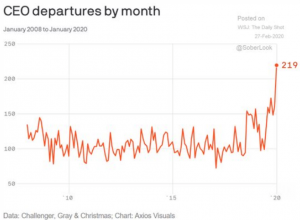
    Winston Churchill is often credited with the advice to “Never let a good crisis go to waste”.  In human terms, the Covid-19 outbreak cannot be described as a ‘good’ crisis. It is also arguable that it is not even a crisis yet despite the financial markets generating price charts dripping with fear. We have no idea how long Covid-19 will exert its influence on the global economy but centuries of history would suggest disease, even pandemics, do pass. In contrast, the world of business often has to deal with long-run structural challenges as well as temporary commercial shocks. One chart caught our eye this week and prompted thought.

    Back in October in “I’m a Celebrity CEO – Get Me Out of Here!” we highlighted an acceleration in the number of CEOs leaving their positions. In fact, July’s total of 159 exits was the highest ever monthly total. Fast forward six months and check out the chart below spiking to a whopping 219 exits this month. This is not a Covid-19 infection chart.

    Clearly, the broad sample of departing CEOs from the likes of Google, BP, Boeing, McDonalds, Mastercard and IBM cannot be pinned on the prospect of a global pandemic. However, there is a sneaking suspicion that the flurry of exit announcements in February could be the wise use of a crisis to prevent scrutiny as to executive motivations. While the financial press might be obsessed with virus infection rates, threatened recessions and VP Mike Pence’s comical history of fighting public health crises, there are a number of structural challenges facing the business world on a longer time horizon.  We can think of three or four global themes that require critical executive attention.

    First, the Covid-19 outbreak is further ammunition for those wedded to reversing globalism. The concentration of manufacturing assets in China will need to be addressed but is not really a result of globalism. No, the wrongly identified outcome of globalism is income inequality. There is no doubt income inequality is in urgent need of attention – Ireland could be Exhibit A in how to blow an election by confusing the difference between average net income and median net income. The latter metric reveals up to 50% of the country is making no progress as Irish national (average) figures zoom ahead.

    The prospect of raising wages and damaging profits and stock options for CEOs is possibly one they’d rather leave to the next boss. Another cost demanded of the markets is also about to rise and initially hit the bottom line. Climate change is real and ESG investment rules are already hurting some very large sectors and their valuations – think Oil & Gas, Steel, Autos and the Transport sector.

    Finally, spare a thought for the monster financial services industry. Yet another one of our 10 outlier surprises for 2020, the prospect of US 10 Year Bonds with negative yields, is not that far away. Yields are at 1.15% and falling fast, even before the Fed is bullied by the recession-threatened Orange Toddler to fix (again?) his 2020 election. The news almost as bad as another four years of Trump would be negative interest rates crushing the traditional business models of banks and curtailing lending.

    Time will tell if Covid-19 fades into history as a temporary tale of human loss and economic shock. However, there are greater structural challenges ahead and it would appear plenty of CEOs are quitting while they are well ahead in wealth terms and also ahead of difficult commercial decisions. Actions do speak louder than words and particularly pay attention when the easier route is chosen.  Churchill, again, put it rather well:

    “The problems of victory are more agreeable than those of defeat, but they are no less difficult”