Category: General

  • Top 10 Trends To Watch For 2020

    The end of the calendar year, and the decade, means readers should brace themselves for a bombardment of articles with all manner of forecasts and predictions for 2020. As always, many will be spectacularly wrong given human beings are particularly awful at forecasting. However, in the world of financial trading the trend is often your profitable friend. More importantly, trends can be evidenced with hard data. On that basis we thought it might be helpful to identify a mix of financial and geopolitical trends which are already established but will continue to impact business owners and investors for the forseeable future. Here’s our Top 10 with the usual health warnings:

    • Debt: Global debt has just topped the $250 trillion mark according to the International Institute of Finance (IIF). It’s rather scary to think that in the ten years since the credit crisis of 2008-2009 the world has piled on another $70 trillion of debt. This debt mountain is incredibly sensitive to rising interest rates. Hence, central banks led by the Fed have had to abandon attempts in 2018 to return interest rates to more normal levels. Central banks are now stuck in a Japan-style debt trap with additional credit creation achieving less and less stimulatory impact on economies. Now, frustrated and worried central banks are pressuring politicians to introduce fiscal policies to break out of this stagnation spiral. Unfortunately, politics at a global level is increasingly polarised.
    • Democracy: Levels of income inequality not seen since the 1930s presents the potential danger of history repeating itself. Democracy is under pressure. The Freedom House think tank published a report in 2018 highlighting that year as the 13th in succession where democratic freedoms were in decline. A total of 68 countries witnessed a tightening of civil liberties and political rights whereas only 50 countries registered progress in these areas. As 2019 comes to a close the strong-arm tactics of Trump, Putin, Xi, Orban, Erdogan and Prince MBS do not provide reassurance that authoritarian trends will reverse any time soon.
    • ESG: There is grounds for optimism that businesses and investors see “doing good” as a prerequisite for wealth creation. It almost sounds like common sense but the ESG investment framework covering Environment, Social and Governance factors is gaining traction rapidly with $30 trillion worth of investments now employing ESG metrics in their investment processes. That $30 trillion number will grow and standardised metrics to measure and audit ESG will be the next challenge for business and investor alike.
    • Trade: President Trump is now saying phase 1 of the China-US trade negotiations might not conclude until after the 2020 US elections. Who knows what will come out of Trump’s mouth next but expect 2020 to again be dominated by trade tensions in the EU with Brexit, and in Asia-Pacific with China. The rise of populist politics and trade protectionism are the two sides of a no-win economic confidence trick. Closer to home, Boris Johnson’s bombastic certainty of concluding trade deals with Europe by the end of 2020 will be particularly painful to watch unravelling.
    • China: The most important macro story apart from debt in the world today is China. It’s arguably the engine of growth which services the planet’s debt. By the end of this year Chinese consumers will have purchased goods worth more than $5 trillion, exceeding that of the original consumption super power, the US. So, financial markets will now have to pay much closer attention to the role of Chinese consumer confidence in the global economy. Think of how many decades financial research and trading teams have agonised every first Friday of the month for the US Non-Farm Payrolls. Get ready for Sunday night China economic reports but before that keep an eye on bond default newsflow. There have been four or five relatively significant blow ups in recent weeks, even involving State Owned Enterprises (SOEs). Do not underestimate the potential impact on consumer confidence if the all powerful state can’t save its own.
    • Tech Tension: Technology has been a dominant driver of markets since the credit crisis. Some companies now have user bases which would be in the top 3 populations of the world if they were sovereign states. Think Facebook and Alipay with 2.5 billion and 1 billion users respectively. As Microsoft and Apple’s combined market value now exceeds that of Germany’s entire stock market at $2.25 trillion it is tempting to think this is a high water mark for tech valuations. Two developing stories/trends suggest the tech sector could meet some growth challenges. First, Facebook’s power and abdication of responsibility on publishing false information to huge numbers of people is moving towards a 1911 moment. That date is neither a typo nor hyperbolic. For the historians, that’s the year when the Standard Oil refinery monopoly was broken up. Second, the rise of ESG is ultimately not compatible with corporate deference and fear of China’s wrath. The recent China anger incidents involving the NBA, Apple and Google suggest corporates may have to decouple from Chinese internet and broadcasting platforms. Yes, the internet could splinter and anyone following the Huawei case with fears over 5G security might be forgiven for thinking a “net split” is not just a possibility but inevitable.
    • Content is King: Even with a potential internet split, original content continues to be the critical asset for every media platform on the planet. We mentioned monopolies earlier but has anyone noticed that Disney has quietly assembled a portfolio of content assets with enormous power? Even before Star Wars opens in cinemas, Disney has accounted for $1 in every $3 spent in cinemas in 2019! The battle for content has exploded to unsustainable levels with almost 500 originally scripted TV shows produced this year. In 2012 that number was less than 300. And the costs are rocketing. One statistic we read recently was that for each $1 of a Netflix subscription the user was receiving $1 billion of content. It’s not just entertainment content. Think about the $5 billion valuation of Manchester City implied by the recent private equity investment made by Silver Lake Partners from Silicon Valley. Live sport is hot but $5 billion for a franchise which can’t fill its home ground…?
    • Energy: Climate change is for some top hedge funds now a critical factor in every investment selection. The climate crisis headlines multiply each week and this means continued pain for fossil fuel investors. Apple’s valuation is now bigger than the entire US Energy sector. Furthermore, for fossil fuel dependent economies like Saudi Arabia and Russia it is striking that their levels of sovereign interference have increased in recent years in the likes of Yemen, Syria and Ukraine. There is a suspicion that this projection of international power is an attempt to disguise significant structural weakness.
    • AI: We have been inclined to highlight the risks/areas to avoid but Accenture tells us there is a $14 trillion opportunity in AI across 16 industries in the years out to 2035. Health, finance, logistics and agriculture all look particularly suited to AI innovation and it is striking to see an out-of-favour sector like finance now attracting the largest chunk of venture capital money via European fintech.
    • Inflating Value: And that leaves us finally with another potential positive albeit it is difficult to argue this trend is established just yet. However, we can include this in our list with a speculative health warning! For years, value investing has been clobbered in performance terms by growth and momentum investing strategies. Yes, it might be difficult for oil to make a come back but other commodities could bounce back sharply if inflation picks up. Whisper it very gently but there is data/evidence to support wage inflation picking up in Europe. Wages are growing at the fastest pace in a decade and Europe remains the largest trading bloc in the world. A stronger Europe would be a very positive development. No doubt, investors stuck in value strategies will be watching hopefully for an end to their performance misery. The rest of the world should hope for the same too.

    Enjoyed this blog? Then why not check out our other great content by clicking here!
  • Could The Internet Fracture?

    The debate about what is the true “fuel” of modern business is now over. The world’s largest oil company, Aramco, failed to drum up any international interest in its planned IPO last week. Not so for the world’s largest online retailer. And, we don’t mean Amazon. Despite plenty of shocking headlines about China in recent days, it would appear the world’s investors will park their social consciences if a tech-fueled business rolls into IPO town.

    Alibaba is the Chinese e-commerce giant that outsells Amazon by a factor of three times in terms of merchandise value and is listing its shares in Hong Kong this week. Yes, Hong Kong. Local elections may have delivered a bloody nose to Beijing-aligned candidates this week and blown up the party line that “the silent majority” was against the long-running protests against mainland political interference. However, Alibaba and its lucky stock code “9988” has provided some positive news for the Politburo. Investors have snapped up almost $13 billion worth of shares sending the stock price up more than 6% and delivering a vote of commercial confidence in Hong Kong. Alibaba’s success will be cheered in Beijing. Probably less so in the Chinese region of Xinjiang.

    Xinjiang is home to 11 million Uighurs of the Islamic faith. The persecution of this minority by Chinese authorities is not a new story and has been consistently denied by Beijing spokespersons. However, in recent days we have witnessed an all too rare media occurrence. Multiple international news broadcasters and publishers have given over top billing and front-page headlines to a remarkable expose which has generated its own “handle”, The China Cables.

    The cables are actually leaked documents given to the International Consortium of Investigative Journalists (ICIJ) and shared with seventeen media organisations including the BBC, the Guardian and Irish Times. The documents are a damning account of deliberative Chinese attempts to intimidate and oppress the Uighurs. The numbers are staggering as a complex of mass detention camps house up to 1 million prisoners without charge or trial. The ugly truth revealed is, per the Irish Times, “the largest incarceration of a minority since the Holocaust”.

    The leaked documents further detail the monitoring of mobile phone apps usage by Uighurs and behavioural flags prompting investigation and likely “re-education” in internment camps. In fact, China is well on its way to compiling a massive database to assist surveillance of its entire population and ultimately deliver “predictive policing” based on a social scoring system. Seventy-five years on, Auschwitz meets Alibaba. We are faced with the uncomfortable prospect of technology, the internet, which has brought the world closer together now being used as a weapon, forcing communities and nations to put up barriers. Indeed, China itself already employs a “Great Firewall” to control information received by its citizens. It would seem our fears are shared at the very highest levels of the planet’s most important sovereign community, the UN.

    In a recent interview with Wired magazine, Antonio Guterres as UN Secretary General expressed his view that the world’s next major conflict will start in cyberspace. Clearly, a cyber threat requires self-protective actions and it was striking that Guterres sounded the alarm bells about the current confrontation on trade and technology between China and the US. More specifically, he spoke about the risk of “decoupling” between the world’s two largest economies, “in which all of a sudden each of these two areas will have its own market, its own rules, its own internet, its own strategy in artificial intelligence.” The current travails of Chinese 5G champion, Huawei, might be only the beginning of protectionist policies introduced by countries watching China’s weaponisation of the internet.

    It is striking that one of the few areas in US politics which generate fully-fledged bi-partisan policy support is challenging China on its aggression in the technology sector. This is often described as “phase 2’ of US-China trade negotiations. Seasoned US-China observers increasingly believe there will never be a phase 2 of negotiations. At the moment the Orange Toddler in the White House is trying to undo the self-inflicted trade tariff damage covered by phase 1 negotiations. However, one does wonder whether events in Xinjiang will reverse the direction of talks and lead to a discussion at the UN level of additional global trade sanctions against the Beijing regime? One sadly suspects sovereign commercial interests will supersede human rights, for now.

    Events in Hong Kong will be watched closely as Beijing patience wears thin with the protestors encouraged by voter defiance this week. A harsh crackdown by Chinese authorities could force further strategic appraisal by business leaders of commercial exposure to a country whose social and technology policies diverge from the ethos of their firms. It is slightly unnerving that Holocaust references this week haven’t already prompted significant discussions. As business owners and investors, be under no illusions that any “decoupling” from China will have a far more significant online impact than the conscious uncoupling of Gwyneth Paltrow and Chris Martin. The internet risks fracturing into geopolitical spheres of influence with real cyber defensive and offensive weaponry.

    Consider recent instances of protectionist cyber actions in India/Kashmir, Iran and Turkey as early tests of the internet world order as we know it. History tells us that relatively local events like Sudetenland, Anschluss, Saar and Kristallnacht combined with political weakness can add up to a sudden global destabilisation. The global internet faces new technology challenges and an increasing number of bad actors – democratic nations are falling in number. Even the UN is worried the internet could suffer a decoupling or fracture. We are worried too, albeit we suspect Boris’s technology “lessons” in Shoreditch won’t prepare him for the fallout…


    Enjoyed this blog? Then why not check out our other great content by clicking here!

  • Fuel For Thought for Aramco…

    Well, well, well. It appears oil wells are no longer the stuff of bankers’ dreams. For a fleeting moment this writer almost felt sorry for the investment bankers who had to meet with Crown Prince Mohammed bin Salman’s officials in Riyadh at the weekend. The message the bankers had to deliver over the whirring of bonesaws was not an easy one. The crown jewel of Saudi industry and national oil champion, Aramco, was due to embark on a series of investor roadshows around the world this week to sell shares in its planned December IPO. However, there was a small flaw in the plan.

    Despite the efforts of the 25 banks employed in the selling syndicate there was almost zero international investor appetite for shares in Aramco at even reduced valuations. The awkward advisory report delivered was that there would be no international roadshows and that the only likely interest was in Saudi Arabia itself and some neighboring Gulf states. The shunning of Aramco is remarkable given its status as the world’s most profitable company. In 2018 it’s profits were $111 billion thanks to an ability to pump an average of 13 million barrels of oil daily. For context, the total US output is 10 million barrels daily.

    The banker embarrassment didn’t end with roadshow cancellations. The much-hyped goal of the Crown Prince to list a company valued at $2 trillion was dashed with current valuations pitched at around the $1.5 trillion level. Without international participation, the number of shares is being scaled back dramatically to just 1.5% of the total share capital rather than the anticipated 5%. One suspects the subjects of the Saudi kingdom won’t have the luxury of negotiating valuations albeit they might get the opportunity to visit the Riyadh Ritz Carlton…

    On a slightly more serious note there are a number of issues to consider for investors in light of this IPO push back. Aramco is no WeWork. It is a hugely profitable company with real assets, sovereign customers like China and the prospect of relatively high dividend yields in a zero interest rate world. It is easy to dismiss investor unease as a fear of being a minority shareholder in a Saudi state-owned enterprise or Aramco’s vulnerability in the unstable Middle East. Recent Houthi/Iran attacks on Aramco refining infrastructure will also bolster that risk factor in investor minds but we think there are bigger structural trends to consider.

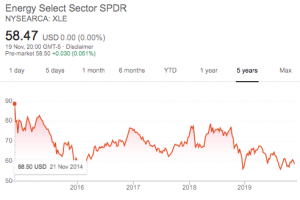
    Fossil fuel energy is in a long term downtrend in international financial markets. The US energy sector ETF (XLE) has almost halved in value in the past 5 years. In previous articles, we have referenced hedge funds which now consider climate change risks before every investment. Pools of capital are chasing renewable energy, electric vehicles, recycling, meat alternatives, etc. as the investment assets with future rising demand and returns. Oil is not part of the climate change future. In fact, Aramco alone has generated 4.4% of all the world’s CO2 and methane emissions since 1965. That’s some history. Here’s the misery chart for oil company investors over the last 5 years.

    Fuel For Thought Spark Crowdfunding blog
    So there is definitely an environmental risk factor in most investors’ processes these days. However, that’s not the only risk consideration. The increasing popularity of ESG compliant investment (that’s Environment, Social, Governance standards) is not just driven by a sudden embrace of “good” corporate citizenship by companies and investing institutions alike. The other critical factor is that recent performance data suggests funds which feature ESG risk filters in their investment process are more likely to outperform.

    The problem for Aramco and its outsized share of the Saudi economy was that investors have equated Aramco with the Saudi kingdom itself. The Saudi track record of repression of women, dissent, Shiite minorities and weaker neighbour states like Bahrain was a difficult pitch for the bankers to investors who would be minority shareholders in governance terms. The human rights atrocities in Yemen and the murder of WSJ journalist Jamal Khashoggi are the more lethal examples of societal tyranny listed earlier and would be red flags in any social or ESG risk evaluation.

    Aramco is an extreme example of ESG failure given investors are now prepared to give up on attractive near term dividends. ESG will continue to grow in influence and actually start to impact valuations; think of it in terms of investor demand(ability to invest). Unfortunately for the oil sector, all the ESG trends are moving in the wrong direction. Climate comes first… and then the creditors.

    Many oil and gas companies will in the not too distance future have their Riyadh Ritz Carlton “moment” with their lenders. Tears will flow rather than oil, but not so many from the planet’s citizens who will continue to battle extreme fire, flood and temperature events.


    Enjoyed this blog? Then why not check out our other great content by clicking here!

  • The Most Important Poll In Markets Today

    As impeachment hearings begin in Washington this week one can’t help wondering what Roger Ailes would do. Ailes, the creator of Fox News, is the subject of the latest US blockbuster mini-series, The Loudest Voice. It’s a scary reminder of how Fox News dramatically changed the US political landscape and used TV, not just to shape audience views but to deliver a vision of the world demanded by its viewers. Ailes himself once said, “Truth is whatever people will believe”. It is already clear Ailes’s legendary truth-shaping genius would be sorely tested on Capitol Hill right now. However, it might not even matter.

    There seems to be an air of resignation that Donald Trump’s base support of Fox viewers are unmoved by their President’s daily dose of awful. Porn star pay-offs, Greenland annexation, Kurdish betrayal, North Korean love letters, Twitter tantrums and Putin puppy dog fawning have failed to erode core voter support of circa 44% in current national polling. Critical to this robust base is the cult-like devotion of almost 90% of Republican voters. Thanks to the electoral college voting system in the US it’s entirely possible Trump could be re-elected in 2020 with a sub-50% support base. However, wall-to-wall TV coverage of impeachment hearings in Washington is possibly the last chance for this core support to shift.

    The live TV depositions of the first two witnesses from inside the US State Department, George Kent and Bill Taylor, paint a very stark reality that the Prime Minister of an ally, Ukraine, was the subject of a mobster style shake-down. The foreign policy version of wise-guy extortion was the blocking of much needed military aid to force a false investigation into election rival, Joe Biden. There are multiple other witnesses due to testify with similar tales and the only accounts missing are White House figures defying subpoenas to appear. It’s TV torture for Trump and his Twitter account is exhibiting heightened levels of agitation. However, there is only one poll that ultimately counts.

    We are only in the impeachment hearings phase. The vote to impeach is still to come in the House of Representatives and will likely pass. Then it’s on to the Senate for a trial. The hurdle in the Senate to actually convict Trump and remove him from office is a two-thirds majority guilty vote. This is where Republicans failed in impeaching Bill Clinton. Most observers correctly believe it is currently almost impossible to see how the required 20 Republican Senators cross the aisle to vote with Democrat Senators for removal of the President.

    This reluctance of Republicans to convict is not driven by any devotion to the country, the presidency or the constitution. It is entirely driven by survival instincts. Republican political careers without the support of the Trump base are toast. But that Trump approval rating within the Republican vote needs to stay at 70% or above. Below that and Senators will know the numbers with or without the MAGA Trump base won’t stack up to beat their Democrat rivals in 2020 elections. So, this internal approval rating within the Republican/Fox base is absolutely critical for Trump’s survival. It also will be watched closely by financial markets.

    A Trump presidency in real trouble will encourage the Chinese to stall on trade war negotiations. That, in turn, will continue to hurt global manufacturing activity levels. One should also consider the impact of a chaotic exit of Trump from the presidency. There will likely be an electoral backlash and fears of a new less business-friendly occupant of the White House. Wall Street is already ringing alarm bells about a potential Warren or Sanders presidency. One should also not overlook the impact on US consumer confidence.

    It will not be easy for a nation to digest the likely truth that the 2016 election was manipulated to install a Russian foreign policy asset. One should be mindful of the performance of markets the last time the US suffered a crushing embarrassment. Arguably, the Nixon resignation and the Vietnam retreat in 1973-1974 had multi-year consequences rather than the Middle-East oil crisis of 1973. The Watergate Hearings were first televised in May 1973 when the S&P 500 was trading at 615 points. By June 1982 the S&P had more than halved to the 290 level after a multi-year bear market. This makes for sober reading but one could argue we are in a better place than the 70s. Globally, investors are enjoying a good year despite geopolitics and slowing economic activity. It’s all very Goldilocks – cooler economics, warmer money-printing/rates.

    Sure, the S&P 500 chart makes for cheerful watching as it reaches all-time highs. Also, TV screens will provide some amusing moments from Capitol Hill in the coming weeks. But…voter polls have the potential to present an uncomfortable truth whether they change or not. The first possibility is that the truth, as most sentient beings understand the meaning of the word, will be ignored and the Trump support belief/truth remains unmoved. In that case, the longer-term implications of constitutional chaos, geopolitical instability and continued illegal actions from the White House will be significant.

    The alternative scenario of a significant shift in Republican polling will deliver more immediate negative market reaction but hopefully undo 25 years of Fox News reality shaping and abdication of broadcasting responsibility. No doubt there will be short term pain and embarrassment for many but a restoration of truth to US politics can only be a good thing. The loudest voices have enjoyed too much airtime.


    Enjoyed this blog? Then why not check out our other great content by clicking here!
  • How Many Sequels For Nightmare on Downing Street?

    Halloween for horror enthusiasts has been a little disappointing so far. As another Brexit deadline passes one can’t help noticing the total absence of street riots, Boris’s corpse in a ditch or Mark Francois’s Territorial Army uniform exploding. Brexit must wait for the outcome of a General Election to be held on December 12th. Europe must wait too but is only giving the UK until 31st January 2020. More deadlines, more headlines and more economic damage. This self-mutilation of an entire country feels more “Saw” than Freddie Krueger if one were looking for Hollywood parallels. Now hold that Hollywood thought.

    On so many levels Brexit is the gift that keeps on giving for the media, and the Conservative party is definitely the Scream Queen of the franchise. The Conservatives’ occupancy of 10 Downing Street in recent years has delivered two general elections, two leadership elections, two referenda and two Brexit extensions. In keeping with Brexit bizarreness, the bookmakers still see the Conservatives as the best bet to win most seats in the December 12th election and continue as the key protagonist in the Brexit nightmare. This may turn out to be the case but readers might want to consider some new characters and plots which have a very good chance of hitting our screens.

      • UK Business:

    Apple and Facebook may have delivered excellent results on Wall Street this week but the news from UK bellwethers is more mixed. The UK’s benchmark index of blue-chip stocks, the FTSE 100, is light on technology but weighted heavily towards financial, energy and mining giants. Let’s just say the updates from Lloyds and Royal Dutch Shell this week have been less than stellar. Domestic UK business is already grappling with Brexit paralysis so a global slow down(Hong Kong recession confirmed) will only squeeze margins and investment plans further. Property and business confidence are strongly linked in the UK economy so a RICS survey which found 62% of respondents confirming a downturn in commercial property is not helpful.

      • UK Currency:

    The removal of a hard Brexit outcome, for now, has stabilised Sterling (GBP). The UK currency reflects the short term views of the financial markets but those relatively benign views can violently shift. Think about how many villainous comebacks occur in a popular horror franchise. Brexit has that same potential to re-introduce Mr. Market as the villain only a decade after the credit crisis.

      • Trade Talks:

    In the week that saw the publication of The Globalist, a biography of the late great Peter Sutherland, one can only wonder what he would think of Brexiteer trade delusions. As the father of the World Trade Organisation framework and the incredible complexities of trade talks, he could paint a rather scary picture of the post-Brexit free trade discussions. Lots of red lines, lots of blood and lots of time. It will be long and it will be ugly irrespective of Brexit actually happening.

      • UK Politics:

    Brexit means Brexit. Taking back control. The people’s will. What will be the post-election slogan of the new government? The current narrative is that parliament is broken and an election is needed to clear a path to deliver the wishes expressed in the referendum. A more incendiary line is that the body politic is frustrating the wishes of the people and is the real villain in the Brexit story. On that basis, the chances of a non-conclusive election and a hung parliament could become the ultimate gore-fest. The probabilities of a hung parliament are more than significant in what is effectively a 4 party election voted on a first-past-the-post basis. Those are the classic ingredients for a very volatile vote and outcome. The nightmare scenario of political paralysis, clocks ticking towards EU deadlines, businesses cutting jobs and civil unrest is a combination of events which even a villain like Jigsaw would appreciate.

    Back in the real world, we can only hope the least worst results of Brexit materialise and then reflect on a horrible hindsight truth. Hallowe’en began as the Celtic festival of Samhain. How the world must wish David Cameron and his Attorney General had paid more attention to Celtic matters when framing the Brexit referendum question. The Good Friday Agreement eighteen years earlier placed into international law the UK’s commitment to keeping at least one of its borders in the EU. The sad irony of Brexit is that the Conservative and Unionist Party of the United Kingdom has committed to sawing off one of its own limbs. The horror of that, and possibly another Celtic sequel to follow. Bloody tragic.


    Enjoyed this blog? Then why not check out our other great content by clicking here!

  • Time Waits For No Business

    Time has been on my mind this week. As a weekend of clock-manipulation beckons, I have a growing feeling that time is, in a business sense, accelerating dramatically. I accept that the acceleration of time makes no scientific sense but bear with me. Google’s engineers have just used quantum computing power to solve a problem in 200 seconds which current supercomputers would take 10,000 years to solve. Armed with that mind-boggling evidence of machine efficiency, perhaps a more accurate statement of my feelings is that the world is speeding up rapidly. Not unlike our climate, the normal life cycle of a business is undergoing a profound change.

    First, let’s remind ourselves of a normal business cycle. Molex Inc was founded in 1938 and started out business life making plastic flower pots. It quickly moved on to making plastic power connectors for General Electric and was instrumental in the development of the first car radio, the first mobile phone and the first Hi-Definition TV. Plastic power connectors are now almost a commodity (despite what Apple charges you for their notoriously delicate Mac chargers) and Ireland is not the place to be in the business of manufacturing a commodity type product. Little things can destroy profits in these types of businesses. Thanks to the Trump Trade war with China, profits at Molex are hurting and sadly its Shannon plant is to close with the loss of 500 jobs and its base in Ireland since 1971.

    There will be further employment hits from trade wars and Brexit lunacy but do not be fooled into thinking we are experiencing once-off events or a normal business cycle. Nokia started life making toilet tissue and rubber boots. Then they conquered the world of mobile phones owning 40% of the mobile market and 50% of the smartphone segment by 2007. Unfortunately, Nokia didn’t focus on the development of the smartphone. Apple and Samsung did. Nokia’s phone business was sold to Microsoft in 2014 after a market share implosion to just 3%. So for the last five years, Nokia has reinvented itself as a mobile networks player. Until yesterday. Or, more precisely, until 5G. The life cycle of each generation of networks continues to shorten and the upcoming rollout of 5G is presenting profit challenges for Nokia and its share price; just the 23% collapse yesterday, the biggest share price fall since 2000.

    This rapid evolution of technology is not just a challenge for technology companies. Be under no illusions that the integration of new technology into all types of businesses is now critical to compete and ultimately survive. Frankly, if businesses are not using data to connect with their customers and then understand what their customers want there will be disruptors more than happy to come up with the next smartphone, product or service. Disruptors can move quickly and don’t need the traditional fixed asset tools of business. Look at Uber – a taxi company that doesn’t own its taxis. New York taxi medallions/licenses as recently as 2014 were changing hands for $1.2 million. You might get $150k today for the same iconic yellow medallions.

    Visit a McDonalds recently? A bank? Robo-servers and robo-advisors reign. Automation is happening now, and not just narrow task-based robotics. Artificial Intelligence(AI) is too often perceived as a replacement for repetitive human tasks. Think again because the machines will think, soon. The most powerful applications of AI will be the combination of experienced humans and deep learning; collaboration rather than substitution. Consider medicine and Atomwise which uses AI deep learning algorithms to massively speed up drug discovery/research with hit rates improving by 10,000x. The largest pharmaceutical companies have been under pressure for a number of years now and share prices have gone nowhere. Glaxo and Novartis share prices have barely moved in five years on market disappointment with the pipeline and delivery of new blockbuster drugs. The blockbuster model is dead so managements are searching for new strategies. Cost-cutting is one, as Cork discovered this week with the loss of 320 Novartis jobs.

    These job losses are very sad for employees, their families and communities but the news is not all bad. Before the fall of the Iron Curtain and the entry of China into the global market place, Ireland Inc got it right, positioning itself as the world’s best high-end manufacturer and service provider. The consciousness of time and fast technology in this article is that Ireland needs to move again and avoid Nokia-type complacency. At a recent excellent Accenture presentation on AI, there was a fascinating factoid that Paisley in Scotland was at one point in the early 1900s host to the third-largest company in the world. Coats Group, the textile manufacturer was ranked globally behind US Steel and Standard Oil. Coats Group plc still loiters in the FTSE 250 index of medium-sized UK companies but the last thread mills in Paisley closed in 1993.

    It is worth reminding ourselves of the political pressures to keep the Ford plant in Cork open in the mid-1980s. It didn’t happen for Ford’s unfortunate workers but Cork did get Apple in the same ‘80s period and its 4,500 employees today. Today Apple is a trillion-dollar company and Ford’s market value is below that of Tesla, its relatively tiny electric vehicle competitor!

    A final thought on cycles. As Mario Draghi retires from the ECB without a single interest rate hike to his name, be prepared for Japanification of the business cycle. Ultra-low interest rates and low growth can keep zombie companies alive for long periods but ultimately they will wither and die. Financial markets may well be close to all-time highs but it disguises massive shifts in value and growth expectations across sectors; see retail, banking, auto, telecoms, energy and media sector performances as Mr. (pick your pronoun) Market’s concerns for the future.

    The markets are already discounting a world of corporate zombies, super quick technology cycles and constant competition from new companies who can access capital cheaply and require no fixed assets.
    Constant competition and low growth require business managers to be super-focused on customers, market trends and costs. There’s nothing particularly artificial or intelligent about acknowledging that reality. So, bank that extra hour of sleep at the weekend.

    Then think time and technology.


    Enjoyed this blog? Then why not check out our other great content by clicking here!

  • Ship Ahoy, A Lesson in Risk……

    The giddy financial headlines of the past decade have been dominated by massive profits for investors in technology stocks, social media influencers and opportunistic purchasers of distressed property portfolios. However, the stories in the world of shipping have been less cheerful. Years of over-supply of freight capacity killed pricing in a global fleet of over 10,000 ships which doubled in size from the early 2000’s. The dry bulk sector has possibly been worst hit with benchmark shipping rates falling by up to 98% from previous highs in 2015-2016. Needless to say investors in publicly traded dry bulk shipping stocks have experienced share price implosions of 95-99%.

    As China’s economy and global manufacturing slows with an increasingly fraught geopolitical environment one could be forgiven for thinking the chances of a shipping recovery would be certainly dead and buried. Welcome to the risk of certainty and the explosive results of almost everyone being caught out at the same time with the same wrong view.

    Events in recent weeks in the crude oil carrier sector have been mind-blowing. And, we are not talking about the Donald’s latest attempt to blow up the Middle East with his Syrian gift to Turkey’s Erdogan. Yes, the Saudi refinery bombings and general US-Iran tensions have contributed to a squeeze on the pricing of rates for very-large-crude-carriers (VLCCs) but crude oil prices have subsequently settled back to pre-bombing levels. Not so VLCC shipping rates. What if we told you VLCCs are currently on daily charging rates of $300,000?  For context, as recently as mid-August daily rates were as low as $25,000.

    The purpose of this article is not to explore the exact combination of factors contributing to a ten-fold increase in freight pricing and an 80% increase in the value of certain shipping stocks in a matter of weeks. We’d rather use this event as a cursory reminder that a relatively minor combination of events can, in certain circumstances, create a violent reversal in market behaviour and views. More specifically, be very wary of an asset class displaying symptoms(pricing) of an extremely certain view. Think of crude shipping and a strong consensus view that the sector was nowhere close to recovery. Now think of a much larger asset class…

    How about the sovereign bond market where $16 trillion of debt currently carries negative yields? In lay person’s terms that is an overwhelmingly benign view of inflation over the coming years, ie bond yields would have to rise significantly(and bond prices fall at the same time) to counter the destructive effects of inflation on capital currently delivering no compensatory income. In contrast to the shipping sector, the cheery consensus view on bonds feels a little too one-sided and allows for very few surprises. A world without surprises just doesn’t feel like the right call in the current bizarre geopolitical environment.

    Finally, to complete our shipping journey it is worth highlighting it is only the VLCC sector(fleet size of 800 ships) which is experiencing stratospheric rate inflation. The larger dry bulk sector remains incredibly depressed in terms of asset values – barely 2 x annual cash flows – but has a couple of interesting drivers over the next few years. Firstly, there is no bank lending appetite and stricter regulatory rules which ensure excess capacity is being whittled down rapidly. Second, recall our mantra that every investment should now consider climate change. The shipping industry is in clean-up mode with global regulations now requiring costly installation of ballast water treatments plus engine re-calibrations for lower-sulphur content fuels by 2020. That means there will be further temporary capacity hits next year.

    Now, also consider shipping as a sector typically non-correlated with other financial assets which are currently trading across the board at close to all-time highs. In fact, shipping is considered a ‘geopolitical hedge” – shipping rates benefit from wars, conflict, canal closures and the odd lunatic leader. The world is currently well supplied on the “leader” front  so don’t be afraid to ship in some protection from madness.

    Of course, the Greeks have been the ultimate shipping nation which has hit hard times. Up until recently, it was assumed Greece would never be able to access bond markets for a decade. Now they are borrowing at cheaper rates than the Land of the Donald. Whoodathunk!

    Certainty, in transport terms, can be laden with risk and emotional biases. Aristotle Onassis put it quite well…

    “I made a big mistake. I never believed in the world that we live in, emotions can overcome every logic in business” 


    Enjoyed this blog? Then why not check out our other great content by clicking here!

  • Culture and Commercials Collide over China

    Culture and Commercials Collide over China

    The West’s Faustian pact with autocratic China is entering a very challenging phase and the timing is not without historical irony. Exactly fifty years ago Chairman Mao officially ended the disastrous Cultural Revolution initiated in 1966. That negative assessment is not just an outsider’s view; the Communist Party of China in 1981 stated that the Cultural Revolution was “responsible for the most severe setback and the heaviest losses suffered by the Party, the country, and the people since the founding of the People’s Republic”. The human cost was less explicit but is estimated at up to 2 million deaths. Fast forward to today and we are beginning to see headlines about “culture wars” involving China but this time the costs are more likely to be massive commercial damage. And not just for China.

    By now readers are familiar with the ongoing trade war between the US and China which is entering its latest round of negotiations this week. By all accounts it’s not going very well, a not unfamiliar experience for the cult followers of the Orange Toddler and “The Art of The Deal”. However, Trump’s take on the US relationship with China is one of the few policy areas where there is unanimous support across the domestic political spectrum for his view that China’s increasing commercial power and influence is negatively impacting US interests. Of course, Trump only sees the impact in dollar and balance of trade terms but US corporations are suddenly having to deal with a much more thorny issue; compromising their corporate values in order to protect commercial interests in Chinese markets. That was never in the Western capitalist play book.

    The consensus view among corporate capitalists was that the opening up of Chinese markets would deliver two big wins. Firstly, vast profits would be made from a billion plus population re-entering the global consumer market for the first time since 1949. Second, the assumption that, over time, Western values would be adopted by China and dilute the less palatable aspects of an authoritarian police state. Events of recent weeks would suggest the second assumption was very wrong which now threatens the correct commercial predictions. Just ask the National Basketball Association (NBA).

    Basketball, an American sporting staple, is now massive in China with an estimated 800 million fans or more than twice the entire US population. The commercial impact of that following is enormous in the context of TV rights and sports merchandise but now there’s a culture cost. The NBA has a reasonably well earned reputation for more progressive values compared to other US sports franchises like NFL(anthem kneeling) and MLB(political silence) but this week that reputation suffered badly.

    A tweet by Houston Rockets’ manager Daryl Morey in support of Hong Kong protestors triggered a firestorm from Chinese partners threatening lucrative TV and merchandise deals. The NBA responded with a craven apology for “hurt” caused to Chinese fans which rightly earned criticism in the US. Then there was a further communication making clear that there would not be an apology for the actual communication by Morey citing the NBA’s values of “equality, respect and freedom of expression”. The situation is still in flux and it’s possible the strength of the NBA franchise and lack of domestic alternatives will allow emotions to take a back seat eventually.

    However, the genie is out of the bottle as indicated by the following corporate examples:

    1. Apple has had to remove the Quartz news app in China because of its negative Hong Kong protests coverage. Hong Kong is not the only cultural touch paper. Apple has also removed the Taiwan flag emoji from its iOS operating systems in China.
    2. Marriott, the hotel chain, is also in trouble for listing Tibet as a separate country in a guest questionnaire.
    3. Luxury players, Versace and Swarovski, have both had to apologise to China for giving Hong Kong “country” status. Clearly, they didn’t get the “one country, two systems” memo. Nor have nearly every news channel on the planet currently observing events in Hong Kong.

    Information is power. Control of information is critical for authoritarian regimes and probably price insensitive as a survival tool. Therefore, it is possible the greatest commercial impact of the culture clash with China will be in the largest US commercial sector of them all, information technology. China is determined to maintain its “Great Firewall of China” which forced Google to give up its operations in the country as far back as 2010. Not for the first time, Google may have moved strategically earlier than most. The information strangle exported by China right now on corporates is merely the beginning of a major clash of values.

    At a more technological level the potential exile of China IT champion, Huawei, from the global IT eco-system could be the precursor to a “Digital Iron Curtain” being pulled across the Asian continent. Chinese companies like Huawei may have to develop their own internet protocols/platforms in a 5G world. This can only be commercially damaging for all companies and countries and might not stop at technology. Companies in the consumer space which have made huge profits in China will be torn between brand values and China profits. Both have a monetary value so a compromise will entail significant franchise valuation impact.

    One fears that developments in Hong Kong are poised to quantify that damage quite soon as corporates discover they traded their values for profits when Deng Xiaoping opened the door in 1978. Reversing that trade will be painful for companies, but probably triggered by far worse human suffering in Hong Kong.

  • The Business of Sport

    The Business of Sport

    What could be the biggest sports story this week? Take your pick from possible typhoons at the rugby World Cup, shock results in the Euro 2020 football qualifiers or the NBA’s craven apology to the Chinese. Or, maybe not.

    Sport is not just professional. It weaves its way into the fabric of society at multiple levels and so it is entirely possible that the biggest sports story this week will be the emerging Twitter/tabloid betrayal blockbuster between footballing wives Coleen Rooney and Rebekah Vardy! We may forecast this with tongue firmly embedded in cheek but there is a more serious point that sport has an enormous impact on many societies at multiple levels including social cohesion, health and commerce. In fact, we have timely data to tell the story of sport at a local level rather well.

    The recent publication by Investec and the Irish Federation of Sport of “An Assessment of The Economic Benefits of Sport in Ireland” is an interesting read. The big takeaway for us was the surprisingly large commercial footprint which sport has in Ireland despite a relatively small population and professional franchise sector. Sport actually accounts for 2.7% of total personal consumption expenditure equating to €30 per household per week. For context that’s the same spend as clothing and footwear. That’s real money but what about the implied value of volunteerism?

    Investec’s economics team used average industrial wages to calculate an economic value of volunteering for sport at €1.1 billion. That’s not far off what is generated in our entire maritime industry(don’t get this writer started on the missed sea opportunity!). In real employment terms, the numbers are equally impressive with almost 40,000 individuals in full time work in sport. That’s about the same number as the entire primary school teaching staff in the country and accounts for 1.7% of total employment in the country. That percentage should be bigger when the potential additional returns to the state are taken into account.

    Sports tourism already generates €500m annually but consumer trends suggest this number can grow much further. The growing demand for touring “experiences” has severely impacted the “fly and flop” beach business models of the likes of Thomas Cook. Given Ireland’s climate there is an opportunity to gear up for increasing numbers of experience-hungry travellers. Not for the first time, government thinking is off the pace to coin a sporting phrase. It’s Budget time this week but Central Government spend on Sports and Recreation Services is now lower than 2009 depite tax revenues increasing by 77% in the same period. That’s enough to make you sick before we even consider the obvious health benefits of sport.

    Investment in sport could offset our ballooning HSE costs and waistlines. The Department of Health research states that 62% of the population is overweight or obese and incurring additional costs of €1 billion to the state. The European Commission in a separate report has calculated that for every €1 outlay on sport there is a multiplier effect of 1.95x in economic activity ie the government could earn a return of €1.95 for every €1 invested. That looks way more attractive than zero interest bank deposits or negative yielding German bunds. Even Angela Merkel might think we are working (for those with Euro 2012 flashbacks…).

    It is easy to be critical but we are hopeful that the government’s excellent track record on attracting multi-national employment might allow the relevant cabinet departments to pitch sport in a similar vein. The good news is that sporting activity is an employment intensive service/good. As always we tend to look across the water and that might help too even in a Brexit world. Sport accounts for 3.75% of employment in the UK or more than twice the levels seen in Ireland. One suspects sports related business pitches in the near future will attract greater government support with the jobs still a huge priority, particularly post a probable rocky Brexit outcome. Two other government/electorate priorities also spring to mind.

    Mental health is a huge social problem and increased sports participation has been shown in studies to boost mental wellness and cognitive cecline in older adults. Also, gender equality is a big area of current government focus and the trends are good in sport with the gender gap closing by more than half since 2011(per CSO figures and Irish Sports Monitor).

    Finally, as society lurches towards mobile screen addiction and nonsensical social media celebrity do not fall into total despair. Sport remains the most commercially valuable live content on the planet. No Netflix, no WAG nor streaming device can generate the social capital of watching sporting thrills and greatness in real time. So, for those with an entrepreneurial bent get thinking. There’s a strong possibility governments and private investors will sit up and take notice of the rich returns available in sport in a low returns world. Sport loves a crowd and one would be confident that equity crowdfunding will equally love a sports story. Tell it soon with the data and, as they say, if you’re not in you can’t win.

  • Six Impossible Things to Believe Before Brexit

    Six Impossible Things to Believe Before Brexit

    It is looking increasingly likely that Brexit negotiations between the UK government and the EU will end in chaotic break down. A Merkel-Johnson telephone call has already triggered a blame game fueled by various unsourced briefings from Downing Street advisors. One would have hoped that recent judicial censure for misleading the Queen would have tempered said advisors’ enthusiasm for the ridiculous, but sadly not.

    The Brexit Mad Hatters Tea Party remains shameless and determined to foist an alternative view of Brexit realities upon potential voters who at some point will discover they stepped through a logic-lite looking glass. Before then, one can’t help feeling that Brexiteers are faithful subjects of another Queen, the White Queen, who once confessed to Alice, “Sometimes I’ve believed as many as six impossible things before breakfast”. Indeed, there could also be six impossible things to believe before Brexit. Here’s our six favourites.

    1. The solution to a hard Northern Ireland border is three borders: Difficult as it is to believe, the latest thinking from the Johnson brains trust is to put customs posts/stops at a polite distance on either side of the border thus creating “three” borders or if one were to be constructive a much wider border.
    2. Technology will ensure the seamless operation of two distinct customs/regulatory regimes: The tiny flaw in this solution is that the technology does not exist.
    3. The UK will avoid recession with government fiscal support: Profit warnings from construction sector bellwethers(SIG) and recruitment firms(Page Group) on top of the worst UK September retail figures since 1995 would suggest Brexit paralysis is already paralysing business and consumer spending decisions.
    4. A clean quick (no deal) Brexit will end this uncertainty and business paralysis: Perhaps the biggest lie of all. There is an assumption that the UK will immediately switch into the WTO trade framework and carry on trading with its largest partner, the EU. Think again. Trade agreements will still need to be agreed with the EU but in a post-Brexit world all the leverage will lie with the larger trading bloc as a country of 65 million subjects discovers its diminishing relevance in the global trade discussion.
    5. The Trump administration will provide a favourable trade deal with the world’s largest economy: The US Congress is not only about to impeach Trump but its leadership has been emphatic that any failure to honour the Good Friday Agreement will prevent any trade deal being done with the US and its highly influential Irish-American vote. Bonnie Greer on a recent BBC Question Time is worth a look if one needs confirmation of that Brexiteer pipe dream.
    6. Other People will fund the UK government’s fiscal efforts post Brexit: This column often writes about the folly of relying upon “other people’s money”. Britain’s public finances in a no-deal Brexit scenario would push UK debt to its highest since the 1960s according to the Institute for Fiscal Studies(IFS). Consider a likely drop in the GBP currency and a simultaneous spike in inflation before assuming foreign investors will commit funds to a country which has demonstrated unprecedented levels of self harm and delusion.

    Irrespective of these impossible delusions the Brexit saga will drag on for a while longer and suck the life out of most sentient human beings. However, amid the paralysing uncertainty there are still a few certainties when it comes to the relationship between the UK and Europe. As tempers fray between the UK and EU, one can be assured of a generous supply of un-diplomatic soundbites plus the always reliable talk of surrender, the empire and plucky Blighty “taking back control”. Language will undoubtedly drift into dreamy wartime territory so it will be difficult to separate tragedy from comedy but, if it has to be war then we will leave it to Captain Blackadder to say it best:

    “There hasn’t been a war run this badly since Olaf the Hairy, King of all the Vikings, ordered 80,000 battle helmets with the horns on the inside.”
     

    Enjoyed this blog? Then why not check out our other great content by clicking here!