Category: General

  • I’m a Celebrity CEO – Get me out of here!

    I’m a Celebrity CEO – Get me out of here!

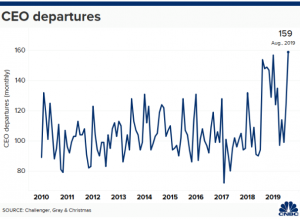
    It’s not just Presidents and Prime Ministers who are looking for the exits at the moment. CEO turnover at the largest companies in the US has just hit an all-time high. While eBay and WeWork executive departures will grab the headlines it is worth noting that 159 other CEOs also left their posts in August alone.

    That’s the highest ever monthly total and 28% higher than the 124 CEO exits in July. In fact, the pace of management change according to consultants, Challenger Gray & Christmas, is more than at the same point in 2008 when the global economy was about to enter a liquidity deep freeze. Clearly C-Suite anxiety is picking up when you see the following chart:
    So what’s going on? Financial markets are in reasonably healthy shape, employment conditions and confidence are very robust and yes, we have a few trade war/manufacturing cycle worries. Of course, CEOs like to leave on a high(share options don’t look too shabby at the moment either) but perhaps there are a few more structural drivers involved in the mix this time.

    Let’s start with the performance of financial markets and share prices. It is true that broad market indices are not far off all-time highs but a quick look under the hood would reveal a more nuanced story which we have alluded to in recent articles. To be frank, technology has been the outsized driver of positive market performance whereas the story in more structurally challenged sectors like retail, finance and energy has been far more frustrating. One senses some CEOs and Boards are becoming impatient and clutching at alternative solutions to boost share prices. So, the capital markets story has been a tale of sector haves and have-nots but there is also another inequality story.

    One might wonder if CEOs are watching the rise of Trumpian populism and wondering when the income inequality backlash is coming? Note that CEO-to-Worker compensation ratio has ballooned from 30:1 in 1978 to 278:1 by 2018! That particular acceleration in uber-celebrity compensation packages stands in stark contrast to productivity gains slowing to a sub-2% annual crawl in the past decade. Perhaps the bigger problem is that worker wages have stagnated over the last 40 years but that clearly has not been a priority at board level.

    The massive expansion of share buy-backs at the expense of business investment and a fixation on quarterly earnings performances has been a prevailing feature of the low interest rate monetary environment. However, that journey, as Thomas Cook employees and shareholders have discovered, can hide some pretty terminal problems for only so long. There has always been a fear that an artificially low cost of capital would lead to poor capital allocation decisions.

    In this latest iteration of financial history we may look back in years to come and rue the arrival of Kardashian capitalism. Corporate failure is likely to experience the cult of CEO celebrity and short-termism starving businesses and their workers of the capital needed to transition for the digital age. Indeed, the latest data suggests CEOs are not sticking around for that final vote.


    Spark Crowdfunding is Ireland’s only equity crowdfunding platform. We are based in Dublin city centre.

    Our equity crowdfunding platform enables investors to invest into various stage Irish companies and it gives Irish companies the opportunity to raise new funds quickly and at low cost to accelerate their business growth.

    If you are interested in learning more about Spark, then check out our website.

  • Belt Up for the Year of the Rat

    Belt Up for the Year of the Rat

    In terms of purchasing power China is now the number one economy in the world. However, when we read financial headlines about monetary policy, Brexit and trade wars there is a tendency to view the challenges facing the global economy through Western-oriented glasses. More bluntly, one could be under the impression that it is in the gift of Western economies to find solutions to said challenges and all will be right with the world. Whisper it quietly to the Donald but 2020, the Chinese Year of the Rat, might not just be about whistleblowers…

    Trade wars may grab the headlines but the reality in a US context is less weighty. Goldman Sachs in 2017 published a report which showed the top 500 companies in the US (S&P 500) earned 30% of their revenues overseas. However, China accounted for just 1% of its revenues. In fact, a mere 41 of those companies generate 10% or more of their revenues in China. There is a real possibility that the business world is placing too much significance on the dampening effects of the US-China trade war on economic activity. In this writer’s view market analysts need to be more curious as to why Germany is teetering on the brink of recession.

    There is a real possibility that China is facing a structural challenge which Japan has faced for the last 3 decades; the growth-killing combination of a 300% debt/GDP ratio and an ageing labour force which is projected to lose 200 million workers by 2050. These numbers are massive and frankly won’t be changed by Fed monetary policies or the impeached removal of a US President. The global trade truth is that Europe is the largest trading bloc in the world and therefore serves as the canary in the coalmine for China’s impact on all its trading partners. The struggles of the German manufacturing sector tell us there may be a bigger story emerging.

    The Belt & Road initiative (BRI), China’s strategy to become a rival super power to the US is a classic example of Sino-long term planning. What has been missed by many, and is possibly now being experienced by German factories, is the sheer scale of this project. Here are a few data points which tell a huge story.

    • The Plan: The BRI strategy involves investment in 65 countries.
    • The Population: BRI countries have combined population of 4.4 billion people or 62% of the world.
    • The Economy: Combined GDP of BRI countries is $23 trillion, larger than the $20 trillion US economy.
    • The Spend: Estimated infrastructure requirements and spend through 2030 is $26 trillion.

    Let’s just say all roads lead to China. Or did. There is no doubt the BRI project has been a key driver of global economic activity in recent years but has been very dependent on Chinese credit. Unfortunately, China which has pledged $1 trillion to the BRI project is struggling under a crippling debt pile. There is a strong suspicion that a downturn in Germany’s manufacturing sector is an early warning signal that China is reining in its spend and this will not change irrespective of trade war resolution or central bank monetary interference.

    One wonders if the waning influence of Oriental fiscal stimulus is the reason why the ECB is almost begging the Germans and other governments to launch fiscal programmes? The real fear of central bankers is that renewed QE has no economic impact and kills market confidence. If China really does dial down its BRI activity the ECB fears will undoubtedly prove correct. Watch China GDP and credit growth very carefully, not the trade negotiations.

    Misplaced optimism on the resolution of US-China trade issues in the Year of the Rat might sink a few ships as well as a Presidency.


    Enjoyed this blog? Then why not check out our other great content by clicking here!

  • Five Market Risks You Might Not Read About This Weekend

    Five Market Risks You Might Not Read About This Weekend

    The Bojo and Trump show is exhausting. The good news is that Sharpie-scribbled weather maps and fainting police have ensured our ribcages are now incapable of further shock and comic torture. The serious market risks associated with trade wars and a chaotic Brexit will receive more media coverage this weekend but not much will surprise.

    In fact, the sheer incompetence of the protagonists has resulted in more positive developments in both the US-China trade dialogue and Westminster. A check of the price charts for the S&P 500 and Sterling (GBP) for the past week will confirm increasing optimism. However, shocks are by definition events not yet considered by market participants. Looking past trade wars and Brexit there are five potential risks which probably won’t get headlines in the coming days but might genuinely surprise.

    1. A Dollar Shortage
    2. It might sound strange that a currency which accounts for 62% of global central bank reserves would be in short supply. However, companies(ex banks) in emerging markets had borrowed $3.7 trillion US dollars by the end of last year according to the Bank for International Settlements. That’s double the levels in 2010 and as the economic cycle slows the US dollar is unhelpfully climbing to new valuation highs versus it’s trading partners’ currencies in emerging markets. Suffice to say debtors are struggling to find/earn the dollars to service debts. The default worries surrounding borrowers like Argentina and China’s Evergrande Group are real-time illustrations of distress in funding markets. To add to these worries there are reports that in recent days an unidentified bank requested a $870m facility from the Federal Reserve. That’s not normal.

    3. European Banks
    4. Negative rates are crushing European banks already struggling with challenged balance sheets. A German economy slipping into recession as data suggested this week could be the final nail in Deutsche Bank’s coffin. Not surprisingly the CEOs of both Deutsche Bank and UBS have pleaded with banking authorities to consider alternatives to negative interest rates as monetary stimuli. European banks are into the ICU phase and it’s possible some won’t make it into 2020.

    5. Saudi Turmoil
    6. There has been more intrigue this week within the royal House of Saud. Ahead of the IPO of the state oil company, Aramco, Mohammed Bin Bonesaw has removed the chairman of the company which will only increase tensions between various factions within the royal family. Growing awareness of climate change and pressure on oil prices won’t help IPO valuations and the royal family’s ability to bribe its citizens and pay protection money to the US. The Saudi story has “coup” written all over it.

    7. EurFired!
    8. The Brexit story had its own “coup” this week as the move to prorogue Westminster resulted in a counter-coup by the opposition, potentially removing by law the ability of the government to leave Europe without a deal. Interestingly, there has been market chat in recent days that Europe has given up on the UK and possibly could cut and run. Yes, the reality TV show “Brexit” could have a “EurFired!” punchline with Europe refusing any extension, citing the need for certainty and the paralysing effect of Brexit on investment and policy decisions across the trading bloc.

    9. Inflation
    10. The headlines keep highlighting the $16 trillion worth of sovereign bonds currently trading with negative yields. The consensus view is that this is signaling lower growth, or worse, in the future. Implicit in that scenario is very low inflation. But, but there is another scenario. Check out the latest data in the US. Job growth and manufacturing activity has materially weakened. Well, there’s your low growth scenario. Now here’s the twist. Trump Tariffs(yes, they must be branded) are pushing inflation(CPI data) to 6-month highs and wage inflation is now cruising along at a 4.2% annualized rate! If Fed Chair, Jay Powell, thinks he has problems with the Orange Toddler right now we shudder to think what he will make of a dreaded stagflation scenario.

    None of the above events are high probability forecasts. In the investment world, they would be considered “tail risks”. However, for pure devilment this writer would hazard one strong long odds tip for the weekend. Prepare for the possibility for Boris de Pfeffel Johnson’s resignation on Monday morning and his place in history as Great Britain’s shortest-serving Prime Minister; the previous record was George Canning who served for just 115 days. By George, that would be a story!


    Enjoyed this blog? Then why not check out our other great content by clicking here!

  • Ireland is now Facing Category 5 Trade Winds

    Ireland is now Facing Category 5 Trade Winds

    Hurricane Dorian may have lost its Category 5 status in recent hours but the headwinds facing global trade are ratcheting up in intensity. At a mid-summer Spark Crowdfunding investor night the challenges facing Irish businesses from Brexit and Trump Trade wars were discussed. One of the key observations of the night was that when trade negotiation counterparties are driven by political survival motives – think Prisoners’ Dilemma – game theory models indicate the probable result is the worst economic outcome for both sides.

    The Nobel prize-winning work of John Nash was profiled in the Russell Crowe movie, A Beautiful Mind, and has become a key foundation of game theory and understanding how multi-lateral trade agreements can play out. Unfortunately, the Nash Equilibrium predicts an ugly commercial outcome for all when political risk considerations trump(sorry) co-operation between parties. Indeed, events over recent days have provided strong evidence of theory meeting reality head-on.

    Yes, there’s a huge hurricane approaching the US coastline but political protests in Hong Kong may well be the political typhoon which visits even more harm on the US economy. Consider the “butterfly effect” of chaos theory and it is increasingly likely that China’s relatively passive response to Hong Kong unrest makes it politically impossible for President Xi to show any weakness in the trade war with the US. The Dear Leader in Washington was apparently stunned China responded to his latest round of tariffs with tariffs of their own on US goods which would be politically sensitive for the White House toddler – think oil, more agricultural products, etc.

    The problem for Trump is that he can’t back down on the tariffs as that would be an admission that his esteemed economics team of the discredited economist, ridiculed CNBC host and Lego Batman movie producer has triggered a global manufacturing recession. In fact, the just-published US ISM Manufacturing Index just posted a sub-50 reading indicating a contractionary manufacturing environment in Trump’s own MAGA hinterland. As Trump would say, but neither the poor US farmers nor factory workers… “Always winning”.

    Having failed to build a Mexican wall, Trump is politically sensitive to showing any weakness on China and has resorted to excoriating his own Fed Chairman appointee, Jay Powell, and demanding lower interest rates to bail out his faltering “greatest economy ever”. The irony of the greatest economy needing a Fed bail will not be lost on some readers nor will the wayward nature of Trump’s trade weaponry. Who would have thought that a core part of the Trump fan base, Mid West farming communities, would be paying the hefty price for Trump’s insistence that China respect the IP/patents of the leftie liberal technology elites in Silicon Valley!

    It is fast becoming apparent that US-China relations have entered a new less co-operative phase. This is structurally bad news for global trade and Ireland’s business community will need to factor this into growth projections over the coming years, not months. One would hope Brexit could deliver a more upbeat outcome but the coronation of Boris Johnson has merely confirmed fears the UK political establishment is in a state of near-complete meltdown.

    Events of recent days would appear to confirm the Johnson strategy is to deliver Brexit no matter what. The request by the new PM of the Queen to prorogue Parliament has triggered a furious ongoing backlash in the House of Commons. EU negotiators and Ireland look on in bewilderment as Johnson’s parliamentary majority of one has evaporated to a 43 seat deficit. This purge of deal-supporting Conservatives including Winston Churchill’s grandson has forced Johnson to threaten a general election. The small problem with this initiative is that the Labour party and Jeremy Corbyn, in particular, are politically aware it is in their interests to see Johnson fail spectacularly and deliver a chaotic Brexit. There is a real chance an election will be delayed until after Brexit. That is worrying but our key mid-summer observation was that Brexit in the near term could be ugly due to political ineptitude and ignorance of international law(Good Friday Agreement). However, the longer-term story could be more positive. A delayed election for an electorate experiencing the chaos of Brexit might kill off the suicide mission once and for all. David McWilliams put it brilliantly in a recent FT article:

    “We understand the yearning for sovereignty, identity and independence, believe me. But just one piece of advice: the first 70 years are the hardest, after that it gets easier.”

    Clearly, Irish business would prefer to avoid any hard Brexit and certainly not a 70-year economic divorce from its closest trading partner. It is unfortunate timing that a combination of income inequality/populism and truly dreadful political leadership in both our largest trading partners has set in motion a series of events which make it very difficult for the protagonists to back down despite the huge commercial damage likely to be inflicted on all sides. There is a Sarajevo 1914 air about developments right now, almost the sense that troops have already been mobilized on thousands of trains and it’s too complicated and late to halt the escalation.

    As we witness Jacob Rees Mogg reclining on the front bench of the House of Commons this week and Trump bestowing the title of “The Chosen One” upon himself it is difficult to avoid comparisons with one of The Great War’s best parodies – “Blackadder Goes Forth”. In particular, this exchange in the trenches of the Somme between Captain Edmund Blackadder and his men resonates quite loudly with the Boris and Trump show we are currently enduring:

    Captain Blackadder: “You see, Baldrick, in order to prevent war two great super-armies developed. Us, the Russians and the French on one side, Germany and Austro-Hungary on the other. The idea being that each army would act as the other’s deterrent. That way, there could never be a war.”
    Private Baldrick: “Except, this is sort of a war, isn’t it?”
    Captain Blackadder: “That’s right. There was one tiny flaw in the plan.”
    Lieutenant George: “O, what was that?”
    Captain Blackadder: “It was bollocks.”

    If only it were a comedy right now. There are stormy days ahead with careful business leadership and strategies required. The good news is that even Category 5 hurricanes eventually die and generate a flurry of investment in perhaps less vulnerable areas. Ireland in a Brexit context could be a beneficiary from investment seeking more sane business environments.

  • Urban Inequality and Opportunity

    Urban Inequality and Opportunity

    In a world rapidly embracing artificial intelligence(AI) one has to marvel at the complete absence of any evidence of intelligence, human or digital, employed in Dublin’s traffic light system. It might surprise non-residents of the city to know that Dublin and its relatively small population of 1.4 million souls is now the 14th most congested city on the planet. For local drivers assaulted on a daily basis by Dublin’s bizarre traffic light sequencing, the challenge is not news to them and merely confirms the existence of planned idiocy(PI). Urban planning is about to become a critical component in driving the prosperity and wellbeing of the planet’s inhabitants.

    Urbanization of the world’s population is rapidly accelerating and revealing winners and losers. The UN predicts the world’s urban populations became the majority of 55% in 2008 and will grow to 70% by 2050. The European Commission using satellite technology and broader definitions of urban centres estimate 84% of the world’s population, or 6.4 billion people, already live in urban areas. One gets the sense that this trend has caught governments off guard and presented challenges and opportunities. Not unlike Dublin’s traffic planning, recent headlines might appear random but actually reveal proactive initiatives to cope with urbanization. Consider the following recent reports which caught the attention of this trapped driver:

    • Indonesia is building a new capital:
    • The reason for this move is that the current capital, Jakarta, and its 10 million inhabitants are sinking into the Java Sea. Excessive pumping of the city’s groundwaters has resulted in aquifer compression and a 4-metre fall in surface elevation. Given Jakarta sits on the coast and sea levels are rising a perfect storm of climate change and planned idiocy(PI) has forced a major governmental re-think and cost; estimates to relocate 1.5 million civil servants are already above $33 billion.

    • India has revoked Article 370 in Kashmir:
    • This critical article in the Indian constitution guarantees special rights to the Muslim-majority state and restricts migration to preserve historic demographics. Kashmiris now suspect the removal of constitutional protections will lead to mass migration to its higher altitude(cooler) territory from Indian cities enduring extreme temperatures, traffic chaos and pollution due to decades of PI. Consider the urban population reports of the UN and EC and then think about India’s urban population percentage at just 33%. The government appears to be looking for planning short cuts even at the risk of war with Pakistan. That smells of panic.

    • Boston is using machine learning to improve its school bus system:
    • Boston has teamed up with MIT to deploy an algorithm which identifies the most efficient and cost-effective routes for its school bus operations. The result has been $5m worth of savings and a reduction of CO2 emissions by 9,000kg daily thanks to 1.6m fewer kilometres driven. The algorithm takes 30 minutes to do a job that used to take weeks.

    Hello Dublin. Any chance of a call to Siemens who have just helped the Chinese city of Zhuhai become a smart green city with the most ecological traffic system in the world powered by AI? Urbanization is a long term structural story and smart solutions to the challenges of legacy planning idiocy will command juicy prices from panic-stricken governments.

    Get planning. Get solution. Get funding.


    Enjoyed this blog? Then why not check out our other great content by clicking here!

  • Are We Too Fearful of Recessions?

    Are We Too Fearful of Recessions?

    Recessions are painful for bosses, shareholders, employees and their families. Resilience is required and often difficult decisions must be made. All are familiar with the negative aspects of an economic downturn but the benefits are rarely heralded in the media headlines; the bad news is so much better for clicks and viewers.

    This has probably resulted in an outsized fear of recessions and an unhelpful recent phenomenon of political pressure on central banks to come to the rescue. In this instance, the wannabe Orange Emperor of Greenland cannot be solely blamed. The political nannying of the business cycle is a global exercise.

    We are currently witnessing a monetary experiment without precedent as $17 trillion worth of bonds carry negative yields thanks to central bank intervention; in practical terms, borrowers are being paid to borrow thus making the cost of capital free.

    The prompt for this intervention has been increasing evidence of the global economy approaching a stall speed and in the case of global manufacturing probably contraction.

    On the face of it, monetary intervention to stave off recession sounds like a good thing but the longer-term effects on economic behaviours and corporate resilience are arguably quite dangerous.

    To use a parenting analogy, we are seeing the emergence of “helicopter parenting” which has been correctly criticized as ultimately unhelpful to the healthy development of children. An unnatural desire by parents to interfere and protect children from any stressful experiences, even low-risk danger, can lead to unintended consequences.

    Adults helicoptered through childhood are behaviourally unprepared for the normal stresses and pressures of the real adult world and end up with limited coping strategies and resilience to deal with sudden challenges.

    It could be an unhappy coincidence that Ben Bernanke, the former Chair of the Federal Reserve, way back in 2002 referred to “helicopter money” as the ultimate weapon to defeat a severe recession.

    The phrase ‘helicopter money’ was used to describe the blunt instrument of printing money in huge amounts to defeat deflation. Well, it could be argued that $17 trillion of free loans (bonds) is getting very close to a helicopter moment. And the longer-term implications are not good.

    If capital is almost free and yields (interest rates on deposits) are too low, it forces investment capital to chase higher riskier yields elsewhere. At one point in July, Greek bonds traded with lower yields than US Treasuries! Who would have predicted that in 2012 when Greek bonds were yielding 35%?

    When money is almost free, painful economic history tells us capital will be poorly invested and permanently destroyed.

    A previous article on the WeWork IPO highlights the degree to which investors will ignore red flags and chase the short term opportunity of a “hot IPO”.

    We are now into our tenth year of economic growth compared to average expansion periods of circa three and a half years. This extended period of growth and cheap capital covers up a lot of weaknesses in the corporate world. Bluntly, there are too many zombie companies staying afloat and destroying capital year after year.

    Europe and China are probably the biggest culprits.

    The large loss of jobs in a normal business cycle, of course, is bad news for employees but ultimately those jobs will be lost as the company shrinks to survive and then finally fail. Politicians, as usual, will lobby governments with emotional statements and sudden expertise on business restructuring and global markets.

    Sadly, the only thing politicians can be relied upon for expertise is election cycles and polling data.

    Think back to 1984 and the huge pressures to keep the Ford plant with 800 jobs open in Cork.

    A little company called Apple had opened a plant a few years earlier but one wonders would it have received the government attention it subsequently received if the Ford plant continued to dominate government policy? Maybe ask the 5,500 Apple employees in Cork today who are probably quite happy that Ford did pull out in 1984.

    It is a fact that some of the best companies in the world started in recessionary periods.

    The robust business models and culture of resilience required in challenging times are hugely important building blocks for super-successful companies. Think Microsoft, Electronic Arts, Burger King and FedEx.

    Apart from building robust business models, startups in a downturn can benefit from lower costs of professional services, leases, machinery, plants and technology.

    And perhaps the biggest challenge of all right now is talent.

    In a cooler economic climate, there are opportunities to hire top quality recruits at sensible remuneration rates.

    It also forces talented individuals to reassess their long term career plans and perhaps consider a move away from sectors which are structurally challenged and unlikely to survive the next downturn.

    The CEO of the government funding agency (NTMA), Conor O’Kelly recently said he was 100% sure there will be a recession. He cleverly refused to put a timeline on that prediction.

    For business owners and employees, it might be worth considering whether you have the resilience for a downturn.

    If you are unsure about the answer it is possible you could become a longer-term victim of helicopter monetary parenting.

    For those that feel they can meet the challenge of a recession – get ready to take the necessary pain and the opportunities.

    Oh, and the average length of a recessionary period is around 18 months or just over 500 days.

    As parents in the old days used to say, you can do it.

  • Any Irish Entrepreneurs up for a Dip in the Sea?

    Any Irish Entrepreneurs up for a Dip in the Sea?

    Did you know that the production of one standard hamburger emits as much greenhouse gas as a car journey of 320 kilometres?

    This was the stunning finding of a Japanese study by the National Research Institute for Agriculture which also estimated the production of that same burger will consume 3000 litres of water! Surely we can try as a species to be a little more efficient in producing our food. Anyway, we soon might not have a choice.

    The UN’s Intergovernmental Panel on Climate Change has just released a rather disturbing report on humanity’s failure to fight climate change by refusing to re-think how we grow crops and raise livestock. The stark facts are that global agriculture contributes up to 37% of greenhouse emissions, uses almost 75% of the world’s ice-free surface area and wastes a quarter of the food produced.

    We are now entering a destructive spiral where available arable land is shrinking due to climate change, deforestation and pollution while the planet population races towards the 9 billion mark by 2050.

    We are farming this planet to death and the land-based solutions to this challenge are limited. A fundamental shift away from meat consumption and our dependence on thirsty methane-belching cows is unlikely to be achieved by humans switching to a plant based diet when fresh water is in short supply.

    But, ironically, water might well be the solution rather than the challenge.

    Our oceans cover over 70% of the planet’s surface and yet only 16% of global animal protein consumption by humans comes from fish. Yes, traditional wild-caught fish stocks are depleted but there is vast potential to scale up the commercial scope of aquaculture.

    A research paper by Rebecca Gentry and her team at University of California suggested a tiny fraction of the ocean’s surface at maximum depths of 650 feet could move the dial significantly on seafood production.

    For illustration, the scientists’ calculations show that an area of water about the size of Lake Michigan( 1/67th of 1% of the ocean) could produce 110 million tons of fish and shellfish each year. That’s about the same amount of seafood caught annually by commercial fisherman.

    It certainly sounds promising but aquaculture does have its own challenges and costs as farmed fish need to be fed from existing wild fish stocks and land-based vegetable feeds.

    Good planning is essential and Norway leads the way.

    Norway exports more than €10 billion of seafood each year. For context, and possible irritation, Ireland’s seafood industry in total generates just over €1 billion with exports accounting for €650 million of that amount in 2018.

    It’s not just Norway showing us up. Denmark with a smaller coastline and roughly similar population exports €4 billion worth of fish and seafood and Holland with an even smaller coastal footprint exports €3.5 billion worth.

    Food for further thought.

    Asia’s growing population and demographic shifts will account for more than 60% of the global middle class by 2030 and drive demand for increased quantities of quality protein in daily diets.

    Unsurprisingly, Asia already leads the way in aquaculture.

    China and Indonesia already cover more than 70% of global aquaculture production and that level of farming is 3-4 times greater than commercial fisheries production in those countries.

    By contrast, only one fifth of EU production comes from aquaculture.

    As a coincidence, Ireland’s territorial ocean waters are more than ten times the land mass of our island and account for 22% of the entire EU fishing waters.  Are we missing something? One hopes there are a few sharp minds out there looking at where food and climate trends are going.

    There is now no doubt the food-climate space will become hot (sorry!) and one suspects there will be plenty of capital to fund the urgent production shift required.

    Ireland has a number of natural maritime advantages which possibly requires greater government support.

    The timing couldn’t be better as this week we witnessed 10 year Irish government bonds trading with negative yields ie lenders are paying our government to borrow from them.

    So, why not ask the same lenders to pay us to invest in aquaculture?

  • Brexit – The Great British Bake Off or Break Off?

    Brexit – The Great British Bake Off or Break Off?

    Staff at the Spark Crowdfunding office had a little bake-off competition this week.

    The competition was keen, voting was controversial and rankings were debated long into the day. However, the true ‘reveal’ emerged over the next day as ‘tasting’ morphed into multiple appetising return visits to the competing creations. The empty serving plates and expanded waistlines revealed the true leaders but the barely touched dishes also put to bed any ranking disputes or inflated expectations…

    On further reflection, this revelatory process did bring to mind the wise words of one of the greatest ever investment thinkers, Benjamin Graham.

    As we ponder the potential outcomes of Brexit we could do worse than heed Graham’s explanation of financial markets, “In the short run the market is a voting machine, but in the long run it is a weighing machine.”

    In the context of the Brexit crisis (it is one now) there are no shortage of opinions, political machinations and financial media commentaries but such verbals are close to worthless. The most credible views are those expressed with real money.

    The currency markets have become the ultimate near term “voting process” on Brexit outcomes.

    So, the strongest voting on the gravity of the situation is now being expressed on a daily basis via the fluctuations of the value of the Great British Pound (GBP).

    Leaving aside the reflex reaction plummet of the GBP at the time of the Brexit referendum result in June 2016, arguably the currency is now at 34-year lows versus the global reserve currency, the US dollar. Clearly, currency traders and corporate treasury departments are taking evasive action in preparation for an ugly British break off from the EU. However, this is just a near term view reflecting understandable fearful emotions.

    The counter-intuitive longer-term view is possibly more interesting and is expressed via much larger individual bets.

    The “weighing machine” for the long run could arguably be reflected in the strategic mergers and acquisitions (M&A) activity of corporates.

    In this respect it might surprise readers to know that in 2018 M&A activity involving UK companies reached a three year high of £360 billion, beating 2017’s total by a whopping 28%. Admittedly activity in Q1 2019 slumped by 55% compared to the same period in 2018 but despite this apparent drop in deal-making confidence a survey published by EY in April revealed the UK as the most likely target for foreign companies seeking acquisitions pushing the US into second spot.

    History would suggest a fall in the value of a target currency and a relatively more expensive US market typically prompts opportunistic thinking from executives looking at long term corporate strategies.

    So, it was interesting to see last week a couple of huge deals announced which ran counter to the narrative generated by the GBP hitting multi-year lows on a daily basis.

    The announced combination of the London Stock Exchange and Refinitiv (formerly the Reuters data business) in a £27 billion deal is noteworthy given the US owners of Refinitiv are one of the sharpest private equity players on the planet, Blackstone Partners.

    There is also another deal to chew on this week. Food delivery giant Just Eat is merging with the Dutch outfit Takeaway.com in a €9 billion deal. Thus speaks the weighing machine.

    Worried Brexit watchers should reflect on Benjamin Graham’s words and consider the likelihood that the near term voting process in currency markets is more akin to a popularity contest with a truly awful collection of UK political representatives.

    Further Graham consideration would suggest the weighing machine of long term corporate dealmaking decisions reveals where there is real substance and value.

    For Irish corporates there may well be opportunities but it’s worth recalling our little bake-off and how the good stuff gets eaten quite quickly…

  • What would Ireland’s population be today if we didn’t have the Famine?

    What would Ireland’s population be today if we didn’t have the Famine?

    Ever wonder what Ireland’s population would be today if we didn’t have the famine from 1845 to 1849?

    I met with a senior Google executive recently and had a little moan.

    My complaint was about Big Tech’s ability to pay relatively junior employees huge salaries compared to smaller companies who desperately need talent to develop products which could benefit the planet at large. He was reasonably sympathetic to the dangers of outsized talent flight to Big Tech but also highlighted the small population of Ireland relative to Big Tech scale-up plans as being a significant contributing factor.

    This prompted a little quiz question which featured in a recent Spark Crowdfunding Investor Night – what would Ireland’s population be today if there was no 1840s famine and the supra-normal emigration which followed?

    Given the current population of the UK is 66 million you still might be a little surprised by the projected population estimate. A quick look at the relative land masses of the two islands might be a clue….

    My Google man was staggered that his 20 million guesstimate was about 12 million people shy of the actual 32 million projection. Both of us then proceeded to agree this capacity for population growth and flexibility to strategically influence demographics could be a big opportunity for Ireland. Imagine how many Irish startups could be funded through equity crowdfunding if we had a population of 32 million!

    That might appear slightly delusional as we struggle to house our existing population but some policy thought leadership could emerge if big money is put on the table.

    It has been interesting to read in recent weeks about the Google plans to invest $1 billion in the San Francisco Bay area to build 20,000 homes, of which 5,000 will be affordable housing units.

    Watch that space and another map which prompted plenty of discussion at the Investor Night mentioned previously. You might ask who would be the most likely new residents in a scaled-up Ireland?  Let’s take a look at another thought provoking graphic:

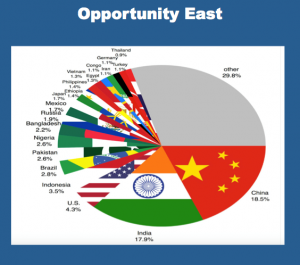
    The graphic above is telling us 36% of the planet’s population is living in China and India and both countries are grappling with major environmental and climate change challenges.

    Perhaps the more stunning statistic is that 64% of the global middle class is projected to be living in Asia by 2030. Now think about that 64% and Ireland’s current export value to Asia of circa €2 billion.

    One would expect Ireland’s current over-dependence on the US and UK is posing some strategic questions at corporate level in light of Trump trade wars and Brexit.

    At the same time perhaps we should think about encouraging some of this new middle class to move to less environmentally challenged regions of the world. Vancouver and Canada can already bear witness to significant Asian immigration with positive economic effects.

    Maybe Big Tech and Ireland should put their heads together and solve their housing and talent problems simultaneously….?

  • What’s the Story? Dublin slang goes corporate in a big way

    What’s the Story? Dublin slang goes corporate in a big way

    Open job positions on a company website can often be a helpful guide to the current strategic focus of the management.

    One role in particular has started to appear with remarkable frequency and increasing seniority within both small and large corporate structures.  The position of Chief Storyteller is now open at Oracle Corporation which has been around for 42 years, employs 137,000 people and has a market valuation just under $200 billion.

    There are a further 125 Chief Storyteller jobs listed on LinkedIn as open in the US alone.

    While this job title can induce a little toe-curling and an assumption that this is a relatively recent Millennial HR fad, you may need to think again.

    The book  “Shoe Dog” written by Nike founder Phil Knight has become a must-read for business people but it is more than just a valuable business guide; it is a story really well told.

    Indeed, Nike and Phil seem to have known their story was a good one quite a long time before the book was published in 2016; Nike hired its first Chief Storyteller in 1999 when the company was valued at $700m. Today it is valued at over $100 billion.

    There is a good reason why we keep quoting market valuations. Businesses now strongly believe stories drive sales and create wealth.  So what’s the story behind this belief?

    Humans have always told stories and in an Irish context the lyrical tradition of storytelling through the written word or song has endured as the glue that bonds communities. Stories have meaning beside simple entertainment. Stories connect people with other people and that’s a critical goal of any business.

    A business needs to answer the most basic question for its product or service: why should people care – why should  customers, employees or investors care?

    Stories are incredibly effective at capturing human attention in an increasingly noisy world. There are four key reasons why stories engages more of the human brain than other communications.

    1. When a story is told it isn’t just the language processing parts of the brain which are engaged. A story generates an emotional reaction , a sensory stimulus, which causes you to feel what the characters in the story are feeling. And we don’t make rational decisions when we buy, we make decisions with emotion. Emotion is a powerful selling tool.
    2. Stories grab attention. They create and release tension as our brains seek certainty and closure. The release of neurochemicals like Oxytocin in our brains when immersed in a story can generate empathy; an essential factor in building community and loyalty.
    3. Stories transfer values and beliefs. Think childhood stories and parables. Now think of the power of a customer who sees in a story how a character arrived at a belief. If the customer begins to adopt that belief the sale is almost done.
    4. In a world experiencing a data explosion the human brain struggles to retain information over time. Studies show that messages delivered as stories are more than twenty times more memorable than just facts.

    The simple truth is that the most successful companies in the world have very strong stories behind them which communicate a purpose and a value which engages customers and investors.  This drives the creation of a community; a sense of belonging and a sense of loyalty.

    Think back to the role of the Irish ‘Seanchai’ and storytelling’s function as a means of bringing a community together. The role of chief storyteller is to communicate both to employees and external stakeholders the company story, its mission and its vision. That story must be everywhere; ads, website content, social media, employees, PR and product/service.

    For start-ups in the early stages of winning customers and funding, budgets may not allow for a storyteller resource but be in no doubt the most effective means of engagement is your story, the founder story. Tell it well and you will engage people ultimately winning their loyalty. Your campaign videos, presentations and marketing collateral should be a story not a product or service fact sheet.

    The best story I have read in a very long time was recently published by Albert Bridge Capital. It has subsequently gone viral online and dramatically raised the profile of the business and its chief investment officer, Drew Dickson, who wrote the story. It turns out Drew writes quite a bit and has a very interesting investment approach. I suspect many others will be thinking the same and investing with him soon. The article is called Stay In The Game– it’s a quick read and it will make you feel really good.

    Tell a story and stay in the game.

    This article was written by Gary McCarthy, a Guest Author for Spark Crowdfunding.  If you’d like to view our live campaigns or learn more about us, click here.