Category: General

  • US Midterm Elections: Ten Things To Watch

    US Midterm Elections: Ten Things To Watch

    US politics can depress the best of us but two words can help; Gavin Williamson. Alas, comic relief can only be temporary. The bullying knight-without-portfolio could be gone by the end of the week but the US midterm elections are set to have a more lasting impact. And, there’s nothing comical about a potential death blow to US democracy. That might sound a bit hyperbolic but let’s see what damage real bullies can inflict. If the Republican party takes back the House of Representatives and/or the Senate this evening, here are ten developments and their real world impacts to watch carefully…

    1. Lame Duck Presidency: The weight of money in the betting/predictions markets and the pollster mathematics indicate the Republicans(GOP) have an approximate 80% chance of taking over the House of Representatives and a slightly better than 50/50 chance of winning back the Senate. Financial markets tend to be relaxed enough about a White House/Presidency having its power reined in by the legislative arm of government – see the Trump years. However, the real prize is the 2024 Presidential election so the temptation for the GOP leadership to do more than just hobble the Biden administration might prove too strong. Financial markets will be less relaxed about a wrecking-ball strategy and the GOP leadership have not exactly been shy about their party-over-country priorities. Financial analysts will be quick to downgrade US GDP growth forecasts as GOP wrecking-rhetoric rises…
    2. Dicing With Debt: In some cases, the wrecking-rhetoric has been very specific.The GOP leadership have suddenly discovered “virtue” on the levels of US national debt. After raising the debt ceiling three times, cutting taxes and growing the national debt by 33% (or just the $7.8 trillion)during the Trump presidency, GOP House leaders like Kevin McCarthy are threatening to prevent the lifting of the debt “ceiling” as leverage to force spending cuts, possibly to Social Security and Medicare. In this game of “debt chicken” the real risk is that the US Treasury defaults on its obligations and pulls the rug from under the foundation plumbing of the global financial system, US Treasury bills and bonds. In a global scenario of potential recession and falling corporate confidence this type of financial brinkmanship is extremely reckless and belies any claims of governance “virtue”. However, it wouldn’t be the only area of hypocritical virtue-signalling by the GOP…
    3. Kidding The Kids: The Supreme Court overturning of the Roe vs Wade abortion case undoubtedly impacts the healthcare options for women but the virtuous counter-argument has been the protection of an unborn child. That is until you check the data and see global US leadership for school shootings, a ranking of 33 out of 36 OECD nations for infant mortality, a tripling of childhood obesity rates since 1990 and a UNICEF 2nd place ranking for child poverty(after Romania) among 35 developed nations. Clearly, the living outside the womb bit for children needs a bit of work. But hey, different folks see different wokes…
    4. Climate Cop Out: The UN’s Secretary General, Antonio Gutteres, has warned the COP 27 Climate Summit hosted by Egypt that the planet is on a “highway to climate hell with our foot on the accelerator”. Curiously, the mention of hell and a threat to our children’s futures has failed to unite US evangelicals in a similar protective manner to their campaign to overturn Roe v Wade. However, their GOP representatives can be expected to launch an assault on the Biden climate agenda and his signature $370 billion clean energy initiative in the Inflation Reduction Act. Indeed, the share prices of energy giants like Exxon and Chevron will likely respond positively to the prospect of GOP moves to ease approvals for oil and gas production/infrastructure. And…the energy sector won’t be the only one with happy US companies.
    5. Inflation Information: It has been a puzzle to this writer how US inflation could be tracking that of Germany. The US is entirely self-sufficient on energy and is far less dependent on trade than the German economy. In truth, the US economy is incredibly self contained(up to 90% of GDP). So, what’s with an annual inflation rate of more than 8%? Don’t ask the GOP . They’re staying shtum and the Democrats are unforgivably missing a trick here. Democracy and abortion are important issues but Clinton did say, “It’s the economy, stupid”. Here are the numbers the Democrat comms team should be ramming down the throats of voters – US corporate profit margins are at 70-year highs of 46%, rental car profits are up 597%, the four largest meat processing companies’ profits are up 134% and the 5 largest shipping companies clocked a more than 29,000% increase in income. Yip, 29,000%. Anybody for price gouging? Clearly, the inflation story needs more scrutiny. The data referenced above features in a report by the US House Committee on Oversight and Reform and covers profit growth between 2019 and 2021. The conclusion of the report is damning and explicitly calls out how “certain corporations are using the cover of inflation to raise prices excessively”. So much for those “do good” sustainability/ESG statements….. and that’s only the “S” in ESG. But there’s even more ESG denial.
    6. Diversity Denial: The more significant aspect of the Dobbs case to overturn Roe vs Wade is about to become more relevant. The Supreme Court ruling in the Dobbs case, in effect, gives individual states the power to curtail individual freedoms previously protected at a Federal level. At last count, there are more than 370 Republican candidates seeking election but are already in various stages of “election denial” when it comes to rationalising Donald Trump’s delusional take on the 2020 elections. More worryingly, many of these cult-like followers have promised voters they will, at a state level, move to remove many of the protections previously provided by Supreme Court/Federal law for same-sex marriage, contraception and gender rights. If conservatives are successful in removing these protections, do not presume the next opportunity to vote for a concerned ‘majority’ can reverse these attempts to visit the Middle Ages.
    7. Democracy Denial: These midterm elections are not just for national representation in Washington. There are multiple state governorships, attorneys-general, secretaries of state positions etc all up for grabs. Many candidates, as well as embracing the Trump “Big Lie”, have committed to re-drawing election maps, stricter voter ID, one-day elections and elimination of mail-in ballots. Yep, democracy is about to become significantly less democratic. And that means the removal or voting out of incumbents is going to be made very difficult. It’s almost like only one result is acceptable, or as Kari Lake, in the running for Governor of Arizona, put it: “I’m going to win the election and I’m going to accept that result”.
    8. Donald Denial: Agent Orange would appear to be able to offer up national defence secrets to the highest foreign bidder, but in some quarters his incarceration would be considered to present an even greater threat to national safety. Many NATO allies plus the CIA (missing quite a few operatives) would beg to differ, but if the GOP gains control of the House and/or Senate then Donald Trump’s chances of avoiding the clutches of the law increase significantly. However, the hope that civil unrest can be avoided in the case of Trump keeping his liberty seems a little optimistic in light of the attack on Nancy Pelosi’s 82 year old husband, Paul. Indeed, the appallingly ugly responses to the attack by certain sections of the MAGA media and Republican party can only have helped to raise the tension temperature in US society.
    9. Defending Defence: Arguably, in times of economic challenge one might take a more forensic look at a US defence budget which amounts to a whopping $3 trillion through a 4-year presidential term. With the GOP keeping watch for their weaponry buddies expect any political discussion to be drowned out by the usual fans of fear. However, it won’t have escaped most people’s attention that the traditional focus of fear, Russia, has just seen its best military forces and equipment suffer generational-level losses in Ukraine. Today’s wars, yesterday’s generals should not be a phrase exclusive to the Russian armed forces. Even with the downgrading of Russia as a conventional threat, one can expect the share prices of defence contractors to benefit from increased Republican influence in Washington.
    10. Defending Despots: Putin might be off most people’s cocktail party invite list, even those at Mar-a-Mango. However, the Biden administration have been clearly unimpressed by Saudi Arabia’s recent moves in cutting OPEC oil production. The suspected motive is Saudi Arabia’s desire to help Republican chances in this week’s election and ensure a morality-free zone in Washington to dove-tail with a Handmaid’s Tale of zealotry at state level. The uncomfortable truth is that the Republican party has become very comfortable in the company of low quality characters, from Marjorie Taylor Green to Matt Gaetz to Lauren Boebert.  The moral gymnastics required to stay close to these charlatans can only be good news for the likes of Orban, Erdogan, Mohammed bin Salman etc.

    None of the above is particularly uplifting but the interesting thing is that most of this has already been factored into share prices, GDP models, ESG scores and inflation forecasts. Bluntly, the darker ambitions of a GOP take-back of the House or Senate are known, and therefore removes much of the drama of the vote this evening. However, I’m not convinced the vote will pan out as expected. Forgive me for clicking my heels and wishing I was in Kansas but that’s exactly where I hope this election goes. Back to Kansas, and back to that state’s August 2nd primary ballot which also included a referendum on a constitutional amendment to remove Roe v Wade protections. Know that this state was a Trump win by a chunky 15 percentage points in 2020 and was expected to ram through the abortion amendment easily. The amendment suffered a stunning knock back by voters. The pollsters and forecasters were shocked in Kansas but tonight could have similar shock drivers. Watch closely the following:

    • Total turnout
    • Youth turnout
    • Women turnout

    Ray Charles brought “Georgia on My Mind” to number 1 in the charts in 1960 but I have Georgia on my mind now. This key battleground state allows early voting. At close of early voting on Friday November 4th, turnout was amazingly within striking distance of the 2020 presidential vote with 2.5 million ballots already cast. I can’t help feeling there’s a few twists to come tonight. There might even be some red faces and a thwarted red wave. But only one sure fire certainty…… GOP denial in all its corrosive guises.




  • A Bird In The Hand Is Worth….?

    A Bird In The Hand Is Worth….?

    The banks who loaned Elon Musk the money to buy Twitter probably don’t want to know the answer to that right now. Nor do I. There is no shortage of commentary on how much Musk overpaid or how much he underestimated the minefield that is social media, free speech and corporate responsibility. Certainly, discussion at Twitter board meetings will be less wordy given there’s now only ONE director on the ‘blue bird’ board, Chief Twit Elon. However, a sweeping dismissal of Musk’s ambition strikes me as a bit premature. Back in April, our article “The Barbarian At The Twitter Gate” concluded with this thought:

    “We can’t forecast the future but Musk’s track record is impressive and I can’t help thinking about his first entrepreneurial success, PayPal.”

    I haven’t changed my mind. Musk has already floated the idea of charging Twitter users $8 per month to verify identity(known as a ‘blue tick’) and the Twitterati are up in arms. The fact that these ID verification blue ticks were previously free and an effective way for the platform to combat misinformation, spam, bots etc. might have obscured the “value” to the user. However, let’s remind ourselves that Musk wants to make money and the potential reasons why verifiable identity could have a value. In our Barbarian piece we suggested the following might feature in the future Twitter story told by Musk:

    1. Twitter is simply the best real time information search engine on the planet.
    2. Twitter is two businesses – a digital network and data analytics engine.
    3. Twitter is a “sit forward” experience – breaking news, sport, geopolitical events, weather catastrophe, information, education etc.
    4. Twitter is NOT a “sit back” experience – leisure, shopping, aspirational, dreams, travel etc
    5. Twitter is NOT a natural home for aspirational advertising.
    6. Twitter with its 250 million users(nodes) has a potential role in a decentralized digital world, the metaverse.
    7. Twitter is the first platform to let people get payouts in cryptocurrencies using Stripe’s Connect facility.
    8. Twitter with its millions of nodes/users has huge validation utility in the areas of KYC, digital currencies, NFTs and tokenomics

    Arguably, Musk has got off to a ham-fisted start in telling and selling the Twitter story but a quick check of points 6,7 and 8 imply services and experiences which value and depend on “identity”. It is noteworthy that former Paypal COO, David Sacks, is apparently advising Musk on Twitter’s emerging commercial strategy. Also, the advisory team will be keenly aware of a Chinese precedent. WeChat started out as a messaging service in 2011 but is now a ‘super-app’ with payments embedded in all its services from broadcasting to gaming to e-commerce. Oh, and WeChat’s 1 billion monthly active users can vouch for the value of a verifiable identity. Musk must know a potential super-app needs to nail down ID verification. Again, we wrote in April …..

    “I’m thinking of Twitter as a launch mechanism for blockchain, digital currencies, digital ID/verification, meta-commerce, neobanking, decentralized finance(DeFi), tokenomics etc.”

    There’s lots of Web3 terminology, even jargon, in the list above. If you’re an engineer or a person like Musk who has solved incredibly complex problems in auto manufacturing and space travel then you probably want to start with basic building blocks, and wording. So, let’s try to introduce some basic wording to the potential re-engineering of Twitter. Here goes:

    • Musk wants Twitter to make money.
    • Twitter can make money by providing and charging for services which support the ownership and transfer of digital assets. These assets can be video, music, currency, gaming, writing, photos, images(NFTs) etc
    • In exchange for upgraded services Twitter will ask users/account holders to upgrade their accounts. The first logical step would be to verify the ID of the holder of the account.

    This might seem like over-simplification but check out a very recent example of the power of wording. Reddit, the social platform for specialist news/communities, offered its users(Redditors) the opportunity to buy “digital collectibles” or avatars which could be used in their profile pictures(think of “skins” in gaming). More importantly, Reddit made it very easy for users to get involved with the following features:

    • The digital images could be bought through traditional currency payment channels like PayPal, Stripe etc
    • The digital images were blockchain-backed ie they gave verified owners the rights to use the image
    • Reddit would also provide digital wallets( ‘vaults’) to store the images but also allow portability ie the images could be sold on

    The offer was outlined in an 800-word post by the Reddit team and interestingly did not use the term “NFT” once. The response was incredible. In the week leading up to Hallowe’en, more than $10 million of digital collectibles/avatars were purchased. So, there are now roughly 3 million of these images in circulation but, critically, more than 3 million vaults/wallets have been created. The wallet feature is not just an upgrade of a user’s account but clearly opens up many more opportunities for Reddit to introduce additional features like gated/tokenised access to communities, creator rewards, loyalty offers etc The Reddit initiative is remarkable given its traditional crypto-sceptic leanings but for an even bigger tradition-busting development we should visit Singapore briefly.

    The Monetary Authority of Singapore(MAS) this week announced the successful completion of the first trades using tokenized(digital) versions of the Japanese yen and Singapore dollar. The trades were a test of a blockchain application which cut out the need for third party intermediaries in the wholesale funding markets used by banks. Singapores’s DBS bank and Japan’s SBI Digital were involved but here’s the kicker.… arch crypto-sceptic Jamie Dimon’s bank, JP Morgan, were the other counterparty doing the trades. Wow! And, this is all happening during a so-called crypto “nuclear winter”. Call me curious. I strongly suspect Elon Musk is too, but back-to-basics won’t be just about wording at Twitter.

    Sadly, news is filtering through that potentially up to  50% of Twitter’s employees are being laid off. The ugly reality is that the re-engineering of Twitter is likely to involve a shift from content/media talent to engineering-focused talent. And, this transition will not be linear, but brutal. Watch this space and recall Musk’s early space initiatives. Not all of his early birds flew, but it was worth the wait.


  • Did You Xi A New War With China Has Started?

    Did You Xi A New War With China Has Started?

    The scene was chilling and highly unusual for seasoned Asia watchers. A frail 79-year old man was being moved against his will in a major political voting arena but this time there was no need for a Therese Coffey headlock or expletives hurled at Jacob Rees-Mogg. President Xi Jinping’s bodyguards were quick to usher the man out of the closing ceremony of the 20th Chinese Communist Party Congress; but this was no ordinary shut-down of a potential protest. The protestor-in-waiting had been seated right beside President Xi in the vast Beijing conference hall and had been Xi’s immediate all-powerful predecessor before handing over power in 2012. Of course, we were never meant to see the video footage of the humiliation of Hu Jintao which cannot be found anywhere on the Chinese internet. It was bad enough that the famed Chinese respect for one’s elders was trashed in public, but there’s another awkward truth which the Xi regime is keen to bury. Comrade Hu was a superior manager of the Middle Kingdom’s economy. The data doesn’t lie.

    The headlines this week have linked Xi’s tightening of the reins of power to the double-digit percentage declines of multiple Chinese technology share prices immediately after the Congress ended. However, the longer-term picture of wealth destruction is even more damning. At one point this week the Nasdaq Golden Dragon China Index which tracks Chinese companies(mainly tech) listed in the US had dived 22% in just a few trading sessions back to levels last seen in 2012 when Xi came to power. Ten years of tech progress and gains made by the likes of Tencent, Alibaba, Baidu etc have been wiped out. However, the story is even worse if you’d invested in Hong Kong-listed shares to track the enormous growth of the Chinese economy. The island’s Hang Seng index this week re-visited levels not seen since 2006. That’s more than three Chinese presidential cycles ago for a zero return! The US, despite enduring 4 years of the only business “genius” ever to lose the house in the casino industry, has seen the S&P 500 in the same period return 175%. The news from the Chinese property markets is possibly worse, and potentially fatal for comrade Xi.

    Property sales have fallen for 14 straight months in China. Unlike stocks and shares, almost every Chinese household is “all in” on property. The home ownership rate is a whopping 89% in China and it is no exaggeration to share Goldman Sachs’s view that Chinese residential is probably the largest asset class in the world with an estimated total value of more than $50 trillion. So, when a Chinese mainstream newspaper warns of “revaluation” in property prices and the bonds of property developers are in distress it might seem sensible to beef up the financial expertise of the Beijing administration. Hu Jintao might have done it, but not Xi.

    The Xi playbook is all about power. The elderly Hu was not the only senior Politburo figure to be squeezed out of the inner circle of influence. Hu’s proteges Li Keqiang and Wang Yang would be well known to western analysts of Beijing politics but have also been removed from the Politburo. In fact, the more alarming development is that the new Xi cabinet contains no recognized financial market expertise. There are also no women members in the Politburo for the first time in 25 years. However, the key to understanding Xi’s current focus is to note the explicit positioning of men who are trusted for their loyalty to the leader and have weapons, miltary, surveillance and aerospace expertise. Not surprisingly, it has been referred to by analysts as a “war cabinet”. Yes, the game theorists will be busy working out potential timelines to an invasion of Taiwan but perhaps that assumption of inevitable conflict in the South China Sea is premature? Arguably, war has already started but in a very different place…Ohio.

    In September semiconductor manufacturing giant, Intel, broke ground on a $20 billion project to build a semiconductor factory(known as a fab) in Columbus, Ohio. This is a reversal by the industry of decades of offshoring production to Asia and is a direct result of the Biden administration’s Chips & Science Act which has just been signed into law. The Ohio project is the largest industrial construction seen in years but there will be many more thanks to $52 billion of government incentives to bring semiconductor (chips) manufacturing home. Micron are about to plough $15 billion into Idaho on a similar facility and Taiwan SemiConductors (TSMC) are going for a $12 billion investment in Arizona. Unusually for US politics, this initiative has received bipartisan support across the aisle on Capitol Hill. The reason is simple. Post Covid-19 and supply chain chaos, the chip industry is deemed vital to US economic and national security. So is energy or food you might argue; but there’s a bit more to chips. At the low-tech end of the spectrum semiconductors might be perceived as commodities like oil and wheat but at the hi-tech end this is about the most advanced technology industry on the planet. More on that later but what about the war? Consider the following:

    • In probably the most aggressive act by a US administration in decades a White House executive order has crippled the Chinese chips industry by banning US citizens/engineers from working on high end R&D projects with immediate effect. Vital staff were lost overnight and returned to the US.
    • The US Justice Department this week announced it had indicted two Chinese intelligence officials who are believed to have unsuccessfully tried to obtain inside information about a federal investigation into Huawei.
    • Washington is also targeting the export of latest generation chips and manufacturing equipment used by dozens of Chinese firms. As the New York Times put it: “The rules appear to establish a more comprehensive policy that will stop cutting-edge exports to a range of Chinese technology companies and cut off China’s nascent ability to produce advanced chips itself”.

    The cutting-edge descriptor is critical. The Biden executive order is explicitly focused on advanced logic and memory chips. These are the next-generation chips which will power artificial intelligence (AI) applications. The words of National Security Advisor, Jake Sullivan, in August are worth noting – “we have to revisit the longstanding premise of maintaining “relative” advantages over competitors in certain key technologies…. we must maintain as large of a lead as possible.” Now recall those new Beijing Politburo members’ areas of expertise and know that AI is absolutely critical in the development of next-generation aerospace, weaponry and surveillance technologies. Perhaps this “war cabinet” is being tasked to fight a very different war? Who knows what the Chinese will do in retaliation for these recent tech provocations but it still feels a bit early for a Taiwan invasion. Given the concentration of global chip manufacturing/supply based on the island nation there’s too much of a whiff of mutually assured economic destruction to divine any invasion logic right now. However, the following developments are worth watching to understand how this intertwining of economic interests might change:

    • Less than 5% of Apple’s products are currently made outside China. That figure will be 25% by 2025. The rush to de-risk China production bases by consumer multi-national corporations is one to watch. Clearly, China is being viewed as an adversary. Any tech company with business in China would do well to note the US is deliberately freezing Chinese domestic chip manufacturing above a certain level. AI might be a small percentage of chip production today but the US views AI as the future, and the means to secure a generational “relative” competitive advantage.
    • China’s efforts to catch up starts with one huge disadvantage. Chip manufacturing is all about carving nanometer-small shapes on silicon wafers. The machines that do this shine exceptionally narrow beams of light onto “photoresist” chemicals on the wafer in a process known as lithography. The machines – extreme ultraviolet lithography machines – or EUVs are worth $120 million each, have 100,000 components per machine and take 4 jumbo jets to ship. Oh, and only one company in the world, ASML in Holland, makes and sells these huge pieces of equipment. China will need to build its own ASML to manufacture powerful AI chips but that will take years.

    The chip arms race has begun. For Taiwan’s sake, the longer it takes for China to catch up the better. Conversely, there must be a calculation made by China at some point that Taiwan is no longer a sufficient technology risk to deter attack ie China forced to go solo in developing chip self-sufficiency has less and less to lose. It is also a delicate calculation for the White House. The pain inflicted by the latest moves are relatively contained but as AI grows in influence the technology gap between the US and China could grow dramatically in a matter of years. Certainly, if you’ve read Peter Diamandis’ excellent “The Future Is faster Than You Think”, technology convergence is accelerating innovation at warp speed compared to previous economic or industrial cycles. A rapid widening of a technology gap may not be good news. This writer’s fear is an act of desperation by Xi.

    A combination of slower GDP growth(2-3%), collapsing demographics and Japan-style property debt stagnation will apply their own political pressures but if the AI future presents a structural threat to Chinese economic competitiveness then the Beijing leadership could see chaos as a means to disguise decline. I’ve often thought Putin was more scared of the structural decline of oil and gas in an ESG world than the prospect of Ukraine joining the EU. We shall see, but recent weeks feel like the geopolitical risk gauge has jumped a few notches. The Great Firewall has already shifted the web into “splinternet” territory but that was a Chinese initiative to control and censor content. This US move to control technology itself is vastly more significant across the entire global economy. Indeed, Ben Thompson in his Stratchery newsletter captures the scale of intent rather well:

    “…..the free trade globalized world that China grew up in is gone, and the US is determined to maintain the advantages it has for as long as possible.”

    Arguably, Hu Jintao was not the only former leader being pushed around last week. However, only one of the aggressors was showing true strength…. Like always, follow the money. As Chinese and Hong Kong stocks imploded in recent weeks the benchmark US index S&P 500 has been on track for its best October performance in history, up over 10%.

  • UK Leads For The Damned United States

    UK Leads For The Damned United States

    UK politics is the gift that keeps on giving. Unless you’ve written a Liz Truss biography “Out of The Blue” which is due to come out for the Christmas shoppers…..on December 8th. A better book, “The Damned United”, has featured in commentary in the past week given the similar 44 day reigns of Brian Clough at Leeds United and Liz Truss at the Downing Street circus. However, in the case of Clough and Leeds, damage was not permanent. Clough went on to win two European Cups with Nottingham Forest and Leeds were robbed in a European Cup final only months after the departure of “Big Head”. Greatness prevailed. But ‘Global Britain’?

    The writing wasn’t quite on the wall but Matthew Parris in the Times as far back as August 20th warned, “Stick to your first impressions. Liz Truss is a planet sized mass of overconfidence and ambition teetering upon a pinhead of a political brain. It must all come crashing down”. The damage to the UK will be long-lasting and Truss’s ambition might have to settle for Nottingham city council. However, the UK is not alone in its self-destructive political chaos. The commentariat will chronicle the Tory Trussterf*ck but I fear we need to watch events in the US even more closely.

    It might have been slippery Tory cabinet minister Michael Gove who said “The people of this country have had enough of experts”. Who knows how many experts from the Treasury warned Kwasi Kwarteng about his “Honey, I shrunk the Gilts” mini-budget or how many lawyers warned that an international treaty(Brexit) cannot be drafted to conflict with a pre-existing international treaty(Good Friday Agreement). If there is potentially one upside to the UK chaos it hopefully might mean experts will be listened to and populist charlatans are given less air time. In the US the experts are worried and the following three developments are the focus of most concern…

    Democracy: Ahead of the November 8th US mid-term elections, it is important to know that the 2021 Jan 6th coup failed but that election denial didn’t die. There are literally hundreds of Republican candidates who will challenge the legitimacy of the upcoming elections if they lose on voting day. Kari Lake in Arizona is possibly the highest profile candidate who won’t commit to accepting a losing outcome but there will be many more. Fox News anchor and Putin propagandist, Tucker Carlson, has already stated that the only proof there isn’t election fraud is if the Republican wins Arizona. And we thought “Daggers” Truss was bonkers because Dagenham was 3 stops past Barking??? The prospect of civil unrest is bad enough but the erosion of US leadership in championing democracy should be a global worry. Already, Jair Bolsonaro in Brazil is employing similar tactics before the October 30th presidential vote which only adds to the pressure on democracy everywhere. A quick check of  Economist Intelligence Unit data would show that the number of democracies peaked in 2012 (London Olympics for UK too?) at 97 countries but has fallen back to 89 today. Stunningly, the number of people globally enjoying democratic rights has plummeted from 3.9 billion to 2.3 billion in just the last 5 years. Now, consider the US and Brazil populations are another 500 million plus combined and must be sitting in the ‘at risk’ category….

    Debt: The financial markets will be watching the US elections anxiously too. As we’ve seen in the UK, bond markets are quite twitchy these days but the UK Gilt market is hardly in the same league as the enormous market for US Treasuries. Worryingly, it might not be just the UK seeing “a doomsday cult” hold the reins of power. Bizarrely, the traditional Wall Street-friendly Republican party is threatening to use its expected post-election majority in the House of Representatives to block the US government’s request for further debt to fund the federal administration. This refusal to raise “the debt ceiling” could potentially paralyse government but also lead to a government default on a key pillar of the global financial ecosystem, US Treasury bonds. For those that think it’s just a Republican bluff, there are a number of seasoned observers who fear Jan 6th was just the first attempt to destroy government and capitalise on the ensuing chaos.

    Climate: And, if you’re in the business of destroying democracy and government, why not up the stakes and kill the planet? The recent moves by Republican-controlled legislatures in the states of Florida and Texas to ban the use of ESG(sustainability) criteria to invest or manage public pension funds is effectively a fossil-fuel fightback. Fund managers like Blackrock, Nordea and BNP Paribas are banned from doing business in these states because their investment frameworks take the global climate into consideration when buying or selling securities. Despite Florida being battered by its deadliest hurricane since 1935, Governor Ron De Santis will shamelessly continue to attack “woke” capital and play to his client capital audience in the oil and gas industry. To add insult to planet injury Governor De Santis had no problem asking the Federal government for $1.2 billion of relief funding in the devastating aftermath of Hurricane Ian. Classic political hypocrisy but Florida will pay a long term cost, and before that, probably an insurance cost which will be obscured in lots of noisy ‘woke’ bashing .

    So, the above is not a cheery read but perhaps the UK experience can provide a more optimistic lead. It might have taken a financial earthquake in the Gilts and pensions markets to wake up the UK political world which unfortunately could mean the US is ‘damned’ to a shock in the near term. However, one hopes the damage is limited but exposes the dangers of economic and political extremism. Furthermore, as Trussonomics and Jacob “Boris or Bust” Rees-Mogg are banished to permanent political exile one can only hope the same for MAGA, McConnell, Tucker, Trump, Lake et al……but not in 44 days.

  • A Wicked Week Of Comebacks

    A Wicked Week Of Comebacks

    “Back again? Dear oh dear. Anyway….” King Charles didn’t sound thrilled to see his new Prime Minister return to Buckingham Palace but we’ve probably all had that feeling in recent days. Unfortunately, a number of familiar risks have returned to our screens. However, like the new monarch’s verbal slip, we should be wary of attaching too much significance to the initial reactions of the commentariat. Let’s start with UK pensions.

    In an era of Putin nuclear threats, shattered energy security and a cost of living crisis who had UK pensions on their global financial meltdown bingo card? Say hello Kwasi Kwarteng, and apparently goodbye too. But, first a little history, and in true Tory style, a bit of German bashing. Yep, it’s all the fault of another Chancellor actually. You see, it was Germany’s first Chancellor, Otto von Bismark, who introduced pensions back in 1889. The purpose of pension schemes was to support those citizens who had reached the age of 70. The more important number from a financial perspective was average life-expectancy at the time. The average German was expected to live to his or her mid-forties compared to mid-eighties (and rising) expectations today. One doesn’t need to be an actuary to know that modern pension schemes are facing increasing pressures. Bluntly, pensions as originally envisaged are not fit for purpose for the following reasons

    1. Longer retirement periods (longer lives) require additional funding.
    2. Funding comes from younger members of pension schemes but in many developed economies like Germany the population demographics are shifting rapidly to an inverted pyramid(scheme?). A smaller number of pension contributors/workers funding a growing number of retirees is a financial challenge and for the younger Peters paying retired Pauls there’s a whiff of Ponzi in the air.
    3. Pension funds have had to battle a 40 year decline in interest rates and therefore income coming from their bond investments.

    To counter these challenges pension funds have changed their investment strategies over the last 20 years. If truth be told, a pension fund is far closer to being a hedge fund these days than regulators, governments or monetary authorities would like to admit…..until now. The intervention of the Bank of England in recent weeks was not a bond market support scheme, it was a pension rescue initiative.

    Pensions had been using derivatives to meet their obligations(juice returns) but the problem with derivatives and the underlying securities they track(bonds) is that the relationship is not linear when market prices move big and fast. Hence, a Kami-Kwasi mini-budget shock was exactly the scenario derivatives don’t need. Thankfully, the Bank of England became the bond(UK gilts) buyer of last resort to enable pension funds to post more cash/collateral with their asset managers and avoid insolvency.

    Commentators have been quick to suggest other pension industries in other countries could face similar challenges. They do, and they will. However, there are two universal truths which should comfort those worried about their pensions

    1. Pensions are a political “red line”. No government wants to lose a pension fund on their watch. Even the threat of pension damage has generated worst-ever polling results for the Tory party and next election seat predictions of as few as…. 4 seats in Westminster, or half those of Plaid Cymru.
    2. Politicians and permanent government/civil servants are all on a massive pension promise. Their interests and main street pension interests are aligned.

    Clearly, bond markets are in trouble. Inflation and rising interest rates are the bond killers. The bond market is about to have its worst year ever and there are some bond issues that have done even worse than cryptocurrencies. In fact, numerous commentators have pointed out that UK Gilts, denominated in the Great British Peso, have experienced more volatility than Bitcoin. Bond turbulence is not a good thing and there are trillions of dollars worth of derivatives whose values gyrate more violently than the bonds they are supposed to track. But, there might be good news and it involved a very interesting mega-gyration yesterday.

    As we know, inflation is not the bond market’s friend. Particularly, if inflation data beats expectations. Take the much-awaited US CPI(inflation) data reported yesterday. The headline figure was worse(not much) or higher than expected and commentariat headlines screamed about 40 year highs. Cue the US S&P 500 equities index took a 2.4% dive into the red, but then something strange happened. Some people actually looked at the CPI data and saw that if rent and health costs were stripped out of the ‘core’ inflation number it looked like inflation might have peaked. The S&P 500 finished the day 2.4% higher and that 5% round-trip is one of the most violent seen for a while. Another inflation bright spot worth mentioning is that services(not goods) inflation had hit 12% during 2022 but was now down to 6.7% and projected to hit 3% by January 2023. Service with a better smile…. but not if you’re in the US Secret Service.

    The 6th January House Committee hearings returned to our screens yesterday. UK politics might be in a mess but, at least, it’s not in coup territory. The shocking evidence before the committee yesterday was mainly focused on the US Secret Service; how they clearly knew in advance that the seat of US government on US Capitol Hill was facing an imminent violent, even murderous, threat. And, they did nothing. Nor did the big social media platforms. One of the more interesting witnesses yesterday was a Twitter employee describing the murderous intent posted on the platform by rioters during the hours of the insurrection and particularly, after Agent Orange inflamed the situation with his notorious VP Mike Pence “didn’t have the courage” tweet.

    The social media platforms like Facebook/Meta and Twitter will take criticism as usual re accountability but there is perhaps a wider question of political will. The role of Fox News and the near-complicity of the US Secret Service in the build up to January 6th must be investigated further, and individuals made accountable. If not, the next threat to US democracy will be some Fox News celebrity undermining Washington’s determination to stand firm against Mad Vlad. Whoops, my bad, It seems Tucker Carlson has already gone there. But… Rupert Murdoch went to the UK first.

    Now the UK is the object of global ridicule coming perilously close to financial and social ruin. Indeed, the case study of the UK’s descent into self-inflicted chaos will be an incredible read one day but be absolutely certain the role of Murdoch and his populist media assets will be very much in the mix. As I write, Kwarteng is gone after 6 weeks as Chancellor and Truss limps into the weekend as a “dead duck” Prime Minister. I keep thinking of a social media commentator quip earlier in the week, “The ringmaster (Boris) has left the circus, and now the lions are eating the clowns.” Wonderful. Again, behind the dramatic headlines, the exposure and end of the political clowns is a good thing.


  • Does The Fed Know Our World Is Much Faster Now?

    Does The Fed Know Our World Is Much Faster Now?

    So, NASA managed to deflect an asteroid 7 million miles away with its DART spacecraft but we can’t sort inflation? Surely, we can do better. Then again, maybe we are doing better. The collision with the asteroid, Dimorphos, has created a 10,000 km comet-like debris trail which feels a bit like our daily dose of inflation headlines. Lots of shiny stuff to catch the reader’s eye but what about the bigger picture? Mission-focused NASA will only want to know if the trajectory of the asteroid has shifted. Not so the Fed with inflation I fear. Indeed, there’s a danger that the Fed is watching the inflationary debris of a high speed global economy and missing more fundamental changes in the macro trajectory. Let’s take a look at a few developments which are catching this writer’s eye…

    • Oil Demand: Lovely to see ahead of a FIFA World Cup hosted on the Arabian peninsula that OPEC are reading the global room perfectly, not. The Russia-sympathy vote for a 2 million barrel production cut was the bad news. But the bad news is good news reaction was noteworthy. Oil prices barely budged which tells us consumers(demand) are already reducing activity.
    • Supply Chain: The post-Covid snarl up of global logistics and supply chains was reflected in sky-rocketing container shipping costs. Even Amazon started buying their own ships as Pacific shipping rates topped $20,000 per container 12 months ago. At the start of this year those rates were still almost $14,000. Today? Try $2,500….
    • Jobs: The Fed has been accused of waiting for lagging indicators like employment to “break”. Well, the latest JOLT data on job openings in the US saw its biggest crash on record (outside Covid) with more than 1 million positions pulled in August. Many companies(see airports, hospitality etc) will be acutely aware of the franchise risks of making redundancies as they did during Covid. Perhaps the more relevant metric in this cycle is hiring intentions/openings….
    • Retail: There was an interesting Wall Street Journal article this week looking at wholesaler, Costco’s, pricing intentions. They are clearly seeing commodities and shipping costs about to fall but the company said they are waiting for supplier contract renewals ie price cuts can lag too!
    • Housing: Big ticket purchase items like houses and cars are correlated with financing costs. Here, the Fed and its multiple interest rate hikes are feeding straight into consumer activity. Used car prices have been falling for 4 consecutive months but the impact on housing has been brutal. Mortgage rates of more than 7% have cratered refinancing activity by 80%. Mortgage applications are down 50% and house prices are falling by the most since 2009. Now, some Wall street research teams think house prices are set for their second worst decline since the Great Depression.

    Clearly, none of the above is good news. The US housing market, in particular, looks bleak but there’s a timing element which is very positive. The Fed will be happy to see they are directly influencing economic activity, and quickly. However, to use the space travel analogy, the inherent danger of high speed travel is that a small shift in trajectory can lead to a massive over-shoot. Apart from the high- speed impact on house prices I believe, elsewhere, the Fed is misreading today’s global economy. It might be the anniversary of the 1973 Yom Kippur war this week but that inflationary event torched a very different economy. I would highlight three factors which allow today’s economy to move so fast…

    1. The move to globalisation and just-in-time delivery means businesses work to much shorter cycles. For example, the Chinese discount fashion player, Shein, has reduced design-to-delivery times from months to a matter of days.
    2. The shift in developed economies from manufacturing to services is significant. For example, US manufacturing accounted for 22% of employment in 1979. By 2019 that was 10%. However, there’s an even bigger picture to watch. The digital age has enabled an explosion of “asset-lite” businesses – think email, website, online payments, marketing technology, social media distribution and tiny teams of tech-assisted people generating millions of dollars of sales. These businesses have very few ‘sunk costs’ and can turn on/off resources with merely a digital click. Asset-heavy businesses with office or property leases, equipment, unionized staff, pension plans etc are no longer the economy leaders.
    3. Global connectivity and information flows are hugely developed. Data analytics provide ‘early warning’ systems for many sectors. This facilitates quicker strategic management decisions as economic conditions change and should feed into activity numbers far faster than the ‘70s or ‘80s.

    So, when I read about the Fed’s tightening plans for 2023 my suspicion, or fear, is that the inflation asteroid has already shifted. Our asset-lite global economy is adjusting more rapidly than the Fed is expecting. And, that timing over-shoot is illustrated by Fed officials speaking of further interest rate hikes “into” next year. Hopefully, the economic data in Q4 moves minds, averts unnecessary damage and preserves wealth. Ahh that reminds me… wealth and moving; the first data analytics product I ever sold was called ‘DART’. The DART software priced interest rate swaps but silly me wanted to move into equities. Anyway, the owner of DART became a billionaire, and I didn’t. He also became a Lord and……. Treasurer of the Conservative Party. Perhaps, a reminder that even the great money gurus can occasionally pick the wrong mission.

  • Trusst Me….There Are More Trillion Dollar Errors

    Trusst Me….There Are More Trillion Dollar Errors

    Captain Blackadder was moved to say, “I think the phrase rhymes with clucking bell”. In the WW1 trenches of the Somme the unfortunate young infantry officer was grasping the reality of a suicidal military tactic, a weapons mis-match, no escape from an imminent charge ‘over the top’ order and no chance of the generals changing their minds. We get it. Kwasi Kwarteng says “we get it” too. But, only after ten long days, and any number of Treasury mandarins mouthing “clucking bell” at the comical tin ears of their political leaders and the brutality of financial markets’ declaration of no government credibility, or trust. Damage was terminal. So, don’t be fooled by the Kami-Kwasi reverse ferret on top tax rates, sterling’s recovery or the stabilisation of UK bond (gilt) markets.

    Until the Bank of England intervened in financial markets on September 28th and effectively bailed out its own sovereign (innit) government we got a very good glimpse of the damage which stubborn leadership can do. I’ve been around for 1992 ERM debacles, 1998 LTCM hedge fund meltdowns, 2000 dot-com disasters and 2008 Lehman Brothers earthquakes where, with the exception of 1992, the story has often focused on how high-flyers have been brought down dramatically. The Lowenstein book on LTCM’s failure “When Genius Fails” is a must-read on how apparently sophisticated trading strategies can blow up but…. there’s possibly another book to be written.

    As I read about the Chancellor’s champagne cocktails with hedge funds on mini-budget day and City insider references to “the useful idiot” I’m thinking of a tome documenting “When Idiots Reign”. The qualification for coverage in this narrative will be trillion dollar losses and the ignoring of sound advice. Furthermore, the corollary to all these stories will be massive profit windfalls for traders who employ the super-simple strategy of expecting the idiot leader to avoid all advice and plough ahead with the misguided action. The more I see, the more I believe this is the era of the “idiot trade”. Here are my top 3 so far but there will be more.

    Trussonomics:

    I actually have to pause when I write this, did it really happen? As flagged in our last article, Liz Truss and her Chancellor, Kwasi Kwarteng, fired their top Treasury official, Tom Scholar; ignored all financial market warnings from remaining Treasury officials; went ahead with a mini-budget of tax-cuts; provided no costings or evidence of funding of planned cuts; and finally promised “trickle down” growth would make everything alright in future years. Those that followed the “idiot trade” will have shared some staggering wins. Here was the scorecard by the time the Bank of England explicitly went against its own inflation fighting/tightening policy and actually made direct purchases of UK gilts/bonds in the markets:

    • UK Equity and bond market losses combined were estimated at over $500 billion.
    • The decline of the Great British Peso before and after a well-flagged mini-budget was a minimum 10% vs the US dollar which means the $3 trillion UK economy(GDP) in dollar terms has lost circa $300 billion of value.
    • Total value of UK residential homes is just over £7 trillion. The mortgage loan market is just over £1.6 trillion. Pick your poison. As UK bonds/gilt interest rates rocketed mortgage holders were staring down the barrel of increased interest costs of $50 billion per year. Three years of that and you’re $150 billion poorer and that’s before house prices take some pain. There were some early post-budget meltdown estimates of house prices suffering 15% declines in a higher mortgage rate environment. I won’t name and shame that fantasy peddler. Be assured, the impact would be far worse but even a 15% hit would deliver a $1 trillion loss of value to the UK housing market alone.

    Just in case you thought this analysis was creeping into hyperbolic territory it is no harm to remind viewers that amid the chaos of last week there were two standout moments. First, the IMF were so concerned they were forced to make this slightly surreal statement about the world’s 6th largest economy: “We are closely monitoring recent economic developments in the UK and are engaged with the authorities”. No, not Haiti, the United Kingdom. Second, if you thought the IMF were over-reacting then check out the thoughts of the economic research team at the world’s largest custodian of the uber-wealthy’s assets. Chief Economist at UBS’s Wealth Division , Paul Donovan, published a research note stating that “Investors seem inclined to regard the Conservative Party as a doomsday cult”. Yep, a doomsday cult. But they are not alone.

    Russia:

    The Putin regime announced the “shammexation” of 4 Ukrainian territories and then were forced to admit that they could not define the borders of those territories right now. It is difficult to apply a comical tone to these developments given the horrendous loss of life involved. Indeed, the veiled Kremlin doomsday threat of nuclear weapon usage is genuinely frightening. However, it is easier to clock up the financial cost of Putin’s disastrous miscalculation of Russia’s military strength. Again, his intentions were well-flagged. Hundreds of thousands of troops massed on Ukraine’s borders, very clear US intelligence warnings, governments all over Eastern Europe fully convinced of Putin’s ambitions and yet, we didn’t really think he’d do it. Sadly, there were winnings to be made in energy markets on this “idiot trade” too but we will focus on the costs today….and it’s well over a trillion dollars again.

    • Russia’s overseas reserves amounting to over $400 billion have been frozen by central banks and monetary authorities. It is unlikely these monies will ever return to Moscow, more likely the funds will be used to rebuild Ukrainian cities and infrastructure.
    • As the Russian army goes into “partial mobilisation” conscription mode it has run out of those sort of options on the military hardware side of things. The destruction of Russian military equipment amounts to years of manufacturing and defence spending. As a proxy for costing Russian military losses we have used 2021 data showing a $65 billion defence budget. At a minimum, the damage to the Russian army has been 5 years of spend or more than $300 billion.
    • Russia’s GDP prior to war was equivalent to Spain’s $1.4 trillion. We have seen data showing the pull-out of more than 1,000 international firms and the knock-on effect for indigenous companies as being the equivalent of up to 40% of GDP. However, we will err on the side of caution and use World Bank forecasts of a 10% GDP drop in 2022, and assume the same in 2023. That gets us close to $300 billion of economic damage and pushes the overall cost of Putin’s folly at over a trillion dollars.

    As possibly the world’s richest man, Putin hides his wealth behind carve-out intermediaries and the secrecy of the Swiss banking system. One could hope for more Swiss disclosure on evil assets but instead this week we were treated to the wrong kind of disclosures from one of its banking leaders. Remember that credibility stuff? It’s huge in politics but critical to survival in the banking system. So what was Credit Suisse CEO, Ulrich Koerner, thinking last weekend?

    Credit Suisse:

    As brief background, giant Swiss bank Credit Suisse (CS) has bumbled from one scandal to another in recent years and stepped on a few trading mines along the way – think Greensill, Archegos etc. The damage is easily seen in the share price of CS which has cratered from nearly $15 in 2021 to under $4 today. Even worse, nobody believes the “book value” of CS which the current share price is telling us is almost 80% lower than it appears in CS’s financial accounts. Oh, and then there are the credit default swaps – insurance instruments which pay out if CS fails. Yep, they were a thing in 2008-2009 and CS credit default swaps(CDS) are sorta hitting 2008 levels again. This was all freely available data last week. There were some rumours of a significant global bank “on the brink” of collapse. So what did the CS CEO do?

    He fired off some internal emails to CS executives urging them to call clients and use specific “talking points”. He also referenced a “critical moment” for the bank but that there was no reason to doubt the financial strength of the bank. Now the Swiss might be good at keeping bank details secret but internal e-mails at an unhappy bank? Leaving aside the inevitable appearance of the emails and their contents on social media, how did he think it was a good idea for CS execs to suddenly hit the phones and call clients over the weekend? If the clients weren’t uneasy then, what did they think after the call….

    Banks are the classic example of franchises entirely dependent on “other people’s money”. Confidence and credibility is critical. Sure enough, the CS share price dropped another 10% on Monday morning and CDS rates spiked even higher. CS now has a market cap (equity cushion) of just $10 billion which is the tiny ‘confidence buffer’ supporting the following versions of other people’s money:

    • Credit Suisse before Russia invaded Crimea in 2014 had total banking assets of a trillion dollars. Today, after multiple restructuring events, assets are still worth a whopping $750 billion.
    • The CS Wealth division holds a further $1.6 trillion of client investment and custodial assets.
    • Credit Suisse is one of only 30 banking institutions in the world described as “Global Systemically Important Banks” (G-SIB) by the Basel Committee on Banking Supervision. CS is important to everyone and, for context, Lehman Brothers’ assets at time of collapse in 2008 were “only” $600 billion.

    The G-SIB designation is what will prevent a Lehmans ‘moment’ ie Credit Suisse will be bailed out. However, it is possible it will not survive as an independent franchise and the assets above, in their trillions, will likely end up in other G-SIBs. And, one suspects those e-mails and client calls have accelerated that process.

    There will be more trillion dollar errors. We live in an idiot leader age. Take a look at Orban in Hungary attempting a second-in-history push for self-sanctioning, after the UK. Then watch Erdogan in Turkey. He must be almost in the trillion dollar club with 80% inflation and central bank credibility shredded. Finally, and most dangerously, wonder what President Xi is up to in China? Take your pick from real estate market collapse, Taiwan or zero-covid shut-downs. One almost hopes the house-arrest and coup rumours are true but, like the Kremlin, the supply of dangerous idiots in reserve seems endless. Just ask the Tory party and their “Four Leaders of The Apocalypse” who on current polling figures are cruising towards just 2 Westminster seats (yes, two!!) at the next election. Damage done, trillions. Comedy, priceless.


  • How Do You Budget For The Great British Peso?

    How Do You Budget For The Great British Peso?

    Amid the screaming and shouting I was hooked. It was two o’clock in the morning on a smoke-filled trading floor in Tokyo thirty years ago this month. The UK government was desperately trying to keep sterling in the European Exchange Rate Mechanism (ERM) and some currency trader friends thought a few of their rugby team mates might be interested in viewing the action. As the earliest global financial centre to open, Tokyo was going to get a front row seat at the battle between the Great British Pound(GBP) and the mighty German Deutsche Mark(DM).

    It was no contest, but no less gripping. The frenzied GBP selling and rapid moves of short-term bank deposit rates through the night saw the largest bank traders in the world (mostly Japanese at the time) sensing their own personal George Soros moment. But, less subtle. The roaring of trader instructions down telephone “squawk boxes” pulled no punches on counterparty credit – “show me only Lloyds Bank” , “no sh*t Americans”, “no lubbish Engrand names”, “Jyamany banks only” – or the massive profit opportunity.

    Banks typically have credit limits for specific currencies. That night the world’s biggest bank at the time, Dai-Ichi Kangyo Bank(DKB), was asked by his broker what was his required ticket size. The trader screamed “yaado”. In trader-speak a “yard” is a billion dollars but typical single deal limits would be in the tens or hundreds of millions. That night DKB wanted to be shown every DM on offer on the planet and there would be “no rimits”. Now, put that firepower in the context of Bank of England intervention the following morning amounting to £600 million. It was never going to be enough and the UK crashed out of the ERM less than 24 hours later on the 16th of September 1992, “Black Wednesday”. Soros grabbed the headlines but it was a relatively small group of financial traders who made the markets move in dramatic fashion and destroyed the credibility of the UK government. Fast forward to today, and there’s another Tory government facing increased scrutiny of its economic policies. Again, the real voters on these policies will not be in Tunbridge Wells but on the trading floors of New York, Tokyo, London and Singapore. And, the traders are twitchy.

    To be fair, it’s not just sterling attracting scrutiny. This week saw the Bank of Japan (BOJ) intervene to stop the slide of the Yen for the first time since 1998. Clearly, a determined and aggressive approach from the US Federal Reserve to keep hiking interest rates is driving a painfully strong dollar in recent months. However, GBP weakness has been a long-running feature of currency markets. Since the Brexit vote in 2016 the volatility of GBP has been more elevated than other major currencies. Bank of America financial analysts went so far as to describe the trading characteristics of the GBP as being “similar to those of an emerging market currency”. Hence, the odd reference to the “Great British Peso” in articles published here and its recent fall to 37 year lows against the US dollar . This volatility of GBP can be likened to seismic tremors measured before volcanic activity. The sources of these credibility tremors are readily identifiable….

    1. Brexit: A first-in-history attempt by a sovereign nation to voluntarily reduce trade with its closest and biggest trading bloc partner in an era of supply chain stresses and logistics challenges plus a more insular approach from its next most important trading partner, the US, remains a strategy in search of a benefit.
    2. Government: Four prime ministers later, Brexit can be rightly identified as a major driver of political instability. However, that would be to ignore the growing reality of a shameless Tory desire to “cling-to-power” at all costs, including credibility, which even got a withering mention in the Archbishop of Canterbury’s sermon at the Queen’s funeral. A prime minister dependent on the support of David Cameron’s “mad swivel-eyed loons”, the secretive European Research Group(ERG), the culture “warriors-on-woke” and quite a few of John Major’s “bastards” is in danger of trying to keep too many of the wrong people happy.
    3. Trussonomics: The UK government’s economic policies look like a direct manifestation of incoherent Tory leadership election promises. The Institute for Fiscal Studies think-tank is already concerned about a run on the Great British Peso. Its worries are focused on the expectation that Truss’s loyal Chancellor, Kwasi Kwarteng, in his Budget this week will cut taxes and hope for “trickle down” growth in the economy while spending more, much more, on energy price freezes and military spending. The obvious result of less income(taxes) and more spend is hundreds of billions of pounds of additional debt on the sovereign balance sheet. The “growth hope” is unproven and the Treasury’s own independent forecaster, the Office for Budget Responsibility (OBR), has stated for the record that there is no evidence that tax cuts can “pay for themselves”.

    These are major credibility issues already in play. And, this week’s interest rate decision from the Bank of England will hardly reassure. After a Fed hike of 0.75% earlier in the week there was a currency market expectation of the BOE matching that. But, no. The BOE decision was to hike by just 0.5% and, more worryingly, the BOE vote was badly split with 3 of 9 committee members going for 0.75% versus 5 going for 0.5%. So, even the BOE are not entirely sure what to do. Sadly, the Chancellor is sounding way too sure of himself. Consider the following:

    • Kwarteng has blocked his own research unit, the OBR, from subjecting his budget to any modelling exercise as to the impact on growth, debt, balance of payments etc.
    • The most senior official in the Treasury, Tom Scholar, has been sacked for his “orthodoxy” which is an unprecedented attempt to impose ideology on the UK civil service.
    • Kwarteng (and Truss) seem convinced that tax cuts (for the rich) will “trickle down” to main street and drive economic growth despite the absence of any evidence or support from a heavyweight economist or think-tank. Indeed, the review of Donald Trump’s 2018 $2.3 trillion tax cut was very clear. The cuts didn’t pay for themselves, 60% of the benefits went to the top 20% of the income earners, and corporate tax revenues as a percentage of the US economy continue to fall.

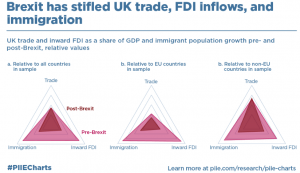
    This “certainty” sounds familiar and almost defies common sense. Behaviourally, it seems reasonable to think that those who live month-to-month on their pay cheques will spend any incremental pesos or dollars received. On the other hand, a comfortably well-off individual is more likely to add the extra dollars to his or her bank account. That outcome seems even more likely in an economic downturn. Of course, in the areas of common sense and behavioural probability the UK government has form. All those Brexit promises and opportunities plastered on the sides of red buses have now been reduced to the glorious freedom to boost the suction power of your Great British vacuum cleaner. The wider world knows that sucks and, for good measure, has kept the receipts. In fact, the Peterson Institute has strikingly captured the trajectory of UK trade, foreign direct investment(FDI) and immigration in the graphic below:


    The trade decline won’t come as a surprise but the shrinkage of foreign investment (FDI) is another tremor worth keeping an eye on. In other words, are international pools of capital less “certain” of growth or even payback and less willing to back the UK? No different to that Tokyo night 30 years ago, confidence is critical and can shift suddenly So, when the Financial Times(FT) reports this week that the UK has become more reliant on inflows of foreign money than at any time since records began in 1955, it is even more critical that confidence is maintained. Furthermore, the FT states that the UK trade deficit is the worst on record and that the current account deficit is the worst of the G7 nations. That means outside capital is being used to finance the UK’s record over-spend(vs income). Other people’s money, eh. How often have we written that script?

    Like Brexit, I fear the UK government is locked into a flawed economic policy and hoping time will cloud memories. This is not the time for that approach. Foreign capital and traders could suddenly form the view that the UK budget is not “serious” and start thinking about the relative strength of other economies. Back in 1992, the UK inflation rate was triple that of Germany’s. What chance of that by Christmas this year? Possibly, more than Kwasi Kwarteng thinks. So, companies and investors might need to budget for another run on sterling if markets lose faith in the UK . It’s all fine and dandy for the faithful in Tunbridge Wells to say in Liz we Truss, but will the squawk boxes? Ah well, I’m still hooked.

  • Crypto Is Not Dead, Long Live Crypto But Join The Queue

    Crypto Is Not Dead, Long Live Crypto But Join The Queue

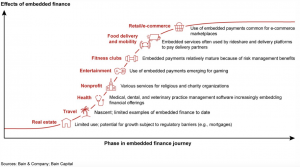
    I’ve been looking at it for hours now. No, not that queue. But, it is a picture and it too illustrates a passing of the old to the new. I’m thinking of digital finance, or as they say in jargon town “embedded finance”. In particular, I’m looking at the progress of various industries in the online commercial world and how they have introduced financial services as a feature of their goods and services. Think of Amazon, and how it introduced delivery as a feature of purchasing on the internet. Now think of payments, subscriptions, buy-now-pay-later (BNPL), funding and foreign exchange as a feature of many online offerings today. Note, I have not mentioned cryptocurrencies but I do believe embedded finance gives us an interesting insight into where crypto assets and Web3 platforms built on blockchains can go. First, let’s look at the picture from consultants, Bain & Co., and apologies in advance for the absence of a Huw Edwards voice-over…

    Bain & Co were using this graphic to make a point that embedded finance accounts for $2.6 trillion which is just 5% of total US financial transactions. The mega-adopters are not particularly surprising coming from the high-frequency retail/e-commerce and food delivery sectors but the laggards look very interesting. The health, travel and real estate sectors as reluctant adopters are possibly not a surprise given they are, for individuals, the highest value items for a household. Clearly, higher value transactions bring with them associated risks and processes which add complexity as security, regulatory obligations, privacy and verification present challenges. If only there was a technology to meet these digital challenges…..but, but dare we mention something even more brand-challenged than Centre Parcs this week?

    Cryptocurrencies, are being hammered. Not even the hugely hyped “Merge” event on Ethereum has halted the crypto carnage. Bitcoin is almost back to 2020 pricing levels and the wider crypto universe has lost more than $70 billion in just the last 24 hours, dragging the crypto market value under $1 trillion. That’s a long way off peak $3 trillion levels achieved in 2021. However, let’s not lose our heads and weep for bigger empires. There’s a danger we focus on cryptocurrencies and miss the more significant moves on the technologies underpinning those digital assets. Specifically, a blockchain code/database with embedded smart contract programmes is potentially a transformational solution to the big-finance challenges listed above. In simple terms, blockchain technology removes intermediaries, reduces the risk of disruption and can solve many of the security, privacy and verification challenges presented by embedded finance.

    If you think crypto and blockchain solutions are dead, think again. Then join the queue to get involved because there is lots going on as the following developments illustrate:

    • Starbucks has announced the launch of a loyalty programme using digital collectibles(NFTs) and the blockchain technology of Polygon. If you thought this was just another high-frequency small item brand dipping its toe into Web3 you’d be wrong.
    • Famed private equity ‘barbarian’ KKR manages just the $450 billion of financial assets. Its investors are huge and they take their money very seriously. So, check out KKR’s decision to put a portion of its “Healthcare Strategic Growth Fund” on a blockchain developed by Avalanche. This tokenisation of an exclusive fund gives smaller investors the opportunity to follow big institutions into alternative markets and suggests crypto is pushing embedded finance further down the Bain & Co graphic.
    • Investment funds are a classic beneficiary of technologies designed to remove intermediaries so expect more news flow in this space. Interestingly, in the depths of a crypto ‘nuclear winter’ it was striking to see crypto-focused investment firm, Valkyrie, ring the bell at the Nasdaq stock exchange HQ in New York last week. The Nasdaq technology index is also providing a helpful crypto insight.
    • We need to start thinking of crypto, blockchain and Web3 as technology, and not currency. Sure, currency is a feature but there are so many other financial features possible and that’s the future. So, it is not a surprise to me or macro analytics experts like Quant Insight(Qi) that crypto/blockchain assets trade like technology stocks because so much of their value is in the future, and therefore hugely impacted by interest rates and confidence. Technology stocks are hurting too – 45% of the member companies of the big tech index, Nasdaq 100, are at new 8 week pricing lows. By any measure, and in comparison to other periods of market volatility, this is a severe tech drawdown. In fact, the Financial Times is reporting that this week marks the longest tech IPO drought in history; 238 days without a tech IPO over $50 million is a longer freeze than the 2008 credit crisis or even the dot-com TMT bust in the early 2000s.
    • However, weakness presents opportunity. The crypto trading platform/investment bank, FTX, is the gorilla in the crypto playground and has been ramping up its acquisition and investment activity in the likes of BlockFi and Doodles. Apparently, FTX’s founder Sam Bankman-Fried is looking to raise more dry powder/funds which is hardly a surprise. However, his valuation of FTX might be more surprising – a $32 billion expected valuation would be similar to that struck at its last fund raising ie not the 60-90% valuation collapse seen by many of its competitors. Might be worth keeping an eye on that as a sentiment changer for the entire sector but there’s possibly more…
    • Abra Bank is seeking full depositary institution status in the US for the custody and trading of digital/crypto assets. They are not alone – Wall Street giants like Citadel, Charles Schwab are building a crypto exchange platform. One can’t help sensing a TMT funeral-watch vibe which 20 years ago fooled many into thinking Web2 was dead. Go and Google Amazon’s history and watch the doc on Netflix….they were all there back then, and busy building.

    Things are busy closer to home too. Look at that Bain & Co graphic again and then wonder why eShopWorld founder, Tommy Kelly, has bought local real estate player, Sherry Fitzgerald, for €50 million? The investment will be managed by Kelly’s family office investment team which in turn, will be managed, by a well-known senior financial figure – what embedded finance strategy might ex-Goodbody Stockbrokers CEO, Roy Barrett, have in mind for Sherry Fitz? E-commerce, finance… real estate. Hmmm. Place your bets but join the queue if you’re looking at ASX Sports’ current crowdfunding campaign…

    Again, check the graphic above and note that the sports, betting and gaming (SBG) sector has been identified as a natural adopter of blockchain technologies like currencies and tokens/NFTs. ASX Sports has teamed up with Aventus to integrate blockchain into its platform to track transaction activity and offer NFT collectibles. The race to innovate and engage customers is understandable given the US sports betting market alone is set to grow to $10 billion a year. Of course, it is early days yet for crypto and blockchain solutions but watch the early movers and imagine if Web3 could this time enable the digital laggards in Health, Travel and Real Estate to play financial catch up. Game still on me thinks…..

  • Today’s Battles, Yesterday’s Generals

    Today’s Battles, Yesterday’s Generals

    Russia’s elite 1st Guards Tank Army (1GTA)had been tasked with protecting Moscow in case of a NATO attack. Now, it is no more. An army which fought in all of the major Eastern Front battles of WWII, beginning in Stalingrad and ending in Berlin, has been demolished outside Ukraine’s second largest city, Kharkiv. Clearly, the surviving generals of 1GTA should stay away from open Moscow windows in the coming weeks but this particular military debacle did prompt a related thought. Are our civilian ‘generals’ – politicians and monetary authorities – in danger of using out-dated strategies to combat today’s global economic challenges too? Put your helmets on and consider the current thinking in our battles against inflation, energy security and autocratic populism.

    In a single day of trading this week a whopping $1.6 trillion was wiped from the value of US stocks. The cause of financial market volatility was, at the headline level, a slightly worse than expected US inflation(CPI) figure. However, in truth, there was nothing new in the CPI report with inflation remaining stubbornly over 8%, but this meant market traders knew the “generals” at the Fed were going to stick to their weapon of demand destruction – more interest rate hikes. Our fear is that the Fed is using the wrong weapon to save its credibility and that supply rather than demand is the bigger challenge. A combination of Covid-19 and war in Ukraine has crippled supply chains and destabilised energy markets but the initial cost shock seems to have receded dramatically in a number of key markets:

    • US house sales have been falling for 6 months and are now down 30% year-on-year(July).
    • US gasoline prices at the pump are down 25% and have been falling daily for 3 months.
    • Global freight rates for container shipping (measured via the Baltic Dry Index) have dropped by 70% in just 4 months.

    Arguably, the Fed is doing even more damage overseas. Higher US interest rates have seen the US dollar increase in value dramatically. Readers are probably aware of a loss of euro and Great British peso purchasing power of 14-15% during 2022, but in emerging markets the effect has been even worse, particularly for those countries buying critical commodities priced in US dollars. Diminished purchasing power can dramatically impact global demand for US goods like iPhones and Nike sneakers. Just yesterday, a Twitter commentator was highlighting the price of an iPhone in Turkey (in Lira terms) is the same as that of a new Volkswagen Golf back in… 2015!

    So, in our view, the Fed’s idea of monetary Red Cross treatment is the equivalent of going back to the battlefield to shoot the wounded. According to financial data group, Factset, a whopping 240 of the S&P 500 companies made mention of recession on their recent Q2 earnings analyst calls. Now, adjust your helmets. The news on the supply side is looking much better. More specifically, energy prices and newsflow are moving significantly in the right direction. Consider the following developments:

    • Germany’s reserves/storage of natural gas have almost reached 90% a full 2 months ahead of schedule and despite Russia cutting off the NordStream 1 pipeline.
    • Goldman Sachs reckon Europe has “successfully solved” its gas supply issues for this winter and is forecasting the price of gas to more than halve.
    • European political “generals” are beginning to act in unison and reform energy markets urgently. In the existing Europe-wide electricity pricing framework the price of gas was the dominant pricing influence and failed to take into account cheaper renewable options. In Germany alone, renewables account for 40% of energy generation. Political action on pricing frameworks and excess profits/windfall taxes will add to the downward pricing momentum forecast by Goldman’s research team.
    • As we pointed out in a previous article, oil(down 25% from highs) and gas are commodities which generally trade in equilibrium and require only marginal changes to supply/demand for pricing to exhibit extreme volatility. Now think about the “marginal” impact of a weakened Vlad the Vulnerable coming to the negotiation table and potential commodity pricing moves. As recently as March 2020, oil futures prices were actually negative ie the producer paid you to take future delivery.

    Irrespective of short term energy solutions, there needs to be a European political re-think on nuclear energy if long-term energy security is going to be a realistic goal. Of course, there are negative aspects to nuclear energy but the climate crisis and geopolitics are messaging clearly that the current alternatives are pretty grim. On that note, our political “generals” should also be urgently looking to skewer another alternative solution with false promises – autocratic populism.

    Janan Ganesh writes an interesting piece in the Financial Times this week, US soft power grows as the alternatives become clear”. The US bit might surprise but the starker conclusion in the article is that 2022 has proven to be a year of “autocratic incompetence” as Russia flounders in Ukraine and China compounds a property meltdown with zero Covid zealotry. Populist right wing charlatans have been banging the Putin drum that liberal democracies are failed social models. As Ganesh puts it, “This has been illiberalism’s pitch through the ages: not that it is nobler or moral, but that it works. In this telling, democracy is a well-meaning charter for chaos and weakness.” But, autocratic regimes are having a very bad year. And, global leaders should not stop at Russia and China in exposing false promises and failure.

    President Biden has outraged many Republicans with his direct accusation that the MAGA cult of ‘Agent Orange’ is a threat to democracy. Arguably, he could have been even more explicit and robust – the United States on January 6th 2021 came dangerously close to a coup and it is increasingly clear that the former golfing executive in the White House was trading national secrets with foreign powers for financial gain. And why stop at Washington? As the UK mourns the death of a genuinely respected global leader it should not be forgotten that its last Prime Minister left office in disgrace. The incompetence of Brexit and the pathetic Channel dinghy bashing was bad enough but the Johnson administration possibly saved its worst till last. As the NHS and cost of living crises gripped the nation in July and August the entire government went missing-in-action. Populist alternatives don’t work, literally. And there’s another thing that doesn’t work…..yesterday’s generals.

    Today’s real leaders should be more vocal about those “generals” promising a return to rose-tinted periods of a country’s history. Take your pick from 1950s ‘Apple Pie’ America, Global Britannia or Iron Curtain hegemony. The future is the opportunity for all, the promise of the past is a lie for the few. A very few. Want to go back in time? Between 1920 and 2020 the average human life span doubled. However, if you were a white male in America wanting to ‘Make America Great Again’ your life expectancy just dropped by 3 years between 2019 and 2021. Bad generals get their own killed too.

    “If nothing else works, a total pig-headed unwillingness to look facts in the face will see us through.

    General Melchett – Blackadder Goes Forth