Category: General

  • What The Floki Is Happening In Currency Markets!

    What The Floki Is Happening In Currency Markets!

    Beware buses and dogs. I thought the move of Boris “Big Dog” Johnson’s £350 million Brexit promise from red bus to bluster was relatively swift but then Floki came along. Who, what??? Well, the who bit was easy – Floki was the name of Elon Musk’s dog. The what bit was more convoluted. Bus adverts all over the UK and Ireland suggested Floki was the next “big dog” in a cryptocurrency market already consumed with the rocketing fortunes of Musk and another canine crypto meme, Dogecoin. And then they were gone, the ads and the currencies I mean. In more traditional financial market-speak they really were ‘dogs’. Dogecoin has lost 82% of its value while Floki has given investors the ultimate six month ‘WTF’ experience with a 96% implosion.   At this point, you might be forgiven for thinking that this is an exclusively crypto phenomenon. But, you’d be wrong. Something much more fundamental is happening.

    For years we have written about “other people’s money” and the risks of it being pulled suddenly from weaker companies, banks and countries in times of crisis. In the majority of cases fear and risk aversion prompted capital to be pulled but, for the first time in more than 40 years, the actual cost of money is driving the movement of capital/money. What cost? Simply put, interest rates.

    I was reminded the other day that anyone working in financial markets under the age of 43 with a primary university degree has never really experienced an interest rate shock in their professional lives. Nassim Nicholas Taleb, author of The Black Swan, had a more brutal take on the post-GFC intake – “Those who entered finance after 2008, are basically, unskilled labour.” Oooft! Or should those be zeros in my exclamation? Here’s a few interest rate headlines we haven’t seen for a few decades:

    US Mortgage Rates Hit 6% After Big Selloff in Bond Market – Barron’s

    Australia Raises Rates By Most in 22 Years – Financial Times 

    ECB To Raise Rates In July for First Time In 11 Years – Sky News

    Yes, the post-GFC environment of zero % interest rates (planet ZIRP) and, effectively, free money meant returns, income and yield hurdles across all asset classes were both compressed and driven lower. In a world where the financials of every traditional opportunity looked very similar, the story was king. The believers may have been new but the fables and red flags were all too familiar in recent crypto newsflow….

    • Luna, its ‘stablecoin’ and its “Lunatic” investors watched $40 billion evaporate rather than earn the 20% annual returns promised. Yep, even on planet ZIRP …“if it’s too good to be true, it probably is” .
    • Celsius was a $10 billion crypto one-stop shop offering custody, asset management and investment(staking) services to its clients. Sadly, those clients are currently unable to access their “assets” as investment/staking activities employed less-well-understood leverage(other people’s money) and all client assets are currently frozen. In reality, the assets(investments) are worth far less than the liabilities(leverage employed) and insolvency beckons.
    • Tether is the largest stablecoin in the crypto ecosystem. Investor confidence is tied to the perception of the collateral backing, or pegged, with the Tether coin, and that confidence is slipping as other crypto ecosystems and funds (3AC ?) implode. A Tether collapse would be ugly given there are still circa 18,000 cryptocurrencies in existence with a total value which has just dipped below the $1 trillion mark. If we recall the credit crisis of 2008 collateral in the same asset class can suddenly be subjected to a buyer-boycott irrespective of quality. Think about high quality real estate and banking franchises which almost failed in that period.

    So, the toxic combination of unrealistic promises, excessive risk-taking and asset class fear/contagion are not new to 2008 credit crisis survivors. However, we should be cognisant of the fact that it is not just cryptocurrencies which will endure increased scrutiny in a world of higher interest rates. ALL currencies and asset classes face a higher hurdle rate, namely higher returns via cashflow, interest rates or dividends. Cash is king and the recent wannabe kings, both currencies and con artists, are dying in their own credibility crises. Think this is just a cryptocurrency collapse? Think again. The traditional financial world is dealing with currency credibility issues too…

    Turkey’s 80 million citizens live in quasi-martial law conditions as President Erdogan fights with his own central bank. Erdogan thinks the best way to fight inflation is to CUT interest rates and has fired three central bank governors in recent years. Unsurprisingly, foreign investors have walked away from the Turkish Lira which has now lost 80% of its value in US dollar terms over the past 4 years. Oh, and inflation is now running at 70%. Credibility is critical but don’t dismiss this as just a developing/emerging market issue.

    Do we need to think about the Great British Pound as a potential emerging market currency? This week the Great British “Peso” dropped below the 1.20 level versus the US dollar and the research analysts at Bank of America(BOA) believe the pound and its trading volatility is taking on “emerging market” characteristics. Hedge funds are apparently betting against the pound in a big way ahead of a potential “existential crisis” and the BOA team don’t pull any punches as to the credibility culprit – “The challenges facing the Bank of England are unique along with a supply dynamic that it remains wholly unwilling to discuss: Brexit.” However, it’s not just countries with law-breaking leaders experiencing credibility tremors. How about possibly the most law-abiding society on the planet?

    Japan is the country which is keeping currency watchers awake at night. The world’s third largest economy is saddled with so much debt(at 266% of GDP!) that it can’t afford to let interest rates and bond(JGB) yields rise. The ‘whack-a-mole’ problem for Japan’s central bank, the BOJ, is that it is “strong arming” the bond market by committing to buying any bonds whose yields move over 0.25%. Now think about that almost zero rate and then consider the US Federal Reserve planning to hike interest rates by 0.75% in just one move this week. The BOJ might be freezing the bond market(some days there are literally no transactions recorded) but Japan’s currency, the Yen, is being battered. The Yen is now at its weakest level(135.60) versus the US dollar in 24 years and Deutsche Bank currency analysts are seriously concerned. According to Deutsche Bank calculations, the BOJ bond buying whack-a-mole policy is the equivalent of the US Fed printing $300 billion in just one month!!! Such levels of currency printing run the risk of rampant inflation and a loss of investor confidence in Japanese assets. Monetary policy makers in Tokyo face an extremely delicate balancing act and be in no doubt that the Yen is hurtling towards a credibility cliff.

    It is no accident that these potential currency crises are emerging now. Ultra-low interest rates were the perfect hiding place for weaker balance sheets and, in certain cases, populist promises from poor leaders. And this is neither a new nor crypto phenomenon. In fact, banker John Mills stood before the Manchester Statistical Society in 1867 and had this to say:

    “Panics do not destroy capital; they merely reveal the extent to which it has been previously destroyed by its betrayal into hopelessly unproductive works.”

  • Wishing For a Recession Or A Re-Set….?

    Wishing For a Recession Or A Re-Set….?

    Careful what you wish for is the old adage. So, spare a thought for the Daily Express social media team who took a break from culture wars and refugee bashing to save Big Dog? Yep, the Boris Johnson cheerleader-in-chief thought it would be a good idea to capitalise on Fat Boy Dim’s escape from a Sue Gray skewering to conduct a poll on Twitter. The absence of a “smoking gun” in Sue Gray’s report on serial partying, wine-time-Fridays, karaoke machines and the walls of 10 Downing Street spattered with red wine and vomit seemed to have prompted the brave polling query, “Should Boris Johnson resign after #SueGray’s report into lockdown parties?”. Oh dear. The crushing response from 97% of the 31,000 responses was “YES” and suggests that the Ministry of Sound-bites’ wish for everyone to “move on” has triggered a far more challenging movement. In a similar, but more serious vein, one senses that the mainstream media is screaming for a recession. Again, careful. Let’s check the data in a few charts….

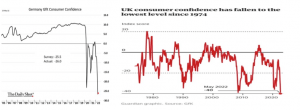
    In a European context, the consumer is definitely losing confidence. The following charts(via The Daily Shot/WSJ and The Guardian) from Europe’s powerhouse economy, Germany, and the UK are illustrative, including an almost 50-year low in Boris-stan:

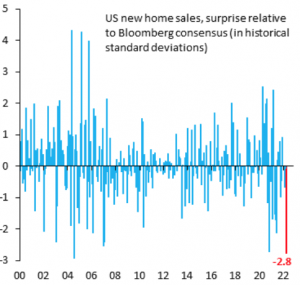
    It’s not just Europe. In the US, where it’s easier to buy a gun than to buy baby milk formula, the Biden presidency is enduring a record low 36% approval rate as inflation rips and monetary authorities scramble. The Fed has been relatively aggressive in using interest rate hikes to counter inflation and dampen economic activity. And, one key sector is cooling dramatically. The US housing market in its new home sales data this week is experiencing the rapid impact of higher mortgage rates. In fact, the negative surprise of a 27% decline in home sales (per Bloomberg) is almost 3 standard deviations from normal and the following chart suggests we are in Covid or sub-prime crisis(2007-2008) shock territory.

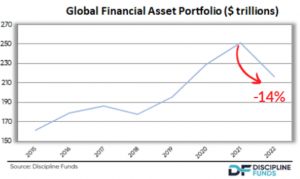
    The charts above are a reasonable example of a problem(inflation) requiring a solution wish(cool the economy) with an action(higher interest rates) which results in a “careful what you wish for” outcome(potential asset price declines). Of course, housing markets globally are holding up pretty well but financial markets have been taking some serious pain across major equity indices(S&P 500), technology stocks(Nasdaq), crypto(Luna) and bond/debt markets. The slightly contrarian view might be that some asset price deflation might not necessarily be a bad thing. Consider the plight of the youth today trying to fund housing, education, pensions and child care. Arguably, this is the worst pricing entry-point in history for those attempting to build a life, savings or family. The following chart showing $35 trillion worth of wealth destruction in recent months looks monstrous but in percentage terms the damage is less scary at 14% of total assets.

    We have documented many times over the past few years that income inequality is at its most stretched since the 1930s. Even the wealthy acknowledge this gap as unsustainable. While a rapid uncontrolled unwind of asset prices would not be a good thing, we should note the following:

    1. Financial markets typically discount(forecast) risks 6-9 months in advance of hyperbolic newspaper headlines. We are already in the 6th or 7th month of asset prices falling so we might be closer to the end than the beginning in market declines.
    2. Understand the difference between economic activity and consumer confidence. For example, in 2020 as Covid-19 raged, Ireland managed to clock up positive annual GDP growth despite the fact that at some points during the year up to 700-800,000 of the workforce were unable to work and worried. Now think of a reverse scenario where growth is disappointing but consumers feel better. Sound mad? Ask the Japanese and Swiss over the past 20 years.
    3. The share prices of Wal-Mart, Target or Snapchat falling by 20-40% in a single day may sound bad but remember 90% of the US population owns just 11% of the US equity markets but account for 80% of spend ie the top 10% are the ones mostly affected by asset price declines but don’t really move the dial on daily economic activity/spend. Let’s just say central banks care much more about the 90% this time. For illustration, the top 50 wealthiest people in the world have seen their fortunes decline by half a trillion(!) dollars in recent months but this enormous figure still doesn’t match the gains in wealth achieved through the pandemic. Tiny violins required….

    Sadly, any sort of re-balancing could entail some short term pain for everyone. Nobody likes slow-downs or technical recessions, including board rooms, and there are already signs that main street will have to cope with job losses. Lay-offs at Klarna, PayPal and Netflix are indicative of technology growth rates and valuations hitting the skids but, again, there are two important points to make if we believe an economic re-set is well overdue:

    • Interest rates held at artificially low levels since the credit crisis encouraged increased risk taking and poor capital allocation decisions. Not long ago there were $15 trillion worth of negatively yielding bonds sitting in investment portfolios. This unattractive rate of return forced investment capital to find higher returns in riskier ventures – see Luna and its ‘Lunatics’ being promised 20% “yield”. Most would agree that a realignment of investment capital, risks and returns would be a long-term positive development.
    • The technology sector and its attractive wealth growth opportunities are an obvious scapegoat for the inflationary labour shortages experienced by many sectors in the economy from healthcare to hospitality. However, do not underestimate the impact on labour markets from early retirements, the crypto/NFT creator economy and self-employment/start-ups. Everything seemed to be rocketing in business, tech and financial markets except main street employee wages.

    Now, whisper it carefully but… current market forces could possibly deliver wage inflation. Typically, this would alarm central banks and governments as this could set off an inflationary spiral where higher wages begets higher prices, begets higher wages….prices…. and rinse, repeat. However, monetary authorities and governments have only recently conducted the biggest fiscal experiment in history by handing people trillions of dollars in wage subsidies, direct cash transfers, Covid relief payments etc and guess what? In the vast majority of cases people spent the incremental dollars in their accounts, maintained  the flow of money, and helped economies avoid GDP implosions during the pandemic.

    We should note that this global economy is not like those of 1974 or 1981. Labour mobility, cloud infrastructure, asset-lite business models and de-unionization of the workforce means the overall economy is more dynamic and agile. Do not presume wage rises are a multi-year phenomenon destined to kill business and trigger a prolonged recession. Rather think re-set.. as not wishful thinking….


  • Cryptocalypse For Dummies

    Cryptocalypse For Dummies

    Imagine investing in a financial “asset” and then experiencing the subsequent humiliation of said asset falling in value by 350%. Sounds impossible; surely, the asset didn’t dip into negative territory? I mean a drop of over 100% would mean…..you had to pay somebody to “buy” it from you. You’d feel a real dummy wouldn’t you? But then, that’s crypto for you. Wrong. The above price collapse references the collapse of oil futures in April 2020. So, be kind. In sporting parlance it might be better to play the ball, and not the person. However, there are a few cruel truths to be learned in the ongoing evaporation of value in the world of digital “stablecoins”. First, a quick refresher on stablecoins.

    Stablecoins, unlike their better-known crypto kin like Bitcoin and Ethereum, peg their value to another financial asset. Think Hong Kong and its currency’s peg to the US dollar. Now, some crypto stable coins do actually peg their value to the US dollar or cash proxies like US Treasury bills. However, other stablecoins were designed to peg their value to related crypto assets/tokens. This was the case with Luna and its pegged/paired stablecoin TerraUSD which relied upon ‘algorithms’ to support a valuation equilibrium between the two crypto assets. Until it didn’t.

    This is not the forum for explaining the intricacies of buying/selling dynamics which caused Luna to de-peg from TerraUSD except to say definitively that algorithms are useless when both crypto assets enter into a pricing death spiral and automate the issuance of trillions of additional not-stablecoins. The Luna was worth $100 in late April but is now trading at a fraction of 1 cent(not %) and it looks like $40 billion of crypto investor wealth has evaporated. These Luna investors used to enjoy social media affirmation as “Lunatics” but the lunacy is really in the crypto asset/instrument itself. Here are a few pointers….

    Utility: Oil may have experienced a momentary absence of value in 2020 but its utility remained. It was still needed as an energy source. Utility justification remains a challenge for most cryptocurrency assets but a few have established some payment status, for example Bitcoin and Ethereum.

    Currency Pegs: Even in traditional finance(TradFi) currency pegs can be tricky. Just ask the Swiss National Bank who not too long ago(2015) were forced to abandon the Swiss franc peg with the euro. Asset pegs are even more difficult to maintain in periods of intense volatility. And, right now qualifies as such a period of pain.

    Incentives: Typically, traditional currencies and their central banks rely upon interest rates to incentivise/deter flows of capital into a currency – see Argentina’s desperate 50% interest rates to attract capital. Now, how did Luna find its Lunatics? Simple. It offered a return of 20% to those who “staked” their Lunas. This known in crypto world as “yield farming” and is the equivalent of offering interest to those who deposit/stake their crypto. Lovely stuff…..but….but….

    Other People’s Money: We write about other people’s money so often you’d think lessons would be learned. The stablecoin experiments have been referred to as technology or financial engineering. Let’s be clear – this is pure financial engineering. And, financial engineering is the use of debt/ leverage ie other people’s money. In Luna’s case, new Lunatics (new capital) paid the staking Lunatics a return, an interest rate. Yep, you can see the fatal flaw quicker than you can say Ponzi. To the surprise of nobody in traditional finance the current market volatility is causing problems for those businesses and financial products which are dependent on the daily flows of other people’s money. The other clue was the ridiculously high interest rate/return on offer and that delivers our final pointer…

    Credibility: The joys of decentralized finance, smart contracts, blockchain efficiency and freedom from central banking/regulatory oversight sound fantastic in a dreamy metaverse until there’s a problem. Sadly for the Lunatics their go-to person is Do Kwan, the South Korean Luna-Terra founder. He is not a central bank and therefore his credibility cannot be determined by the returns Luna was offering(nor his previous crypto failures!). With interest rates at historic lows in recent years there should have been extreme scepticism attached to the supra-normal yields/rates being offered. That level of return smacks of desperation and should have triggered instant credibility issues. Expect “yield farming” to come under further scrutiny but also be wary of the following apocalyptic forecasts….

    Crypto Is Dead: It isn’t. Digital currencies have utility as payment instruments, as did oil in 2020. Bitcoin is not exactly flying but it is holding up rather well at $30,000. And note, Bitcoin’s price would need to fall to $6,000 to “do an Amazon” and replicate that 92.7% collapse in 2000.

    Crypto Lacks Any Use Cases: Look closer. We are still in experimental phase but the daily announcements in the corporate world of digital token/NFT initiatives and all-time high references to “metaverse”in analyst/earnings calls is striking. One senses tokenomics, NFTs and blockchain are hugely interesting to companies wanting to increase engagement and open up new digital channels with customers.

    Regulation Will Kill Crypto: Anyone remember Napster? Music copyright laws finally killed it but not Google, Facebook, Spotify, Netflix etc which digitalised content and found a way to incentivise the most powerful stakeholders. There will be regulatory influence eventually to avoid lunatics being separated from their loot or Luna but there will also be crypto/blockchain technology embedded in lots of everyday businesses. Think streaming, user analytics and cloud computing today and remember all the risks and fears listed by the commentariat in the early days. This is not the apocalyptic end but just early days with harsh lessons.

    We need fewer dummies and more patience. Ask Jeff Bezos……or an oil trader.


  • Did You Cheer The News Today, Oh Boy…?

    Did You Cheer The News Today, Oh Boy…?

    I have an important medical appointment this week. All should be ok, but ya never know. What I do know is that, unsurprisingly, my mind has been doing some interesting good news, bad news triple-salchows over the past week. Who needs to ‘doomscroll’ Twitter these days? The mainstream media is all over rampant inflation, financial market meltdowns, Ukraine horror and a Chinese growth shock unless…… you’re a Daily Mail reader. Yep, in that case you’re being treated to a ridiculous 7-day curry crime series in Durham. Oh boy. Back in the real world, I’m thinking about how media coverage of events can be skewed towards negative stories. But don’t blame the media entirely. Their audiences actually like bad news…

    In the midst of pandemic chaos in 2021 American economics blogger, Matthew Yglesisas, highlighted a research paper on US media published by Bruce Sacerdote, Ranjan Sehgal and Molly Cook. The findings of a negative skew to stories on Covid-19 was not the surprise but the source of the stories did challenge existing perceptions. The study showed that partisan politics did not drive the negativity. In fact, conservative and liberal platforms alike emphasized the negative. However, the most striking observation was that “the most popular stories… have high levels of negativity for all types of stories”. This prompted Yglesias to deliver a rather depressing conclusion…

    “In other words, the negativity bias in Covid coverage didn’t come from the liberal media being out to get Trump. It came from you, the reading and viewing public, who strongly prefer to consume negativity-inflected stories on all types of topics, creating a situation where the biggest and most influential media brands have gotten really good at delivering the negativity that the people crave.”

    My personal sense of pandemic coverage was that the stunning science of delivering an effective vaccine in just over 9 months, remote working technology and the revolutionary funding decisions of states and global central banks never received the kudos they deserved. A more optimistic view of humanity might argue that the latest thinking in science, technology and finance saved the world. And……arguably, financial markets reflected that renewed optimism.

    Many investment portfolios and pension plans would have clocked up 25-30% gains in 2021 and observed all was hunky dory until Vlad The Invader ruined things. This might be the consensus conclusion, but would be wrong. Chinese vaccine struggles with C-19 Omicron variants, accelerating inflation, rising global interest rates and a correlated rollover in technology stock risk/valuations were all growing in macroeconomic influence well before the end of 2021. As an illustration, the tech-heavy Nasdaq stock index peaked in November 2021, months before the late February invasion of Ukraine. Agreed, the numbers are ugly; a 27% collapse on the Nasdaq, bond markets’ worst start to a year in history and $20 trillion wiped off the value of global stock markets. However, the sense that we are back to early 2020 levels in financial markets(we are) should not necessarily be a source of gloom or require us to revel in the scary media headlines. The following potential headlines won’t be click thrillers but are very possible:

    China Sources New Vaccine

    It is striking that the best data analytics platform for tracking macro factors (Quant Insight) was recently showing China as the most powerful driver of markets right now. Another data point is also catching my eye; Covid lockdowns in China are affecting supply chains/delivery times at a quantum of 8 standard deviations(Z-score) from normal. In early 2020, at the start of Covid, Z-scores spiked to 11. So, things are almost as bad as early 2020! The puzzling thing is why the Chinese authorities are pursuing a zero Covid lockdown strategy? Vaccine efficacy is a major factor, and pride. However, the CCP Politburo, are not reckless. If economic turmoil threatens power they will act and it’s entirely possible they will use international vaccines to open up their economy. This also would be a major positive for the global economy.

    Mega-Deals Shock Wall Street

    The behavioural aspects of financial markets never cease to amaze. The power of the herd overwhelms rational thought and ensures that market trading is possibly the only human activity where the buyers will ignore the “on sale” signs but stampede towards an all-time-high priced offer. That’s the herd and it is interesting to read the reports of Robinhood, Reddit and meme-stock traders feeling real pain and leaving the ‘game’. Meanwhile, some longer-term thinkers are starting to flex their buying muscles. Check out the following:

    1. 1.Warren Buffett had been selling stocks for almost 2 years but in recent months has ploughed $50 billion into new purchases. That’s the most money deployed by Buffett in a quarter since 2008. Note that date and the 13 year bull market from March 2009.
    2. Elon Musk’s purchase of Twitter has been analysed to death from a media, freedom of speech and governance perspective. But, he’s pretty good at making money as the world’s richest man. So, should we be more intrigued that not only did he buy Twitter “on sale” at a 30% discount to its peak price but it seems he’s not alone in smelling a bargain. In recent days it has emerged that savvy investment names like Sequoia, Andreessen Horowitz (a16z), Fidelity, Brookfield and Larry Ellison have pitched $7 billion into the Twitter funding pot. Expect more of this influential buyer activity. There are a plethora of technology stocks which are down more than 70%. How you fixed for Netflix? Peak valuation last year of $320 billion, today try $76 billion. Once there was a stampede to buy it on a valuation of 11x its annual revenues, today nobody will touch it on 3x. How about Zoom, PayPal, DocuSign, Shopify, Peloton, DraftKings, Pinterest or Spotify who are all on the ‘70% off’ sales rack?

    Bond Funds See Inflows

    Boring, boring bonds. Ehhhh… not so fast. Bond markets rule the world. They are the instruments which hold “other people’s money” which, in turn, is borrowed by companies and governments around the world. Global debt was approaching $300 trillion in 2021 which puts global stock markets worth $120 trillion(then) in quivering context. However, a vicious circle of inflation and central bank interest rate hikes to dampen activity has triggered $2.5 trillion of losses in global bond markets from their peak. The bottom line is that interest rates and bonds set the “cost of money” for ALL financial markets.

    All these instruments(equities, commodities, cash, crypto, property) compete for money but that money keeps flowing through the system. This is not 2008 when money/liquidity froze. At some point there will be an equilibrium struck between inflation, interest rates and economic activity(slowing in Germany, China, emerging markets) and money will seek the “safe haven” and income(yields) which bonds offer. Note, today you can earn more than 3% on US Treasuries guaranteed by the US government. When bonds are bought(inflows) the “cost of money” falls and that helps all asset classes and economic activity.

    Hold My Beer….

    Implicit in the final point about the cost of money is that bad headlines in the short term (economic slowdown) will lead to more encouraging but less click-friendly headlines in the future. Don’t expect the media to seek the positive, they know their audiences! Also, do not presume that audience demand for negativity is just a Trumpian US phenomenon. The nuance in the Sacerdote, Sehgal and Cook paper was that the audience demand for negativity seems to exist cross-nationally, but the US stands out in that its domestic media is more willing to supply it.

    One suspects, as do that research team, that US capitalism and private media ownership has been typically efficient but then the UK might say “Hold my beer….”. The #Beergate nonsense forcing opposition Labour leader, Keir Starmer, to commit to resignation if fined for a Covid rules breach has generated the most baffling response in the media. Rather than celebrating the fact there is one leader of integrity and principle in Westminster, it has triggered a wave of media condemnation or caution that Starmer’s honesty has put undue pressure on the investigating Durham police force. Oh boy……I’m up for some good news anyway.

    “In your head, in your head

    Zombie, zombie, zombie-ie-ie

    What’s in your head, in your head

    Zombie, zombie, zombie-ie-ie… “

                       –   The Cranberries (1994)


  • Roe v Wade: Is God Sustainable in ESG or Gilead?

    Roe v Wade: Is God Sustainable in ESG or Gilead?

    I had a feeling it was going to be a dangerous week. Russian state TV kicked things off with some of its highest profile personalities raising the prospect of “probable” nuclear war but with a soothing assurance for its audience that “we will go to heaven, while they simply croak”. Lovely stuff. Even the consoling thought that this was run-of-the-mill wartime propaganda didn’t last long. On Monday night the “culture war” in the US had its own nuclear event.

    A leaked draft of a Supreme Court decision overturning the Roe v Wade judgment on constitutional privacy and abortion rights is a stunning reversal of 50 years of legal precedent. Christian white-wing (or right?) fundamentalists are thrilled. Everyone else is wondering what’s next? Same-sex marriage, interracial marriage or contraception? So much uncertainty unless you’re a fundamentalist. The ISIS caliphate might be gone but the zealous certainty of a  ‘good vs evil’ holy war is alive and kicking in the US of A. Think that’s a bit OTT, think again.

    The recently published text messages between the wife of Supreme Court Justice Clarence Thomas and the then-Chief of Staff at the White House, Mark Meadows, around the Jan 6th Capitol Hill insurrection are eye-opening on lots of seditious levels but the language of Meadows is striking. He describes the disputed 2020 election result as “a fight of good versus evil”. Then he goes biblical with fundamentalist reassurance – “Evil always looks like the victor until the King of Kings triumphs. Do not grow weary in well doing. The fight continues.” Yes, that’s the White House Chief of Staff….. but he was not alone.

    Mike Pompeo as Secretary of State in the Trump regime was the principal communicator of American foreign policy as well as being a former Director of the CIA. He might actually run for President in 2024 but that’s not the only battle he has his eyes on. If you think Russian TV is scary, check out this little message from Pompeo to a Wichita church congregation in 2015 – “It’s a never ending struggle… until the rapture. Be a part of it. Be in the fight.” Just to be clear, and not Russian, the rapture is an apocalyptic vision of the future, a final battle between good and evil, the second coming of Jesus Christ when the faithful will ascend to heaven and the rest will go to hell. Who needs Disney fantasies? Apparently, not Florida….

    Governor Ron DeSantis, another 2024 Presidential hopeful, isn’t happy with Disney. His recent “don’t say gay” legislation to ban discussion of sexual orientation and gender identity in Florida schools prompted Disney to speak out against this blatant pandering to the right-wing GOP Taliban. Retribution was swift as the Governor’s office announced the abolishing of Disney’s special tax status in Florida. The damage to Disney’s stock market valuation at one point exceeded $60 billion and corporate America is slowly digesting the fact that the ‘House of Mouse’ won’t be the only company who will discover the potential cost of not wanting to “be in the fight”.

    Legendary clothing company Levi Strauss has noted that 58% of its employees are female and that it will reimburse travel expenses for employees who need to travel to other states for abortions. Right now there are anti-abortion “trigger” laws in up to 20 US states which are primed to be enacted as soon as the Supreme Court overturns Roe v Wade officially and permits individual states to legislate. The reference to ‘individual states’ and Levi Strauss whose incorporation in 1853 pre-dates the US civil war is not an accident. Nor is the deliberate attempt by the Justice Alito draft judgment to justify the erosion of constitutional rights on the basis that such rights are not “deeply rooted in this Nation’s history and tradition.” NOT DEEPLY ROOTED. Anyone feel like the quiet bit has just been said out loud?

    Individual states are now free to legislate their way to a theocratic Gilead. For investors and corporates weighing up sustainability and ESG principles in their commercial activities and supply chains the implications are far from free. Consider the following probable costs of religious zealotry if companies follow the “S” in ESG and support diversity and inclusion principles…

    1. Relocation of offices out of states which restrict the human rights of employees.
    2. Increased banking and insurance costs as institutions impose tougher terms on lower /declining ESG rankings across service/goods supply chain.
    3. Municipal bonds which are already enduring their worst decline in history are the critical funding instrument for US cities. Bond buyer boycotts will increase borrowing costs and negatively impact regional economies.
    4. US political polarisation is incredibly badly timed given income inequality is at its worst since the 1930s, 40-year high inflation hits the poorest most and so does repression of female human rights. The concept of democracy and majority rule is under real threat from a powerful minority.

    If the last point smacks of hyperbole then you haven’t being paying attention in recent years. Putin bullied his way over two decades to mass troops on the borders of Ukraine and the commentariat said he wouldn’t dare. Say Bucha without wincing now. Putin’s Agent Orange made it to the White House but everyone said he’d leave when his term was up. Except the Kremlin puppet kept talking about three terms, and then tried a coup after only his first term of failure. Say January 6th over and over, then read those insurrection texts. Justice and the law will have its say surely….. but, but Trump put three conservative judges on the Supreme Court, all of whom assured us that Roe v Wade was “settled law” when they were vetted by Congress. Say nothing, just wonder why Justice Clarence Thomas voted against mobile phone/record discovery motions without disclosing his wife, Ginni’s, close involvement in attempts to obstruct the peaceful transfer of presidential power? Her text to the Chief of Staff, Mark Meadows, in the White House days after the November 2020 election is spine-chilling – “Do not concede. It takes time for the army who is gathering for his back”.

    Army, fight, battle, good vs evil, King of Kings and the rapture. I’m gonna go out on a limb here and suggest that this is not a sustainable situation for a federal union of secular states. However, in the interim, the area of corporate “good citizenship” and ESG is facing an additional challenging question. Can God and fighting evil be potentially a bad thing???? What an extraordinary question but Margaret Atwood, author of The Handmaid’s Tale, seemed to understand the dangers of treating extremism as normal…..

    “Ordinary, said Aunt Lydia, is what you are used to. This may not seem ordinary to you now, but after a time it will. It will become ordinary” 

    The Handmaid’s Tale (1985)


  • The Barbarian At The Twitter Gate

    The Barbarian At The Twitter Gate

    Doubting Elon Musk has been an expensive experience. So, why should we be so quick to query the world’s richest man attempting a $44 billion leveraged buy-out (LBO) of Twitter? The commentariat has been quick to colour the story with free speech rights, editorial muscle and entrepreneurial ego but I wonder whether we need to ‘de-Twitter’ this story. Those of only a passing acquaintance with the Twitter-sphere might actually, in this instance, be in a better place to see a picture with very different colours. Also, there are some interesting angles in the proposed deal for business owners and start-up founders. Lets start with the financials of this LBO.

    The Deal:

    First off, this is potentially one of the top 10 LBO deals in history and is the biggest since Michael Dell and private equity house, Silver Lake, engineered the $67 billion acquisition of data infrastructure giant EMC in 2016. The unusual feature of the Twitter deal is that there are no traditional private equity beasts involved aka the fabled Barbarians at the Gate. It’s just Musk and $19 billion of his own cash(!) plus $25 billion of “other people’s money” in margin loans and debt financing from a Wall Street bank syndicate. The collateral will be Tesla shares owned by Musk but check out the interest rates on the loans in a world where the cost of capital(and inflation) is rising. Reports suggest an interest rate on these loans could be in the region of 5.5% which would consume about $1.3-1.4 billion of cash. To put that in Twitter context that’s 30% of its revenues and almost two thirds of annual cash flow(EBITDA). The operational wiggle room for this business and other debt-laden businesses is shrinking, and therefore carries more risk. And, that has consequences.

    The cost of capital risk trade-off is in the valuation of the acquisition. Take note owners looking at acquisitions or founders raising funds or negotiating exits in 2022. Musk is paying a 38% premium to the Twitter share price on the day prior to his announcing the taking of a 9% stake. However, it’s just a 16% premium to the Twitter share price in the calmer days of early 2022 and 30% off the all- time-high share price of $77. Please recall the Twitter board initially rebuffed Elon’s offer and then giggle at the Bubblevision maestro, Jim Cramer, telling his CNBC audience that the Twitter board had “no choice” but to reject the offer. Clearly, the board’s advisors and bankers had a subsequent awkward conversation about 2022 valuation realities. So, that’s the financial engineering covered but one suspects these are not the numbers which motivate Musk.

    The Motive:

    Musk wants to make money. The Twitter platform has 220 million monetizable daily active users but its $5 billion of revenues can’t even match those generated by a single video game, Call of Duty: Black Ops Cold War, in 2021. Arguably, the advertising business model has failed Twitter. However, Elon Musk has famously never spent a single dollar on advertising Tesla or SpaceX. You may not agree with his social media messaging but Tesla is a remarkably well told story of consumer product and manufacturing excellence. Think about that for a second – a consumer product manufacturer which has never advertised but is selling a million cars a year and has achieved a $1 trillion valuation. Musk has joined Steve Jobs as the greatest consumer product storyteller in history and he knows Twitter has told its story incredibly badly. Musk will tell a far better story and the following might feature….


    The Story:

    1. Twitter is simply the best real time information search engine on the planet.
    2. Twitter is two businesses – a digital network and data analytics engine.
    3. Twitter is a “sit forward” experience – breaking news, sport, geopolitical events, weather catastrophe, information, education etc.
    4. Twitter is NOT a “sit back” experience – leisure, shopping, aspirational, dreams, travel etc
    5. Twitter is NOT a natural home for aspirational advertising.
    6. Twitter with its 200 million users(nodes) has a potential role in a decentralized digital world, the metaverse.
    7. Twitter is the first platform to let people get payouts in cryptocurrencies using Stripe’s Connect facility.
    8. Twitter with its millions of nodes/users has huge validation utility in the areas of KYC, digital currencies, NFTs and tokenomics.


    The Challenge:

    The list above conveniently skips over the fact that Twitter like much of social media is facing increased scrutiny as badly governed platforms for hate speech, disinformation and political extremism. On Twitter alone just 6% of its users generate 75% of its political content. However, the fears that Musk is going to let Trump, anti-vaxxers, Nadine Dorries and the lunatic fringe destroy the Twitter brand and drive mainstream users to other platforms seems naive. The solution and the clue is in the KYC/validation opportunity in point 8 above. Musk’s engineering skills and ambition should not be underestimated in making Twitter a safer place. But, but, but…. he’ll be a billionaire media owner and that can’t be good for free speech says nearly everyone. Hmmmm….

    Amazon’s Jeff Bezos is already querying Musk as a media owner but he’s the second richest man on the planet and he owns the influential Washington Post. Musk as the richest will own Twitter. The third richest guy owns Facebook. The 5th and 6th ranked billionaire boys(!) started Google and the 4th and 9th guys started Microsoft. Oh, and the 10th fella owns Bloomberg(hat tip to David Rothkopf at The Daily Beast). What ya think ladies? Actually, Marina Hyde in the Guardian today put these fears into perspective quite amusingly….

    “People who seem to spend half their lives complaining about Twitter, on Twitter, seem stunned by the idea that a shitposter would ultimately buy it. Catch up! It doesn’t feel like a complete coincidence that all social media platforms are owned by men you’d run a mile from, socially.”

    On a more substantive note, and in keeping with the ESG/sustainability hypocrisy flashing across Europe this week Jeff Bezos suggested China could have “leverage” over Musk and Twitter. Indeed, China now accounts for almost 25% of Tesla’s annual revenues, is home to a large Tesla manufacturing facility as well as being a major supplier of key EV battery components. Given Twitter accounts for barely 5% of the value of Tesla, the leverage point is valid. However, the craven behaviour of many consumer brands, sporting organisations and even sovereign governments in keeping Beijing happy indicates ESG hypocrisy is not exclusive to the gas guzzling Europeans funding Russian mass murder in Ukraine. China remains a global challenge with or without Twitter influence or leverage.


    The Future:

    Ultimately, the Twitter deal is a judgment and a call on the future. Two of the better books I have been reading recently are fascinating insights into how fast the future and technology is moving(The Future is Faster Than You Think – Diamandis, Kotler) and how humans are so susceptible to noise and bias in decision-making(Noise – Kahneman, Sibony, Sunstein). We can’t forecast the future but Musk’s track record is impressive and I can’t help thinking about his first entrepreneurial success, PayPal.

    In many ways, Musk has already maximized his wealth opportunity in manufacturing the future(EVs and Rockets/Satellites) with Tesla and SpaceX. So, Twitter might be part of a de-risking or diversification strategy which puts him at the confluence of technologies delivering next generation PayPal services. I’m thinking of Twitter as a launch mechanism for blockchain, digital currencies, digital ID/verification, meta-commerce, neobanking, decentralized finance(DeFi), tokenomics etc.

    Not much media in that list. So, it’s quite possible the hyperventilation in this week’s media is more noise than knowledge. And… be in no doubt, Elon Musk will tell a much better story.

  • Scholz Thinks We’re Watching ESG At Work…

    Scholz Thinks We’re Watching ESG At Work…

    I know, I know.. I should be happy about fascism taking another punch in the mouth in the French elections but there’s something really bothering me. Actually, somebody. Olaf Scholz, the Chancellor of Germany, is driving a hypocritical truck right through the whole concept of sustainability, sovereign responsibility and ESG. Even Boris and his trucks can’t compete with this level of moral abdication. Was it only a decade ago Irish fans unfurled a banner at the Euro Football Championships in Poland and Ukraine(!)) with the cheeky message “Angela Thinks We’re At Work.”?? The German and ECB austerity messaging at the time went something like this….

    • Economy: It was essential for Ireland to take the financial pain in the near term rather than limp through a long low-growth recovery ie Ireland would be storing up greater costs/wealth destruction if financial imbalances were not dealt with immediately.
    • Irish Population: Austerity and debt repayments must pay for your misallocation of capital and reckless spending prior to the credit crisis.
    • The European Project: If the EU and ECB shied away from imposing tough financial medicine then there would be larger nations and larger debt mountains which could be encouraged to ignore warnings and ultimately threaten the whole EU project.

    All’s well that ends well, right? Possibly for Ireland, but maybe ask the Greeks whose sovereign debt yields soared to 35% in the summer of 2012 and forced an IMF/EU intervention. The €240 billion bail-out and the austerity measures demanded by international lenders caused the incineration of 25% of the Greek economy. In the light of how central banks in recent times hosed pandemic fires with trillions of dollars to counter potential GDP contractions of less than 10%, there will no doubt be further retrospective analysis on whether economic shock therapy was really the best approach. And the debate is timely in a German and EU context. Let’s consider the bind Germany finds itself in thanks to Putin’s horror show in Ukraine.

    1. Whatever about Greece and Ireland’s indisciplined allocation of capital earlier this century, the “you did what….???” strategic Darwin award must now go to Germany. The Berlin government’s decision post the 2011 Tohoku earthquake and tsunami to phase out nuclear power was bad enough given this sustainable source of energy supplied 25% of the country’s electricity needs. However, the decision to cosy up to Putin and replace both nuclear power and coal with Russian gas and oil has proven to be even more catastrophic.
    2. The supply of gas in particular is not a simple switch on/off proposition. Prior to the Ukraine war Russia accounted for up to 55% of Germany’s imported natural gas supply and 25% of its oil imports. Germany’s own Bundesbank reckons an immediate shut down of Russian gas would cost Germany €180 billion or circa 5% of GDP.
    3. Germany is already cutting Russian oil imports but is saying the embedded nature of natural gas in German industry makes things more complicated. Note, however, that German GDP was forecast to grow by 3.6% in 2022. Clearly, a 5% GDP hit would put GDP growth on a negative trajectory but nowhere near the near 10% contraction in 2020 pandemic times. There are also reports that German gas reserves could last until September/October. Would Russia?

    It all sounds quite painful, but not catastrophic. Forgive me for sounding like Angela Merkel all of a sudden but surely Germany needs to take the pain now rather than storing up much bigger destruction further down the tracks. Literally. It is now becoming the consensus view that Putin will only actually be stopped when he is on NATO territory. That is a horrific thought but it is a view shared by many in NATO intelligence circles and among every European neighbour of Russia. Already, Russia is making demands for a connecting corridor with Transniestra (and its troops there) which is internationally recognised as part of Moldova.

    Sadly, it is looking like we are facing an attritional period of proxy conflict with Putin’s Russia unless new thinking and action materialises soon. One could argue there is a sustainability issue for the continent of Europe if a wider war ensues. So, where is German leadership? Where is the $80 trillion of global capital seemingly committed to planetary sustainability and ESG? Does global conflict not count as a planetary survival issue? As Ukrainian GDP collapses by 45% and the poorest on the planet go hungry with food price inflation running at 35%, all European countries and their US allies should be telling Olaf Scholz that a GDP hit of $180 billion is a price worth paying to keep Germany’s sustainability and ESG integrity. I choose the word ‘integrity’ deliberately as I am watching a few other German developments closely. To say we should be concerned is quite the understatement but will let you make your own minds up on the following:

    There has been plenty of headlines about Germany making historic decisions to supply Ukraine with finance and weapons but the reality is rather more murky.

    February 2022 – German defence industry sends Scholz list of heavy weapons available to send to Ukraine. But, Scholz doesn’t share this list with Ukraine. Then he says there are no weapons left.

    March 2022 – German defence industry denies the Scholz excuse and leaks original list to press. Scholz then says weapons are needed by NATO and NATO must approve. Then NATO officials and German military deny this.  

    April 2022 – Scholz under pressure announces €2 billion for Ukraine military. German MPs then discover the value is really €1 billion which won’t be available for another 2-3 months. Sholz then says €1 billion can be made available now but then removes all the equipment Ukraine actually needs from the list.

    There is so much more to this developing story but there is a strong whiff of obstruction and intrigue as to Scholz’s erratic behaviour. However, some readers will recall my account of the amazing Wirecard fraud a few years ago and the strange behaviour and inaction of German financial authorities at the time. The CFO of Wirecard, Jan Marsalek, was apparently a Russian intelligence asset and is now reported to be in hiding in Moscow. These were incredible events matched by incredible inaction for years but maybe we should not be so shocked. The finance minister during the Wirecard implosion was a certain….. Olaf Scholz.

    Irrespective of motivation or political intrigue, the urgency of the Ukraine crisis needs no further debate. It is pointless to be launching ESG/sustainability funds, benchmarks, EU directives and corporate frameworks if we can’t get the basic principles and actions right. Putin is a threat to the world and Germany is the lead contributor of funding (estimated €1 billion per day) for the Kremlin mass murder machine. That’s the ugly reality. More importantly, the threat and destruction of Putin’s retro-colonialism is expected to grow. If ESG capital really wants to help the world the following should happen soonest…

    1. Message the Bundesbank and Berlin government that a boycott of German sovereign debt auctions by international investors will begin on sustainability/ESG grounds.
    2. Message German banks and insurers that financial relationships with purchasers of Russian gas will lead to sanction(ie US dollar restrictions)
    3. Message the German economy, its citizens and Europe that short-term pain will avoid long-term European destruction.

    Those messages ideally should be sent from Athens and Dublin as previous lecture recipients but one suspects Washington will be the ultimate messenger. The world, not just Scholz, must see ESG at work. And don’t rule out regime change in Berlin before London, or even Moscow.

  • Banking On Chaos And Opportunity

    Banking On Chaos And Opportunity

    Oh dear. Ireland is about to conduct the most tumultous banking transition witnessed in a developed economy for years. Forgive my anxiety, but I’ve had the misfortune to experience the double-Dublin treat of hospital A&E and airport chaos in recent weeks. More than a decade ago a national newspaper quoted me as saying “Scandinavian tax rates, African execution”. If anything, it’s now even worse. How long before Irish taxpayers jump in one of Priti Vacant’s dinghies, paddle the English Channel and pray for a Rwandan transfer? Anyway, back to real transfers, banking transfers. Well, that’s the hope. Here’s the Irish banking reality game show…..

    The departure of Ulster Bank and KBC from Europe’s most over-priced banking market means 1 million current and deposit accounts must be moved to new banking homes in the next 6 months. This is the biggest movement of bank accounts in the history of the State. Existing customers of KBC and Ulster Bank have two options to move accounts:

    1. Contact new banking platform directly – digitally or in person.
    2. Use a Central Bank switching code which apparently makes things easier.

    Now, let’s think about mortgage payments, utilities, direct debits, social welfare etc. Option 1 is more complex than you might think and recent anecdotes are already filled with waiting times running into months. Option 2 might be the better bet until you hear that this switching code was set up almost twenty years ago and switches completed with this code in 2017 and 2018 amounted to just 5,200 and 2,000 respectively. No wonder the Central Bank’s director of consumer protection, Colm Kincaid, told a parliamentary finance committee that arrangements for this seismic market disruption “are not where they need to be at this stage”. You just know it’s going to be painful, expensive and stressful for thousands of people. However, there might be a future upside….

    If we think about the challenges of this banking transition we can break it down into 5 key segments which I will do my best to describe in lay person’s terms. Here goes….

    • Change Bank: In reality a customer is moving his/her details from one centralised database to another ie they are separate information locations. 
    • Identity: The customer must establish a unique identity with the existing or new bank account(number) which will be hosted on the new database/platform.
    • History: The existing account will have a history/track record of relationships with various counter-parties; employers, mortgage lenders, utilities, waste, mobile companies, clubs, gyms, credit/debit cards etc The new bank will probably need to upload most of this information on its own centralized database.
    • Payments: The existing bank account will possibly already have some basic automated instructions to continue paying these counterparties. These instructions will also need to be uploaded to the new hosting database.
    • Security: The customers in switching their accounts will need new security arrangements – passwords, logins, mobile verification etc

    So, the number of actions to achieve the above list of transition requirements is going to run into the tens of millions. The cost, the hours, the repetition is mind-boggling. And…this should never happen again. For a while now, I have been bombarded with crypto and metaverse sceptics challenging me to come up with a real problem that existing Web2 digital technology cannot already solve. Well, this might be the metaverse moment. I have deliberately bolded some key words above and would suggest the metaverse and blockchain will be critical to creating a more efficient financial system and opening up the banking system to the unbanked or the badly banked. Consider the following as the current proven deliveries of blockchain and a decentralised metaverse. In the same order as my task list above…

    • Change Bank: The metaverse is decentralised so Web3 users will be able to seamlessly move between all “real estate” on the web. Think about how you can use Facebook or Google logins to access your favourite apps, but not all of them. Web3 changes that because….
    • Identity: A Web3 user’s digital wallet will establish a unique identity and effectively act as a digital passport across all Web3 applications, sites, worlds, games, finance etc
    • History: As you know crypto currency is the economic backbone of Web3. However, far too much time is wasted on analysing crypto ‘valuations’. The far more important function underpinning all crypotcurrencies, tokens and NFTs is blockchain and a record keeping ledger which cannot be interfered with.
    • Payments: Blockchain is not just an encrypted record keeper. It is also a computer programme. That means smart contracts (automated instructions) can be embedded in your digital wallet(unique identity) and can be transferred seamlessly across multiple Web3 locations.
    • Security: The clue is in the crypto bit. Encryption and decentralized verification are major security features of blockchain and cryptocurrencies.

    I have tried not to bamboozle with metaverse jargon but, for the avoidance of doubt, blockchain and a decentralised Web3 is a financial hyper-sonic weapon. It won’t help the Irish banking system this time but there are thousands of the brightest people on the planet moving to work on the most exciting real-time blockchain/metaverse experiments ever seen in finance. Many projects will fail but the blockchain one-stop super powers of Identity, Movement, Ledger/Verification, Smart Contracts and Security will some day soon make all our lives easier. Not perfect, but more Wakanda than Rwanda…….


  • Got That Portfolio Sinking Feeling?

    Got That Portfolio Sinking Feeling?

    It’s not just Russian admirals feeling a bit anxious today. One would hate to be giving Mad Vlad his Black Sea briefing papers this morning but the financial press seems to be causing angst in the private investor classes too. Arguably, both Putin and private investors are failing with outdated tools and strategies which date back to the early ‘80s. In Putin’s case his Black Sea flagship, Moskva, was commissioned almost 40 years ago, retired once in 1993, re-launched in 2000, upgraded with the best radar, comms, missiles, air defence and sonar in the Russian navy before being destroyed by two Ukrainian missiles last night. This was not supposed to happen.

    Apparently, the distracted main radar system (tracking a drone) on Moskva had only a 180 degree coverage area, and the other defence radars/systems failed to pick up the tiny Neptune missiles skimming the waves in the stormy darkness. That failure to have 360 degree radar coverage has proven to be fatal and a battleship that once hosted George H. Bush and Mikhail Gorbachev for the 1989 Malta summit is now on fire and sinking slowly into the Black Sea. Enough of the maritime history but regular readers will know that history has usually provided a vital perspective in constructing an investment strategy. Not so, this time.

    I have fielded more pension queries in the past few weeks than I have done in any time since the credit crisis and, in naval parlance, I am focusing on the 360 degree strategy rather than the torpedos. I have written previously about bonds not being able to provide the shock absorption features of traditional 60/40 portfolios but this article is not going to get bogged down in specific security selection and recommended asset allocations. Instead, I would like to expand on the ‘360 degree strategy’ to cope with the complex future promised by the following:

    • Interest rates are rising everywhere at a pace not seen since the Moskva first sailed.
    • This pace of change in interest rates is causing bond markets in 2022 to lose value in record amounts – up to $6 trillion of value has been lost since the market peaked in summer 2020.
    • There is a major international war in Europe for the first time since 1945 and arguably a proxy war between NATO and Russia for the first time ever too.
    • Technology and the digital economy has been a key driver of globalisation and financial markets but now faces a potential decoupling with China.
    • The planet is in a climate emergency. How sustainability/ESG impacts capital flows is still up in the air and awaits real direction ie should we focus on changing behaviours/impact or reward just the “good boys and girls”?
    • The internet is going through its 3rd generational iteration. Increasingly we read that companies without a Web3 or Metaverse strategy will struggle.
    • The economics of Web3 have spawned a whole new asset class. Digital assets like cryptocurrencies, NFTs and community tokens now have market capitalization levels in the trillions of dollars.
    • Public companies(equities) as a pool of opportunity is possibly shrinking. Jamie Dimon, CEO of JP Morgan, was recently highlighting that publicly listed companies have shrunk from over 7,000 to just 4,000 in recent years.
    • The corollary to the de-equitization of public stock markets is that private equity and venture capital has exploded in size and the number of billion dollar companies being created privately (aka “unicorns”) is running at an average of more than 10 each week.
    • Debt levels globally are still worryingly high and allows for little wiggle room if interest rates shoot higher. Watch Japan’s current financial gymnastics closely.
    • Inflation and ongoing pandemic interruption(Shanghai) capture most of the current headlines and could possibly trigger recession if not brought under control.

    So, an increasingly complex world is facing new geopolitical and technological challenges while battling some more familiar foes like inflation and pace of digital change. That is not an easy risk cocktail for private investors and pensions which means potentially new thinking. As always, I try to look at ‘change’ and the data to support that perception. Here are three developments which are striking and might be a good way to illustrate my 360 thinking….

    • Not Boring: Not the emotion, the newsletter. I have often referenced the author Packy McCormick and his 100,000 notboring.co  subscribers in these pages eg. Axie Infinity, Solana, FTX etc. However, two years ago Packy launched Not Boring Capital which planned to invest in start ups and help tell their stories. Performance has been good but markets have been helpful. The activity, however, is staggering. Packy and his tiny team have invested $30 million in just over 200 companies. That’s like 2 investments a week!
    • Google: The Web2 search giant set up its own VC fund in 2009. To date it has invested in well over 1,000 companies with more than 200 exits. If we include funding/investments made by the core Google operations the deal numbers would suggest it’s investing style has been pacy, at more than 2 investments per week over 12 years. But Google can’t match our next leader in the speed stakes….
    • Tiger Global: We referenced these guys a few times in 2021 but Q1 2022 must have slowed the deal flow with Nasdaq/tech turmoil, Ukraine and China tensions all presenting execution challenges? Wrong. Tiger did more deals than ever before; it backed 120 unique companies in Q1 2022 which equates to closing nearly 2 deals per business day!

    To be clear, my key focus is the number of deals being done not the pace ie I’m struck by the huge numbers of companies being backed. Obviously, speedier deal making helps build the portfolio faster but let’s consider something else. These leaders are looking at the future and trying to decide what sectors, technologies, metaverses, currencies and geographies are going to deliver returns on their capital. My sense is that there are so many technologies(robotics, materials science, space, quantum physics,blockchain etc) that these portfolio managers have recognized the difficulty in weighing up all the variables of complex systems and forecasting the future. Instead, they have tried to cover as many bases as possible. In classic portfolio management jargon this would be described as ‘diversification’. Me thinks that means something very different these days….

    In particular, when start-up investors are weighing up the pros and cons of a specific investment opportunity they should remember what the leaders are doing. Even the relatively tiny Not Boring Capital is using a 360 degree strategy, deploying an average of just $150,000 per investment. Frankly, one cannot forecast the future so if it’s your pension portfolio or your private start-up portfolio forget about picking “winners” and try to cover as many trends and risks as possible. You just don’t know. The activity of the most informed people on the planet suggests they don’t really know either. Keep covering the bases and broaden your opportunity pool. Similarly, in the pensions space forget about trying to bet on value, growth, ESG, bonds, alternatives, gold, crypto, cash, quality, GARP, etc in isolation. Use them all and keep that risk radar on 360 at all times…..


  • New Masters Of Inflation Revealed!!

    New Masters Of Inflation Revealed!!

    The talk in the cold Forty Foot waters this morning was the Masters. And, not just the golf. The elephant in the Irish political room has revealed itself once more. Apparently, Secretaries General in the public service are our true Masters. That conclusion swiftly led to a ‘fantasy job’ group chat with my own idea for a new chair of Inflation Studies in Trinity College not just being shot down but described as “obsolete”. Ouch! Back at The Tower of Gravitas I trashed my Robert Watt intro e-mail quicker than a Liz Truss tank selfie and steadied myself for further investigation. Happily, the investigation did not need to be forensic, nor need to be passed on to Dame Dick and the Metropolitan Police, so the results can be revealed today rather than in the next decade. Let’s meet our new Masters of Inflation…..

    Wajih Ahmed: Who???? Wajih might actually be described as a Wall Street “Master of The Universe” but he’s not your typical bond, stock or currency guru. Firstly, he’s only 24-years old. Second, thanks to the super editorial content work by the www.efinancialcareers.com team, we also know that he graduated from university aged just 17 and joined Goldman Sachs one year later. This guy doesn’t do stock trading, M&A, bond arbitrage or crypto. Nope, he sits on an inflation trading desk and apparently that team has made just the $300m of trading profits in the last 3 months (per Bloomberg). The trading room chat is that European inflation bets and derivatives have been the big winner trades. Interestingly, you’ll note gold doesn’t feature as a trading winner despite its historical super powers in inflationary environments. Time to meet another new Master….

    Sam Bankman-Fried: In the world of crypto trading he might be better known as ‘SBF’ and he is the CEO and founder of FTX, a cryptocurrency trading exchange. Cryptocurrencies might also be the new reason why gold hasn’t really set the world on fire in 2022 despite spectacular inflation data around the world. There is no doubt crypto is siphoning off capital that would have previously moved into gold. Check out the latest Nasdaq survey which shows that 72% of financial advisors “would invest more in crypto” if there was an appropriate fund(ETF) available. This is music to SBF’s ears and also insanely profitable. The 30-year old American has a net worth approaching $25 billion and wants to give all his money away. I suspect he’s having more fun than the Goldman inflation trading desk too. SBF shares an apartment with ten of his mates in Bermuda, drives a Toyota Corolla and sleeps on a bean bag.

    So, apart from driving a Japanese car, I’ve a bit of catch up to do on these guys. However, on a much more serious note I’m not sure crypto will hang on to its recent gains if some recent developments gather pace. Bluntly, crypto remains a ‘risk asset’ and has benefitted from improved sentiment in financial markets. Right now, I see three risks – all part of the inflation story but with very different outcomes, and one of which is hugely difficult to model but could be very destabilising globally. Let’s deal with the easier ones first….

    Supply Chain Shock: The disruption of the Ukraine-Russia war is clearly having an impact but we should also be keeping an eye on two other developments:

    1. China: A zero Covid policy response has locked down 30 million people in Shanghai. This has resulted in typical 100 ship queues outside Chinese ports ballooning to a 500 ship armada.
    2. UK: Having flame-grilled Rishi Sunak’s prime ministerial hopes one can only wonder what the Great Misleader will do next. For starters, there are worrying reports of Article 16/Brexit trade truc(k)ulence coming and the embarassing scenes of lorry car parks in Kent are screaming for Downing Street distraction tactics. Sadly, those ”sunlit uplands” of Brexit fantasists not only “hold all the cards”, but also all the lorries.

    Financial Shock: Bond markets have enjoyed a 40 year bull market but the re-emergence of inflation has incinerated portfolio values on a seismic scale. Bond markets last week dropped another $960 billion in value. That’s a staggering $6 trillion vaporisation of value from the bond market highs of summer 2020. This scale of loss is ‘unprecedented’ according to all the commentariat. My concern is the derivative products which have been manufactured based on bond market assumptions (vs unprecedented reality) and the possibility of a financial ‘accident’ at a significant financial institution. One might recall Warren Buffett twenty years ago describing derivatives as “financial weapons of mass destruction”.  So, let’s hope bond market collapse is not the trigger.

    Geopolitical Shock: This is possibly the most explosive and also the most difficult to fix. Inflation for the poorest people on the planet becomes a life or death scenario. We have documented the Ukraine-Russia food chain impact previously but there are already very early signs of what hunger can do. The turmoil in recent days in Pakistan and Sri Lanka are not exclusively food related but it feels too coincidental for those with memories of the Arab Spring in 2010-2011. The tragic destruction of Libya, Syria and Yemen will take generations to rebuild, and I remain convinced Russia’s use of Syria as a test battle ground was a critical encouragement to Mad Vlad and his mass murder machine. A destabilised Pakistan and its 225 million people with nuclear weapons next door to a 1.3 billion person Indian neighbour with a worryingly nationalistic government and more nuclear weapons should keep us awake at night. In this instance, new Masters could be very bad news.

    On a more positive inflation note, there is evidence of economic activity slowing down. Additional supply chain shocks will add to that dampening effect. In fact, global GDP data and freight rates are rolling over. However, the big fear is global hunger and the growing probability of an attritional war in Ukraine. Again, our European Masters might be missing the big picture on painful energy supply decisions compared to global hunger shock waves. Wonder is it time for me to draft a ‘Gas Master’ role …..for the attention of…. Sir Humphrey of Humanity?