Category: Investment

  • Four Pictures To Cheer

    Four Pictures To Cheer

    I’m not sure words are going to do it this week. I mean, where do I start? The leading contender (aka the accused) for the 2024 presidency of the United States has re-jigged a notorious 1930s Nuremberg threat against his “vermin” political enemies and all I can think, hear and see are goose-stepping jackboots. Meanwhile, in the UK, the Home Secretary attacks her police force, incites a knuckle-dragger riot and this doesn’t even feature as the Prime Minister’s reason for her sacking. Apparently, it was Suella Braverman’s “tone” in deeming homelessness a “lifestyle choice” which threw the cat amongst the dalmatians.But hey, don’t worry. ‘Call Me Dave’ Cameron is back to save the world.

    The ex-PM being parachuted simultaneously into the House of Lords and Rishi Sunak’s Cabinet as Foreign Secretary wasn’t quite on anyone’s bingo cards. Best not to use words, just hum the Dallas theme tune, hear a shower running and think of Bobby Ewing. Or…. Esther McVey, rescued from GB News obscurity to become, I kid you not, minister for ‘common sense’. No words, none. However, where words might fail or depress there might be a few sights to cheer. I’m thinking of four very interesting charts. So, here goes…

    We often write about the cost of money and ‘other people’s money’ being the critical driver of financial asset markets. Tighter financial conditions have been hurting business and investors but now, after almost two years of inflation followed by central bank interest rate hikes, there appears to be signs of a change in trajectory. First, check out the move in the yields(interest rates) of globally important US Treasury bonds:


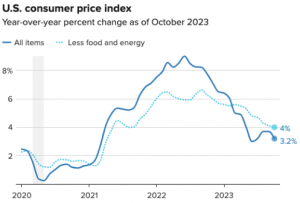
    Then, check out the latest CPI inflation report in the US. The CPI in October recorded a better-than-expected 3.2% increase in costs. However, on a month-on-month basis the rate of increase was actually zero %. That sort of price stability helps business and investors plan and see the future more clearly.


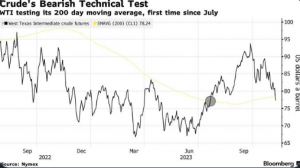
    The future can look ugly when geopolitical events are dominating headlines. Clearly, the war in Gaza, apart from the enormous human cost, is adding to the stresses in a global economy already struggling with the war in Ukraine. In both wars, oil and gas supplies have been quickly identified as huge risk factors. However, the decline of oil prices in recent weeks suggests investors are confident the global economy will be able to cope with the shocks.


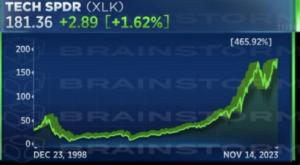
    And, of course, the best barometer of the future is the business of the future, technology. So, check out the sector ETF (XLK) tracking technology stocks in the S&P 500. It has just hit its all-time high!


    These charts are real prices reflecting real money being invested on more upbeat developments. The pictures drawn by this data do not lie. Or am I just dreaming, Pam?


  • Get Ready For The Cloud Wars

    Get Ready For The Cloud Wars

    When the value of just two companies changes by $200 billion in a matter of hours I usually take a closer look. That can even happen when “Married At First Sight”, and not Gaza, has brought you to the point of giving up on humanity. More Gaza later. For now, let’s revisit the events of October 24th. Despite the glow of its recent 25th birthday, Google’s quarterly earnings results failed to impress investors and the subsequent share price dive clipped the guts of $75 billion off the value of the Mountain View tech giant. In contrast, investors were excited by the update on the same night from the world’s second most valuable company, Microsoft, as investors rushed to buy shares and added a cool $125 billion to the valuation of the Seattle tech giant.

    The only word on any traders’ lips that evening in New York was ‘cloud’. More specifically, the revenues earned by the critical data storage and processing architectures which support all our personal and business digital apps and services. The ‘cloud’ is where big tech has leveraged its scale and offered enormous computing power to live and work your digital existence. However, these apps and services are now feeding off a new digital super-power – Artificial Intelligence(AI).

    Generative AI with its large language models(LLMs) and enormous data learning appetites have turned the cloud into a battle field fought by the big three – Microsoft, Google and Amazon. And, the cloud is flying – not quite literally but Microsoft’s Azure cloud business revenues are rocketing at 29% annual growth rates. Google’s cloud business was perceived the ‘loser’ last week with a growth rate of just….. 22%. You get the picture – the cloud is big money, but it’s also really all about AI. Revenues earned by cloud services (powered by data centres) are a proxy for measuring who is winning the AI ‘war’. Let’s be very clear Google and Microsoft have lots of other revenue channels but there is no doubt that the $200 billion shift in valuations between the two giants was entirely driven by the cloud, and by AI. Still sceptical? Allow me to expand on this thread…

    Remember Mistral? Yep, that was the company with 4 guys who raised $120 million with no business and no revenues. Just a PowerPoint presentation. Well, that was 4 months ago. And, now they’ve reportedly raised another $300 million. This time they can actually demonstrate a proprietary large language model(LLM) built with 7 billion parameters for AI training. Yes, built… in 4 months. In valuation terms, Mistral is already a ‘unicorn’ – a startup worth more than $1 billion. If you thought this was merely VC excitement about ‘disruption’ then think again. It feels like the world is still figuring out which of emerging disruptors (with new AI models) or big tech (with its massive proprietary data head start) will win the modelling wars. However, big is still beautiful in investors’ eyes.

    Check out all the gloomy headlines – inflation, painful interest rate hikes, war, recession. You’d think stock markets would be cratering. And, you’d almost be correct. If you strip out the share price performance of just 7 technology companies – aka the “Magnificent 7” – then global equities are probably in negative territory for 2023 so far. Now, think about what is driving Apple, Microsoft, Tesla, Google, Facebook, Nvidia, and Amazon who, on AVERAGE, have rocketed in value by 80% this year. For this writer, it is clear these 7 companies possess the best databases on the planet and are in pole position to train AI models to do whatever they want. Some are happy to use 3rd party models like OpenAI’s ChatGPT or Anthropic’s Claude and the investment monies are still flowing fast.

    Microsoft has already put $10 billion into OpenAI and the latest reports of funding activity suggest OpenAI’s valuation has jumped from $20 billion to $85 billion….in 8 months. Amazon is putting $4 billion into Claude but, as we have illustrated, there are about 200 billion reasons and counting to be in this race. We can’t forecast the future but it is worth remembering that this is AI in its infancy, or to put it another way, at its worst.

    I had the genuine pleasure of chatting to “the Oracle of AI”, Jim Dowling, who presented at an IIBN business event last week. He’s usually based in Sweden and, uniquely, is that country’s only resident lecturer in Deep Learning. It was fascinating to hear him talk about “emerging reasoning” in some of the very large AI models and how lots of well-known businesses are using his company, Hopsworks, to re-configure their data architecture for pending AI applications. What was less fascinating was my estimate that probably 75% of the questions from the audience were fixated on deep fakes, misinformation, AI ‘hallucinations’ and cheating on…. homework. I know, how do we sleep at night!

    Now, recall my earlier words that these early building stages are seeing AI ‘at its worst’. Then just repeat one word to yourself, quite a few times. GAZA. As a species we seem to be perfectly good at bringing ourselves to the brink of World War III or demonstrating barbaric behaviours which, on reflection, didn’t quite end with Ghengis Khan or the Inquisition. Bluntly, we can do far better and AI could help – think of education, the unbanked, healthcare, medicine, energy, decarbonisation, urban planning or agriculture. You know, all the bits to do with living. Of course, all important things must have governance and guardrails. How many unapproved foods, drugs or banks do you know? So, get ready for more of the following:

    Biden Executive Order Imposes New Rules For AI – ABC News


    The excellent Tech Brew newsletter gives a good summary in the following bullets:


    • The directives in the order cover everything from housing discrimination to bioweapons, and aim to address AI at each stage of development.

    • Developers must share safety test results with the government, and various agencies will work on developing standards designed to mitigate threats from AI-created biological weapons and deceptive deepfakes.

    • The order includes a regimen of new privacy research and rules that aims to better govern how developers use information they collect on users.

    • A section of the order homes in on algorithmic discrimination; it calls for guidance to landlords, federal contractors, and welfare programs on reducing bias in any AI tools they use, as well as new guidelines for the Department of Justice to probe this type of discrimination and more rules around AI’s use in the criminal justice system.

    • The general consumer protection section focuses mostly on developing standards for AI’s use in healthcare and education.

    • The order calls for a report on AI’s impact on the workplace, and lists directives for working with allies to implement AI standards internationally.


    Meanwhile, over the other side of the pond……


    UK, US, EU and China sign declaration of AI’s ‘catastrophic’ danger – The Guardian


    Hosted by the British government this week, twenty-eight governments signed up to the so-called Bletchley declaration on the first day of the AI safety summit. One can understand the British government’s eagerness to exhibit some form of responsible stewardship given the stunning revelations coming from the ongoing Covid-19 inquiry in Westminster. An “unfit” Prime Minister surrounded by “f*ckpigs and morons” administering a staggeringly incompetent response to a global pandemic is truly a review for the ages. And a relative reminder of AI’s infancy and humanity’s ability to be……. ehhh…..almost inhuman, or non-human.

    So…..GAZA or AI? My money (and clearly a lot of investment capital) is on cloud wars potentially delivering a better humanity. Keep watching, and hoping. It will be worth it.

  • Government NOT Making It EIISy For Startups?

    Government NOT Making It EIISy For Startups?

    In the investment world of benchmarks and relative performance, portfolio managers will tell you every year is a tough year. World going thrillingly gang-busters? Gotta keep pace. Risk, slowdown and volatility? Don’t blow up, survive. Arguably, for startup businesses and founders dependent on external funding support there is a similar dynamic in play.

    In the giddy years, if your investment story isn’t ‘shiny’ enough you can be starved of capital which is diverted to other sectors. Then, in tougher more cautious funding environments like the last 12 months, you’re possibly juggling slower sales cycles and slower funding rounds and decisions. Worse still, no decisions. Uncertainty is a decision and business killer. And, we have no shortage of uncertainties fuelled by inflation, rocketing interest rates and geopolitical powder kegs in Ukraine and the Middle East. Now, smaller businesses and investors must deal with a fresh uncertainty coming from perhaps a surprising source, our own government.

    The last US President to close out a global geopolitical proxy war was Ronald Reagan but he’s also famous for his disdain of government over-reach. In a 1986 press conference he said, “The nine most terrifying words in the English language are ‘I’m from the government and I’m here to help.’” Arguably, these words might resonate with businesses and investors currently wrangling with the latest Finance Bill and its changes to EIIS rules for equity investors and investee companies. Firstly, an easy-to-understand flat rate of 40% income tax rebates for Irish resident investors in qualifying Irish startup businesses has been chopped up into 5 different bands. The different bands, to come into effect on January 1st 2024, are as follows:


    • 50% for businesses that ‘have not operated in any market’;
    • 35% for a business in its first EIIS fundraise within 7 years of its first sale;
    • 20% for a business in its second or subsequent EIIS fundraise;
    • 20% for a business expanding into new markets or regions; and
    • 30% for investments via a ‘Qualifying Investment Fund’, of which there is only one in Ireland.


    Quite apart from introducing potential confusion, the ‘core’ or standard EIIS rebate of an equity investment will now be reduced from 40% to 35%. Clearly, this reduces the incentive to invest rather than increases the incentive with what could be considered particularly poor timing. We would highlight three key pre-existing factors as challenges for businesses seeking investment capital:


    • Higher interest rates: Remember our reference to capital chasing the “shiny” things? Well, interest rates rocketing to 5% are forcing all asset classes to increase their attractiveness by offering better returns. Think deposit rates, mortgage bonds, corporate bonds and other lower risk options to earn returns. They are all upping incentives/yields while the government is seeking to make startup investment less “shiny” or easy.


    • Financial Conditions: The Goldman Sachs research team tracks the broader financial climate and looks at lending patterns, terms, spreads, credit trading etc Its view on euro-area financial conditions is that they haven’t been this tight since the Great Financial Crisis (GFC) in 2008-2009. This means businesses must search harder for investment, endure tougher terms and possibly find new banking channels unless your choice is….


    • Irish Banks: A senior Dublin legal eagle only recently told me that the banks are effectively ‘not open’ for any additional risk on their books before year end. True or not, the banking choices for SMEs are extremely limited as Nat West(Ulster) and KBC have pulled up sticks in Ireland and followed Rabobank and Danske Bank into retreat to their higher margin core markets.


    The recent memories of Covid-19 and the pitiful take-up of the government’s Credit Guarantee Scheme (just 12% of funds used by April 2021) hint at a limited banking system which isn’t massively interested in the SME sector. As a reminder, the government was guaranteeing 80% of the €2 billion in loans under this Credit Guarantee Scheme but it seems even a 20% share of the risk was too much for the Irish banks. But, also be mindful that 99% of active enterprises in the state are SMEs and account for 70% of employment. Of course, there are other institutional sources of capital.

    In the US 70% of venture capital comes from pension funds and educational endowments. In Europe, you’d be lucky if that number even reached 20%. So, despite the fabulous efforts of Ireland’s state funding agency, Enterprise Ireland, the role of private investors is critical in supporting early stage businesses. It is true that European government agencies and EU institutions(eg Horizon 2020, EIC) play a significant part and these latest EIIS changes in the Finance Bill are part of a broader harmonization of state aid. However, harmony works both ways.

    Due to limited competition and regulatory constraints, smaller Irish businesses are experiencing a much more difficult banking and funding environment than their European peers. In those circumstances, one would hope that European and Irish policy makers were encouraging private capital to fill the institutional and bank funding holes. Complicating simple tax treatments is not a good start and, to add to decision paralysis, there is a critical question outstanding in the new EIIS rules.

    The 50% rate applied to investments made in companies “not operating in any market” is leaving many people, both founders and investors, in the startup world scratching their heads. For us, we need to clarify the “not operating” phrase. Does this mean companies not generating revenues yet or is this demarcation geared towards companies in earlier risk stages like R&D, pre-API-type development phases? These are the questions which, left unanswered, will delay business funding and investment. Fatally, in some cases.

    Now, to finish on a more upbeat note. This writer, as a long-time analyst of investments and their returns, has always been wary of treating tax rebates as a means of re-setting your starting point. In other words, if EIIS of 40% is applied, your €1,000 investment cost only €600 post your tax rebate. In my world of valuations and RETURNS the more critical point was that your investment value remained €1,000. So, in a 35% EIIS rebate world the return of your €1,000 in subsequent exit value would amount to just shy of a 54% return. If that €1,000 becomes €2,000 that’s a greater than 3x return, irrespective of whether you started with a €600 or €650 cost. That broad quantum of outcome should still keep investors very interested in startup investing. However, as we hit GFC levels of funding tightness, the government may not be able to magic up more banks but it could certainly incentivise more private investors to support the 99%. Kinda like what governments used to say they do.

  • Father Ted, Perspective And Portfolio Positives

    Father Ted, Perspective And Portfolio Positives

    “Ok. One last time, Dougal” says Father Ted to his TV side-kick Father Dougal. In a small caravan on Craggy Island, Ted is holding some miniature plastic cows while pointing through the window to the real much larger versions grazing in the adjacent fields . “These are SMALL. But the other ones out there are FAR AWAY….. small…. far away” repeated Ted in yet another failed attempt to teach perspective to a confused Dougal. “Ah, forget it!!” says a defeated Ted. Great comedy, but in real life that sort of capitulation can be both dangerous and costly. The confusing aftermath of the horrific carnage at the Al-Ahli Hospital in Gaza was a reminder of the increasing dangers of deep-fake imagery, misinformation campaigns and client-journalism in fighting to establish ‘a truth’. We just can’t give up on The Truth. Perspective and reflection does help. So, in a world dominated by ugly headlines and woeful weather let’s visit a few big investment themes growing real legs. Where better to start than security…far away

    The heads of cybersecurity from the UK, Australia, the US, Canada and New Zealand, known collectively as the “Five Eyes” security alliance, have seen “a sharp rise in aggressive attempts by other states to steal competitive advantage”. In particular, they urged smaller companies and startups to be more vigilant in protecting their IP and critical business information. Having recently raised funds for Binarii Labs, we are very much aware of the increasing demand to protect data rooms for corporate finance deals, cloud storage architecture, legal files and personal ID information from being breached. The good news for Binarii shareholders is that the cybersecurity theme continues to attract VC funding. In New York fraud prevention play, Prove Identity, secured $40m from MassMutual Ventures and Capital One Ventures. Also, despite its name, Fingerprint, has built a big reputation in detecting fraudulent devices rather than human beings. The Chicago-based company has attracted $77m of investment since its 2010 inception and completed a $33 million Series C funding round this week with Nexus Venture Partners as lead. Cybersecurity feels like a portfolio “keeper”. But, as always we advise diversification of risk in a portfolio for the health of your wealth. And, for health too…

    Well, for those who have invested in AuriGen Medical then you know we like healthcare technology on lots of levels. The good news is that we have a few more medical and biotech investment opportunities to add to your startup portfolio before the end of the year. Even Bloomberg is picking up on the super medtech ecosystem which has emerged in the west of Ireland. The recent arrival and $327 million investment by medtech Dexcom in Athenry might have been the prompt for the Bloomberg article and some great data featured. However, this has been a steady build in the shadow of the higher profile Big Tech “Silicon Docks” cluster in Dublin. Now, medtech and biopharma are experiencing that virtuous circle of investment, deep-tech expertise, spin- off activity, entrepreneurship and innovation. The inspiration for this flow of healthcare startups is a multinational backbone of 14 of the world’s 15 leading medtech companies and 10 of the leading global biopharma companies. Clearly, your wealth could also be your health…..or your pet’s health.

    I have always listened carefully to the UK’s best performing fund manager of the past decade, Terry Smith. Having worked for him, and embraced his investment philosophy of observing the cash flow returns on all of the capital in a business(debt, leases/commitments and equity), I know he likes high frequency consumer product businesses – think Coca Cola, Nestle, Unilever etc. Then know that he LOVES pet food and pet health producers! He would often quote some bonkers survey that consumers would sooner feed their pets than their children. The key point is that the spend on pets is enormous and consistent. In the UK alone £10 billion is spent annually on dogs. Dubliner-founded Butternut Box recently announced a £280 million funding round with venture giant, General Atlantic, as lead. That business is valued at over $500 million now, but at the other end of the pet healthcare spectrum, Spark is raising money for a vet-designed and managed platform to match reputable breeders with properly vetted owners. Pet healthcare is the mission and Pet Bond is currently offering equity at a significant discount. It’s also eligible for a further 40% valuation discount via its EIIS tax rebate eligibility for private investors. So, that’s a lot of health covered but what about the planet’s health

    We have written plenty on the cleantech theme but it’s highly likely there will a few portfolio investment opportunities coming Spark investors’ way very soon. To whet your appetite and apply perspective, know the following:


    • European VC market sentiment is at a record low. However, the drive to save the planet doesn’t do sentiment. It’s all about action. So check out the Q3 European VC funding activity. A whopping $4.5 billion, or 25% of total tech investment, went to green technologies in Q3.


    • Aira, the latest startup from Northvolt and H2 Green Steel founder, Harold Mix, has just raised €87 million for its heat pump business.


    Of course, early stage investment is higher risk but we do need to keep an eye on those themes which are enjoying healthy investment flows. Then again, there is no such thing as a sure thing. Or…. risk free. As a final reflection, for the sceptical and the risk averse out there, who would like to guess the fall from peak value for Bitcoin compared to that of ‘risk free’ US Treasury bonds guaranteed by the mighty US Government? Who got close to a 51% dive for Bitcoin? Probably a lot of you. But did you get anywhere near US Treasuries cratering by 47% from their all-time highs!!! Probably not. It’s all about perspective really. And, keep watching those healthy portfolios.


    • For details on the Spark EIIS Private Portfolio product DM direct or call your Spark relationship manager.
  • Old Economy Flexes Deal Muscles

    Old Economy Flexes Deal Muscles

    These are dark days. We wait for the clocks at the end of the month to re-set but sadly geopolitics and the history of the Middle-East never gets a re-set; just a replay. The horrific terror of last weekend marked, almost to the day, the 50th anniversary of the last major attack on Israel’s borders. Back then, the oil price rocketed 300%. This week… Brent crude oil is up just 2%. The human crisis is not over as 550,000 children face a 24 hour evacuation order from Gaza City but the global economy and oil prices are sending more subdued signals of alarm. Or does it reflect the diminishing influence of hydrocarbon fuels, or even the “old” economy? No, and no. Despite the climate crisis, we will still be using lots of hydrocarbon fuels over the coming decades. Arguably, oil usage has peaked but it is not going away. As for the old economy and its asset-heavy activities in construction, extraction and manufacturing we need to pay attention to corporate activity and investment flows.

    First, start with oil itself. Energy exploration and production (E&P) was once the dominant stock market sector before tech took over, but it flexed its corporate muscles this week. US oil giant, Exxon Mobil, announced a $60 billion acquisition of Pioneer Natural, the largest player in the low-cost Permian oilfield. That doesn’t smack of climate crisis capitulation but reflects the reality, like tobacco before it, that consolidation is the corporate survival strategy when regulators want to curtail your business. At the other end of the corporate scale, startups, there were interesting data points this week too.

    The European Investment Fund (EIF) surveyed 500 European VC funds and found sentiment at a record low. Two thirds of respondents say valuations have fallen and 28% of firms have reduced their investment activity. But, here’s the old economy kicker. The research firm, CB Insights, has just released its Q3 report on VC deal activity and a whole Exxon-Pioneer deal has been generated in the startup world, or slightly more. Global VC funding in Q3 hit $64 billion, up 11% on the previous quarter. The deal sizes were bigger as deal count fell to the lowest seen since 2016. However, in these larger deals the old economy came roaring back with half of the 10 largest deals going to the automobile industry. More specifically, electrical vehicles (EVs). And two of the other top 10 deals were in clean energy and sustainable manufacturing.

    Readers should get used to the manufacturing re-set story as decarbonisation investment hits its $275 trillion stride to 2050(Source: McKinsey). Despite the gloomy ‘higher rates for longer’ and geopolitical anxiety, it feels like manufacturing sector confidence is growing. Check out Smurfit Kappa’s $11 billion deal with WestRock to create the world’s biggest paper and packaging company. Of course, manufacturing in its energy transition and storage journey will become more dependent on other elements in the earth. So, the vote by Newcrest Mining shareholders this month to accept the $17 billion offer from gold producer rival, Newmont Corporation, should be a reminder that the mining sector will be very busy on the deal front in the coming years as the EV battery revolution drives demand for nickel, cobalt, manganese, graphite and lithium. And don’t presume all the old economy deal activity needs to have a green angle. Two little snippets this week caught my eye.

    The first snippet or nibble in the old old economy was hospitality. Private equity giant, Apollo Global, has just bought Wagamama owner, The Restaurant Group, for an enterprise value of almost $850 million. This continues the ‘UK on sale” theme in the UK hospitality sector as then-Chancellor Rishi Sunak’s “Eat Out to Help Out” Covid-19 population cull has morphed into “Eat Out and Sell Out”. Big Mamma Group sold out to McWin in September and this follows other private equity purchases of Bourne Leisure, Boxpark and Punch Pubs in recent years. However, it’s not just the grizzled private equity sharks snapping up businesses. A recent Bloomberg article was highlighting the surprising trend of MBA graduates shunning consulting positions with McKinsey, Accenture et al and acquiring entire companies in the SME space. It has its own M&A category now – ETA or “entrepreneurship through acquisition”. Always learning, eh. Now, let’s turn to a sector which is often accused of never learning.

    The banking sector is unloved despite monster interest rate-fueled profits. The problem is that the financial markets think bank customers(and loans) could be facing tougher times. Indeed, Goldman Sachs has published data showing the tightest financial conditions (access to funding) in Europe for 15 years. For context that’s when the great financial crisis (GFC) was raging, and Lehman Bros. had collapsed a month earlier. For an even more stark illustration of investor ‘fear’ the KBW Bank index which tracks US banks is trailing the broader S&P 500 market index by 37% year to date. That’s the worst spread in history surpassing the nadir of the 2008 credit freeze period. As a final old economy, and possibly old fashioned thought, that’s a helluva lot of bad stuff priced into the banking sector and its future. And frankly, if the future is that bad for banking then the pricing of everything else is delusional. I’m not in the Armageddon camp so I’m wondering will the last big pillar of the old economy follow form with a shock banking deal? Let’s see. Anyway, we could do with a positive shock.


  • Learning From Nazis And Bond Markets

    Learning From Nazis And Bond Markets

    I was taught by a Nazi. No, a real one. Not a NatC (National Conservative member), or even Nancy Mace, one of the extremist Republicans who ousted Speaker of the House, Kevin McCarthy this week. No, these fascist wannabes have nothing on this teacher. It turns out my 1970s(!) educator’s French nationality hid the fact that just over 30 years earlier he was an officer in a regional Waffen SS unit during World War II and earned a post-war death penalty for his enthusiastic services to the Third Reich. Revelations of Louis Feutren’s war criminal past and noose-defying flight to Dublin only emerged in recent days but coincided with the publishing of an intriguing financial chart which contained some fascist reminders. In fact, there might even be a few lessons for us.

    First, the chart from the WSJ/Daily Shot newsletter. It was highlighting that financial markets are currently pushing US equities to a record valuation premium over non-US equities. These levels of outlier valuations have only been seen twice in the last 100 years. The latter period was 1965. The world then was in the hottest part of the Cold War post a Cuban missile crisis in 1962, and about to see the escalation of the Vietnam War while also gearing up for a huge technological leap out of this world and to the moon by 1969. Given the emergence of a new major European war in Ukraine and the current global dominance of US technology, you can kinda make some comparisons and be a little hopeful.

    However, if we think about the period earlier in the last century when the US valuation ‘premium’ was similarly pronounced we might be more concerned. Despite the global economic depression of the 1930s, it would appear all things are relative and the US was deemed a slightly safer home for capital than the rest of the world. The Nazi invasion of Poland and official beginning of WW2 in September 1939 confirmed those fears but why should the 1930s resonate more than 1965 in this writer’s head right now. Well, it’s not the state of my French linguistic skills.

    In fact, it could be how my native tongue is being tortured and twisted into Orwellian double-speak at the Conservative Party conference in Manchester. The lurch to the right of the UK’s governing party is truly remarkable. The Tory insistence that the party out of power for 13 years, Labour, are guilty of the hooligan-like damage done to great British institutions is a delusional stretch but what about human rights becoming “luxury beliefs”? This from the party of Winston Churchill, drafter of the original text in the European Convention on Human Rights….. And, my personal favourite “we are the trade union of the British people”. You’d laugh only it is too serious. It’s not just me. The bond market, the ultimate financial arbiter of credibility, truth and stability is exhibiting some 1930s-style volatility….

    While Sunak, Braverman, Mordaunt et al stood up and fought reality in Manchester (yep, watch Penny without the Coronation sword and file a copyright breach with Munster Rugby and Bizet’s 1975 opera, Carmen) the bond markets were busy voting. And, the results are in. UK government borrowing costs are set by the yields on 30 year instruments traded between financial institutions; the benchmark instrument, the UK’s 30 year Gilt(bond), is now carrying an interest cost(yield) above 5.1%. For context, that level of yield has not been seen in 25 years. That’s even higher than the Liz Truss pension fund catastrophe a few short lettuce-lives ago. For further context, the yield on the same instrument was just 3.75% back in September. And, for balance, it should be acknowledged that other countries’ bond markets are experiencing renewed inflation fears and higher yields. However, the UK bond market is weakening faster and hitting 25 year milestones earlier.

    Former Clinton advisor, James Carville, used to quip that if reincarnated he’d come back as the bond market, and not as the Pope or a baseball hitter, “because you can intimidate everybody”. If Sunak, Coffey, 30p Lee and Braverman are scared of Channel dinghies and the ‘hurricane’ of 780 million refugees(no, really she thinks they all want to come to the UK) you’d hope they’d be wary of the bond market. Maybe they are? The cancellation of the HS2 high speed rail project might be short-sighted but something has to give if you’re determined to bribe your last remaining voting support with inheritance tax cuts and triple-lock pension promises. However, back in the real world what should worry UK observers is that these higher bond yields/income are failing to attract overseas buyers of the Great British Peso(GBP). Sterling has dropped from $1.30 to $1.21 in the last two months but note that the premium on security is not just in dollar assets.

    As a slight digression, and as a hat tip to a recent Spark funding round with Irish cyber-security play Binarii Labs, if the bond world is feeling less secure they are not alone. Cisco just did its biggest M&A deal ever with a $28 billion acquisition of security information player, Splunk. Not to be outdone, Palo Alto Networks is acquiring two Israeli cybersecurity startups, Dig Security and Talon Cyber Security. In fact, market analytics firm, CB Insights, reported cybersecurity M&A activity doubling quarter-on-quarter to 78 deals in Q2. So, every fascist cloud has a cyber lining. So does every vote. Let’s finish with a feel good technology story.

    We might be frustrated with portions of the voting populations in the UK, US and other democracies believing the promises of some pretty awful human beings with a track record of incompetence. Indeed, we can only hope that future votes will restore some sanity and even be inspired by a recent vote. This week the Nobel Prize committee voted to award the Nobel Prize in Medicine to Katalin Kariko and Drew Weissman for their research which helped develop mRNA Covid-19 vaccines. For Kariko it was particularly sweet recognition. Back in 1995 the leadership of the University of Pennsylvania, instead of offering her a position as a tenured professor, offered her the choice to leave or take a demotion AND pay-cut. Oh, and she had been just diagnosed with cancer. Luckily for the world she chose to stay at Penn, carried on her mRNA research work and collaborated with Weissman from 1997 onwards. That was an amazing demonstration of resilience. Now, we must hope that voting and healing in the world can show similar resilience as the bond market measures truth in real time, and with history on its side.

  • Huge Week For AI, Not Humanity

    Huge Week For AI, Not Humanity

    Oh boy. It felt like the clock was wound back a couple of hundred years as SIR Jacob Rees-Mogg and Ghengis Khan’s long lost cousin, DAME Priti Patel, strode forward to receive their honorary gongs at Windsor Castle. It could only be for services to nastiness. Meanwhile, Cruella Braverman was busy in Washington incinerating Britain’s 70 year leadership on human rights with a shocking 30 minute speech of fascist fantasy. Wow. And there we were, all worried about the threat to humanity from AI. In fact, the bots might be taking advantage of the recent low ebb for our species. Check out recent business and market activity in the AI space and you’d be forgiven for thinking the bots are on the march. Certainly, in this writer’s opinion, the past week or so has been the most significant week for generative AI since ChatGPT hit our screens nearly a year ago. Consider the following:


    • OpenAI’s generative AI model, ChatGPT, has moved on from answering your questions in text (on your screen) to responding in voice. Think about hey Google or Alexa as voice assistants, but now on super-human steroids. That was quick. And speed means money…


    • Microsoft, has already committed $10 billion to its collaboration with OpenAI but, when that news broke at the beginning of the year, the valuation of OpenAI was buoyed by market giddiness to potentially $20 billion. Fast forward a few months(or centuries in Jacob’s case) and the same company is raising a new round of funding with a $90 billion valuation. For context, that might amount to the current market value of two Stripes in depressed fintech funding conditions.


    • Amazon, in the same cloud business as Microsoft isn’t holding back either. It’s ploughing just the $4 billion into OpenAI competitor, Anthropic, and its large-language-model(LLM) version of ChatGPT, the smoother sounding Claude. Speaking of smooth voices……


    • Spotify has announced some of its top ranked podcasts will now be available to listen to in 6 or 7 different languages…..but with the same voice as the actual host. No wonder writers, actors and artists want to nail down their creative rights as soon as possible. Things are clearly moving very fast and it’s not just sounds and voices.


    • Getty Images have launched their own AI-powered image generator taught by its enormous library of copyright protected images. Getty Images is so confident its models are independent from any copyrighted content that it will cover any IP disputes for its customers. By the way, the chips being used to power this AI generator are made by our latest trillion dollar baby, Nvidia. And there are more babies on the way…


    • According to VC research firm, Crunchbase, former employees of Nvidia have raised a total of $1.4 billion and founded 72 companies. Indeed the same Crunchbase data shows that three of the four biggest VC deals done last week were in the AI sector – MapBox($280m), Pyron($100m) and Writer($100m) – and would seem to challenge the narrative that the AI craze may be cooling.


    So, the big bets on the future still look pretty significant from here. However, get ready for some anxious conversations in the board room as competitors start to demonstrate greater productivity and speed combined with lower costs. Does this sound like something you’d read on the side of a red bus in 30p Lee’s constituency? Yes, and no. It’s a promise, but my sense is this time there will be delivery.

    The adoption of Googles’s AI assistant, Duet, looks like a no-brainer for busy users of Gmail, Docs or Sheets. In the same vein, the Microsoft AI assistant, Copilot, is due for launch in November and likely to make a quick impact at future-ready teams. Keep an eye out for that news flow and prepare yourself for AI to continue gathering speed in capability and financial markets. And, if you don’t, please avoid blaming the Channel dinghies, meat taxes or the “7 bins” routine. It will be too late; ChatRishi is already all over that delusional race back in time.

  • Investment Shocker: France Has World-Beating Strategies

    Investment Shocker: France Has World-Beating Strategies

    If you’re a Daily Mail or Daily Telegraph reader stop reading now. If you’re looking for an update on French skipper, Antoine DuPont’s, eye-socket injury you can stop now too and call my maxillofacial surgeon cousin instead. But…. if you’re looking for an investment view that might surprise you then keep reading. And, it’s not just my view. Let’s start with the biggest private equity player on the planet. Blackstone’s billionaire CEO, Stephen Schwarzman said this week that “France has been the biggest beneficiary of Brexit”. Arguably, Brexit is a bit too narrow a lens to look through and you might think Schwarzman is really only highlighting financial services. However, his Bloomberg TV interview referred to France as the “best of the European countries” and how Blackstone are expanding their office in Paris. Crikey… there will be many investment veterans who will struggle with that observation but look closer and one can see France winning on many fronts.

    The perennial image of France as a capitalist-unfriendly paradise for socialist ‘woke’, punchy pensions and labour strikes took a bit of a bang earlier in the year when global rich lists were published. Topping the male and female categories for world’s richest billionaires were two French citizens. Luxury visionary, Bernard Arnault, of LVMH has rolled up $200 billion of wealth and brands over the decades while L’Oreal heiress, Francoise Bettencourt Meyers, is another $85 billion beneficiary of French dominance in the world of luxury goods. In fact, just 5 French companies(Hermes, LVMH, Essilor, Kering and Dior) have a combined market value of over $1 trillion and account for 80% of the value of the 20 largest public luxury companies globally. The strategy of focusing on long-term premium brand build has paid off spectacularly with possibly even greater riches ahead. Indeed, long-term strategic thinking must have clocked the prospect of two thirds of the world’s middle class being located in luxury-obsessed Asia by 2030. This is not the only long-term French bet paying off.

    Some might be surprised that Blackstone have put France ahead of Germany in Europe but the world changed when Ukraine was invaded by Russia. The German strategy of appeasing Putin and guzzling its oil and gas has been a spectacular own-goal and exposed another French strategic win. The Fukushima nuclear accident in 2011 pushed Germany to commit to decommissioning its nuclear power plants while France stuck with its 68% exposure to nuclear electricity generation. The world on a climate emergency footing and reconfiguring its power sources can only look on in envy at France right now. But there’s more….

    Go on, admit it; we’re all a bit jealous of France on an endless TV loop of sporting mega-events…. FIFA World Cups, Olympics and Rugby World Cups did not happen by accident. Again, the French played hard and paid up to win hosting rights for these events because they could see the long-term value of live events in a noisy digital multi-screen world. Sport is for instant gratification, not customised viewing schedules. However, investment in sport has been very strategic. Moreover, as live concert music tickets, sporting tickets and festival tickets continue to rocket on “experiential” demand premia, the value of sport(even gaming) as an engagement tool is almost unmatched. It is no accident that Steve Ballmer’s first purchase after leaving Microsoft was the LA Clippers. The $2 billion price was the subject of some sniggering at the time. Not now.

    In fact, my own personal experience of having breakfast with Chelsea FC owner, Todd Boehly, way back when he looked after the money of America’s richest financiers was my fascination about what he’d do next as a thirty something whizzkid. Yep, he went for sport investment and built a $6 billion empire. The French ‘get’ that most human beings are programmed for sports and games engagement and see it as a great opportunity to sell brand France, its goods and services. Closer to home, it is striking to see marketing technology company, XtremePush, go out and buy a gaming franchise, Thunderbite, and declare it a game-changer. Back to France, it would be mistaken to think a nuclear break and a historical appetite for champagne and sports leisure explains success. We can learn more from the French. Literally.

    France is an educational powerhouse too. A top 5 ranking globally for its education system is no accident. We associate France with the Arts and Humanities but a STEM focus (maths, science) and emphasis on critical thinking(vs learning by rote) has prepared its workforce well for the digital age. But, it’s not just technology and derivatives trading who have benefitted from France’s digital dividend. France has identified other commercial sweet spots, particularly where scarcity(think luxury) is involved. Is it any surprise that two of the largest water companies on the planet are French(Suez and Veolia)? Also, as the world economy re-constructs its industrial base for cleaner manufacturing check out the order books for giant construction companies like Vinci and Lafarge-Holcim. That cleantech manufacturing revolution is in full swing in Europe but there is another challenge – an ageing population. Guess who’s thinking ahead?

    Two of the top three nursing home operators in Europe are French. In fact, one of them, Orpea, is the largest operator of nursing home beds in Ireland and a good example of a potential acquiror of  smaller healthcare operators. In the world of start ups ‘exits’ or trade sales, predatory acquirors are always at the top of investor queries and considerations. So, for both founders and investors, dare I suggest we keep a closer eye on France as an opportunity and not just a World Cup threat!


  • Back To Debt School

    Back To Debt School

    Will we ever learn? I know, I know…. it seems a bit extreme to go back to school forty years later. Then again, we haven’t experienced this kind of thing since the early 1980s. I’m specifically thinking about the current financial environment where interest rates have dramatically spiked in a little more than one calendar year and perennial deflation fears(Europe, Japan etc) have been replaced by a genuine global inflation challenge. For illustration, this week the ECB raised its key deposit interest rate to 4%. Think back to summer of last year and European interest rates were actually negative. Frankly, the cost of money(rates) affects everything and when one considers the sheer pace of change we need to go back to the books or, at least, re-visit a number of emerging risks not seen for decades. Even hidden ones.

    Equity is not debt but…. the relationship is typically very tight. The text books say higher rates hurt business and equity valuations but not this year. Global equities are up 15% year to date and the tech-heavy Nasdaq index is up a whopping 33%. Of course, you will have read about AI excitement and the fact that the giant technology names are doing most of the stock market heavy-lifting this year. That makes sense when you compare previous debt/inflation shift periods. The fortunate truth for big tech is that they have absolutely no debt! Back in the 1980s the biggest companies in the world were the likes of GE, Exxon and General Motors; classic old economy industrial names with traditional balance sheets and plenty of debt. In contrast, some of big tech’s customers are not so fortunate and a few things have caught my eye….


    • US corporate bankruptcy rates (via Chapter 11 filings) are at a 12 year high. Chapter 11 filings surged by 68% in the first half of 2023 versus the year earlier period (Source: Epiq).


    • Retail bankruptcies can also reveal consumers tightening spend so the demise of the iconic Bed Bath & Beyond in April was a big deal in the US. However, it’s not just the US experiencing retail stress. The collapse of 400 Wilko stores and its 12,000 employees in the UK shows that not every self-imposed economic challenge can be solved by filling the English Channel with sh*t, slashing school safety budgets or machine-gunning dinghies.


    On a more global(and serious) basis, there are two key personal assets which are impacted by higher interest rates and debt dynamics. One well-flagged, one not so much. Mortgages as debts attached to properties are attracting the headlines but this could be a slow burner in many countries where markets use fixed rate mortgage products rather than variable rate products which are already causing stress in the UK and Ireland. Thankfully, that cohort of variable borrowers is a much smaller one than in previous rate spike cycles. One cannot forecast the future but it is quite likely that the re-financing, or re-set, of fixed rate products over the coming years will be in a significantly higher rate environment than previous negotiations. Now, for some good news….

    Pensions might bore people but something’s up. Income. Yep, a senior stockbroker was telling me last week that the hottest product for him this year was boring old government bonds, but with a relatively new twist. These debt instruments are actually generating decent income for people’s pensions for the first time in ages. It might not sound very exciting but the possibility of earning 4-5% per annum from almost risk-free assets is a huge bonus for pension funds which have been starved of income for years. That’s a great result for individuals but for governments with stretched debt profiles it’s going to hurt.

    We are approaching another US government debt ceiling deadline at the end of the month. Sadly, it’s not just women’s bodies being held hostage by the lunatic wing of the Orange Toddler cult on Capitol Hill. House Speaker, Kevin McCarthy, and the GOP have reneged on the original debt deal struck with the Biden administration so there are an anxious few weeks ahead. However, the longer term debt scenario for the US and other countries is beginning to have real budgetary consequences. The US is hurtling towards a $33 trillion government debt total and the servicing of that debt is meeting the recent reality of higher interest rates. Debt costs for the US government have increased by 25% this year and will be approaching an annual cost of $1 trillion soon. That’s more than the US spends on its defence budget.

    In the UK another form of government debt is in the headlines – the state pension. Currently, this commitment is costing the government over £100 billion per annum. The problem is that the Tory government have bribed their last remaining voters, retirees, with a “triple-lock” promise. In effect, pensions must increase every April by the highest of the following three cost of living rates: inflation rates, wage growth rates or 2.5%. Well, it’s not going to be 2.5% next April. Try 8.5%, on top of the 10% increase last year. Given the UK already has other, ahem, economic challenges it is no huge surprise that RishiGPT Sunak (or more recently nicknamed “Inaction Man”) is beginning to wobble on that commitment. At least the Tories have 13 years practice of false promises but other governments will have awkward budgetary choices in the coming years. And yet, I have become more hopeful in recent times….

    The fiscal support of governments in transforming industrial policy and moving away from fossil fuels can be viewed as a must-do climate emergency response. However, there are two key policy consequences which could be of longer term benefit. First, as seen in the US, Bidenomics is not just capital spend. It is creating jobs, new industries and growth. Europe and Asian economies are following suit and, in a world facing the increased threat of populism and false promises, we might actually be witnessing a second key policy consequence – the death of one of the great canards of modern politics. Trickle-down economics. The decades-long conservative/GOP orthodoxy of believing tax cuts for the asset-rich would ‘trickle down’ into main street growth never ever materialised. Bidenomics is proving that governments can use a far more effective policy lever to spread and grow the wealth. However, that lesson must be balanced with old-school debt discipline as I fear the headlines will keep coming on that front. Always learning, eh.

  • How To Capture The Investment Value Of A Crowd

    How To Capture The Investment Value Of A Crowd

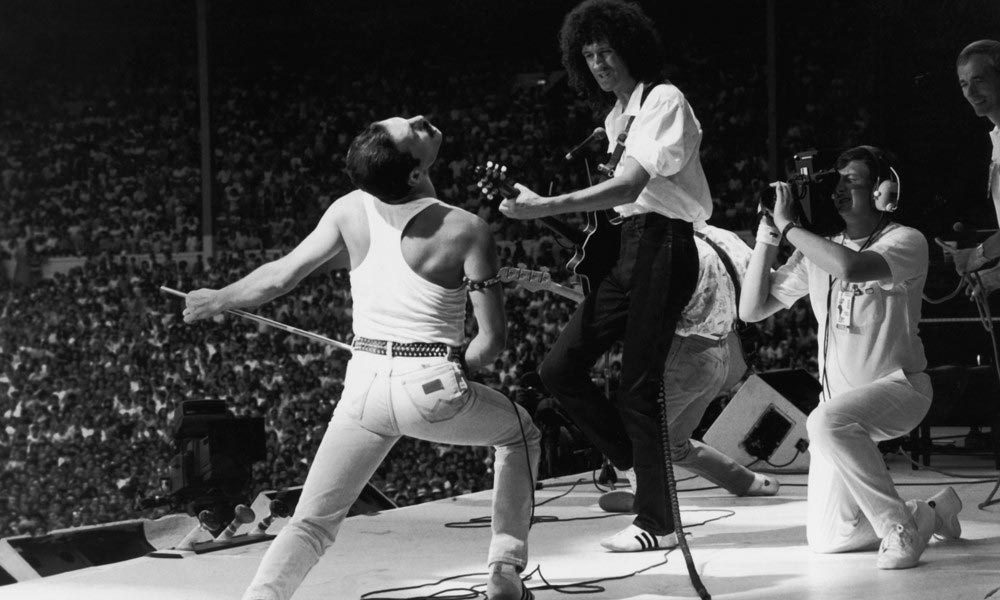
    I’ve always been fascinated by crowds and how their energy can sometimes spontaneously erupt. A personal all-time favourite crowd watching moment was the 1985 Live Aid concert, Freddie Mercury conducting the Wembley crowd and the “Ay-Oh” chant described as “the note heard around the world”. He nailed it. And, he’s doing it again. The contents of Freddie’s Garden Lodge home are on exhibit in the Sotheby’s auction rooms of New Bond Street for all of August and well over 100,000 people have queued for hours to take a peek. Of the thousands of lots on show, from the Yamaha piano, to the original Bohemian Rhapsody lyric sheet, to his art collection there is one item which has caught my eye in recent press coverage. A silver Tiffany moustache comb, estimated to be worth £400-£600, is currently expected to fetch over £24,000 and that should not really surprise. In fact, those that believe this emotional “premium” only applies to collectibles and celebrity memorabilia would be very wrong. You see, there are lots of crowds out there and it doesn’t always make sense. Here are a few current favourites of mine…

    Banking: A short five months ago, the Swiss banking authorities had to plead with UBS to ‘rescue’ the collapsing Credit Suisse(CS) banking group. In the end, UBS paid $3.4 billion to acquire the entire assets of CS. Fast forward to this week and UBS have posted a Q2 quarterly profit of $29 billion! This is the largest quarterly profit in banking history but the vast majority of the Q2 profit was an accounting treatment of ‘negative goodwill’ acquired with CS. In main street speak UBS is booking the gap between the $3.4 billion acquisition price and the ‘value’ of the assets on the CS balance sheet. Sadly, for CS, at the time of takeover there was a total lack of confidence in those assets(loans, property, IT, investments etc) and there was a “crowd” of buyers which amounted to precisely one.

    Automobiles: The internal combustion engine (ICE) has been around, mostly unchanged, for more than a century. But, there’s a new electric (EV) guy on the block, with Tesla being the trillion dollar poster child of the EV revolution. The crowd who cheerlead this revolution are very excited but there is another large crowd of investors who wonder about the competition from the traditional players like BMW, Toyota, GM and Ford. To illustrate this crowd push-pull, check out the recent IPO of the third most valuable car manufacturer in the world which you’ve never heard of, VinFast. This Vietnamese EV manufacturer is yet to make profits but at one point of trading post-IPO in New York the company was worth more than Ford, BMW and GM combined. A $170 billion climb in value to almost $200 bilion in just 4 trading days was followed by a $130 billion collapse in value over the next 4 days. That’s how two big crowds sometimes work.

    Restaurants: Subway, once the largest franchise on the planet, has sold its 37,000 restaurants to private equity player, Roark Capital, for just under $10 billion. Now, consider McDonalds with a very similar market footprint of 36,000 restaurants. It’s a bigger hit with the fast food crowd, doing nearly 50% better annual revenues of $23 billion(vs $16 billion). However, here’s the real crowd kicker – McDonalds is valued at more than $200 billion or 20x Subway. If you look more closely, you’ll see McDonalds is not just a food business, but a brilliant property business. However, some property crowds can be fickle…

    Offices: At its peak, serviced office player, WeWork, was valued at $47 billion. Its 2019 IPO was originally pulled but eventually listed in 2021 with a $9 billion market cap. Today, not so much. A 99.9% collapse in the share price and its fantasy balance sheet leaves WeWork on the cusp of liquidation. The days of founder Adam Neumann’s private waterfall, 3 storey water slides and $1.7 billion severance “parachute” are now but a distant, albeit soggy, memory.

    Insurance: Like banking, a purchase, when the crowd is tiny and all are fearful, can be very lucrative. Check out recent news closer to home that Axa has purchased Laya Healthcare(formerly known as Quinn Insurance) for €650 million. As recently as 2015, AIG bought this book of business for just €80 million. It was a small buying crowd back then…

    Artificial Intelligence(AI): The research analysts thought Nvidia was a bit giddy rich in valuation when its share price surged 80% in the first weeks of this year’s ChatGPT excitement. Then in May, Nvidia told the analysts everybody’s forecasts needed to be revised UPWARDS by 50%. It turns out Nvidia’s semiconductor chips are critical to AI processing power so the stock before its results last week was sitting on a $1 trillion valuation or almost 40x its revenues(not profits!!) – and you thought 10x for SaaS was exuberant? And, guess what? Yep, Nvidia’s results last week showed revenues for the last quarter still beating the upwardly revised estimates of Wall Street’s finest minds by another $2 billion…


    The above illustrations are not exactly Malkiel’s “Random Walk Down Wall Street”. However, Malkiel’s 50- year old message is just as relevant today; asset prices are random and unpredictable. Crowds play a big part in unpredictability and can make it difficult for investors to spot emotional ‘fear’ or emotional “exuberance” in a valuation. But….. there is a way for an investor to play to bigger and more varied crowds.

    We have written many times about the value of a portfolio approach to investing. Trying to time, or spot, opportunity on an ad hoc basis is fraught with challenges. The superior investor knows that regularly adding to a portfolio keeps them in the market at all times irrespective of “the crowd”. As a stark illustration, the entire excess returns of the S&P 500 in its almost 100 years of existence(1926) were delivered by just 4% of stocks in the database(Source: Bessembinder, Arizona State University 2017). That might rock you, but you don’t need to comb through all the research; Buffett and Lynch have said it for decades. The best investment strategies represent a portfolio of crowds.