Author: Gary McCarthy

  • The Biggest Cyber Crime Target In The World

    The Biggest Cyber Crime Target In The World

    So, you thought a Chinese real estate implosion was a big threat to the world economy? Yes, Evergrande missed another bond payment this week which does suggest one third of the $15 trillion Beijing control-economy is facing some significant financial challenges. And yes, problems with a $5 trillion industry would have serious global implications. But, what about a threat to a target twice the size of that activity? Maybe it’s the Bond movie hype of recent weeks but I have been thinking of juicy master-criminal targets which possibly require more of our attention. Then I saw the $10 trillion headline….

    The Financial Times magazine front page of October 7th flashed the zeros and the milestone – ‘The ten trillion dollar man: how Larry Fink became king of Wall St’. There is no doubting that Fink’s Blackrock Inc is an asset management monster. Assets under its stewardship have grown from $2 billion in its first year of operations in 1988 to a whopping figure just shy of $10 trillion today. As recently as 2012 the New York based asset manager had $3.5 trillion of assets on its books which, if it were a bank, would have placed it in the top 5 banks globally at the time.

    Big banks post the 2008 credit meltdown are watched closely. So, the Financial Stability Board(FSB) publishes an annual list of “too big to fail” banks. There are 30 banks on the list which are given the more politically sensitive moniker of “global systemically important banks”, or G-SIBs. Five Chinese banks feature on the G-SIB list(including HSBC) for those still watching property bond payments. However, Blackrock is not listed because it is not a bank, but should it be? Consider the following:

    • Blackrock’s $10 trillion of assets under management (AUM) are as big as the global hedge fund, private equity, and venture capital industries combined.
    • Blackrock’s profit margins are bigger than those of Apple or Google, and its $126 billion market capitalisation beats Goldman Sachs for Wall Street bragging rights.
    • Blackrock’s financial asset base is twice the size of the GDP of the world’s third largest economy, Japan.
    • Blackrock’s exchange-traded-funds (ETFs) business now runs $3 trillion of assets which rely on a dizzying array of technologies to ensure these funds exactly replicate(by the minute) the benchmarks they are mandated to track.

    The purpose of this article is not really to lobby for Blackrock’s G-SIB inclusion. There is no doubt it is already heavily scrutinized by regulators and employs the most sophisticated risk management and security systems on the planet. But, that does not mean Hollywood-type Bond scripts don’t become ugly reality. And if you want real scary stuff, think about the ‘plumbing’ of the financial system; State Street Corporation based in Boston handles the custody of $42 trillion of financial securities, or the equivalent of half the GDP of the planet!

    This writer is wary of acquiring ‘chicken licken’ status but clearly these asset bases are enormous and critically dependent on sophisticated technologies. We should also remind ourselves that even the most sophisticated of societies can foul(!) up chicken or turkey deliveries. So let’s not presume technology cannot be undone by criminally motivated human beings.

    There is also merit in teasing out hypothetical risks, and how one would manage the unexpected. Indeed, Hollywood screened the pandemic thriller, Contagion, in 2011 for the first time and less than 10 years later the global economy went into pandemic lock down. Dare we point to the sky (or solar flares) for a technology threat or do we just reflect that the Bond movie Skyfall  hit our screens way back in 2012…. just one year after Contagion. The plot of Skyfall nearly ten years ago? Cyber terror.


  • Red Hot Chilly Preppers

    Red Hot Chilly Preppers

    Red Hot Chilly Preppers

    I thought my eyes were deceiving me again and this time I wasn’t even watching a Conservative Party Conference speech from Manchester, or was it Nuremberg? Nope, the trading screens are definitely showing UK Natural Gas prices rocketing by 40% in just one morning session. This is a classic commodity supply-demand squeeze and it is global in impact. Temperatures in the Northern Hemisphere are still mild but one wonders whether long-range winter temperature forecasts are prompting some aggressive prepping?

    One thing is for sure, we are about to find out how the global economy copes with the almost forgotten phenomenon of red hot inflation. How apt it was that scientists, using chilli peppers to discover the workings of the human nervous system, won the Nobel Prize for Medicine this week. Swap peppers for popping prices and you have a new lab rat; global supply chains. The supply chain experimental data is instructive:

    • Germany’s factory orders in August fell by 7.7% mainly driven by auto industry cut backs caused by semiconductor shortages.
    • Container freight costs for the China-US route have climbed from $3,000 to $20,000 over the last 24 months.
    • Aluminium prices are at 13 year highs.
    • Crude oil is now trading above $80 per barrel.
    • The Natural Gas oil-equivalent price is now well over $200 per barrel.
    • Bloomberg’s Commodity Spot Index, a basket of 23 energy, metals and agri raw materials contracts, jumped to an all-time high this week and has now surpassed 2008 and 2011 commodity super-cycle peaks.

    It is tempting to slip into ‘stagflation’ doom and gloom prognoses but this writer can’t help feeling the Evergrande real estate implosion in China is yet to show its demand destructive teeth. An economy with a 25% GDP dependence on real estate activities, 90 million vacant residences and extreme household wealth/confidence sensitivity to property is generating epic Celtic flashbacks. Of course, the Chinese authorities are acutely aware that intervention to re-balance supply(production) or demand (consumption) will have a significant impact on GDP growth targets. So, get ready for deflection strategies and lots more headlines about PLA fighter jets strafing Taiwan’s airspace – just the 52 jets yesterday. Taiwan’s defence minister says “China could mount a full scale invasion of Taiwan by 2025”. Spicy stuff, but hardly inflationary. However, if you are looking for spicy and inflationary stuff the world of NFTs keeps on giving.

    The interesting thing is that some serious heavyweight institutions are now prepping for the emergence of a new super asset class populated by digital currencies, blockchain technologies, smart contracts/ programs and digital tokens(NFTs). On July 23rd we wrote about a game called Axie Infinity developed by a studio company, SkyMavis. At the time we were staggered by the growth of this play-to-earn (NFTs) fantasy game as revenues rocketed from $3 million to $80 million in the May-July period. Well, there’s more. SkyMavis just announced a funding round of $152 million which attracted the globally famous VC, Andreessen Horowitz, and crypto-gurus, FTX.

    The valuation of SkyMavis implied by the funding is circa $3 billion but there are other data points which are even more eye-watering. The Axie Infinity tokens (AXS) currently in circulation gained 40% in value this week on the funding news and catapulted AXS tokens into the top 20 cryptocurrencies on the planet. The market capitalization of AXS tokens is now over $9 billion and is the only NFT asset to generate more than $1 billion in trading volumes on crypto exchanges monitored by the Dapp Radar industry report. Trading volume in AXS tokens has actually passed the $2 billion mark and active users of the Axie Infinity platform now number over 1.5 million. Red hot stuff.

    More broadly, the Dapp Radar report highlights NFT trading volume in Q3 of over $10 billion with year-on-year growth rates of 38,000 % (yep). Opensea is the biggest NFT marketplace and had one of its biggest trading days last Sunday (the City truly will never sleep) with volume of $136.8 million. Even if you’re not quite ready to swap oil and gas trading for collectible avatars, like Bored Ape Yacht Club and CryptoPunk images, the sheer heat in the digital marketplace suggests something big is afoot. Step forward the most influential financial chef of the lot, the Federal Reserve Board, who this week told the US Congress, “The relevant parts of our law were written long before digital finance was a thing… it would be ideal if this were to be part of a broad consultation and ultimately authorizing legislation from congress.”

    Consider yourselves prepped for the Otherside….

  • The Big Squeeze

    The Big Squeeze

    This feels different. It can’t even be blamed on Brexit. Yes, the UK continues to provide the best tragi-comedy headlines with Kim-Johns-Un’s rocket ambitions for ‘Galactic Britain’ just the latest exercise in deflection. However, on a global basis there is growing awareness that business activity faces an unusual trifecta of cost shocks. Let’s start with the one which appears to be affecting almost everybody – global energy prices.

    Natural gas prices have more than doubled in 2021 and are approaching crude oil-equivalent pricing levels of $200 per barrel! Not surprisingly, this has impacted electricity prices in many countries and has caused China to hit the panic button. This week China’s Vice Premier, Han Zheng, ordered the country’s top state-owned energy companies “to secure supplies for this winter at all costs”. This will certainly focus anxious minds in other economic regions but this writer is beginning to feel the real cost shock will be one which hasn’t flexed its muscles in more than 40 years.

    Headlines closer to home have spoken about Europe-wide truck driver shortages and UK staffing issues in food production and hospitality. However, a phenomenon known as “The Great Resignation” has caught the eye after a staggering 4 million workers resigned in the US in July alone. In Ireland and the UK surveys show that up to 40% of staff see their work futures elsewhere. The battle to keep talent is about to become more expensive and the following recent headlines would suggest same:


    • A Sharp Rise In Wages Is Contributing To Worries Over Inflation   – CNBC
    • German Workers Strike For Higher Pay As Eurozone Inflation Surges – Financial Times
    • Why Wages Are Growing Rapidly – Both Now And In The Future – Forbes


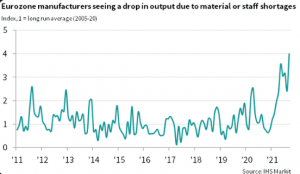
    So, that’s two rather important cost inputs on the rise – energy and labour. The final cost shock is pandemic related but could take years to remedy. Supply chains are under immense pressure and semiconductor chips have often been referred to as the “oil” in a global digital economy. Recent estimates by consulting firm, AlixPartners, suggest semiconductor shortages have cost the auto industry alone more than $200 billion. Furthermore, the pandemic in the form of the Delta variant is now wreaking havoc with important Asian manufacturing country bases like Vietnam triggering output drops in European manufacturing. IHS Markit have produced rather stark data on the hit to Eurozone production caused by staff and materials shortages. The chart below indicates these shortages are four times more likely than usual to reduce production levels:

    The triple whammy of cost shocks can only lead to one thing – inflation. The “I” word has been missing in Europe for decades but the latest figure for Eurozone consumer prices is showing a 3.4% inflation rate. That’s a 13 year high. The next big question is whether this inflation spike is temporary or permanent?

    In an inflationary world one would expect bond yields (income) to rise to a level to compensate for the erosion of purchasing power. Bizarrely, there are a whopping $16 trillion of bonds trading globally with NEGATIVE yields. This would suggest bond traders are pricing the inflation threat as just a temporary thing. This writer would not be so sure and is intrigued by trading activity in what can only be described as an emerging asset class – cryptotech.

    Inflation is usually perceived as the enemy of money/cash as purchasing power is diminished with rising prices of goods and services. Indeed, gold was often bought as inflation protection. However, gold prices have barely moved over the last year. Are institutions looking elsewhere for stores of value? Well, one of the leading cryptocurrency exchanges, Coinbase, has reported Q2 institutional trading volumes of $317 billion, more than double Q2 retail volume of $145 billion. That level of institutional activity strikes this writer as more than curiosity.

    The entire cryptotech ecosystem of currency/coins, blockchain infrastructure and tokens(NFTs) has now grown into a digital asset class with a market capitalization worth almost $2 trillion. No doubt there will be volatility ahead for the crypto world but the business potential of this technology has an inflationary twist. We might be entering an era of higher business costs but, ironically, blockchain technology has the potential to revolutionize service propositions by cutting out intermediaries, speeding up transaction processes and cutting costs by up to 90%. Get ready for the big winter squeeze on business costs but also for increased crypto curiosity too!


  • The Imperial Measure For Economic Failure?

    Apparently, Britain will revert to the Imperial system of measurement as part of “new Brexit freedoms”. And, before you howl at a script more becoming of a Carry On comedy, the UK government is weighing in with a demand that TV broadcasters be required to produce “distinctively British” content. No, seriously. It would be gas, if things weren’t so serious. But now even gas is serious. Bizarrely, ahead of a critical COP26 Climate Change summit in Glasgow, there’s a shortage of CO2 gas in the UK and no amount of political hot air can deny Brexit culpability.

    Dire warnings from farmers, food producers and supermarkets of even more empty Brexit food shelves have forced the UK government to pay a US company to open up two fertilizer plants which had been shut due to the rocketing price of gas. CF Industries is now going to be paid the full operational cost of the factories which generate CO2 as a critical by-product used in the food industry. Crisis averted, carry on Global Britain? I’m not so sure and I do wonder will foreign bewilderment turn to something far more financially calamitous for GB. Let’s weigh up the following developments:

    • Trade: The Biden administration in the US has pushed back on any bilateral trade agreement with Boris Johnson’s government. Note that the freedom to pursue a solo deal – ‘sovrinty innit’ – with the US was a significant post-Brexit promise to compensate for potential EU trade losses. Even that EU trade risk was downplayed as a “they need us more than we need them” calculation. So, how’s that measuring up? Awkwardly, the EU just announced its trade figures for the first 8 months of 2021. The EU’s trade surplus with the UK has jumped by €26 billion to €82 billion thanks to a €16 billion collapse in imports from the UK. To add insult to Brexit injury, the EU has also managed to increase its exports to the UK by €10 billion. Ouch, those pesky little facts suggest Global Britain needs the EU a bit more than previously thought.


    • Taxation: The Conservative government has introduced a hike in National Insurance taxes for both employees and employers. This leaves taxation levels in the UK at their highest since World War II and obviously kills off the promise of the UK as a “Singapore of Europe”. At the same time, tightening government purse strings have removed the £20 per week Universal Credit support. Rising food and energy prices(up 250% this year) have a 1979 Winter of Discontent feel about them but Boris Johnson has assured citizens that price spikes are “a short term problem”. That might sound less reassuring when one considers the long-term planning of this government….


    • Energy: Globally energy/gas prices are rising but the UK is acutely exposed due to some very short-term thinking. Firstly, gas storage facilities are in woefully short supply in the UK which means current market price volatility immediately hits UK energy providers who have failed to hedge for such scenarios. Second, the grand Brexit plan pulled the UK from the EU Internal Energy Market(IEM). The IEM has ensured much lower energy prices for EU nations which, again, is a pesky fact contradicting another Global Britain promise.

    That’s just the bigger financial items but the misery list keeps growing. Truck driver shortages, farming and food woes, fishing carnage, Northern Ireland tensions, untreated waste water, increased mobile roaming charges and a chaotic Afghanistan exit are hardly “feel good” factors for the natives of Boris-stan but in some ways domestic views are irrelevant. The views of foreign providers of financial capital are possibly far more significant. In one financial area, the news is pretty positive.

    UK companies thanks to valuation discounts and currency weakness on the back of Brexit have created a “UK for sale” buy-out frenzy. This week’s headlines about a potential bid for Ladbrokes(Entain) from US fantasy sports giant, DraftKings, is classic M&A activity with a corporate strategic motive but check out the enormous wave of private equity buy-out activity in the UK. The returns on offer are too good to ignore for the financial Barbarians at the City Gate, unmoved by Priti Patel’s armoured jet-skis patrolling the Channel.

    The first 6 months of 2021 witnessed 38 UK buyouts worth $45 billion according to financial data group, Refinitiv. That’s double any previous record for a half year period and could see the likes of Morrisons, G4S, John Laing Group and Aggreko snapped up by foreign funds. Clearly, foreign money sees a future for UK corporates. However, there is a larger pool of foreign financial capital which needs to be watched.

    Let’s go back to the big financial items listed earlier. Expanding trade deficits and dramatic rises in energy costs make it more difficult for the Chancellor, Rishi Sunak, to balance the government’s books. Hence, the tax increases. However, public sector net debt stood at £2.2 trillion in August and the government is spending £20 billion more than its income…..every month. Borrowing other people’s money at an annual rate of circa £250 billion requires a degree of confidence in the competency of government. Things like planning, credibility and sticking to international commitments are typically considered important.

    It is early days yet and debt servicing costs are at historic lows but one can’t help thinking of Hemingway’s line about bankruptcy happening “gradually, then suddenly”. Now think about a Winter of Discontent with rising food and energy prices, struggling exports, labour strikes and comical political dysfunction. Credit is all about confidence and the maintenance of same with one’s lenders, particularly those foreign lenders who look at data rather than Daily Telegraph or Daily Mail editorial fantasies.

    An increasingly isolated Global Britain will still be depending on the kindness of strangers for funding of at least £20 billion per month, and that figure will rise rapidly if the economy stalls. The big danger is that, if the sovereign bond markets demand better terms (higher rates) to compensate for higher risks and deteriorating credit quality, then the economic cost of Brexit will have its very own catastrophe measurement category. Imperial stuff.


  • Celtic Tiger Survives As Protected Species In China

    Celtic Tiger Survives As Protected Species In China

    What a strange week. The governing Conservative Party in the UK has raised taxes to levels not seen since WWII and the Chinese Communist Party is limiting online gaming activity for children to just 3 hours per week. These are hardly populist moves and one does wonder whether these modern political masters of deception and deflection are steering domestic eyes away from two far bigger economic disasters? In fact, both potential disasters have a Celtic twist.


    In the case of Global Britain and the Brexit fantasy, it was striking to see the UK fall out of the top 10 trading partners of Germany for the first time since 1950. The commercial carnage of Brexit is a clown car crash which can’t be hidden from UK tax payers for much longer no matter how many landmark sausage and cheese deals Trade Secretary, Liz Truss, and Sir Ian “Beefy” Botham land with Togo. Of course, our closest trading partner’s historic world-first attempt at a trade reduction treaty is not good news on this island but events in China may soon resonate even more strongly given our recent economic history. Remember the Celtic Tiger and an economy where almost 20% of activity(and government revenues) were derived from construction activity? Well, that tiger’s Sino relatives seem to have found sanctuary in the Middle Kingdom.


    Check out this week’s news on Chinese real estate construction giant, Evergrande. China seem happy to bash its own technology companies in recent months but Evergrande has been allowed to reset debt terms by the Beijing authorities. The numbers might explain why. Evergrande’s debt pile is more than $300 billion which is more than Ireland’s GDP back in 2008. That’s the official number. It is quite likely off-balance sheet commitments/liabilities would bring that number up to $600 billion which would put the developer in Lehman Brothers territory.


    Arguably, in enterprise value terms(debt + equity), Evergrande, and its 200,000 employees plus 3.8 million jobs in its construction ecosystem, is in the top 10 biggest companies on the planet. And, it is bust. It also is not alone. A quick peek at the distressed public market prices of bonds issued by other Chinese construction companies would indicate another $300 billion of debt in troubled waters. Now we are into $1 trillion dodgy debt territory. It is no great surprise the Chinese authorities are offering “sanctuary” to this construction tiger by seeking renegotiated debt terms on its behalf. The ripple effect of a full-scale default would hurt the entire construction industry in China. But, this is where I am a little concerned debt quarantine or sanctuary for one company might not be enough. Consider the following:


    • China is not in Celtic Tiger territory but a construction/real estate industry accounting for 16% of GDP (vs Ireland at 20% in 2008) is about 3 times what would be considered healthy.
    • Property statistics in 2019 showed Chinese home ownership at 90% – actually 96% in rural areas.
    • In 2019 20% of urban housing stock or 65 million residences lay vacant.
    • 44% of mortgages according to 2019 statistics are for second homes. And 24% are for third homes….
    • Loans to the Chinese real estate industry are difficult to quantify because the banks are only one part of the financing system. We may soon get used to terminology like shadow banking(non banks), trust products(investments) and local government finance vehicles(LGFVs) because these will be the dominos which could fall first, and hard. Estimates of debt in these entities are well over $10 trillion and much of it will be real estate related.


    We need to watch carefully the impact of a potential asset fire sale at Evergrande. Pressure on real estate prices will have Celtic-type consequences; lending freezes, collateral calls, liquidity pressures, defaults and more selling. But no buying. This is not a Brexity blip in trade. For context, consider “Global Britain” is a $3 trillion economy. Now add $50 trillion to that number and you are close to a 2019 Goldman Sachs estimate of the total value of Chinese housing and developers’ inventory. And for those quibbling with out-of-date 2019 data points above and possibly citing pent up Chinese structural ‘demand’ for housing I will leave you with two rather important numbers to consider.

    • Chinese population growth is zero %.
    • The value of new housing built in China since 2019 is estimated at $3 trillion.

    Yep, Global Britain and its centuries-old history of empire, industrial revolution and world wars won has just been built in the space of two years…..

  • Money: Five Things You Need To Know Fast

    Money: Five Things You Need To Know Fast

    We have written previously about the sheer speed of growth achieved by certain companies and asset classes. At this moment I believe we need to revisit this analysis and conclude that things are moving even faster. In particular, the entire world of finance seems to be rapidly approaching an existential moment. And the most obvious way to illustrate that shift is with the most basic instrument in the financial world: money. We should pay particular attention to the following five developments as indicators of much more significant structural moves:


    1. Research by Blockdata, a blockchain market intelligence firm, indicates that 55 of the top 100 banks by assets-under-management have increased their involvement in blockchain and cryptocurrency projects. The structural signal is clear – digital currencies are coming.


    1. FTX, the cryptocurrency exchange, recently raised $900 million at a valuation of $18 billion. Its founder, Sam Bankman-Fried, is already reputed to be the richest person in crypto with a net worth of $16 billion. The structural trend to watch here is how digital currencies will reduce intermediaries costs, tolls, friction etc. However, there will still be some tolls paid. Whoever cracks that opportunity is quite likely to be the planet’s first dollar trillionaire. Keep an eye on Sam.


    1. This week Budweiser changed its Twitter profile to a Non-Fungible Token (NFT) which it purchased for 8 ETH(or Ether) on the Ethereum blockchain platform. Do not laugh. Other US corporate heavyweights like Coca-Cola, Marvel and Visa have been dabbling in NFT trading too. The structural point here is less clear but NFTs like other digital assets will probably become more mainstream ‘stores of value’ ie currency to be used in commercial activities.


    1. Perhaps as an illustration of the growing influence of NFTs it was interesting to note in recent days that a new digital token surpassed meme favourite, Dogecoin, in market value. Solana is a cutting edge blockchain technology firm which is particularly suited to supporting NFT issuance. Recall the race to remove friction and costs in the digital world and then know Solana is much faster and more scaleable than other blockchain platforms. Solana’s token, the sol, has rocketed from circa $30 in July to $140 this week. There is a growing realisation that the structural ‘must-haves’ for digital assets will be scale and speed.


    1. Finally, new digital currencies and platforms are going to need one more thing – customers. The greatest opportunity is actually those customers who have very little money. We are talking about the 2 billion adults in the world who remain ‘unbanked’. Digital currencies can remove the banks from the equation and help the flow of money to the poor. In fact, El Salvador with 70% of its population without a bank account has just adopted Bitcoin as a national digital currency. This is the last great frontier of banking and it’s a structural challenge in desperate need of impact investors who can see a role for digital currencies.


    It is probably appropriate to finish up on the impact investing angle because events closer to home this week highlighted some of the points above. A few days ago Pollen Street Capital invested an estimated €300 million in Irish mobile top-up payments technology player, Ding. Apart from being a fantastic result for founder Mark Roden and team after a fifteen year journey, the reports on the deal threw up two interesting nuggets. Firstly, Pollen Street Capital were keen to highlight the “impact investing” motive for the deal and second, Ding is connected to 4 billion phones through 400 mobile operators on the Ding platform. Four billion phones…. Wow!


    Can you imagine the impact of digital currencies and tokens going directly to consumers and possibly without even needing a bank? Lots to think about and plenty of weird and wonderful surprises ahead. I have read recently one needs to put your ‘sci-fi mind’ to work when reflecting on crypto developments so I will conclude with some words from The Hitchhiker’s Guide to the Galaxy author, Douglas Adams:

    “I’ve come up with a set of rules that describe our reactions to technologies:

    1. Anything that is in the world when you’re born is normal and ordinary and is just a natural part of the way the world works.
    1. Anything that’s invented between when you’re fifteen and thirty-five is new and exciting and revolutionary and you can probably get a career in it.
    2. Anything invented after you’re thirty-five is against the natural order of things.”
  • Kabul A Risk Game Changer?

    The pictures from Kabul are upsetting. The twenty year waste of human life, money, time, Western credibility and the hopes of 20 million Afghan females is a depressing fact. Instant analysis is not. Of course, one is tempted to jump in and join the circular firing squads of finger-pointing politicians, armchair military experts and populist bandwagon buffoons but it all feels too early and raw.


    Fifty years ago Chinese leader, Zhou Enlai, famously told Henry Kissinger that “it is too early to tell” the impact of the French Revolution. What is less well known is that the Chinese Premier misunderstood the question and was actually referring to the student protests in Paris just three years earlier. Inconvenient truths eh! Now think about all the strategic questions thrown up by the fall of Kabul…… and then maybe ask the Kurds the same questions.


    Less than two years ago the Kurds were the on-the-ground allies of the US in its fight with ISIS in Syria. Then the Trump administration in October 2019 gave the green light to Turkey for the invasion of north east Syria. US forces stood aside and watched the Turkish army clear out the Kurdish fighters who the Ankara regime had considered to be terrorists. The result was hundreds of thousands of displaced Kurds and an embarassed US military leadership. In fact, earlier Trump moves in 2018 to help Turkey and Russia(again!) in Syria had triggered high profile resignations by General Jim Mattis, Secretary of Defence, and US envoy to the region, Brett McGurk. Indeed, it was Trump who initiated the withdrawal from Afghanistan too, excluding the incumbent Kabul government from the process and negotiating with the Taliban directly. The parallels between the treatment of the Kurds and the Kabul government are difficult to ignore and would suggest some strategic questions are already answered. The events in Afghanistan should focus minds on the following two questions:


    1. What other geopolitical risks are accelerating much faster than is commonly understood? The catastrophic failure of US and NATO intelligence to realise that the Taliban had bought off all Afghan regional leaderships before heading to Kabul is one for the ages.


    1. Which traditional Western/NATO ally is in danger of being abandoned if intelligence services are once again blindsided by a geopolitical development?


    We have previously written about the global economy’s dependence on Taiwan for semiconductor chips which power our digital world. How many people know Taiwan Semiconductors(TSMC) is now in the top 10 most valuable companies on the planet with a market capitalisation of almost $600 billion? The prospect of conflict in the South China Sea and its impact on global trade and technology is almost unthinkable. But we must think. And, watch the headlines:


    Chinese state media sets sights on Taiwan as US Afghan retreat stokes nationalism – CNN


    Beijing plans to build airport on reclaimed land near Taiwan amid tension – South China Morning Post


    China recalls Lithuanian ambassador in Taiwan diplomatic office row – The Guardian


    China drills near Taiwan as Chinese media warns US won’t help – Business Insider


    Perhaps we should look closer to home. It was difficult for many ex-military Tory MPs in Westminster this week to suddenly realise that a failed Brussels journalist as Prime Minister surrounded by a cabinet of village idiots was never going to deliver a Global Britain. Other European NATO allies must be furious with the US and its “unilateral” withdrawal from Afghanistan but, so far, NATO’s secretary-general, Jens Stoltenberg, is trotting out the Washington line about the Kabul leadership’s lack of resistance to the Taliban advance. Interestingly, it was Latvia’s defence minister, Artis Pabriks, who pointed out the dawning reality that “the west, Europe in particular, are showing they are weaker globally”.


    As the Russian embassy sits fully and safely staffed in Kabul one wonders how the governments of the Baltic states, Poland and Ukraine feel about an emboldened Bear on their borders looking for another Crimean opportunity? Well, let’s not be too gloomy and think back to Chinook helicopters on an embassy roof in Saigon in 1975. Kissinger’s frightening Communist ‘domino theory’ was in full flow but less than 15 years later the Berlin Wall had fallen and the USSR was no more. Today, amid the gloom, there are a few more potential positives which over time might gather more historical significance. These personal thoughts might seem contrarian but risk works both ways. So, here goes:


    • Afghanistan tires of perpetual strife and rebuilds its economy in relative peace. Surprisingly, NATO occupation leaves behind one enduring benefit; the female population experienced a degree of opportunity and freedom which cannot be reversed by the Taliban in a digital/creator economy world. Female literacy, higher education and employment participation statistics continue to rise dramatically through the decade.


    • NATO doesn’t force Russia to become a better global citizen. Climate does. The climate change emergency and rejection of fossil fuels breaks the financial grip of Putin and his oligarchs who are removed from power.


    • The decline of US influence is reversed by a populist revolt. The shocking pictures of terrorists sitting in the offices of government, threatening female political voices and freedoms, mocking science, challenging the rule of law and claiming religious superiority was too much for the silent majority. They knew the nation and its constitution was under attack again. The criminal investigations into the January 6th attack on the US Capitol leads to hundreds of prosecutions and the incarceration of political figures plus the lawyers, lobbyists and media personalities who enabled the corruption of the democratic process.


    • China’s GDP slowdown, zombie debt and shunned capital markets force a capitalist rather than a Communist re-think. President Xi is quietly ‘retired’ by more progressive elements in the Politburo.


    Time will tell. As always with risk, and as the Zhou Enlai anecdote shows, the consequences of geopolitical events can often be over-estimated or misunderstood because there are other more significant forces and cycles at play.

  • Code Red: See The Legal Forest For The Trees

    Code Red: See The Legal Forest For The Trees

    ‘Code red’ sounds serious. ‘Unequivocal’ sounds definitive. And yet… we live in a world of Brexit denial, Antivaxxers, Mask Free-Dumb, The Election Big Lie and Zapponic Picnics at the Merrion. What chance has this planet got if the truth is a perpetual political football? Yes, UN Secretary General Gutteres made it clear that the “evidence is irrefutable” and that global heating is a “code red for humanity”. And yes, the 3,000 word report written by 234 scientists for the Intergovernmental Panel on Climate Change(IPCC) stated that climate change was “clearly human-caused” and “an established fact”. So, this looked like a very robust platform to appeal for urgent common sense and survival. Silly me.

    Not for the first time, the White House didn’t get the memo from humanity.

    We woke up to headlines this morning that the Biden administration has called on OPEC to boost oil production to stem the rise in gasoline prices. More fossil fuels please. More gas emissions, more heat. How depressing and lethal. However, this writer believes the lethal threat now supported by “irrefutable” evidence is potentially a very positive game changer. As death tolls mount from German floods, Mediterranean super-fires and Canadian heat shocks the nexus between mortality and climate change is established. Indeed, this is an ‘established fact’ now agreed by 195 sovereign states and 234 scientists. Bingo! Or so the lawyers might say. Those sharp legal minds might also mention precedent….


    As recently as May this year the oil monster, Royal Dutch Shell, was ordered by a court in The Hague to massively accelerate its planned greenhouse gas emissions cuts. The action was taken by 17,000 Dutch citizens and failed to get the mainstream attention it deserved. However, the board of Royal Dutch Shell certainly paid attention as the ruling forced the company to commit to reduce gas emissions by 45% before 2030 rather than the 20% planned. The law might be humanity’s best hope. We also note that the world’s largest mining company, BHP Billiton, is currently considering its exit from all fossil fuel activities. My sense is that the boards of most fossil fuel companies are urgently considering the following:


    • Litigation risk has just gone into global over-drive.
    • Financial/funding risks are also rising as an estimated $53 trillion of investment funds claim to be steering capital based on sustainability(ESG) mandates/principles.
    • Just 100 companies apparently account for 70% of total greenhouse gas emissions.
    • ESG risk has supply chain effects ie customers, suppliers, investors etc are ALL under pressure to ensure their commercial eco-system is adhering to corporate good citizen principles.
    • Insurance and banking relationships are critical to most businesses. Now consider Australian contractor, BMD Group, recently failed to obtain insurance for a coal mine project due to environmental concerns.


    This pincer movement of legal and financial risk is real. The truth still has a legal route to victory. Just ask Fox News who are anxiously backing away from election conspiracy theories as the maligned(damaged) Dominion Voting Systems company initiates multi-billion dollar law suits against right wing media organizations. Worryingly, for serial environmental offenders, the IPCC report does not allow for much legal wiggle room in future climate litigation. However, emissions are only part of the climate change story.

    Deforestation has hugely reduced Earth’s ability to absorb carbon. In fact, the Amazon region is now estimated to be a net source of gas emissions rather than acting as a carbon sink. Forestry looks like a very interesting mitigation tool in our fight for climate survival and one which might be considered by some of the world’s largest fossil fuel players as an interim emissions off-set. We note that the African country, Gabon, with 88% forest coverage is the first on the continent to be paid to maintain its forests which absorb 127 million tonnes of CO2 each year – that’s the equivalent of 30 million cars disappearing…every year.


    Closer to home it is interesting to note a recent deal in the local fund management world. Leading UK alternative investment manager, Gresham House, has purchased boutique Dublin fund manager, Appian. On the face of it, it’s a standard enough fund consolidation deal but Appian had one interesting fund product which probably caught Gresham’s eye. The Dublin fund manager had presciently launched a forestry fund well before ESG and sustainability became ‘hot’. Gresham too had spotted the forests for the ESG trees and has assembled €2 billion of forestry assets which delivers an annual plant rate of 9 million trees. That’s the equivalent of 700,000 cars leaving the road but also returning 5-6% per annum for climate focused investors. Win win.


    So, the climate message is urgent. Lives and property are at risk right now. The time for debate, whataboutism, anti-science and political lobbying is over and the lawyers will move fast. Companies and sovereign states who fail to act are on a lose lose journey; the first loss won’t surprise. The law will play out eventually but financial markets will move far quicker. That’s an established fact too. Code red, or dead.

  • Control Alts + Delete Pension Dogma

    Control Alts + Delete Pension Dogma

    If pensions were an Olympic sport I’m thinking Modern Pentathlon right now. Rarely viewed, poorly understood and then animal spirits can wreck one’s hopes. Horses bolt, pensions blow up. Where are the animal spirits you ask? Well, the traditional pension structure contains 60% equities riding a safety buffer of 40% bonds. The hope is that low-risk bonds will smooth the volatility of riskier equities on your pension journey. However, this week we have read that there are a whopping $16 trillion of negatively yielding bonds sitting in investment accounts across the globe. In other words, the bond world is riding a horse which has never been so expensively priced.

    One would need Olympian optimism to think these bonds will sufficiently off-set any shocks experienced in periods of equity volatility. They won’t. Actually, I would go further and suggest we need to quit traditional pension assumptions. Control-Alt-Delete might be a keyboard quit function but in the investment world we are witnessing a pronounced shift by the most influential investors into alternative investments, or ‘Alts’ as described in market-speak. Alts are financial assets which don’t fall into one of the conventional asset classes like equities, bonds or cash but they are now generating some eye-catching data points. Here’s a few snippets which would suggest the Control of Alts is a very big business:

    • UBS the world’s largest wealth custodian recently reported that its family office clients who think long-term allocate 35% of their portfolio to alternative investments(Private equity, real estate, hedge funds etc).
    • For context, their allocation to bonds is just 17% or less than half the Alts component and way lower than traditional pension fund guidance/thinking.
    • Blackstone, the private equity giant, estimates the size of the assets under management(AUM) invested in Alts at $14 trillion.
    • As an illustration of the growing influence of Alts, the world’s largest Alts player, Blackstone, overtook Goldman Sachs in market value in the past week.
    • Private equity/Venture capital deals are on course to break the $1 trillion level in 2021. That is triple the levels achieved only a decade ago(2011). Source Bain &Co.


    It would be easy to dismiss these moves as exclusive opportunities for high net worth(HNW) investors but we need to look a little closer. Blackstone is currently attracting $4 billion of assets every month from main street retail investors. Some retail investors are skipping the Wall Street intermediaries completely and trading for free on Robinhood but that’s not really pension construction territory. However, equity crowdfunding is presenting retail investors with the opportunity to build their very own venture capital(VC) fund with zero costs. Of course, there is risk involved but one wonders what younger savers will think of negatively yielding bonds on a 30-40 year journey when the “democratization” of financial markets offers up the following:

    • The global cryptocurrency/blockchain universe of assets is approaching $2 trillion.
    • The creator economy of individuals monetising their online activities is estimated to number more than 50 million people per VC firm, Signal Fire.
    • These creators can now issue their own digital tokens of value(NFTs) thanks to blockchain technology. That allows fans and followers to back/invest in these creators early. Yes, there is a “valuation” question surrounding these creators but….
    • The richest man in the world, Bernard Arnault, has amassed an almost $200 billion fortune selling luxury items totally dependent on “perceived” value of relatively scarce items. And…
    • Rihanna has generated $1.7 billion of wealth in fashion, not music. Oh, and Ronaldo makes $40 million a year on Instagram, considerably more than his efforts on the sporting fields of Turin.

    It is clear the world of alternative investments is challenging the orthodoxy of 60/40 pension allocations. In particular, the most savvy investors are reducing their exposure to bond markets at all time pricing highs. What is not clear is which alternatives will be the best performers, but all the best pensions have three critical weapons:

    1. A Plan
    2. Time
    3. Diversified Assets

    It might be worth checking your pension and considering other risk alternatives because debt is now a risk asset not a safe haven. Indeed, our sense is that influential capital has already quit traditional pension dogma and is racing to control more Alts.


  • The Metaverse: To Infinity and Beyond ………………

    The Metaverse: To Infinity and Beyond ………………

    Skibbereen is basking in a golden Tokyo moment today thanks to our love of games. However, this Olympic connectivity over a 10,000 kilometre distance suddenly felt very small when reflecting on other other headlines over the past week. First consider the “Metaverse”. This is the next phase in the evolution of the internet, often referred to as Web 3.0, which provides users with a bridge between the physical and digital worlds. Online gaming has been the standout sector in exploring the commercial possibilities in the metaverse with blockchain technology and token(NFT) incentives. Only a few days ago we wrote about Axie Infinity and its 200x revenue growth achieved in just three months. Talk about hyper growth on steroids, but here’s the update.

    Axie’s June revenues were $12 million and the first 18 days of July delivered $79 million. Since Monday the Pokemon-like game has been generating $9 million, each day. That’s a staggering $100 million of activity on this blockchain powered platform in just a couple of weeks. No wonder Mark Zuckerberg has just described the metaverse as “the next generation of the internet and next chapter for us as a company”. In fact, it’s more than a chapter. Zuckerberg used the Facebook earnings report this week to announce his ambitions to turn Facebook into “a metaverse company”.

    Of course, there will be debate about what that “beyond” world will look like and how we will virtually experience it. However, there appears to be growing certainty about how the bridge between the physical and virtual worlds will be built. The debate about cryptocurrency valuations is a distraction which generates the headlines but the investment world is beginning to wake up to a digital world which will employ blockchain-type technologies to support a creator economy trading in digital tokens(NFTs, crypto etc). Follow today’s money. Technology investors are making moves and here’s a few funding events from recent days as an illustration of the appetite for exploration of the metaverse:

    Crypto infrastructure firm Fireblocks raises $310 million with a $2 billion valuation. The start-up provides custody and other digital assets-related services.

    Ethereum-based project EthSign raises $650,000 seed funding to put signed documents on the blockchain.

    Blockchain infrastructure provider Biconomy raises $9 million in a funding round. The company provides blockchain support infrastructure for developers.

    Bitcoin rewards provider Lolli raises $10 million in a Series A funding. Lolli gives free bitcoin to its users as a reward for shopping.

    Mega venture fund, a16z, backs the Valora digital wallet with $20 million.

    Opensea is one of the top NFT marketplaces and has just achieved unicorn status(> $1 billion valuation) with a $100 million fund raise.

    A new Facebook focus, freakish Axie Infinity growth and frenzied funding rounds suggest readers look “beyond” cryptocurrencies and think about the infinite possibilities of building a next generation virtual world. The Metaverse is a digital gold rush. Now it’s time to find the digital shovels.