Author: Gary McCarthy

  • Game On for Robinhood and Revolut

    Game On for Robinhood and Revolut

    So, the Irish stockbroking version of Game of Thrones concluded this week with J&E Davy shareholders ceding power to its former master, Bank of Ireland. No blood, but there were some interesting twists in the tale. It is not that long ago Bank of Ireland sold Davy to its management team for €300 million. At least half that MBO purchase price was debt so the latest €600 million break up of Davy looks like at least a four-bagger for the leaders of the 2006 coup. Well played.

    Some might find the game-type language a wee bit distasteful given recent governance issues on Dawson Street but there is method in my badness. Awkward and costly change of strategy or not, Bank of Ireland desperately needed to get back in the game to add some new revenue channels. Recent newsflow on Robinhood and Revolut would suggest ‘new revenue’ can generate serious valuation boosts.

    First, consider Revolut which derives 12% of its revenues in Ireland. The UK-based financial “superapp” has just raised $800 million from Softbank and Tiger at a valuation of $33 billion, or slightly more than the value of Nat West! For those waxing on about winners and losers in the Davy deal think about that theoretical $4 billion valuation attached to the Irish portion of Revolut’s business. And that’s not even the eye-catching number.

    Revolut’s 16 million customers generated revenues of £222 million in 2020 but for each pound of revenues there was an almost equal loss of a pound(£207 million). It is early days yet but the business model is possibly still in search of its mission as bank product/service or wealth/trading platform. Or both, as Bank of Ireland are trying now. Clearly, the pandemic hit Revolut’s original winner, its slick foreign exchange service, but it was striking to see that almost one third of revenues came from its trading platform used to buy stocks and….. cryptocurrencies. More games than banking maybe, but don’t knock it. Ask Robinhood.

    Robinhood, the US-based trading platform, has just filed for an IPO in New York. Remarkably, the indicative valuation of the Robinhood IPO is the exact same as Revolut’s latest $33 billion mark. However, revenues of the former are almost triple that of Revolut, just shy of $1 billion in 2020, and it is not losing money. Net income was only $7 million in 2020 but here’s the interesting bit – it doesn’t charge its customers fees or commissions. How does that work? Well, arguably its product, like all free functions these days, is its customers. More specifically, the order flow of its 18 million accounts in 2020 generated PFOF(payment for order flow) from Wall Street market makers like Susquehanna and Citadel who value the “insight” provided by the early view of retail trading direction and activity. This might not sound in the best interests of the customers and the SEC are watching closely but there’s more to this in this writer’s view.

    The unique conflation of pandemic, free trading, crypto currencies and social media championing of meme stocks like Gamestop and Tesla has created huge communities of new traders who enjoy the shared experience of taking on Wall Street. US financial writer, Matt Taibbi, describes it well :

    “If and when IPO money comes, Robinhood will be on its way to becoming a finance version of Facebook: a free platform that keeps a sea of customers engaged with a hyper-stimulating user experience, while making money selling intelligence about those customers’ behaviors to expert wealth extractors on the other end. … Instead of stealing from the rich and giving to the poor, the American version takes in the young and sells them to computer-powered hedge funds; this Robin Hood is the house that always wins.”

    That poor-to-rich summation is not quite the theme in Robinhood of Sherwood Forest. However, if customers, in the main, are playing for fun and not risking financial distress then the shareholders of Paddy Power/Flutter and Draftkings Inc can tell you these franchises are sustainable profit machines. We shall see, but we should also reflect on the enormous power of providing a community shared experience with money or pride at stake and the huge attraction of that buzz. Community recognition of skill is the motivation in nearly every game in history. Dreams sometimes come true and a staggering 47% of Robinhood trading activity is in the all-or-nothing world of options trading. Believe it or not, people are happy to pay to have fun. Fun also has warp speed growth potential.

    I had never heard of Axie Infinity until last week. Then Packy McCormick in www.notboring.co mentioned this Pokemon-like game which has its own little meta-world, crypto-tokens, competitive skills, and cash for crypto exchange all built on blockchain technology. Oh, and fun.

    Viral fun which has required zero marketing spend. How’s it going? Well, in April Axie did $670,000 in revenues. In May, it did $3 million. June was $12 million and the first 18 days of July did $79 million. Revenue growth of 200x in just three months….Unreal!!!! Fantasy game but real revenues generated by more than 600,000 players around the world. So, when this writer sees Bank of Ireland pulling off a back-to-the-future strategic deal I do wonder whether financial services need to start thinking about communities rather than traditional products, revenue channels and functionality.

    We have written before that finance will be embedded like a Stripe code in every business or service. Think Amazon and free delivery; finance is the new free delivery. Also, think fun and its virality. Not convinced? I will leave you with two final snippets, with thanks to the Morning Brew newsletter for flagging.

    1. Start up, Virtually Human Studio(VHS), has just raised $20 million from some seriously heavyweight investors like Andreessen Horowitz and TCG Capital. VHS has developed a NFT platform called Zed Run which should tweak the noses of hobbyists in the equine community. Yep, this platform has a community of 14,000 “stable owners”, called #ZEDheads, who buy, sell, race and breed virtual horses. Each of ther horses has its unique blockchain verified token(NFT) which can cost up to $45,000 each. So far, $30 million (Yes!) of virtual horses have been bought and sold. Zed Run gets a fee every time there’s a race, trade or birth.

    2. If that’s just a little bit too far for some of you then pay attention to some more traditional “hobbies” with serious wealth outcomes. How about the art market? The art market’s $1.7 trillion of assets beats the entire crypto universe and also delivers. Art prices in the 1995-2020 period have trounced S&P 500 returns by a whopping 174%.

    We have no hope of forecasting the future accurately for Revolut, Robinhood or Bank of Ireland but a rapidly growing creator economy seeking community, shared experience and fun feels like a wealth creation ‘banker’ for those that can service it well. Game On.

  • Thinking, Fast and Faster

    Thinking, Fast and Faster

    As I briefly caught up on Love Island developments last night, I experienced an out-of-vacuum sensation. Thought. Could these cognitively challenged conversations between contestants be considered investment pitches by individual social media start ups? Don’t laugh. The speed at which talent-free idiocy can turn into million-follower Instagram franchises with ‘influencer’ royalties is a frighteningly real proposition. It would also be a mistake to dismiss this as just a reality TV phenomenon. The business or sector as an illustration is actually irrelevant from an investment perspective. Our focus today is speed.

    Nobel Prize winner, Daniel Kahnemann, wrote Thinking, Fast and Slow a decade ago. This exploration of human decision-making highlighted the strengths and flaws in the two systems which drive how we think: System 1 is fast, intuitive, and emotional. System 2 is slower, more deliberative and logical. The field of behavioural finance has always assumed both systems interact whether one was a short term day trader or a long term value investor. Bitcoin or Buffet, we understood the difference. Now, I’m not so sure.

    All I can see is ‘fast’ and it’s not just the speed of investment thinking. The digital economy is generating warp-speed growth for all types of businesses, from Dogecoin social media creator/influencer franchises to payment platforms like Stripe . Let’s consider some data I came across in recent days which really hammered home the point about speed. Firstly, I was flicking through the CB Insights update report on venture capital investing activity in Q2 and two figures stood out:

    • Q2 2021 witnessed the birth of 136 new ‘unicorns’ – private companies which secure a valuation of more than $1 billion for the first time through a funding round or corporate activity. For context, that is six times the number achieved in Q2 2020 and higher than the 128 unicorns created in ALL of 2020.

    • Tiger Global was the most active investor globally. The total of completed investments in the quarter by the Tiger team was more than 8 times the number completed in the same period a year ago. But here’s the jaw dropper; 81 deals were completed by Tiger in Q2 which works out at 1.3 deals per business day!

    Yes, markets and valuations, are enjoying record highs which always helps System 1 thinking, per Kahnemann. So what could be driving the optimism? Of course, daily record highs and eye-catching valuations can create a virtuous circle of wealth creation, fund flows, FOMO and yes, greed. However, there’s another speed data point which is highly relevant and possibly the game-changer for venture capital firms. Start-up companies are no longer just fast growing, they are reaching globally significant size at hyper-fast speeds.

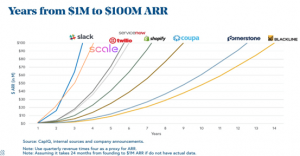
    The excellent Not Boring blog www.notboring.co has generated so many followers it has just launched its own venture capital fund and shared a few interesting charts to explain their strategy. One graphic really caught the eye as it highlighted more recent vintages of start-ups are growing from $1 million to $100 million of annual recurring revenues(ARR) in ever-shorter time periods. Check out Slack below which has just been bought by Salesforce:

    Clearly, higher revenue numbers earlier generates far higher valuations and incredibly attractive returns for venture capital investors. It is no surprise to see the CB Insights Q2 report highlighting global funding of start-ups has rocketed by 157% year-on-year to $156 billion. So let’s slow things down for a second and think about how speed is changing the venture capital fund world. My three key takeaways would be:

    1. Companies can grow incredibly fast and achieve whopping valuations much earlier than in previous investment cycles. In many cases this is revenue(ARR) driven not just story and valuation euphoria.
    2. Venture capital funds know there are more opportunities to find companies/investments which can generate 100-200x type returns.
    3. One big win can erase lots of losers. Hence, portfolios are being built faster and with far more constituents – see Tiger and its staggering 1.3 investments per day.

    My final thought is more challenging. As start up investors we may need to think fast, and faster. Spend less time trying to identify a small group of winners. Think about a bigger portfolio approach with a higher number of investments and the speed at which your investee companies can accelerate revenues to a significant level.

    Bringing those thoughts closer to home it is striking to see Irish companies no longer exiting into the arms of a bigger global parent but choosing and executing hyper-growth strategies themselves. Ask yourselves would the past weeks’ headlines ten years ago have featured buy-out in the headline rather than foreign capital backing global growth ambitions below?

    • Collison brothers’ Stripe takes a first step towards stock market – Irish Independent

    • Xtremepush to double its workforce as it raises $33 million – RTE

    • Covid testing pushes LetsGetChecked to $1 billion valuation – The Irish Times

    All of these companies are focused on hyper-growth. And they also know another digital truth which we touched on before. The only barrier to entry is scale, global scale. Oh, and the winners in this competitive reality actually get off the island first.

  • What If China Bytes?

    What If China Bytes?

    It’s coming home. That Baddiel & Skinner ditty was coursing through my bored TV brain the other night when something odd happened. The advertising boards at Wembley suddenly flashed up the corporate name and logo of Alipay. China’s really coming here I thought to myself. Alipay may not be familiar to all readers but this Chinese mobile payments company is the world’s largest with over one billion active users. China and Chinese tech is on the march globally but financial markets are not so sure.

    International capital markets have typically taken a benign view of Chinese government influence in the commercial activities of its corporates. However, the Chinese authorities are beginning to show some teeth and the ‘byte’ marks are being felt acutely by investors in Chinese technology shares. Since February more than $800 billion of market value has been wiped from Chinese tech giants but this is not a normal episode of tech valuation volatility. There is quite a bit going on….

    Let’s start at the top – the political leadership. Tension between China and the US is not a secret but President Xi’s recent speech at the centenary celebrations of the Chinese Communist Party (CCP) struck a surprisingly defiant and aggressive note. The translators usually apply some diplomatic lip-stick but there’s not much nuance or wiggle room on “we will never allow anyone to bully, oppress or subjugate China. Anyone who dares to do that will have their heads bashed bloody against the the Great Wall of Steel forged by over 1.4 billion Chinese people”. Pretty clear to most observers, and the Uighur minority in western China can confirm the bashing heads bit. But what about the rest of the world being wooed with Wembley wishes..?

    There appears to be three current targets of CCP aggression. First, Chinese technology companies and their owners are experiencing a regulatory crack-down under the guise of data security. The following events were shots across the bow for tech investors:

    • The biggest IPO ever was going to be financial services monster, Ant Group, owned by Jack Ma and parent of the already huge, Alipay. However, Chinese authorities blocked the transaction in April, Jack Ma went to ground for weeks and then re-emerged to announce a restructuring of the group.

    • In May the Chinese Cyberspace Administration warned 100 mobile app companies(including TikTok’s parent) about the illegal collection and exploitation of user data.

    On the face of it, these moves looked like a clipping of big tech data wings but then international investors were literally taken for a ride in the past week. The Chinese version of Uber, Didi Chuxing, was offered to international investors as a New York IPO on June 30th. The shares were priced valuing the ride-sharing giant at almost $70 billion but just days later Chinese authorities ordered app stores to stop offering Didi’s app due to “ a serious violation of regulations in its collection and use of personal imformation.”

    Didi’s share price promptly collapsed by 25% and continues to fall post the July 4th holiday. That $20 billion slap of wealth destruction with such suspicious regulatory timing raises a far bigger question. Is China trying to force Chinese tech companies to list their shares closer to home, in Hong Kong, or face the regulatory wrath of the CCP? Given there is a whopping $2 trillion of Chinese tech shares listed on US markets this has serious implications for investors and global capital markets. It certainly might be the end of US IPOs for Chinese tech companies. We note TikTok parent, ByteDance, and medical data play, LinkDoc, have just abandoned plans to list on US markets. Clearly, trading desks are buzzing as speculation grows on the future of $2 trillion of Chinese tech shares which might be coming home. And that’s not the only buzzing….

    China is significantly increasing its activity over the Straits of Taiwan. It seems very deliberate and the data is clear. In 2020 there were incursions of Taiwan’s airspace on 87 days, more than the previous 5 years combined. Half way through 2021 and that number has already been surpassed. We have already written about the global economy’s acute dependence on Taiwan’s semiconductor manufacturing base so the implications of conflict or interruption is almost unimaginable. Unless… you are the top US military officer in the Asia-Pacific region.

    Admiral Philip Davidson is not preoccupied, like Wall Street analysts are, with byte bashing. In fact, he had already expressed his views months before President’s Xi’s ‘head bashing’ threat and imagined the very real threat of Chinese military might and ‘bite’ – “Taiwan is clearly one of their ambitions before that(2050). And I think the threat is manifest during this decade, in fact, in the next six years.” That might explain China’s longer-term motive to position its technology and capital markets closer to home.

    Plenty to chew on and hope that some things don’t come home…..

  • TRUMPOCALYPSE NOW

    TRUMPOCALYPSE NOW

    Apologies for the apocalyptic header but a 4th wave of George gLee has left some emotional scars this week. We will survive. Donald Trump’s business empire will not. The Manhattan DA’s office has just charged Trump’s CFO, Allen Weisselberg, and the Trump Organization with fifteen felonies. Despite Trump family claims of a “witchhunt”, the discovery of two sets of books in the Trump accounts looks like a red hot smoking gun for fraud and tax crimes. Don’t watch Trump. Watch what other people do.

    We have written so many articles on the business model risks of dependence on “other people’s money” and how it can be called at exactly the wrong time. Now is that time. This will be a blockbuster version of a real estate collapse, on a global scale which will sadly touch the shores of Doonbeg and Turnberry.

    Imagine the awkward scenario for local banks and professional advisors providing services to the Trump Organization. They all have client due dilligence(KYC) and money laundering (AML) obligations. Updating the status of a client/customer to ‘criminal’ ends those relationships immediately. Other commercial relationships could end in days with fatal business consequences. Think about the lenders of billions of dollars to the teetering Trump empire. Count 12 in the New York indictment is the zinger – “FALSIFYING BUSINESS RECORDS IN THE FIRST DEGREE”.

    Every loan covenant requires the maintenance of truthful books and records. Now every Trump bank lender will be demanding to see the books. There’s a good chance those lenders won’t see the books or won’t like what they see. Some won’t even wait given the recent Archegos stampede for the exits leaving Credit Suisse with a $5 billion hole. Oh to be a fly on the wall at a Deutsche Bank board meeting right now! And forget about restructuring loans and repayment schedules.

    The Trump Organization cash flows are about to be grabbed by the….. KYC and ESG. We have previously written about the big new financial sticks in town; you must know your customer (KYC) and if due dilligence reveals a poor actor then the trillions of investment capital dollars signed up to sustainability principles(ESG) will force hands. Closer to home, Davy and Teneo can tell a tale or two about the new world order and how no relationship is sacrosanct. Now get ready for the following:

    • Corporate bookings at Trump properties (and their cash flows) will evaporate.

    • Trade creditors/suppliers will hardly be reassured by the soothing words of an Orange Toddler still believing he will be back in the White House in August and a multi-decade track record of stiffing creditors. Expect Trump properties to encounter operational issues.

    • The emergence of stories in the media about professional advisors, politicians and corporate donors being far more aware of Trump illegality over the years. Trump has destroyed lots of careers (his lawyer, his CFO, White House cabinet figures etc) in recent years but expect some significant commercial casualties where wilful blindness and greed combined. Ask EY in Germany how their Wirecard experience is going.

    • Whistleblowers. A cash-strapped Trump won’t be able to promise rewards for silence. Indeed, the recent attempt by former Attorney General , Bill Barr, to re-write his malign influence was pathetic but instructive.

    There is plenty of debate as to whether the Don himself is charged or serves time. In some ways, at a national level, that is irrelevant. The murderous 6th January Capitol Hill riot was perhaps the nadir of American democracy. A re-set is required with a return to fact-based political, social and economic discussion and negotiation. That could be a wish too far but a few early initiatives would help.

    Perhaps, the best way to ensure the Russians never place an agent in the White House again is to show the enablers that criming in plain sight will eventually destroy the leader and then you. The banks might act first but watch the followers. GOP leaders(?), political donors, media executives and corporate board rooms will be plotting their own distancing strategies. Hopefully, most will fail and will be confronted with the two most basic questions or truths about their wilful negligence:

    1. In 1987 the New South Wales police board refused a casino licence to Trump because of his alleged “mafia connections”.
    2. In a world of increased regulation(KYC) why did so many banks in New York view Trump Org as ‘toxic’?

    These are basic risk questions. Those that ignored them are about to feel some real pain as loan agreements and hotel bookings are cancelled, and billions of dollars go up in smoke. Cancel culture eh! How woke is that!!

  • In A Brexit World of Pure Imagination

    In A Brexit World of Pure Imagination

    Fifty years ago this week Willie Wonka invited his young factory guests to “come with me and you’ll be in a world of imagination”. Only 5 years ago the UK  public were invited to vote for Brexit and imagine a “Global Britain”.  So, how many voters feel like the gluttonous Augustus Gloop right now? Jammed in a chocolate vacuum tube while the rest of the world winces with Wonka-like schadenfreude  – “The suspense is terrible, I hope it’ll last.” Take a look at the following developments and think about all the imagination required to skirt the awkward realities of sailing alone in a very connected modern world….


    • Financial Times: Almost one third of British companies which trade with the EU have suffered a decline or loss of business since post-Brexit rules took effect.


    • The Guardian: UK facing a summer of food shortages “because of a loss of 100,000 lorry drivers due to Covid and Brexit, industry chiefs have warned.”


    • The Independent: Collapse in British exports hands Republic of Ireland a trade surplus for the first time since 1922. Exports from the UK to the Republic of Ireland have collapsed €2 billion.


    Of course, some will argue the “big picture” tells a different story. Except it doesn’t. The ultimate arbiter of economic progress is financial capital and the data is damning:


    • The Great British Pound/Peso: Among major currencies sterling has been the worst performer against the dollar since the 2016 Brexit vote. Bloomberg reported a 6.3% depreciation for the GBP while the Euro appreciated by 4.5%.


    • UK Share Prices: A weaker currency can often assist stock performance. Not so in Brexit land. On the 5th anniversary of the Brexit vote the MSCI World Index of 23 developed nations posted a 104% return over the period. The FTSE 100 delivered just 37%.


    • Valuations: JP Morgan’s research team have published analysis showing UK equities “trading at a 35% valuation discount to world markets”.


    • Financial Assets: More than $1 trillion of financial assets have moved from the UK’s financial engine, the City, to other financial centres.


    UK assets are clearly perceived by financial trading markets as less attractive in the near term. This writer has previously written that the longer term thinking of financial players will be reflected in corporate activity – mergers and acquisitions. That market is booming. In fact, private equity buy-out activity hit an all time record in Q1 2021. However, it is less clear whether this is a good thing for “Global Britain” – selling prize assets like Morrisons, Asda, Itsu, Senior, St Modwen, John Laing etc on the cheap. Dearie me, even the Daily Mail is concerned. Alex Brummer, its City Editor, recently penned a bleating headline “ We Can’t Let These Locusts Strip Our Economy”. Perhaps Brexit dreams of “taking back control” were not all about money. Well how’s that going?


    No amount of “flag-shagging” or “One Britain, One Nation” singing by the Boris-Youth can gloss over the structural challenges posed by the Northern Ireland Protocol and Scotland’s independence movement. It’s not just sovereignty looking a little frayed. It was striking to read former Downing street aide, Dominic Cummings, suggest the opposition parties in Westminster should “kick the Tories up and down the street on violent crime”. That’s quite the reversal for the traditional “law and order” party but then again the law is enduring a rather poor run of UK government exceptionalism.

    The ongoing verbal gymnastics displayed by various government ministers in justifying a breach of an international agreement they have only just agreed and signed up to(NI Protocol)  is not just infuriating Brussels. The Biden administration in Washington and international capital markets are wondering how the UK government can be trusted going forward. And, the UK’s farmers and fishermen might be asking similar questions. But perhaps there is a much bigger question…..


    There is nothing wrong with a country wishing to manage its trade and geopolitics alone. British history could indeed inspire but the world has changed dramatically since the days of Empire building. This is a hyper-connected world and begs the question whether trade and geopolitical exceptionalism is a realistic strategy? I am reminded of  a recent conversation with a senior executive of a Big Tech company. We were discussing barriers to entry and competition in the corporate world. His view was that technology and commercial ecosystems can be built so quickly  in a digital world that now there really is only one barrier to entry – scale, global scale.


    The UK ‘s population is just 65 million. The EU market contains 450 million consumers and the British government has signed the first trade agreement in history where the outcome is a definitive reduction in trade activity. Just as Apple, Google and Amazon get the best trading terms because of their economic weight, it is logically inconceivable that any trading bloc or large country will sign up to an agreement with 65 million people and better terms than those in place with a 450 million strong market. The thinking that a nimble agile small economy competitor is going to receive more competitive terms than monster single market ecosystems is Wonka bonkers, and decades out of date.


    Wetherspoon’s CEO,Tim Martin, won’t be the only Brexit cheerleader forced to meet economic reality with a comic u-turn appeal for “more liberal immigration” to assist the staffing of his pubs. Expect more of  this jaw-dropping revisionism. Meanwhile, the denial of the daily realities of Brexit by the likes of Gove, Redwood, Rees-Mogg, Frost and Johnson is a tedious attempt to keep leave voters on board. Stunningly, the most recent YouGov poll shows less than half of Leave voters(45%) think Brexit is going well. Oh well, at least there are £200 million plans for a new national flagship “to promote British trade and industry around the world”. Dreadnoughts, 1914 and irrelevance spring to mind but the shifting of Brexit views will be attritional and bitter.  Willie Wonka had a sweeter ending….


    “We’ll begin with a spin

    Travelling in the world of my creation

    What we’ll see will defy explanation”   


                                                              Willie Wonka & the Chocolate Factory

                                                                                             June 30th 1971

  • Crypto: Watch the Moves, Not the Charts ……

    Crypto: Watch the Moves, Not the Charts ……

    Ok, I am now crypto convinced. Cryptocurrencies need to be watched very closely. But, possibly not for the reasons one might think. Weirdly, my crypto thoughts have been infected by Covid-19. Let me explain. A recently watched ‘Panorama’ documentary on future pandemics got me thinking about the collision of massively expanded population centres and our planet’s wildlife.

    On a map, China and India’s territories have not changed too much(sorry Hong Kong) over the past 40 years, accounting for just over 8% of the world’s land mass. However, the mix of occupants of these lands has shifted dramatically. The two countries now account for 25% of the wildlife species on the planet and a whopping 35% of global humanity. The big change is in the latter number – since 1980 there are an extra 1 billion people living in ever-closer quarters to a quarter of the world’s wildlife. Now recall SARS(2002), Swine Flu(2009), Ebola(2014), MERS(2015) as recent and increasingly frequent precursors to our current Coronavirus and glimpse our future – two habitats threatened by a failure to plan and understand the dangers of encroachment. I see a species habitat battleground. But, I also see a crypto economic battle ground. Really?

    Yes, really. But, also virtually. The pandemic public health emergency split the global economy into separate commercial (goods/professional services) and social (lifestyle) crises which required differing treatments. In the commercial world, essential activity was supported by government and central bank funding across the globe. However, the social world was prescribed restrictions, lockdowns and profoundly changed human behaviours. In turn, social activity accelerated its move in to the digital world as Zoom, Netflix, TikTok, gaming, YouTube etc picked up the connectivity slack. But there’s more than connectivity. Much more, a whole economy.

    The Creator Economy is not a new thing. We’ve gone from the Kardashians, Howard Stern, Beliebers etc to Joe Rogan, El Presidente, Tyler Blevins, MeganPlays and PewDiePie. More followers, more communities and more money have followed the digital revolution but there’s a danger we are thinking in media content terms only. We need to re-set our understanding of where the internet can take us.

    The best thing I have read in the past month was ‘The Great Online Game’ by Packy McCormick on his www.notboring.com blog. Two things really struck me reading through his piece:

    1. Think of the internet as an always-on video game where you star in the game. You value communities, being curious, building relationships, collaborating and….. having fun.
    2. Crypto, token (NFT) and Wall street ‘meme’ trading are communities of participants sharing experiences, knowledge and fun. Those that fixate on the imminent collapse of crypto and the daily value gyrations miss the point. Crypto is in-game money for the internet.

    Wow. I can imagine a future for a digital credit system which is earned online and becomes a store of option value in your life or career. In effect, it’s an alternative currency underpinned by the values of the online community. That’s the future. Significantly, recent newsflow suggests governments and regulators know digital currencies are coming. However, they are uncomfortable about the implications of digital currencies from the social online world “infecting” the activities of the physical commercial economy. Watch the following developments carefully:

    • China has banned cryptocurrency trading since 2019 but has taken a digital view. Its central bank has just launched a digital version of the Yuan which is deployed on blockchain technology and is a first for a major global economy.

    • El Salvador has become the first country in the world to adopt a digital currency(Bitcoin) as legal tender. High levels of un-banked citizens and reliance on emigrant remittances in El Salvador will resonate with populist leaders in other developing world economies. And, it’s not just the little guys…

    • A Bank of International Settlements (BIS) study found that 60% of the world’s largest central banks are researching their own digital currencies.

    It is true cryptocurrencies are super-volatile and hardly reassuring as every day exchanges of value. For illustration, Bitcoin having topped $60,000 is currently trading back down closer to $35,000. However, some players are now backing crypto with dollar assets. And that’s now posing some interesting questions for banking regulators as crypto grows in size and begins to potentially impact or “infect” the wider economy. Consider the following:

    • Tether is a crypto platform which backs its so-called ‘stablecoin’ with US commercial paper(CP). According to latest disclosures by Tether, and reported by the FT, its holdings of $30 billion of CP would make the firm the seventh largest CP player in the world. This market is worth more than $1 trillion and helps companies to raise short-term cash for payrolls and inventories. Clearly, regulators won’t want any shocks or volatility in that critical corporate funding market.

    • Bitcoin is the largest cryptocurrency but owner concentration could be considered a potential risk in the future. It is believed that more than 50% of bitcoins are owned by just 2,500 trading entities. On recent peak valuations that’s almost $500 billion in a small number of hands. And what hands might be the most pressing regulatory question of the day? Criminals love crypto.

    • The wider economy “infection” by crypto is most clearly illustrated by a huge increase in cyber crime accompanied by ransoms demanded in cryptocurrencies. The bad news is that companies are choosing to pay rather than face the disruption faced by the HSE here. US oil pipeline company Colonial paid a crypto ransom in recent weeks and Brazilian meat giant, JBS, has reportedly just paid an $11 million ransom. Crypto is the fingerprint-free way of extracting ransoms and is possibly the biggest legal threat the asset class faces if the authorities seek to shut down cyber criminals.

    • The EU Cybersecurity Agency (ENISA) have just reported that large-scale malicious attacks on “critical sectors” doubled to 300 in 2020.

    Perhaps we should shift our focus away from the currency aspect of crypto. Possibly more interesting is the blockchain technology which is integral to the secure recording of any digital currency transaction. Ethereum has its own currency but its blockchain infrastructure lets people build apps and products with money embedded in the code. Now let’s return to that thought about the Creator Economy and the Online Game.

    Whatever the currency there is no doubt in my mind there will be digital versions/tokens to be accumulated by all internet players/users in the near future. So rather than torturing yourself with FOMO or forecasting the direction of travel of any particular crypto currency might we suggest a different play? Think about the social economy and three ways your commercial world might benefit:

    1. Create. There will be communities and currency/tokens to reward you.
    2. Follow. Be curious, join communities, collaborate and invest in other creators/tokens.
    3. Learn. Expertise in blockchain and Ethereum-type platforms will be very valuable.

    Like the maps of China and India, crypto price charts don’t really capture the bigger picture. Indeed, there will be many crypto observers over the coming years saying “game over” but the moves being made by central banks, creators, online communities and traders say something very different – “Game On!”

  • As Banks Flounder Irish Fintech Flourishes

    As Banks Flounder Irish Fintech Flourishes

    Another bloody virus!!! This time it’s the digital variety acompanied by ransom demands. Technology can be scary. So scary that the HSE couldn’t even tempt a chief technology officer to join its 600-strong manager ranks of six figure earners over the past three years. Ah well, it didn’t stop an IT spend of more than €500 million over the same three year period. But, it didn’t stop Wizard Spider either. If managing the security of the HSE’s network of Windows 7, Outlook 2010 or Lotus Notes(!!!) packages sounds like a Sysyphean task, spare a thought for the Irish banking sector.

    Irish banks have spent billions to upgrade IT systems but, every now and again, we are reminded of the Jurassic tone of these efforts. It would appear that the transfer of €9 billion of loans and customer accounts from the fleeing Ulster Bank to the zombie Permanent TSB franchise (PTSB) has suffered an IT meteor strike. Ulster’s UK parent, Nat West, are not satisfied IT systems could cope with the transfer of thousands of current accounts to PTSB. So, the overall shape of the transaction is under threat. There are no winners in these IT failings but there is also no need to lose faith in technology, specifically financial technology, or fintech as it is known. The Irish fintech sector is flying.

    Check out these recent stories from the fintech world:

    • Fenergo and its regulatory compliance technology used by the world’s largest financial institutions just completed a $600m share sale. A majority stake in the firm was sold to private equity groups Bridgepoint and Astorg putting a $1.165 billion valuation on the company.

    • CleverCards and its payments platform is about to complete a €10 million funding round. Their payment solution is very interesting; it allows organisations to send a digital pre-paid Mastercard to a mobile phone. Think about all the unbanked people out there.

    • Pipit Global have been doing lots of thinking about the unbanked. It has developed an award-winning B2B cash payment platform to assist migrant cross-border cash remittances and is raising €250,000 through our own Spark Crowdfunding platform.

    • Kerry-based Taxamo has been assisting coss border transactions too. Its innovative tax compliance automation solutions are used by e-commerce businesses operating in multiple markets. Word of its success must have reached the US. Vertex, a Pennsylvania software company, has just bought Taxamo for $200 million in an all-cash deal.

    • Staying in the US, Inscribe is San Francisco based but with an Irish founder team. Looks like the team are staying on the West Coast as they have just raised $10.5 million to expand its operations. The company has developed technology to detect fraud in documents typically provided to lending institutions.

    • On another West Coast, Payslip in Mayo has secured $10 million of funding to create 150 new roles and expand the footprint of its payroll technology.

    • Fintech investors are not the only ones giving. Dublin start-up, &Open, has developed software(SaaS) which is used by companies of all sizes to create specialized gifting campaigns. It has just raised $7.2 million from an influential group of investors including Intercom’s Des Traynor and PCH’s Liam Casey.

    If it feels like things are hotting up, you’re probably correct. There may be some debate about the merits or valuations in cryptocurrency land but that misses a larger point. The financial payments eco-sysytem is undergoing a rapid structural evolution and Irish fintech innovation is beginning to attract some serious capital. Keep the technology faith, but maybe not the Jurassic bank account!

  • There’s no ‘I’ in Teams

    There’s no ‘I’ in Teams

    Spare a thought for those still trapped in the lockdown tyranny of Teams and Zoom meetings. There is no escape yet from the pandemic mind-set. Remote screen working plus the daily doses of covid case numbers, hospitalisations, dashed travel plans, George gLee, Sam McConkey, vaccine cohort juggling and Stephen “Eliot” Donnelly can numb the most inquisitive of minds. Covid complacency is a real business risk now. The world is moving on and our team of pandemic and alco-warrior “Invincibles” need to transition to the “Invisibles”. The global economy is already transitioning and there’s one big story emerging which won’t be found on Teams…..

    Believe it or not, people are really looking ahead. Furthermore, those eyes are seeing better days in the future. That’s the good bit. The less good news is that those better future days involve higher prices….so people are buying now as we cautioned previously in February’s “Great Expectations” article. The “I” you won’t find on a pandemic-forced Teams call is INFLATION. Take a look around and you will see plenty of interesting headlines. We will start with the biggest name yet to deliver a more cautionary tone about the implications of a super-charged global economic recovery:

    • Yellen says rates may have to rise to prevent ‘overheating’ – Financial Times

    • Lumber prices rocket as demand overwhelms supply – Forbes

    • Bond ‘taper tantrum’ is bigger worry for fund managers than Covid-19 – Markets Insider

    • Used car prices jump up to 29% on scarcity – Business Daily

    • UK house prices increase at fastest rate since 2004 – The Guardian

    • Euro zone factories surge to record high in April – The Irish Times

    • Bloomberg’s spot agricultural index is at the highest level since 2013 – The Daily Shot

    • Not enough ships in the world to meet consumer demand surge – South China Morning Post

    We didn’t even detail the exorbitant rise of renovation costs in the Downing Street region but will leave the travails of Carrie Antoinette to the tabloids on this occasion. Back in the real world it is important to caution against “pandemic recovery” thinking. It is not just industries and raw materials returning to more normal activity and pricing levels. Possibly more significant are the latest results from the Four Horses of The Cookiepocalypse who were already enjoying a stellar pandemic.

    Remember the promised demise of Facebook? Yeah, well check out their 48% growth in the last quarter. That’s revenues, not income. Then drool over Google’s 34% growth, Apple’s 53% ‘recovery’ and amazing Amazon. It is simply staggering that the lockdown economy’s delivery service of choice has just clocked a quarter with 44% sales growth. Whatever happened to the law of large numbers????

    Pricing for a huge variety of goods and services is on a tear and one needs to pay attention. Janet Yellen is, and she’s the Treasury Secretary for the largest debt issuer on the planet.

  • Dodgy Super Leagues and Dogey Assets Still Need Fans

    Dodgy Super Leagues and Dogey Assets Still Need Fans

    Oh my, how the crack hotel quarantine squad must have loved the media attention shift to the all-too-brief Super League fiasco. Both debacles contain elements of comedy, outrage, failure and legal intrigue but this time the whole planet was watching. And… witnessing galactico levels of incompetence. What were the club owners thinking!! Finance, actually. However, the super clubs oligarchs made one very important miscalculation.

    They thought the fans would eventually accept the financials. They didn’t and the owners also forgot that players, managers and politicians are fans too. In a world of franchises, brands, digital rights and a global race for streaming live content the big surprise for many observers was the speed of the fan victory. My own personal surprise was that Spurs and Arsenal still had fans… but let’s get back to finance and a few other surprising things. It is very apt this week that fan power is grabbing the headlines because financial markets are beginning to accept that fan power is very powerful and can overwhelm financial fundamentals. Consider the following trends:

    Meme Stocks: Originally, meme stocks were perceived as a joke played by retail investors on the professional traders. Not so now. A quick perusal of online financial discussion channels will quickly give the reader a sense of retail investors’ cult-like devotion to certain stocks like Tesla, Blackberry, AMC and Gamestop. The good news for the army of retail investors holding these stocks is that the professional skepticism on Wall street has been proven wrong, so far. Even in cases of outright fraud, fan devotion is still to be found.

    Nikola: This is the poster child of potential investor pain. Despite SEC investigations, a doctored video of its hydrogen-battery technology in action, a GM walk-away, the founder’s departure and a $50 billion evaporation of value this truck manufacturer (without technology) enjoys a $4 billion valuation on the Nasdaq exchange. More red flags than a Labour Day in Beijing but there are still fans.

    NFTs: Non-Fungible-Tokens took the world by storm in Q1. Thanks to blockchain technology, investors could buy the unique digital rights to art, sneakers, tweets etc. Christie’s set pulses racing with a $69m auction result for a digital work created by the artist Beeple. A Gif of a flying cat made $500,000! Suddenly, the world thought NFTs were the answer to collectables just as Bitcoin was seen as the digital answer to currency. Despite a very recent and current 70% fall in values in the NFT market, there are still plenty of fans out there who see value in unique digital assets.

    Coinbase: Yes, cryptocurrencies are gaining impressive support every day even as valuations yo-yo with scary volatility – see Bitcoin fall 15% over the weekend. Let’s leave the currency vs crypto debate alone today and marvel at the sheer scale of trading activity in this ‘asset class’. The Coinbase IPO was stunning and this time it was the financials not just the crypto cult which caught the eye. Coinbase is not a cryptocurrency. It is a trading exchange for cryptocurrencies and clocked $1.8 billion of revenues in Q1 alone! On its first day of trading in New York, Coinbase hit a valuation of $112 billion which is the exact same valuation as the 150 year old Goldman Sachs. Coinbase only began operations in 2012. As long as cryptocurrencies keep their millions of fans trading Coinbase looks a proper business.

    Dogecoin: Dogecoin started out in life as a joke cryptocurrency. But April 20th was declared “Doge Day” by its faithful supporters/investors. Now Dogecoin boasts a valuation above $50 billion; that’s more than Ford or the former most valuable company in the world, Exxon Mobil. The fans are applying a flamethrower to financial fundamentals. Whoodathunk. Food for thought but if we are talking food let’s finish with my personal favourite…

    Hometown International: The ticker for this company is HWIN but the “international” bit is slightly over-clubbed. HWIN is actually a single deli in New Jersey. More club sandwich than global food player but still valued at ……. just over $100m.

    What can I say? Call Tony Soprano? On a more serious note, do not under-estimate this democratisation and social networking of finance. It is very powerful and could continue to embarrass the professional money people. However, these new ‘assets’ have to keep their fans entertained. One shudders to think what would happen if these fans became bored or disillusioned…….

  • There’s Lies, Damn Lies and …………… Weekends

    There’s Lies, Damn Lies and …………… Weekends

    A guilty pleasure of mine is flicking through the weekend tabloids. Usually, my reading expectations are limited to entertainment and irrelevant information but this week things took a funny turn. Well, not that funny. When a tabloid story of a storm in a Dubai ‘D’ cup (gotta be done!) seizes broadsheet headlines and the attentions of national broadcast media we are in danger of slipping into an information ice age.

    There is zero requirement to explain the Dubai story, except to say the tabloids were way more informative. However, there is an urgent national requirement to ask why our mainstream media lack inquisitive energy on the subject of the vaccine roll-out activities of government, HSE and NPHET. For society, the economy and SME business owners a competent vaccine roll-out is critical. So, is accountability. Not media passivity.

    There is only one set of statistics which should lead every national news bulletin; the number of patient vaccinations carried out over the previous 24 hours, and the rolling 7 day average. They are the window into our living-with-Covid future. Case numbers, hospitalisation rates, deaths and lockdown strategies provide upsetting pandemic context but fail to give strategic perspective. This backward-looking approach to the pandemic is not helpful, and sometimes downright misleading.

    RTE’s science correspondent, George gLee, in recent days has been comparing current case numbers to previous lockdown periods. The comparison bases are completely different given the massive testing capacity expansion, new variants, younger demographics etc. and therefore provide very little insight on the impact of current lockdown behaviours by the public. But, they do scare and mislead. The public and desperate business owners waiting for an end to Europe’s longest lockdown deserve better. If one wanted to scare people the following data probably deserves more media scrutiny….

    • Department of Health data shows there were 30,000 vaccinations done on Friday 2nd April. But on Saturday 3rd April only 8,400 vaccinations were done. The previous Sunday the number was 4,000. It would appear a global pandemic and crippling economic pressures don’t do weekends. How will monthly 1 million vaccination targets be hit if 28% of the week is operating sub-capacity?

    • Hospitalisation figures have cratered by 15% in just the last 24 hours. Is it chocolate or Vitamin D which is providing some medicinal hope? Long weekends, eh.

    • The Oireachtas Health Committee has been quiet on the ‘weekend effect’ on hospital discharge rates but IS issuing a report on the benefits of taking Vitamin D supplements. However, NPHET believes there is insufficient evidence to prove Vitamin D offers protection against Covid-19. Evidence, like data?

    • How about the Irish Times report showing outdoor transmission accounts for just 0.1% of the State’s Covid-19 cases? Ah well, the HSE’s National clinical advisor, Dr Colm Henry, says that data is “misleading”. At this point, SME business owners are tearing their hair out but it could be worse…

    • Try applying for the 2,600 vaccinator roles which still need to be filled. Those with professional medical qualifications are still being asked for hard copy proof of Leaving Cert results!

    • Or try alerting the HSE that the 4th text message re a vaccination appointment is not necessary as one has already been vaccinated. Anecdotal evidence of rampant “misunderstanding” around vaccine scheduling is not confined to today’s Aviva story.

    Where is the urgency or logistics expertise? Vaccination saves lives, time and….. money. But it’s difficult to spot that in the HSE world. For my sins, I flicked through the most recent HSE Annual Report(2019) after my tabloid indulgence at the weekend. It’s a whopping 184 pages long but there is no mention of financials for the first 100 pages. The HSE is by far and away the State’s biggest spender – more than €20 billion spent in 2020 – and employer with more than 100,000 personnel.

    The HSE is in reality a logistics behemoth which has now been tasked with possibly the most important project in the history of the State. Credibility is critical for public and business confidence. Travel quarantine soap operas are a distraction. Vaccine scheduling u-turns for Gardai and teachers are not helpful either. But… two big questions really cause concern.

    First, the HSE did not become the largest organisation on the island overnight. One would have thought a spending budget in the billions would need executives with world class enterprise management skills. So, when I checked the last employment stop of the HSE’s two most senior executives, my LinkedIn search failed to find a McKinsey, Accenture, Diageo, CRH or Goldman Sachs career footprint. Instead, there was a strikingly similar background to both executive searches. Who’d have thought Fingal County Council (yep) would forge the management skills to lead Ireland’s biggest organisation?

    Now, the second question. Given the HSE was already creaking under the weight of chronic under-investment in hospital capacity, was it wise to entrust the vaccination roll-out to an already stretched management team? The project is a classic logistics task which would certainly have benefitted from expertise in the management ranks of FedEx, UPS, Maersk, Deutsche Post or DHL. Oh well, it might be too late to change the management but it is certainly time to scrutinise the data tracking delivery of this game-changing project. Just think, the “wasted” capacity over the past weekend could have vaccinated all 15,000 Gardai in the country. Instead, our media decided public interest was better served with breathless quarantine details of chest augmentations and Brazilians. All cosmetic, no substance.

    The public and SME business owners deserve better media scrutiny. From now on, there is really only one data point to lead every bulletin, every single day.