Author: Gravitas

  • AI…AI…AI…AI…I Just Don’t Know

    AI…AI…AI…AI…I Just Don’t Know

    I’m going to have to up my game. Not just tennis. As a frequenter of the occasional business discussion panel, this week threw up a very different type of panelist. The Dublin Tech Summit at the RDS hosted a panel discussion on AI which featured contributions from a meta-human avatar created by AI, named Anja. Quite unnerving in a way. If it had been a horse on the panel, I don’t think it would have unsettled me more. Mind you, the no-clothes Emperor Taco Trump guy can’t be far away from appointing a horse to the Senate soon. Anyway, I digress as humans do. Back to AI, and I was thinking it would be no harm to highlight a few significant AI datapoints and developments which have caught my eye in recent weeks. First, the data.

    The Stargate data centre project backed by OpenAI, Japan’s Softbank, Oracle and Nvidia and to be built in the UAE is estimated to eventually have the capacity to consume 5GW of power, For context, that’s the power consumption equivalent of the entire island of Ireland. And, Ireland would already be considered a global leader in terms of data centre capacity as a proportion of the total energy grid, about 21%. Clearly, AI and its critical data centre/cloud infrastructure is moving at pace to meet expected future AI usage demand. The pulse-take on AI investment pace has been chip-maker, Nvidia, who reported quarterly results this week. Revenues for Nvidia (despite Trump China tariffs/blocks) are still growing at almost 70% but this doesn’t quite capture the scale of growth. Two years ago, at the time of ChatGPT’s launch, quarterly revenues at Nvidia were $6 billion. Now, they are at $44 billion. Furthermore, Nvidia plans to invest $500 billion to build AI infrastructure in the US. Note, things have also moved on from  ChatGPT and other Gen AI tools (like Gemini and Claude) as the drivers of AI investment. The big move now is to “Agentic AI” or “AI Agency”.

    Agentic AI is not a pilot or learning model wanting users to test its knowledge. No, this is the real “doing” stuff which companies are now paying to integrate in their work flows. According to CB Insights research, enterprise AI and copilots will generate $13 billion of revenues by the end of 2025 across a variety of activities from sales to coding to customer service. That’s a growth rate of 155% year-on-year and a wake-up call for most companies; the reality is that their competitors are likely deploying AI to dramatically improve productivity and costs. One wouldn’t want to be in the spectator seats for too long and it’s not just a corporate caution. At a sovereign level, Dubai has offered all its citizens free access to the premium ChatGPT Plus service which normally costs $20 per month. The digital information race is truly ‘on’ but there’s also a hardware story emerging.

    OpenAI has just acquired  Jony Ive’s AI hardware start-up, Io Products. The former Apple key man, whose design credits include the iPhone and iPad, will now lead design at OpenAI as the company pushes deeper into hardware. The move highlights a trend of VC-backed companies buying one another amid a shifting tech landscape and a hunger for talent. However, it is worth noting that this is the largest private-to-private acquisition ever at $6.4 billion. Indeed, over 40% (7) of all-time $1B+ private-to-private acquisitions have happened in just the last year. OpenAI, Databricks, and Stripe have each spent over 15% of their total funding to date on acquisitions in the last 2 years. Don’t forget Anja too. Venture capital investment in humanoid robots are estimated to double this year to over $2 billion per CB Insights data. Then consider that there are 660 million people in Asia (average age 27) using digital companions. That disturbing little gem came from anthropologist, Dr Lollie Mancey, in a recent RTE interview and….. I just don’t know. I’m not alone.

    The fascinating story of Irish recycling software company, AMCS, and its $2 billion wealth creation story was told by its founder, Jimmy Martin, at the Renatus/Fitzgerald Power “Real Deal” SME conference in Goffs this week. When asked about AI, he wisely declined to predict the future but did make one very interesting and more definitive point. As a hugely successful observer of ‘margin’ in industry ecosystems, Martin was quick to identify the monopolistic power of the big 3 cloud infrastructure players, Microsoft, Amazon and Google. For me, the unanswered question of who will be the winner(s) will focus on the following :


    1. The manufacturers of the critical semiconductor chips
    2. The owners of data centre infrastructure
    3. The providers of energy/power capacity
    4. Sovereign/digital alignment (China, Europe or US).


    I really don’t know, particularly the geopolitical/sovereign and energy/power questions. However, I do think it interesting that in recent days companies exposed to the nuclear power industry have seen big share price moves. Not coincidentally, the US and a number of European countries have been embracing a nuclear industry revival at the same time. Plenty to ponder, not all of it comfortable. Isn’t that right, Anja?

  • Big Beautiful Bull Breaks Bonds…

    Big Beautiful Bull Breaks Bonds…

    Here we go again. Toddler throws tariff tantrum again, and then some. I’d say “Happy Friday” but our screens have just puked up a headline about 50% tariffs hitting Europe within the next week. Clearly, the crypto-corruption-fest dinner last night in Virginia didn’t lighten Agent Orange’s mood. Indeed, in the past few hours we have also seen Harvard’s entire international student programme blown up by a planned White House denial of education visas and Apple have been threatened with 25% tariffs on foreign manufactured iPhones. Only a few weeks ago commentators were flagging that trade policy had already changed more than 50 times since Trump 2.0 entered office, rather than a prison cell. One could despair, or even ignore the headlines, but in the bowels of the financial system something is stirring. At first, you’ll be alarmed but there might be an optimistic twist to follow. First, let’s look at the finance stuff.

    The global tail wagging the dog (or DOGE) is the bond market. Specifically, investors in US bonds (Treasuries) are worried about a now centrally-controlled economy run by a fella who almost uniquely bankrupted a casino. There were two events this week which signalled increased investor nerves about US debt and Washington’s ability to rein in its budget deficit. The catalyst was the passing of Trump’s “Big Beautiful Bill” by one vote in the House of Representatives which was a mix of spending cuts for poorer Americans and tax cuts for the rich. Economist, Robert Reich, estimates the have-nots will lose $700-$1000 of benefits (including Medicaid) while the have-yachts in the top 0.1% of US society will pocket an extra $390,000 per year. Sounds ugly, but the bond market is clearly not buying the thesis that making oligarchs richer will benefit the nation overall. Nope, investors in US Treasuries expressed their concern in two ways:


    1. US Bonds of longer maturities (20-year and 30-year Treasuries) were sold by foreign investors which resulted in the yields(rates) on those bonds rising. In simple terms, when a bond falls in price, its yield or rate of interest rises to hopefully attract new buyers.
    2. A regular auction of 20-year bonds conducted by the US Treasury was received poorly and forced the Treasury to offer higher yields to attract sufficient investor interest.


    The blunt impact of these events is that US bonds are becoming less attractive for investors and so they are demanding higher yields (interest rates) to compensate for the risk of policy lunacy in Washington. Think Liz Truss and lettuce economics and then put on your helmet. The undermining of the credibility of the US bond market is a far bigger deal than turbulence in the British bond markets. The critical point about US bonds is that they are the source of the primary building block in every debt or investment calculation around the world. You will see it referenced as the “risk-free rate” of interest which makes the presumption that the US would never default on its debt obligations. Did anyone say bull…..??? Well, the whole world is beginning to wonder is the next toddler tantrum going to be the stiffing of a sovereign counterparty on a debt repayment. And the casino cracker guy has form. However, it will be US citizens who suffer monetarily first.

    The price of mortgages, auto financing, insurance, credit cards, BNPL rates will all rise as ‘risk-free’ interest rates rise. The scary thing is that the concept of “risk-free” returns on dollar denominated debt being trashed will impact the entire financial system and the calculations of everything from M&A deals to commodity prices.  Hopefully, this might spook the right people in Washington, including the 100 Senators who must vote on the “Big Beautiful Bill” too. There are potentially a few other things that might catch their eye.

    Firstly, credit default swaps (CDS) which this country became familiar with prior to Troika/IMF intervention can measure a sovereign state’s risk of default. Right now, the financial markets (through these CDS instruments) are pricing US default risk higher than…. Greece. Second, somebody might spot a little flaw in the MAGA make- everything-in-America dogma. Sure, the US has trade deficits on goods. But, what about services surpluses? More importantly, and a critical input into all GDP calculations, is foreign investment in US assets. We have written recently on Japan’s position as the world’s biggest creditor/investor in foreign assets. But, do you know the country which has the world’s worst, or most negative, net international investment position…? According to research by Deutsche Bank, that would be the good ol’ USA in the chart at the end of this article.

    Finally, as institutional vandalism is in full swing in Washington, the rest of the world is hoping the independence of the Federal Reserve (the Fed), and its Chairman Jay Powell, can be preserved. Again, there is breaking news and it’s not so good. The US Supreme Court overnight has decided that it is comfortable with the idea of independent government agencies (like the FTC, FCC, EPA etc) being abandoned. Instead, the right-wing constructed court has embraced the idea of a “unitary executive” which means Trump gains control over these agencies. However, the majority decision of the court stated that the Fed was not covered by this judgment.  For now. There is perhaps a wider perspective than Fed independence. If US rule of law is under threat, that will ultimately feed into US bond market weakness. Bonds are, in effect, a legal contract between the USA and investors. And, I’m quietly hopeful international bond market investors are going to be bullying quite a few US Senators before they vote…..and understand the impact of the chart below.

  • Land Of The Rising Sums

    Land Of The Rising Sums

    Japan still blows me away. After almost three weeks in the Land of the Rising Sun, it’s not just the cultural kaleidoscope of ancient ways and tech adoption which wows. Being a data lover, I just thought I’d share some numbers and sums as a final reflection, and possible inspiration. I’m going to start at the end – Dublin Airport, our little island of zero rail connectivity. We hope for Rugby World Cups, UEFA and FIFA group matches but we don’t do transport. In contrast, when Japan were awarded the 1964 Olympics they decided to build a high speed rail solution to connect their big cities. The design, execution and project delivery before those Olympics was the Shinkansen, or “Bullet” train. Yes, I know – more than  60-years old but still capable of whizzing me and my tour-inspiring partner around Japan at 320km per hour. But here’s the best bit…

    One of the days on tour we were in danger of missing a Bullet connection to Hiroshima. It’s not actually a big deal, you just hop on the next one without a reserved seat. But, you do have to wait…..  6 minutes. Yip these 300 km/hour country-crossing marvels run at a faster frequency than our peak-time Darts! As we worry about the decline of city centre vibrancy, you can’t help but notice the role trains play in Japan’s urban centres. Train stations often house vast underground shopping malls, restaurants and towering hotels above ground. And, great transport creates great footfall. My second stunner stat is that the station nearest our Tokyo hotel, Shinjuku, and a former home district of mine plays host to 3.5 million passengers….every day. But, before this number overwhelms you with angst about over-crowded streets and lack of personal space, let’s take a look at Japan’s urban planning.

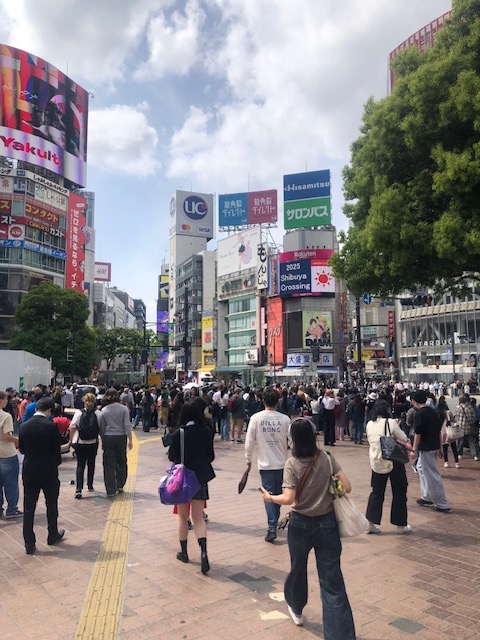
    By historic accident and design, the classic Japanese urban scenes portrayed in media hide a massive secret. The multi-floor buildings housing restaurants, retail, nightclubs, gaming cafes, hair salons etc tend to be clustered around the train stations and are lit up with the famous neon signs flashing the services available on each floor of the building. Of course, these emporia of consumption end up in Blade Runner futuristic urban shots but the Zakkyo, as they are known, serve another purpose. These vibrant urban areas thrive because of high commercial density. They are also enjoyable – thousands of small businesses in close proximity makes it fascinating for the curious. And, walkable. We walked everywhere, and that reveals the hidden magic of urban Japan. Shibuya is possibly Japan’s most famous shopping area with its famous “Scramble Crossing” and statue of a patient dog, Hachiko, who waited every day for his owner who had sadly passed away. However, Hachiko had plenty of company. The famed “Scramble Crossing” sees up to 3,000 pedestrians cross at each light change during busy periods, but two streets and 250 metres away it’s a different universe. You can hear a pin drop; total quiet, no cars, green areas and low-rise buildings housing both residents and businesses. The excellent financial writer and former Tokyo resident, Noah Smith, explains:


    “A lot of older Japanese buildings are made of wood, even if they have external facades that make them look like stone or concrete. This is a giant fire hazard, especially in a city like Tokyo where buildings are crammed so closely together. So in order to contain the possible spread of fires, Tokyo created a bunch of large streets fronted by giant concrete buildings, to act as natural firebreaks. This had a very interesting effect on the urban landscape. It created …..“pocket” neighbourhoods, where a dense maze of small streets and low-rise buildings are shielded by what are basically giant walls…. What this means is that if you’re inside the pocket, you don’t run into a lot of cars. Cars still can go inside, into the maze of small streets, but they typically don’t, because it’s almost always easier to just stick to the big streets outside the pocket. So the pocket neighborhoods become very quiet and peaceful…”


    So, the Zakkyo high-rise buildings are really a gateway into the true strength of Japan’s cities. Big block, mall economics which has obliterated town centres in many advanced economies has not happened in Japan. Critical to that success has been mixed-use zoning. People in residential areas might have small living spaces but they really LIVE in the neighbourhood where hair salons, Pachinko parlours, multiple tiny restaurants, bars, bike shops, cafes and vintage clothing stores are pretty much next door. I’d say 50% of our meals in Japan were in restaurants with seating for less than 15 people. How does small business survive in advanced economies in thrall to scale economics? Well, the Japanese government supports small businesses with miniscule rate charges, low taxes, low-interest loans and a Large Store Law which protects smaller businesses from mall creep. For example, our relatively small new office in Dublin will pay rates of €2,500 per annum but in Japan it might not even be €200. And, don’t get me started on comparable SME banking or tax regimes. No point whining, just see the results and hope one day our leaders do too. Here’s one sum to whet the appetite….

    Paris has 13,000 restaurants. London has 15,000 and New York has 25,000. But…. sum them all up and you still don’t get Tokyo.  Stunningly, Zakkyo fire-breakers, pocket neighbourhoods, train connectivity and walkable streets have created an environment where 160,000 restaurants are in business in the country’s capital. Oh, and Tokyo manages change too. Many of the buildings I last saw in 2002 don’t exist today. Note to Dublin urban planners, cities work when buildings are actually USED… for a variety of activities and not strangled by zoning tyranny. The average lifespan of buildings in Tokyo is 26 years. In the US it’s 55 years and the UK (and us probably) drags out progress by 77 years. We have lots to learn. Hopefully, my final data point will inspire given our hospitality industry is struggling and recent tourist figures are causing concern.

    As a resident of Japan in the 1990s I was one of barely 1 million non-nationals living in Japan out of a total population of 126 million. The year I left (1994)2.7 million tourists visited this amazing country. This year the tourist number will probably hit 40 million. And, the Shinjuku district of Tokyo with its mind-boggling train station of 3.5 million passengers and 200 exits (seriously intimidating) hosts a non-national residential population close to 15% of total. Clearly, a strong government commitment to infrastructure and urban planning is good for business of all sizes. And the tourists tell their friends too…..


  • Japan’s Secret Private Power….

    Japan’s Secret Private Power….

    Thirty three years ago I was slightly ahead of George Soros in battering Sterling (GBP) out of the European exchange rate mechanism (ERM). In time terms only. I left the trading bit to the Japanese banks who I witnessed on the Tokyo trading floor of broker, Meitan Tradition, wield financial power like the world had never seen. Sound a bit Trumpy?  Yes, but unlike the Orange trade toddler, this was all attached to financial reality. In fact, nine of the ten biggest banks in the world at the time (September 1992) were Japanese. And, that night those banks tried to buy every German Deutschmark (DEM) on the planet, sharing the view of Soros that the British government would give up defending Sterling (against the DEM link) and pull their currency from the ERM. They were right.

    Soros and the hedge funds got the headlines but traders in every global trading centre knew who really moved the markets and broke Sterling. Fast forward to today, another financial sage, the greatest of them all, Warren Buffett is retiring and rightfully grabbing the headlines. However, one of Buffett’s final significant trades was to build 10% stakes in five of Japan’s biggest trading conglomerates. We referenced this in the first of our Japan series of articles and promised more on the investment environment and why the smart money is quietly returning to Tokyo trading floors.  So let’s start with the public markets.

    Japan’s stock market has suffered infamous ‘lost decades’, and it was only last year that the benchmark Nikkei index recovered to previous peaks and marked a new all-time-high. It took 34 years. However, the recovery of Japan’s stock markets has been accelerating in recent years and Buffett first started building equity positions in 2019. Change in corporate behaviour has been slow, but the following initiatives have been considered the key catalysts:


    *Japan Corporate Governance Code: Introduced in 2015 by the Tokyo Stock Exchange (TSE) as a set of principles to improve long-run value creation and encourage engagement with shareholders. Previously, Japan Inc had a notorious reputation for rejecting any strategic/governance or ownership challenges through “poison pill” defensive tactics.


    *TSE “name and shame” pressure: In early 2023 the TSE asked companies with poor ratings (valuations with a price-to-book ratio (PBR) of below 1x) to disclose initiatives they were making to improve ratings. In main street terms, a PBR of less than 1x is effectively the investment market saying the company is destroying value and therefore the book value is in decline, rather than creating wealth. In financial terms, returns running below the cost of capital destroys wealth. 


    So, did it work? Yes, slowly but surely, Japanese companies started to address return on capital, shareholder dividends and non-core holdings dragging performance. For example, Toyota started to offload cross-shareholdings in companies like Denso and KDDI. Then Obayashi, one of the biggest construction companies increased its dividend. Finally, share buybacks, which were extremely rare in Japan’s corporate world, have exploded. In 2024 more than $100 billion of buybacks (from existing shareholders) were committed to by companies publicly listed in Tokyo. That’s a 75% increase in this shareholder-friendly activity on 2023. And, there’s lots more to come. Consider the following:


    *The price-to-book (PBR) of Japan’s entire stock market is barely 1.3x. That compares to the US market on 3.9x.


    *There are at least six sectors in Japan where average PBR is below 1x:  banking, insurance, utilities, basic materials, autos, and auto parts.


    Please note these companies can remain cheap forever if investors believe there is no possibility of improved returns and strategies. So, there needs to be confidence in the ability to influence change. Of course, the ultimate barometer of change appetite is the willingness to accept new owners of a business. And, that’s where private equity activity and the buying out of publicly listed (cheap) companies is the pulse check on CHANGE actually happening. Let’s just say things are quite giddy. Activity really picked up with the 2023 buyout of the iconic blue chip firm, Toshiba, by local private equity house, Japan Industrial Partners(JIP) for $14 billion. That set the tone for M&A activity in Japan to grow by 44% to $230 billion in 2024(Source: Nikkei Asia), and the involvement of private equity houses has been striking.

    In previous times Japanese corporates would have considered it “a loss of face” to be seen meeting and exploring investment from “the barbarians at the gate”. Now, it’s very much game on and Japan Inc is increasingly open to private equity investment.  The big buyout battles have featured the usual global giants like Blackstone, Bain, Carlyle, Elliott etc but the acquisition targets in recent months have been a fascinating mix of $60 billion convenience stores (7-Eleven), $4 billion software (Fuji Soft), $8.5 billion cybersecurity (Trend Micro) and $42 billion auto parts (Toyota Industries). The last deal does not actually involve private equity but is in fact a potential acquisition by Toyota Motor Corp. It’s the sheer size of this deal which caught the eye and also a reminder of the cash firepower in Japanese listed companies. Two things to consider:


    *Cash held on Japanese corporate balance sheets is estimated to be more than $2 trillion, or almost 50% of Japan’s GDP.


    *Despite market reforms and 80% compliance with TSE “name and shame” pressures, almost 50% of Japanese listed companies (TOPIX) are trading at PBR valuations of less than 1x.


    This mix of cheap underperforming companies and enormous “dry powder” of cash on balance sheets is incredible fuel for both corporate and private equity buyout activity. The US since 1996 has seen the number of publicly listed companies decline from 7,300 listings to just 4,300. In Japan, the opposite has happened with 3,900 companies now listed and adding about 100 companies per year. I could see that trend reverse as private equity and corporates increase acquisition activity (and take public companies private) but there’s also another potentially massive driver of public assets moving into private hands. We have written about demographics before, but we haven’t considered the seismic and more rapid financial transfer going on in Japan right now.

    According to a Japan Times article written back in 2020, the country was about to embark on a wealth transfer never experienced by any other country in history. Between the years of 2020 and 2030 it was forecast that $5 trillion would transfer to Japan’s “Millennial” generation via inheritance. That’s $500 billion per annum or more than 10% of GDP every year for ten years. We have previously written about the $14 trillion of savings by Japan’s households (50% of it in passive cash) but this active $5 trillion wealth transfer is highly likely to lead to changed financial behaviours and riskier investment targets. The local millennial generation watching private equity activity take off must be tempted to get involved. Indeed , local capital (JIP) has shown what’s possible with the Toshiba take-out. Europe might be tempted to get involved too. Not necessarily with a Japan focus. But, recall Mario Draghi’s EU Competitiveness Report last year and its recommended financial policy changes for the following:


    • Infrastructure project funding
    • Innovation investment of €884 billion, mostly from venture capital.
    • Strengthening the Capital Markets Union (CMU) across the 27 jurisdictions
    • Revitalizing the securitization market to improve the financing capacity of the banking sector.


    Bluntly, Europe has been poor at putting risk capital to work. However, the experience of Japan and financial market reform has been extremely positive in driving domestic and foreign investment capital into its corporate assets. So, there is recent precedent. But, is there the money? Well, try this for starters – a 2021 report from X-Wealth forecasts a wealth inheritance transfer of $3.6 trillion across all of Europe by 2030. Maybe the demographic  “Japanification” of Europe won’t be as scary as some think. In fact, the future is looking increasingly private.


  • Tech Up And Smell The Coffee

    Tech Up And Smell The Coffee

    Japan is the number one coffee-to-go consumer in the world. It wasn’t always so. For 12 centuries the Japanese were a tea-drinking nation while a stigma attached to coffee and its miniscule 1% market penetration. Early commercial attempts to expand coffee consumption in the 1970s were a disaster. Contrast that with today where Japan’s best-in-world urban centres are served by a massive coffee culture. In fact, 48% of all coffee consumption is coffee to-go beating the likes of the US (45%), Australia (23%) and UK(17%) to global top spot. What happened? Well, Nestle spent a fortune in the 1970s and failed. Then, they hired a child psychologist. Nestle knew the existing tea culture (ceremonies, 90% domestic presence etc) was in the national DNA so they ignored the adult consumer and focused on youth tastes. Literally taste. They didn’t sell coffee.

    Nestle sold coffee flavoured candy, then snacks, then ice-cream. Of course, kids grew to love the flavour. By the 1980s vending machines and canned coffee were everywhere. In the ‘90s, when I was living in Tokyo, the marketing push had entered “genki drink” territory  associating nostalgic childhood flavour with increased productivity and professional success. Fast forward to today and the 30-year re-wiring of Japan’s taste buds has created a coffee market worth $12 billion consuming 7 billion cups annually (Source: Statista). So, as my Bullet train races away from Hiroshima, I can’t help thinking about generational shifts and how advanced technology (A-bomb) was part of a nation’s destruction but was adopted by subsequent generations to lead its future. Japan might be considered conservative but there is a boldness attached to their use of technology. World-leading in fact.

    Japan might be considered a strange leader-location for cryptocurrency payment/usage given its reputation as a cash-preferring economy. Wrong. Most of my trip payments here have been done on my phone but there’s more to report. In a number of retailers I have seen iris-scanning orbs supporting the Worldcoin crypto ecosystem set up by Sam Altman (OpenAI founder). For me, the big evolution to come in crypto/blockchain is payments ie the ‘currency’ actually being used. To date, the emphasis has been on cryptocurrencies and stablecoins as stores of value or investment instruments. Interestingly, there is a strong piece of Japanese DNA which lends itself to the use of tokens instead of cash. Ever heard of Pachinko? Here’s what we wrote about it back in 2023…


    “Ever heard of Pachinko? If not, this game’s annual revenues might surprise. Estimated annual revenues of $200 billion are more than ten times those of the NFL! Pachinko is a ball game too but it’s a vertical pinball game played in Japanese gaming arcades. Players twist wheels to steer descending small steel balls into cups which trigger a prize-winning payout of more balls which, in turn, can be exchanged for cash or small prizes. Gambling for cash is illegal in Japan but this low-stakes, low-strategy game exploits a legal loophole and is 30 times bigger than the annual gambling revenue of Las Vegas, as well as twice the size of Japan’s export car industry.”


    The key point is that entire Japanese generations have grown up exchanging prizes/tokens for cash. Not surprisingly, I note that Japan’s three biggest banks – Mitsubishi UFJ, Mizuho and Sumitomo Mitsui – plan to integrate stablecoins, blockchain and digital ID into their use of the SWIFT cross-border payment platform. My suspicion is that Japan is going to lead on payments which is the ultimate route to crypto commercial penetration. And, they culturally ‘get’ tokenisation, as well as providing Bitcoin with its pseudonymous founder name, Satoshi Nakamoto. So, if you smell Japanese opportunity, it might not just be you. It could be a robot. Seriously.

    Yep, our digital world has been built on two digits: 0 and 1. So, how can a robot smell? Japanese robotics company, Ainos, has installed its AI Nose in a humanoid robot built by another Japanese robotics player, Ugo. The collaboration introduces a new class of robots that can perceive the world not just through sight and sound, but also through smell, enabling them to make more intuitive and intelligent decisions that will transform industries, public health, and everyday life. The new robot combines a high-precision gas sensor array, real-time signal processing, and advanced AI algorithms to identify and digitize a wide range of scents, turning them into unique “Smell IDs.” Clearly, this is big news for life sciences precision manufacturing, elder care, gas safety etc. Again, it should not be a surprise that Japan is leading in robotics.

    Japan dominates the global robotics market with a 40% share of global exports. No fear of AI here. Of course, given the demographics of a shrinking workforce, it has become a social necessity as Japan turns to robots to care for its elderly population. Like crypto and blockchain payments (vs investment), robots are the natural next step for AI adoption. Nvidia’s CEO, Jensen Huang, is on record as saying that the “ChatGPT moment for robotics is coming…. I can’t imagine a better country to lead robotics AI revolution than Japan. This country loves robots”. Japan also has buckets of engineering talent. Almost 50% of global industrial robots are made by 3 Japanese giants – Fanuc, Yaskawa and Nachi-Fujikoshi. But….Nvidia knows these AI powered robots will need advanced semiconductor chips. Japan might have the latest manufacturing answer in a world where tariffs, supply chains, China decoupling and Taiwan are an increasing source of business worry. So, Japan is going technology “bold” and fearless again.

    Build it and they will come is a tried and failed tech commercialisation strategy. However, Japan is making a $67 billion bet on its semiconductor chip industry without securing any customers yet. Specifically, the Japanese government has passed legislation to allow it to invest in chip manufacturing start-up, Rapidus. The homegrown chip maker is due to produce the smallest chips in history (2 nanometer size for improved performance, density and efficiency) in its Hokkaido-based facility, backed by $27 billion of investment from heavyweight Japanese corporates like Sony and Toyota plus a design collaboration with IBM. In fact, IBM has made very clear that Japan as a next-generation chip manufacturer is “good for the world” given the global economy’s dependence on Taiwan and China for chips. The first chips are due to be produced from the Hokkaido plant in July (rumoured to be for Broadcom) and the latest reports suggest Apple and Google are in talks with Rapidus too. Watch carefully as this would be a massive chip comeback for Japan. On a broader level, Japan Inc can look forward to a re-assessment by global business as a stable supply chain partner with a healthy respect for international trade agreements. Who knew healthy democracy would be a business winner in 2025….? But, we do know health is big.

    Japan is already a leader in the $6 trillion wellness industry with its outsized presence in the personal care/beauty, healthy food/nutrition, wellness tourism and spa infrastructure sectors. However, one senses demographics, AI and robotics will combine to significantly increase Japan’s investment focus in the medtech sector. Typically, European and Irish medtechs have looked to the US for product market entry and venture funding. That will continue, but watch out for an increasing Japanese investment profile. We are often asked by Spark medtech investors “where will the exit come from?”. Well, Japan might need to be added to the list. Indeed, Digital Gait Labs (currently raising funds through Spark) tick those AI, wellness and elder-care boxes very nicely. As for Japan’s investment power, there are a few things you need to know.

    Japan is effectively the biggest creditor or banker to the world. There’s a reason why the Japanese can actually buy more coffee to-go than America and…. intimidate its President. Japan is hugely wealthy. The Japanese population holds a whopping $14 trillion in financial assets, or almost 5x the GDP of France. More strikingly, half of these assets are in cash or deposit accounts. That’s almost 50% of the EU GDP waiting to be used…… possibly by the next less-conservative generation. For me, this is the generational “coffee” wealth moment to start showing opportunities to Mrs Watanabe and her children. And, there’s an early leader.

    We recently wrote about ChatGPT/AI company, OpenAI’s funding round being the biggest public(IPO) or private raise in history. What we didn’t mention was that the lead investor was Japan’s Softbank who have committed $30 billion to the AI trailblazer. Softbank is an investment holding company led by Masayoshi Son whose career has been chronicled by ex-FT editor, Lionel Barber. The book is a fascinating read and the title, Gambling Man, hints at the highs of Alibaba, DoorDash, Uber and Slack as winners but also the losers like WeWork. However, the tagline of the book title tells us more –  “the world’s greatest disruptor.” I strongly believe Son has planted the “risk seed” in this generation of Japanese investors like Nestle did in the ‘70s with coffee. Japan has got “the taste” of private early-stage equity. Now, the rest of us need to show them candy with the same “unicorn” taste as Son has pursued. No psychologist is needed this time, just on the ground observation. Then action. We need to tech up, and show up.


  • An Eastern Promise  Worth Exploring…

    An Eastern Promise Worth Exploring…

    It is 23 years since I was last in Japan. I still love it. The cultural collision of ancient tradition, mass urbanisation and advanced technology is a gobsmacking experience. And, then there’s the friendly population hungry to learn while blessed with fabulous food, beautiful rural scenery, extraordinary attention to detail, safe streets and a commitment to social harmony. It is perhaps unique among the advanced economies of the world. However, Japan has its challenges. We all do these days but maybe Japan offers a fresh perspective on how to cope with change. I lived in Tokyo for three years in the ‘90s and this visit has been an eye-opener on how Japan is responding to change. So, I have decided to write a series of short articles in the coming weeks while travelling here on topics relevant to European business and investment. I’m currently on a Shinkansen (Bullet) train out of Tokyo on my way to the beautiful Gifu region and wanted to touch on a few early themes. Let’s set the scene.

    A quick glance at the daily newspapers – Yomiuri Shimbun, The Nikkei and The Japan Times – confirms that global trade disruption is the topic du jour in common with almost every other country on the planet. The Japanese economy is a trade-based one, given its relative lack of natural resources. It also had its own MAGA-type isolationist experiment from 1602 to 1863 when trade and foreign visitors were effectively shut out from Japan by its ruling Shoguns. So, it’s interesting to note the Japanese media focus on the “isolationist” aspect of the extremist Trump regime in Washington. Let’s just say the Japanese are a bit sceptical on Washington’s ability to put together a coherent trade framework. In fact, the unofficial feedback from the Japanese trade delegation sent to the White House was damning.

    There was a strong Tokyo view that the American negotiators “have no idea what they want”. Furthermore, this is a Japanese negotiating team which agreed trade deals with Trump in 2017 (TPP) and 2019 (agriculture/industrial products). As long-time Japan observers know, Japanese business and its leaders value relationship building and trust before committing slowly to any commercial deal. The mind boggles as to how Trump’s negotiating team think they will get any deal done with the Japanese while ignoring the terms agreed with Trump himself during his first presidency. Trust in the US is evaporating.

    There has been a global ‘sell America’ trade in recent weeks as the US dollar, US Treasury bonds and US stocks have been whacked by foreign sellers who have lost faith in US institutional stability. Japan is believed to have been the original foreign seller of US Treasuries (it holds $1 trillion (!) of these bonds) which spooked Trump into delaying tariffs on ‘negotiating countries” like Japan earlier in the month. Instead, Trump’s team focused its tariff tantrums on China while giving most countries a 90 day breather. As I write, the White House attempt to shift focus and possibly gather trade “allies” against China is blowing up rather embarrassingly. Indeed, Japan have just said they will not join any co-ordinated trade axis against China as it is too important as a trading counter-party. Sensible stuff. Meanwhile, the CEOs of Walmart, Target and other US retailers have apparently told Trump that store shelves “will be empty in 2 weeks”. Indeed, import activity at US ports has collapsed and the country’s 8 million truck drivers (and MAGA hats) are on stand-by for mass lay-offs. Whoops… not so sensible stuff.

    It turns out China can’t be removed from the US economy on the whim of Agent Orange. In fact, the latest word from the ‘stable genius’ is that tariffs on China will be reduced. No doubt, there will be some spurious ‘win’ claimed by Trump and his blowhard MAGA champions but the silence from China and President Xi has been deafening to all sane watchers of geopolitics. China has been prepping for this trade war for years, and has forced Trump to blink for all to see. However, the damage is already done to US credibility and increases the relevance of Japan as a trading partner for economic blocs in Asia and Europe. So, where can Europe work with Japan in a new world order? I already see a few shared pain points.

    In many ways Japan is a window into Europe’s future. Europe is already in “low growth” phase with its ageing population and high level of risk-averse savings. However, the demographic cliff facing Japan has already sparked a dramatic change in policy. For context, Japan’s working population is expected to lose more than 10 million workers (72m to 62m) in the next 15 years. Yep, ten million. So, it was immediately striking on this visit to Tokyo to see the number of non-Japanese working in the hospitality and retail sectors. So striking that I went to check the statistics. According to a Japan Times report in 2018, more than 1 in every 8 adults living in Tokyo’s 23 wards (cities) are not Japanese citizens. That is remarkable considering when I first worked in Japan there were just over 1 million foreigners living amongst a Japanese population of 126 million across a country roughly the size of Italy. Perhaps the desire to live in Japan is less surprising when you consider in the same time period (from the ‘90s to now) the annual number of tourists has rocketed from 2.7 million to 40 million. However, the true surprise is the policy shift in Japan to allow immigration in significant numbers. Bluntly, despite far right political party activity in Europe, immigration is a necessary part of its future. But…. not the only solution. Japan again is leading.

    Mario Draghi in his 2024 European Competitiveness report highlighted innovation and productivity as a necessary policy focus. In Japan, the use of robots and technology to assist in service-heavy healthcare and retail is well established. I personally witnessed robots in action in Narita airport and  a variety of Tokyo retail settings but the presence of humanoid robots in Japanese nursing homes is also well established. In fact, Japan dominates world robotics, accounting for 40% of the global market. Of course, innovation does not happen without risk capital/investment. While the financial headlines have obsessed over AI and the gyrating performances of “Mag 7” tech stocks, Japan has quietly turbo-charged its investment environment.

    Thanks to policy changes facilitating shareholder activism and takeover activity, the Japanese private equity market has exploded. We often write that the “future is private” so it is remarkable to see conservative Japanese capital markets experience 40% growth in 2024 private equity/venture capital activity. Unsurprisingly, the global private equity giants like KKR, Blackstone and Bain are all over this structural shift. Hedge funds have been racing to set up offices in Tokyo to follow the action too. Back in Europe, Draghi has highlighted the lack of innovation and investment/financial policy coherence across 27 different jurisdictions. Joined up thinking on investment could be as transformational for Europe as it appears to have been in Japan. And if you’re looking for policy endorsement, then who better than Warren Buffett.

    We will return to the Japan private investment environment in greater detail in subsequent articles but the public markets have already received the “Buffett kiss”. Over the last few years Berkshire Hathaway has built 10% equity stakes in each of 5 Japanese trading houses. These trading houses, also known as sogo shosha, are large, diversified conglomerates involved in a wide range of businesses, from trading and investment to logistics and manufacturing. Buffett has invested in the big five sogo shosha –  Mitsubishi, Mitsui, Sumitomo, Itochu, and Marubeni. We have written previously on this Buffett move but way before the Trump tariff tornado hit global markets. And, now I’m beginning to wonder. Did Buffett see an isolationist America coming and deliberately seek out the centuries-old trading relationships established across Asia by these Japanese trading giants? It wouldn’t be the first time Buffett saw a structural shift early. However, it’s not too late for Europe. A deliberate attempt to increase co-operation and relationships with Japan might be a very clever way to diversify risk away from an inward-focused US and explore Asian opportunity. Certainly, the Japanese can offer interesting perspectives and responses to deal with the four horses of Europe’s stagnation apocalypse: trade, immigration, demographics and innovation. Lots to learn, lots to write (or right).


  • Beautiful Minds Will Prevail

    Beautiful Minds Will Prevail

    The late Peter Sutherland would smile. Sutherland’s stellar career took in stints as Ireland’s youngest ever Attorney General, youngest ever EU Commissioner, father of the student Erasmus Programme, Director General of GATT and its successor, the World Trade Organisation, topped off with Chairman roles at Goldman Sachs and BP. He was a pretty decent rugby prop forward too. Sutherland’s appreciation of equilibrium at scrum time, laser-like attention to detail and powerful negotiation skills were critical to his success in securing 123 sovereign signatories to the General Agreement on Tariffs and Trade (GATT) in 1993 when the highly complex Uruguay Round of global trade talks were in danger of collapse. He might always have been “Suds” to his friends, but in the international business world Sutherland was the “father of globalism”. And, he truly understood the complexity of global trade agreements. So, what would he make of the Trump regime’s shakedown of the global trading system? Well, as all students devouring legal judgments in the UCD Sutherland School of Law will know, precedent is key. And…..we have Brexit as our stare decisis case study.

    Recall the Brexiteer mantra of “Global Britain” and those fantasy soundbites like “we hold all the cards”, “they need us more than we need them”, or best of all “Britannia Unchained”. Sound familiar? In hindsight, the freedom to pursue new trade deals featured far more chains and ridicule than expected. Britain is still to create the promised bi-lateral free trade deals with the likes of the US and India, while Truss-trumpeted deals done in Pacific Rim countries have had no more impact than if these faraway agreements had been signed by penguins. We mentioned “equilibrium” earlier and this really isn’t just a scrummaging thing. The brilliant Nobel Prize winning research by John Nash, featured in Hollywood’s “A Beautiful Mind”, are the foundation of all game theory analysis applied to trade deals. The Nash Equilibrium is a key concept in game theory where knowledge of other players’ strategies (politics) gives no players incentives for deviating from their own strategy. Hence, we experienced a “hard” Brexit. Now, think about China and the US currently engaged in escalating tariff retaliations. Also, remember the Pacific penguins.

    The Trump trade team seem to believe they have 70 nations queuing up to sign trade deals with the US. Let’s be very clear, and Britain can attest to same, the signing of bilateral trade agreements (two countries in isolation) is extremely difficult to execute. Peter Sutherland would quickly point out that a change in trade terms with one country automatically opens up the possibility of trade being diverted through more favourably disposed countries eg China production switching to Vietnam during the Trump 1.0 administration. Trade is by definition MULTI-LATERAL and requires Nash-like understanding of game theory and trade negotiation. Britain’s trade delegations can sheepishly tell you all about how their Japan deal negotiations went. The short version is that Japan told Britain any new trading terms would be inferior to the EU because the EU was a far bigger and  more important trading partner. Now,  cast your minds back to Trump 1.0 and his renegotiation of an existing trade agreement (NAFTA) with Mexico and Canada. This “straightforward” renegotiation took TWO YEARS to complete. The current Trump trade advisory team are delusional about their ability to close out a series of bilateral trade deals in 90 days. Also, there is no Nash or Sutherland on the US team. In fact, it’s far worse than that…


    *Trump’s White House Counsel on Trade, Peter Navarro, and his alter false ego Ron Vara, went on TV last night to claim bond yields (which “didn’t intimidate” his mobster boss) were going down while the rest of the sane world saw them continue their worrying climb higher.

    *US Secretary of Commerce, Howard Lutnick, continues to laugh hysterically in his media appearances and reassured all viewers on Fox yesterday that the US economy would “explode”. Yes, Howard, that’s what we all fear.  

    *If you were hoping AI was going to help frame a complex trade agreement then think again. US Secretary of Education, Linda McMahon, was outside her WWE wrestling comfort zone but still managed to stun a panel discussion this week with her comments on how “A1” would impact teaching. Yep, Linda hasn’t really heard the “AI” term in conversation before, and her reading to date on the topic picked up the AI term as “A1” which is a steak sauce apparently.  


    Not only will trade deals not get done there is now a US institutional credibility issue. As I write, the US dollar, US Treasuries and US stock markets are being sold by investors all over the world. Typically, the US dollar and Treasuries would strengthen in a period of stock market volatility so this is HIGHLY unusual erosion of trust in US governance. There is perhaps worse to come. Lost in the crazy headlines this week was a decision by the US Supreme Court to allow Donald Trump to fire officials leading two independent agencies. Again, the critical point is precedent. These officials have the same legal status as that of Federal Reserve governors. Already, Trump is whining about the Fed not cutting interest rates so the possibility of Federal Reserve Chair, Jay Powell, being removed by Trump can’t be ruled out. We should also be aware that the trade war with China could go financial and some commentators are speculating about the US government reneging on US Treasury interest(coupon) payments. A hint of either of these actions would make this week’s market gyrations look like jelly ripples in comparison. And yet, it’s possible we could have an “Orange Swan” event in the global financial system. Also, if it’s black swans you’re looking for, keep an eye on Chinese internal politics.

    President Xi looks like he’s in for the long haul in this trade war with the US, but he’s not sure about his comrades. Latest reports suggest that the second ranking general in the People’s Liberation Army(PLA), He Weidong, has been purged. That level of rank in the PLA being purged has not happened since 1968 during Mao’s Cultural Revolution, and signals some dissent within the Politburo. Regime change in Beijing is a long-shot but most of the action in the near term will be in Washington.

    Business decision-making is paralysed and the charts showing US Economic Policy Uncertainty Index in this week’s Financial Times were unprecedented, surpassing even Global Pandemic levels of confusion. Consumers aren’t feeling much better. The results of the University of Michigan consumer survey has just hit the screens and the commentary is ugly:


    “Consumer sentiment PLUNGED 11% this month to a preliminary reading of 50.8, the second-lowest reading on records going back to 1952. April’s reading was lower than anything seen during the Great Recession”


    This all reads as gloomy stuff but there’s a potentially “beautiful” outcome not quite in Trump’s strategic vocabulary. Financial markets, business and voters are all aligning in rapid fashion and beginning to smell incompetence. Was it only a few weeks ago that Trump’s security team shared military operational details with the outside world in real time via mobile phone chat groups? This week, team Trump stands credibly accused of almost blowing up the world’s financial markets. Whether you’re a Fox News viewer, or an oil worker in Galveston, or a farmer in Idaho you know something’s up and it isn’t pensions, savings or 401ks. Global trade needs great thinkers not spoofers, and the world is calling this ugly trade bluff quickly.


  • Truly A Moron

    Truly A Moron

    We are into the name-calling phase of global trade policy. The “Stable Genius” Party told us to “reject the evidence of your eyes or ears” or even the ten trillion dollars of capital destruction. But, enough is enough. Or, so thinks DOGE-whisperer Elon Musk. The focus of his ire is the White House driver of Donald Trump’s trade tariff policies, Peter Navarro. Now, Peter is an interesting chap. He first came to my attention with a series of books featuring hard line views on China and US trade deficits generally.  He then served in the Trump 1.0 administration of 2016-2020 when his “fringe” economist status acquired an unusual qualification. Well, weird. It turns out the globally reputed economist, Ron Vara, quoted in many of Peter’s books was a fictional figure. Indeed, Ron Vara was not just supportive of Peter’s bonkers economics but also an anagram of his own name. No, seriously.

    So, who’s surprised to read the Navarro tariff calculations are the work of a ChatGPT output which the right-leaning American Enterprise Institute (AEI) think could be out by a factor of four times(400%)? It’s a bit late now but Musk has just described Navarro as “dumber than a sack of bricks” and “truly a moron”.  You’ll note my view that Musk is too late to undo the damage of the Mad Orange King and the Ron Vara school of economics. In fact, it’s not actually my view.  Policy uncertainty paralyses business activity and the scores are coming in fast….


    *Larry Fink, CEO of the largest asset manager on the planet, BlackRock Inc, with $10 trillion reasons to care says “Most CEOs I talk to would say we are probably in a recession right now.”

    *Jamie Dimon, CEO of the most valuable bank on the planet, JP Morgan, in his annual letter to shareholders delivered a blunt warning – “The recent tariffs will likely increase inflation and are causing many to consider a greater probability of a recession.”

    *Airline share prices are traditionally viewed as early warning signals of trouble ahead. So, when you see Delta, American and United stocks drop 35-45% this year we should pay attention. Larry Fink is anyway – “Airlines and air traffic are a canary in the coal mine. Right now the canary is sick”


    Cheery stuff. However, these are US-focused observations. We have been here before and we should remind ourselves that capital markets can be quite effective in taming policy tyranny. Ask Liz Truss. Then check bond markets. Interestingly, if bond markets “believed” recession was imminent then bond yields(rates) would not be rising like they are right now. US 10 year Treasury yields have jumped from 3.87% to 4.52% in the past two trading sessions. This is highly unusual bond behaviour when equity markets are so volatile or declining. In fact, it’s the all-powerful bond market questioning the credibility of US institutions. Hence, you’ll soon be hearing Trump whining about the Fed lowering interest rates but, again, not quite understanding bond markets. Other markets are behaving in a more orthodox manner but could also upset the tariff toddler.

    You might have noticed that Trump has refused the pre-‘Liberation Day’ EU offer of zero tariffs on industrial goods. Trump and his team are now switching focus to “non-tariff trade barriers” and demanding the EU buy $350 billion of energy to balance out trade deficits. The White House is rapidly losing the faith of its fossil-fuel friends who are staring down the barrel of $50 spot prices for oil. Ahead of inauguration, the reversal of Biden’s signature IRA act and decarbonisation/cleantech investment incentives sounded good to the oil barons but they didn’t plan on Trumpolini playing Texas Hold ‘Em with every trading partner in the world …..at the same time. And, don’t forget the Kremlin and its war economy is acutely oil price sensitive too.

    Cryptocurrencies and their broligarch fan boys are also going to be a bit tetchy apart from “car assembler” Musk. Bitcoin is down 17% year-to-date with cryptocurrency ETFs (funds) suffering their third consecutive month of outflows. In fact, the big picture worry for all cryptocurrency evangelists is that on current pricing history evidence Bitcoin appears to have morphed into a tracking instrument for the tech-heavy Nasdaq equity index. It’s supposed to be a currency, as a quick reminder.  Go check the charts and then wonder how long before the broligarchs put pressure on Trump to move the markets into risk-on crypto-friendly mode. We will wait but private markets won’t stand still. In fact, big global structural themes (outside trade) will continue to play out in private. Just this week we spotted these three deals amid all the screaming red ticker-chyrons and panic headlines:


    • Faster research: San Francisco-based Rescale provides AI-powered R&D simulation software and has raised $115m from investors including Nvidia.
    • Content generation: Another Californian start-up with Spanish founders, Krea, uses generative AI for image content generation and design. They have just raised $83m from investors including Bain Capital.
    • Payment infrastructure: Juspay, an Indian payment infrastructure start-up has raised $60m from institutions including Kedaara Capital.


    Humanity and innovation will keep moving forward irrespective of the headlines. Public markets gyrating violently are the real-time expression of capital flows, fears and policy paralysis but, in private, both in Washington and in private markets we can be far more optimistic. Nothing crystal clear right now but the waters will still be blue ahead…

  • What Signals Are You Watching?

    What Signals Are You Watching?

    I’m a bit lost. I can still remember as a child staring out at the Ballycotton Lighthouse as it guided battered yachts to safety during the Fastnet Race disaster of 1979. Fast forward to today and there’s another potentially calamitous “storm” brewing for the most basic concepts of accepted facts and truth. Worryingly, there’s increasing evidence that the “lighthouse” of global leadership on rules of law and common values has gone dark. Orwellian dark. I know we’ve been here before with White House Press Secretary, Sean Spicer, and bonkers claims of inauguration crowds for Trump 1.0 but the second coming of Trump is a whole new level of autocratic demands to “reject the evidence of your eyes or ears.” That’s Orwell, not the White House.

    It would appear that “their final, most essential command” this week is to NOT read the time-stamped texts of the US Secretary of Defense on the unsecured Signal mobile chat app shared with 16 other US security chiefs (plus one mistakenly added journalist) and conclude that this was the most embarrassing and dangerous self-inflicted security failure by US institutions in decades. The cover-up and spin-fest since the Atlantic magazine scoop has witnessed equally incompetent and criminal attempts to parse the meaning of “war plans” and “attack plans”. To be clear, the key “ground truth” in this intelligence near-miss is that advance information on a military mission puts US military personnel in danger. But here we are.

    Donald Trump has given a press briefing stating the US “has to have Greenland” and his Kremlin keeper, Vladimir Putin,  is dovetailing on message beautifully by saying “Trump’s plan to seize Greenland is serious”. Doesn’t that sound like two mob bosses agreeing ‘territory’?  Yes, but don’t ask the lawyers. Leading law firm, Skadden Arps, has just “agreed” to provide $100m of pro-bono work for initiatives supported by the White House in order to avoid adverse targeting by a regime irked by previous “woke” cases taken by Skadden.  So, do we all surrender as democracy dies in darkness? Well, there are other Signals to watch with possibly more impact than a Houthi-Yemen air strike mission. In fact, their potential impact could be sufficiently influential to trigger “lighthouse” leadership, even change.  I’m looking at three Signals in particular.

    First, as we head towards the Trump self-styled “Liberation Day” of trade tariffs imposed globally, we watch the money or flow of same. Some might think the enormous switch by investment institutions out of US equities (down 5% year to date) to international equities (eg. German Dax up 15% year to date) is a big deal. It is. But, equity markets could be due a “rotation” anyway after 15 years of US dominance and, frankly, more challenging valuations when economic leadership veers into cult lunacy territory. The awkward fact for the Trump crime gang is that foreigners own $16 trillion of US stocks and they are selling them even quicker than Tesla shares. However, the bigger more worrying signal is in the debt (or credit) markets. As we regularly say, debt(bond) markets can really intimidate as they can cause proper global economic damage. So, when I look  at the ‘plumbing’ of the financial system and corporate debt (credit) data, I’m seeing signs of cracking and stress. The jargon monoxide will involve terms like “spreads”, “VIX”, “call options” and “default pricing” but, take it from me, this is where the intimidation of the Trump White House is beginning.

    Second, how long will Trump’s ‘broligarchs’ go along with his trade war when there is possibly a far more consequential technology “war” exploding across our screens every day? My sense is that there could be a calculation that trade wars are a dangerous commercial distraction. Check out the latest data from Stripe. Software companies (SaaS) were always the uber-growth leaders, with Stripe analysis showing the median time for the top 100 software/SaaS start-up companies to reach $5m of recurring revenues was 37 months(data from 2018). But, there’s a new growth monster in town. Stripe data (2024) shows the top 100 AI start-ups hitting that $5m milestone in….. 24 months. You might have read that executive suites across the USA have been paralysed by indecision due to erratic Trump economic policy. Indeed, M&A deal activity has fallen to the lowest in a decade and year-to-date is down a whopping 30% on last year. However, the story in start-up world is very different. In the first quarter (Q1) of 2024 there were two start-ups acquired for more than $1 billion (unicorn status). In Q1 this year, there have been ELEVEN $1 billion plus start-up acquisitions. In fact , the total value of these deals this year has been more than $54 billion or 10x the activity value of Q1 2024. It’s all driven by AI and cloud infrastructure(including Google’s largest ever deal with Wiz) but when you see the latest text-to-image generation of OpenAI and the “Ghibli” craze you’ll definitely feel something’s up. But not the Tesla share price…

    Finally, and Elon Musk might think I’m being “mean” (while he cuts social security support for the elderly) but Tesla’s share price is worth watching. The DOGE whisperer in the Oval office says he’s leaving government ‘service’ at the end of May. However, for Tesla and its shareholders, post its $800 billion share price meltdown, the value destruction pain may not end in May. The brand damage of embracing right-wing extremism has been staggering to witness but the end-game could be no less dramatic. The recent deal to sell X/Twitter to xAI (this x stuff is tiresome isn’t it) has been seen as a way for Musk to avoid margin (debt) calls on Tesla shares he has pledged as security on cross-company loans. The trigger for those margin calls was reportedly a Tesla share price of $120 per share (vs today $263 per share) but I’m not sure the pain point has been removed. The market value of Tesla is still more than $800 billion compared to Ford at less than $40 billion. Let’s not forget it’s a car company where a balance sheet and cash flow can implode if sales/revenues go into reverse. Last year revenues had a small 1% decline… but this year? Watch revenues closely, and watch Musk.

    This might seem like a random set of signals to watch but sadly, there’s one emerging truth re US leadership. Money talks, not values nor principles. The Japanese (Nikkei) stock market has kicked off the week with a 4% wipe-out and we can only wonder when the men with the money (and the loans) pay a visit to the White House. We might have to wait a bit, but I’m hopeful the money will find that “lighthouse” moment.

  • Three Pictures Of Opportunity From A Changing World Order

    Three Pictures Of Opportunity From A Changing World Order

    It is difficult to avoid pictures of the St Patrick’s Day sex-pest parade at the White House but I can assure you it is well worth the effort. Clearly, the rule of law and the world order is enduring a seismic shakedown but it would be a mistake to assume all is lost. Hidden behind the disbelieving headlines and festive mug-shots there are a number of alternative pictures really worth thinking about. Hedge fund billionaire, Ray Dalio, wrote The Changing World Order: Why Nations Succeed and Fail  as recently as 2021 and used five centuries of history to show how nation success depends on cycles much like business. So, I have been struck by three investment trends whose emergence could be attributed to these long-run cycle shifts. The first cycle journey actually starts with cars…..


    The mighty Volkswagen AG (VW) of Wolfsburg was founded in 1937 in the midst of another seismic geopolitical shift and 80 years later in 2017 became the world’s largest automotive manufacturer by global sales. In 2021 VW reached its peak market value of €155 billion but the Ukraine war, rocketing energy prices and electric vehicle (EV) competition has wiped almost €100 billion from that valuation since then. In fact, this week the even-older arms and military vehicle manufacturer, Rheinmetall AG, surpassed VW in market value. In reality this is a 10-year story rather than a 135-year history. As recently as 2014, Rheinmetall’s 125-years of manufacturing ammunition, missiles and military transport vehicles had built a total franchise value of just €1.3 billion. The invasion of Crimea by Russia in the same year was the “butterfly wing flap” moment as the company’s valuation over the following 10 years increased exponentially to deliver a 48x return to any far-sighted Kremlin watching investors. The picture below is a graphic reminder of the defence sector resurgence opportunity and the industrial shift away from the internal combustion engine (ICE):


    Of course, Germany is not the only country impacted by geopolitical change. Plenty of Trump apologist commentators seem to believe “Agent Orange” is playing 4D chess and seeking an alliance with Putin to take on the growing threat of China. Well, how’s that going? About as well as Trump’s ‘day one’ defeat of inflation or the $5 trillion evaporation of the US stock markets driven by a tech-heavy “Magnificent 7” meltdown. In contrast to US investors, the Chinese are enjoying a 40% rise year-to-date for their tech sector stocks and a healthy almost-20% gain for the broader Hang Seng Index. Ironically, it’s a Chinese AI company called Butterfly Effect which is creating possibly even greater waves than the DeepSeek cost ‘shock” back in January. Butterfly’s AI digital assistant, Manus, is more powerful than DeepSeek and has automated up to 50 tasks from buying a property in New York to editing a podcast. There have also been big Chinese breakthroughs in recent weeks in quantum computing and robotics adding to a stark picture below (Source: Bloomberg) – a whopping 40% outperformance by the Chinese tech sector over the US tech sector since Trump took office in January.


    If it feels like US Big Tech is in relative retreat then the latest data from VC research house, Pitchbook, makes for interesting reading. Big Tech is playing a less prominent role in the US start-up M&A market due to regulatory pressures but big corporates seem to have been replaced by start-ups themselves as acquirors. More specifically, in 2024 more than one third of start-up acquisitions were made by VC-backed start-ups. This highlights the emergence of a new buyer profile and exit route for start-ups; VC-backed ‘unicorns’ with significant cash reserves and an appetite for growth. Indeed, Pitchbook analysts put this rather well:


    “Amid the trend toward ‘profitability’, it is important to remember that growth remains essential and serves as a key motivating factor for these buyers…..The high number of VC-backed companies also creates numerous opportunities for consolidation. While acquisitions by VC-backed companies may not often dominate the headlines, they are becoming an important aspect of the venture capital liquidity narrative. ”


    The chart below (Source: Pitchbook) shows start-ups accounting for just 20% of M&A by value as recently as 2018. So, the move above 33% today seems significant…


    In summary, the pictures above should be viewed as opportunities happening in real time while we are distracted by tawdry turmoil and photo-ops in Washington. More importantly, we should start to think about geopolitics as the driver of not just nation cycles, but also business cycles and new long-run structural trends.