Author: Gravitas

  • Back To School For A Monster Theme…

    Back To School For A Monster Theme…

    I’m running out of expletives. It’s a sort of “FOMO” thing which rules out obsessing on Labour’s implosion or the Epstein “hoax” which mysteriously keeps removing only British citizens from high profile roles. No, the headlines driving my heightened state of anxiety are derived from a familiar theme. However, it’s a theme which is now hitting warp speed. We have previously written that the best pulse-take of the monster AI trend was tracking the “picks and shovels” of AI/cloud infrastructure rather than the “gems” of digital intelligent progression. Well, this week is turning into a “biggie” for the AI infrastructure theme. I’d highlight three key developments and a few other snippets. So, here goes….

    The creation of start-up billion dollar ‘unicorns’ has hardly any scarcity value these days. Maybe, we should think in trillions. Step forward almost 50-years old Oracle. Who knew Larry Ellison’s database software business would rack up a trillion dollar enterprise value at the beginning of this week? Probably nobody. Even the Wall Street analysts paid to follow every line of the Oracle business and financial model were truly shocked by the big reveal in Oracle’s quarterly update. In fact, earnings results were slightly shy of expectations. But, the share price proceeded to rocket 40%. Why? The future contract work backlog in its cloud(AI) infrastructure business grew 359% to $455 billion. I mentioned “warp speed” earlier so here’s what caught the eye. Oracle’s cloud revenues from Amazon, Google and Microsoft grew by 1,500% but the entire division this year is annualising revenues of circa $10 billion. That number will be $144 billion by 2030. Welcome to trickle-down AI economics. Oracle was barely mentioned in AI giddiness a year ago, now its owner is the richest man in the world. Oracle is not the only AI ‘unknown’ making waves.

    Anyone heard of Nebius? No, me neither until this week but I do remember its former Russian search/e-commerce platform, Yandex. Anyway, Russian sanctions forced a sale of the Russian assets leaving Nebius as an Amsterdam-listed company specializing in cloud computing (GPU) infrastructure. This week Microsoft signed an agreement worth up to $19.4 billion for Nebius in exchange for 5 years’ access to its GPU datacentre infrastructure in Vineland, New Jersey. Nebius’ market value before that news was less than $15 billion. Not surprisingly, the share price has roared 50% higher and the company is now seeking to raise $3 billion in fresh funds to accelerate its growth plans. This was not the only Dutch tech/AI zinger story this week…..

    Eindhoven-based ASML is the world’s dominant player in critical lithography technology used in chip manufacturing equipment. A single machine can contain up to 100,000 parts and cost $300-400 million. Clearly, semiconductor chips and AI are thematically closely connected. But investing in an AI start-up caught ASML analysts on the hop. ASML has just invested $1.5 billion in French AI player, Mistral, for a circa 11% stake valuing Mistral at close to $14 billion. Remember, Mistral raised $385m in late 2023 with a $2 billion valuation and early investor support from BNP Paribas, AndreessenHorowitz, Lightspeed Ventures and telecoms entrepreneur, Xavier Niel. Less than 2 years later, the Mistral valuation is racing towards a 7-8x return for those early investors. Apart from being an example of multi-layer AI investment activity, the deal is being hailed as a boost to Europe’s AI and semiconductor chip sovereignty.  And maybe I’m not the only one feeling a bit FOMO….

    It seems Ireland’s Taoiseach, Micheál Martin, has been thinking ‘sovereign’ too and looking at France’s early initiatives in funding AI startups. The Business Post has reported that Martin has sought the help of Eir owner, Xavier Neil (see above), in establishing an AI/tech incubator modelled on his highly successful Station F start-up campus. There might be good reason why Ireland needs to increase the pace of its AI and start-up readiness. I thought the next few little snippets should be focusing minds in Government buildings and elsewhere:


    Private investing: The UK debt market is worrying many, but on a more positive note it was interesting to see Hargreaves Lansdowne and Schroders join forces to offer UK retail investors the opportunity to add private assets to their pension pots. Note to Irish government – start-ups need investor incentives first, then campuses.


    Consumer behaviour: Wildfire Systems’ 2025 Consumer Shopping Trends Report shows 61% of consumers are now using generative AI tools like ChatGPT as a tool for deal-hunting.


    Company growth speeds: Stripe’s Indexing the AI Economy report shows AI companies reaching $1m annual recurring revenues (ARR) 4 months faster than even the fastest growing SaaS/software companies. And… AI companies reaching $5m revenues are reaching that milestone 3x faster.


    I feel my back-to-school mantra should read:    The future is private, AI and fast. Very fast.



  • Who’s Really Losing Power…?

    Who’s Really Losing Power…?

    We sorta knew didn’t we? The Donald really doesn’t ever want to leave power. National Guard troops might be armed and patrolling the streets of Washington DC but we might be missing an even bigger power move. No, neither I nor the South Park writing team are contemplating a horse being appointed as a Senator, or JD Vance as President or Eric Trump …. replacing the horse. Parody and Caligula’s legacy are safe, for now. However, if you’re a fossil fuel investor things are looking anything but safe despite the Orwellian data-denial of the Dear Orange Leader. Let’s start with a few ground truths.


    *Oil prices have fallen in three of the last four weeks and are now in the low $60s per barrel pricing region which is close to a 4-year low.

    *Bloomberg recently reported that global oil markets are on track for a record surplus next year as demand growth slows and supplies keep growing [Source: International Energy Agency(IEA)]

    *IEA data shows oil inventories will accumulate next year at a rate of 2.96 million barrels a day, surpassing even the average build-up during the pandemic year of 2020

    *World oil demand this year and next is growing at less than half the pace seen in 2023.

    *But what about “Drill, Baby, Drill” ? Maybe not so much. US drilling activity continued to fall in early August as the oil rig count fell to 539, near its lowest since Dec 2021.


    No wonder Texas is trying to re-draw and gerrymander voting districts 5 years early. Texans are unlikely to fall for Fox News fealty to the Dear Leader, but they will be bombarded with untruths. That’s just a no-fact of life in politics these days. However, the strategic problem for the US in this energy leadership crisis is that climate crisis denial has directly impacted investment in renewable energy projects. The facts are stark. The Financial Times has reported a whopping $19 billion worth of projects have been cancelled this year alone. In fact, cancellation rates on all renewable projects are up over 2,000%.

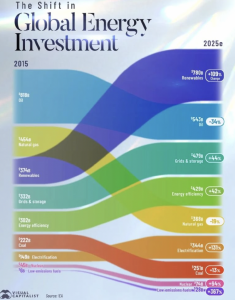
    The most recent cancellation was a biggie in Rhode Island. An off-shore wind project 80% completed by Danish company, Ørsted, was halted by the Department of the Interior citing “concerns related to the protection of national security interests”.  That project would have powered 350,000 homes in Connecticut and Rhode Island. Meanwhile, the rest of the world is rapidly shifting focus away from fossil fuel projects. The graphic below is from the Visual Capitalist team using IEA data and compares global investment from the years 2015 and 2025 (estimated). Renewable energy investment projects have more than doubled to $780 billion and overtaken oil project investment which has shrunk from over $800 billion to $543 billion. Interestingly, electricity grid, storage and efficiency projects are now forecast to reach close to $800 billion in 2025.


    The slippage of oil, gas and coal in the investment rankings is clear to see in the chart above. A seismic power shift is already happening and it is worth keeping an eye on the headlines and developments listed below. Arguably, the current White House administration, rather than bolstering “national security” is handing the energy keys of the future to more far-sighted leaders elsewhere. Check out these data points:

    In July, China’s single month electricity usage exceeded 1 trillion kw/hours. That’s more than Japan uses in a whole year. Of this total, 25% was generated by wind and solar energy sources.

    In April 2025, China’s solar generation of 95 TWh was larger than the TOTAL ELECTRICITY DEMAND of all but two countries in the same month.

    For the first time in history, despite soaring electricity usage, CO2 emissions in China are falling.

    The UK in Q2 granted planning for 16.1 GW of renewable energy capacity. That’s up 195% on last year.

    Renewables in the UK for the first time in 2024 supplied over 50% of the nation’s electricity over the entire year. Renewables and nuclear energy combined, accounted for 65% electricity generation in the world’s 5th biggest economy.

    In Pakistan, over the last two years private individuals have imported solar panels which equate to 68% of the entire national public grid!

    India’s solar PV manufacturing capacity has increased 50x in 10 years from 2GW to 100GW.

    In May this year, 68% of Germany’s net public electricity was generated from renewable sources.

    The electric vehicle (EV) revolution is not just happening in wealthy economies. 76% of new passenger cars sold in Nepal are electric. In Ethiopia that number is 60%.

    EV sales in Europe took 29% market share in June 2025. The share in Sweden is 65% while China moves in to the tipping point of more than 50% of sales being electric.


    The future is fast becoming electric, powered by renewable energy sources. One wouldn’t want to be on the wrong side of history, or your previously loyal customers. Ask Elon Musk and his European sales and marketing team. And…. if you want history to be a guide as to how power can shift slowly, then suddenly,  maybe don’t go to a US museum. Apparently, the Dear Leader doesn’t want US museums like the Smithsonian to raise awareness “too much of the past”, but rather “focus on the future”. Yep museums shouldn’t do history too much. Go figure.

    I’m going to stick my neck out here and risk future US visa issues but ……..it feels like the US energy future is not in good hands, just tiny ones clinging to the wrong power.

  • Are We Watching The Wrong Bear…?

    Are We Watching The Wrong Bear…?

    I am worried now. And, I’m not talking bear markets. Not yet. I’m not even talking about the Russian bear heading for the Alaskan Trump TV-fest. Of course, Europe should be worried about the Dear Orange Leader trading Ukrainian sovereign territory with his Putin pal but this summit feels more and more like a photo op with minimal progress. Another chance for the Donald to host, and hallucinate. Even the Kennedy Centre Awards for the Performing Arts have been threatened with a Trump MC slot. Bill Kristol of The Bulwark amusingly described Trump as claiming “his aides had wept, pleaded, besought him to host the awards personally” with reluctant success.


    “I’ve been asked to host—I said, ‘I’m the president of the United States! Are you folks asking me to do that?’” Trump said. “‘Sir, you’ll get much higher ratings.’ I said, ‘I don’t care, I’m the president of the United States. I won’t do it.’ They said, ‘Please.’ And then Susie Wiles said, ‘Sir, I would like you to host,’ I said, ‘OK, I’ll do it.’”


    Grown men crying again. The former reality TV star can’t resist the cameras or weepy stories but he’s certainly showing a  curious resistance in one aspect of his gyrating global trade war. China was the original bipartisan focus of US trade deficit ire. Now, not so much. China trade tariffs are now lower than those smacked onto many US allies. In fact, Trump has once more delayed the imposition of escalating 100% + tariffs on China by 90 days. Global trade watchers and geopolitical risk analysts have been left scratching their heads. Apart from China tariff leniency, other developments indicate a shifting Trump focus. Here are three moves which are causing most confusion:


    1. Check out US Treasury Secretary Bessent describing to an incredulous Fox TV host, Larry Kudlow, the intention of the US to “appropriate” funds from allies in Europe, UAE and Japan to be invested in their trillions at the whim of the US government. Incredible stuff.
    2. Pity poor Switzerland. They are, as a friendly ally nation, currently topping the global tariff league tables with draconian 39% rates, higher even than China.
    3. After decades of US diplomatic efforts to woo India, the White House now seems determined to provoke the Modi government with tariffs because of their purchases of Russian oil. Never mind that China is in far bigger sanction infringement territory with its oil purchases, and weapons parts supplies.


    It has not escaped the notice of most risk analysts that China must be very happy with how things are playing out. Arguably, they might even be encouraged. That’s not good news for Taiwan which sits in Beijing’s crosshairs for ultimate political annexation or military invasion. The bear to watch, in my view, is the China panda bear. We are already seeing the US and Trump caving on rare earths/critical mineral supplies and even the export of high-end AI chips in exchange for a 15% cut of Nvidia and AMD Chinese revenues. Yep, if that sounds like the actions of a Politburo centrally-controlled economy, you’d be very close to the exact definition of same. However, there’s a real danger the US is slipping in the ‘imitation’ stakes of competing in many key technologies.

    We already know China controls close to 90% of electric battery cell production. Its dominance of the entire battery ecosystem from raw materials to processing capacity to battery components looks unassailable. Batteries might not be the only technology of our future racing to Chinese dominance. Research from the Australian Strategic Policy Institute (ASPI) shows that China is now leading the way in 57 out of the 64 technologies assessed by its Critical Technology Tracker, which has been updated to cover the last 20 years. The tracker measures a country’s performance based on the high-impact research it produces, specifically looking at the number of publications its institutions released in the top ten percent of cited papers in that specific field. The data studied was from a range of fields, like AI, cyber, defence, and robotics.

    Yep, even AI might not be the US lead technology you thought it was. Perhaps, looking at share prices and massive AI infrastructure spend by Big Tech might not be the best indicator of future leadership. The WIPO Patent report tracking generative AI patents filed in the period 2014-2023 showed China filed 6x more patents than the US, or 70% of the global total. This feels like a very focused busy China, not quite a playful low-energy panda. Recent visitors to China speak to warp-speed adoption of autonomous transport, delivery, digital currencies, robotics and digital services. Then consider our recent article flagging solar power capacity being built at a rate equivalent to 5 nuclear power stations…..per week!  It’s all about power, political and physical. It’s a language Trump understands, and one wonders has he decided it’s a battle he won’t win? If so, there’s one more focus for the panda.

    Taiwan historically has enjoyed the security protection of the US and its allies in the Asia-Pacific region. Right now, nobody is sure that will continue. China will also be hugely encouraged by the former gameshow host’s preference for transactional relationships, rather than principles or loyalty. Meanwhile, the general risk view in Asia is that we should be very concerned. We missed Ukraine. Dare we miss Taiwan….?


  • Are We Ready For Another Banking B-AI-L Out?

    Are We Ready For Another Banking B-AI-L Out?

    Domestic business and investing titan, Dermot Desmond, upset the orthodoxy this week. Ireland’s 500-year plan to build the Metrolink might be cut short, even ended. Desmond suggested the €12 billion urban rail project due to start in 2028 could be a white elephant project superseded by AI and autonomous-driving vehicles. Any bets on the kilometres per annum build speed on this 18 kilometre ‘monster’? Actually, don’t bother. Reflect on China’s average motor expressway construction build of circa 8,000 kilometres per year. Then think about the UK adding barely 65 miles of motorway over the past ….decade. Given the Irish public service obsession with tracking the UK National Health Service or UK Housing/Planning as benchmarks, one shudders to think what our ‘ambition’ could deliver in over-spend and century-shifting deadlines. On a more positive note, AI could be one of the tools which could dig us out of our transport infrastructure black hole.  A bit early to call that one you might say, but I’m beginning to think another crucial economic sector which gets its fair share of criticism is enjoying the halo AI effect. Don’t bank on it but the banking sector is suddenly looking interesting….

    The ”animal spirits” of Wall Street and record financial market highs always help the banking sector. Indeed Wall Street’s banks have just finished reporting quarterly results where trading revenues clocked a whopping $34 billion in Q2, up 17% on the previous year. Yes, the phenomenal gains in AI-focused stocks like Nvidia and Microsoft inflate bank trading revenues and drive increased investment activity but there’s more going on. You might have read about meme-stocks and unheard of companies in the US smaller cap markets (Russell 3000) tripling their share prices since April; 33 companies at the last count and only 5 actually making profits. But, banks as meme-stocks? Really? Well check out the Financial Times headline this week:

    “European banks get their meme-stock moment”

    Not even US banks, but European ones tracking an economic bloc getting its tummy tickled on tariffs by the Fiddler on The Roof of the White House. Can’t wait for the South Park treatment on that one, but back to the FT and European banks. When French banks like Societe Generale see their share prices increase by more than 100% year-to-date then my “spidey sense” tells me this is not about mundane cyclical banking drivers like trading revenues, interest rates or the shape of the bond yield curve. The aggregate European bank sector is up a whopping 40% in 2025 and there could be an (infra)structural driver of this story. Think back to our earlier sniping about Ireland’s struggles on transport infrastructure. Banks have struggled with unwieldy data and service infrastructures which have been a nightmare to upgrade to modern customer expectations. As we have written many times on these pages, the banks sit on some of the richest consumer data on the planet. Critical information on individual and institutional funding, spending and income patterns are in the possession of the banks. What if that data could be mobilised in a far more efficient way using AI and its agentic tools? Like Dermot Desmond’s thinking, could AI allow banks to skip an infrastructure bottleneck? It is early days but let’s take a look at a company you’ve probably never heard about before.

    Palantir Technologies might be named after a Tolkien crystal ball but it looks like its future might be right now, thanks to AI. The Denver-based company has been around since 2003 and specializes in software to analyze or “mine” data. Its early customers were government departments seeking assistance with unwieldy datasets and looking for actionable information. In particular, it gained traction with security/police departments searching for surveillance and predictive intelligence solutions. Sound familiar, or creepy? Park that thought and think banking. Then consider Palantir only just hit quarterly revenue run rates of $1 billion in its most recent results. However, that was enough to make it one of the 20 most valuable companies in America. Stock market investors think it’s worth $440 billion which is bigger than the mighty healthcare player, Johnson & Johnson (J&J) and its 138,000 employees. Yes, if you were wondering if the valuation of Palantir was looking a bit punchy, you’d be correct. Annualized revenues of just over $4 billion (vs J&J’s $85 billion) means the Palantir valuation multiple is currently 110x current revenues. The excitement and valuation is driven by two recurring messages whenever Palantir is mentioned:


    1. AI is accelerating the monetization of data infrastructure
    2. AI is reshaping enterprise software and Palantir is uniquely positioned


    Palantir is expanding beyond government into commercial sectors like healthcare, finance and energy. The first thing that should strike readers about government and these three specific sectors is that they have enormous customer/user bases. This is the banking sector clue, and possibly its infrastructure B-AI-L out. AI will very likely remove the need for “transition” projects to upgrade data infrastructure and provide banking organizations with valuable action prompts which might even be carried out by AI-agents/bots. That’s a business model ‘Hail Mary’ for the bank sector and Wall Street’s banking analysts are doing something unusual too.

    Typically, bank analysts stick close together and move their recommendations in tandem with their competitor analysts at the other investment banks. Remember, “nobody gets fired if we are all wrong” is an established career strategy for the average analyst. This also means that share price targets set by analysts move in relatively small increments so as not to spook the herd or attract excessive attention to their analysis or models (usually flawed as with all human forecasting exercises). So, I was checking a few market analytics dashboards today and spotted the following:

    KeyBanc target price moved UP from $60 to $100

    RBC Capital  target price moved UP from $63 to $97

    Raymond James target price moved UP from $79 to $95

    Believe me, 25%-65% banking share price target upgrades are not the done thing on Wall Street when TACO Trumpolini is threatening the Chairman of the Federal Reserve Bank on interest rate policy.  So, this is yet another sector to add to your list where the two letter response to any share price move query can be “AI”. However, at a structural level, you don’t need a Tolkien crystal ball to know that technology can transform the commercial prospects of a country or sector saddled with a perceived long-term ‘challenge’. I’m old enough to remember the gloomsters telling us Ireland was destined to perpetual under-development because we had no energy resources and could never compete in manufacturing/building things. Who knew? Maybe, the leaders who finally gave up on Ford in 1984 after welcoming and watching Apple begin manufacturing in Cork in 1980…..


  • The Euphoric Wisdom Of Crowds

    The Euphoric Wisdom Of Crowds

    I laughed a lot at a very sad funeral this week. Emotions, eh. I’m hopeful this weird juxta-positioning of emotions is a kind of human coping strategy, rather than a sociopathic tell. Then again, the mourning crowd laughed at the brilliant life narration too. Back at my desk, a flurry of headlines hitting the screen prompted a further emotional conflict. Surging extreme weather events globally, Europe battered by tariff tyranny, Gaza starved and Ukrainian cities terrorised by Russian bombardment are hardly sources of optimism for the progress of our species. And, yet……I’m picking up a very euphoric vibe from the financial markets. Strangely for this publication, I’m not that interested in retro-fitting the euphoria with some financial rationale along the lines of falling cost of money(rates), corporate earnings, tech innovation or economic cycles. The sheer phenomenon of financial euphoria is worth highlighting first. Then we can do some thinking, all of us.  Now for the euphoria…..

    The “wisdom of crowds” leans on the idea that large groups of people (markets) are collectively more likely to be correct than individual experts. What is particularly striking about current financial market behaviours is that there is a wide variety of “crowds” ignoring the gloom-filled headlines and seeing a better future out there. However, that optimism is not exactly a new phenomenon. Note that financial markets typically enjoy positive returns in seven out of every ten years. In other words, it pays off to be relatively optimistic. However, in this piece we are looking at something more, evidence of euphoric excess. Let’s try a few of these crowds for starters…..


    *The crypto crowd: Bitcoin is hitting record highs of $118,000 while the entire crypto ecosystem has now surpassed $4 trillion in value.

    *The IT crowd: If one uses pre-2018 sector classifications, then technology stocks’ weighting in the S&P 500 is above 45%. That’s way higher than the dotcom bubble of 2000.

    *The ‘Magnificent 7’ crowd: There’s now, not one, but two Big Tech companies with market values in excess of $4 trillion. For context (and wobbly comparison), the $8 trillion combination of Microsoft and Nvidia alone would rank 3rd globally as a single country GDP.  

    *The meme-stock crowd: In 2021 it was Gamestop and the Robinhood day-traders. Now, it’s Kohl,’s (retail) Krispy Kreme(donuts) OpenDoor (estate agent) and American Eagle with Sydney Sweeney dominating social media, chat rooms and…. Wall Street trading volumes.

    *The AI/Cloud crowd: Earlier in the year Microsoft CEO, Satya Nadella, in a Davos interview stated he “was good for $80 billion of investment in 2025” in AI/Cloud infrastructure. Scratch that. This week he said the number will be $120 billion. Google said $85 billion (up from $75 billion) as Big Tech companies look like they will do a giddy AI spend of close to $400 billion in 2025.

    *The M&A crowd: Research data from Pitchbook shows robust merger and acquisition (M&A) activity in Q2, marking the third consecutive quarter for deal value to hit about $1 trillion across roughly 12,000 transactions. It’s not just tech showing confidence. Railway giants Norfolk Southern and Union Pacific are doing an $85 billion merger to create the first transcontinental railway line in US history.

    *The retail crowd: Barclays research points to retail investors as the “primary driver” of the recent stock market rally. In the past month alone, retail investors poured $50 billion into US stocks and now account for up to 20% of daily trading volume on Wall Street. That’s double the levels seen before the pandemic.

    *The VC crowd: The challenged venture capital (VC) world has been looking for a genuine positive pulse-take via an IPO exit. As I write, Greylock Partners, Sequoia and Index Venture will be the VCs doing cartwheels tonight after the largest VC-backed tech IPO in years, Figma, tripled in value within hours of its NYSE debut to almost $50 billion. Or… will they be wondering how they got the selling (IPO) price so wrong?

    It is entirely possible many of the above trends are rooted in fundamental investment theses but suggestions of dangerous  “euphoria” can be found in aggregate valuations of US stocks. The average price/sales valuation multiple (per Bloomberg) for US stocks is a punchy 3.3x. Furthermore, Warren Buffett’s favoured sanity check of comparing the market value(cap) of all publicly traded US companies with total US GDP currently stands at 212%. As a risk guide, Warren is usually uneasy when that number is over 100%. My own two personal favourites in the euphoria beauty parade are more esoteric but tell their own stories.

    First, it is no secret Facebook/Meta and others in the AI “arms race” are desperately looking for AI talent. However, the numbers are starting to look bonkers. According to Wired magazine, at least one prospective employee was offered a 3-year billion dollar salary package to join Meta. Others were offered hundreds of millions (rumoured to be Mira Murati’s Thinking Machines Lab team) but here’s the best bit…. the prospective hires turned down the offers!! Now, here’s a few other proposals that were turned down as recently as November 2022.

    If that date sounds familiar, you might have been vowing to stay away from markets at the time as stocks hit bear market lows spooked by rising global interest rates. Online car retailer, Carvana, was “on sale” that day after its share price had collapsed by almost 99% from its highs the previous year. Nobody wanted to touch it. As of today, it’s up more than 10,000% since then. Fear and greed, emotions eh. Oh, and Meta’s share price on that day after a rough year for the Zuck was $88.91 per share. It’s up almost 800% since then but here’s the best bit….in barely one trading session after its excellent quarterly results this week, Meta’s share price jumped by about $88.91 per share. That number sound familiar?

    No more teasing. The key point is that confidence is surging in public markets. The quieter, less public private markets have struggled to generate similar headlines. Yes, there are pockets of excess. However, it would be foolish to ignore the ‘wisdom’ of the public market crowds. Ultimately, higher trading activity levels, record capex investment, big M&A deals and higher valuations will feed into private markets and smaller companies. Indeed, you might have to get used to the giddy headlines for a bit longer. Goldman Sachs have done a bit of historical analysis and concluded that spikes in speculative trading actually precede abnormally high returns on a one-year time horizon. Don’t stay too long at the beach….the YOLO crowd might be on to something.


                                      N.H.  RIP


  • Tech Sovereignty Getting Very Real

    Tech Sovereignty Getting Very Real

    Random thought – did music break the USSR? As I watched 40 year old re-runs of Live Aid last week, I found myself trying to recall the emotions and vibe at that moment in time. The Live Aid concert itself was a significant exhibition of global solidarity in raising awareness of famine in Ethiopia. In hindsight, the long-lasting impact of Live Aid on preventing famine might be questionable as global leadership values currently go AWOL on the Gaza and Sudan catastrophes. However, the sheer reach of that day’s broadcast to over 2 billion people in more than 150 countries was a display of communications tech power which has to be considered against the geopolitical backdrop of the time. Saigon had finally fallen to Communist North Vietnam only 10 years earlier, Afghanistan had been invaded by the USSR just 5 years before and Poland had recently come out of a period of martial law. Nobody felt like the USSR empire was faltering. But…. its “iron curtain” was failing to block the reality of better living elsewhere.

    In 1981 MTV, the US music video channel, launched on cable television and was syndicated to countries around the world. Global audiences were seeing music combined with video imagery celebrating freedom, democracy and the rewards of talent and endeavour. Live Aid confirmed communications technology was moving rapidly and posed a real threat to those who needed message control to stay in power. The Chernobyl nuclear disaster happened a year after Live Aid, the Berlin Wall fell 3 years later, and the USSR imploded 2 years after that. Today’s Russia is a rogue state with a GDP of barely $2 trillion, or about half the value of one US tech company, Nvidia. This stark reversal in geopolitical and commercial leadership is a reminder to the leaders of today about “network” power. My sense is that there are three particular ‘networks’ where governments are now beginning to assert sovereignty for national security reasons. I’d flag three stories in recent weeks which illustrate the point well.

    European satellite internet network company, Eutelsat, is a competitor to Elon Musk’s Starlink and is listed on the Paris and London stock exchanges. The company is raising €1.5 billion of capital funding with a sovereign twist. The French government is investing €750m and the UK is putting in €163m in exchange for shares in the company and maintaining ownership stakes of 29.65% and 10.89% respectively. However, Eutelsat’s fleet of just over 600 satellites has a lot of catch up to do. Starlink’s network has deployed more than 7,500 satellites thanks to the dizzying rocket launch timetable of sister company, SpaceX. If you were looking for one area of European urgency on tech sovereignty, then it’s probably defence. Germany is stepping up with €500 billion earmarked for defence investment, so it was no huge surprise to see Berlin-based Planet Labs win a €240m satellite services contract from the German government earlier this month. Planet Lab’s brief is to deploy its fleet of 600 next-generation Pelican satellites to deliver high-resolution SkySat imagery, and AI-enhanced surveillance tools, specifically designed for security, infrastructure monitoring, and maritime awareness. Clearly, it’s time to look up and keep an eye on a rapidly shifting space race, but don’t forget what’s under our feet.

    Earlier in this piece I kinda said that communism died in the ‘90s but the idea of centrally controlled economies is making a bit of a comeback. Bizarrely, the US is leading the charge. Again, I’m going to park the politics and walk you through a few developments in recent weeks. First, the US government via the Pentagon announced it was getting into the mining business. Yep, the Pentagon (Department of Defense) invested $400m in MP Materials, a US company which extracts and processes rare earths materials. These rare earths are the essential basic materials for the high-end magnets used in technologies from mobile phones to medical equipment to ballistic missiles. Anyway, we know the world is overly dependent on China (90% market dominance) for these rare earths/magnets and is a primary reason for the Trump TACO pause on trade tariffs with China. Clearly, critical raw material supply chains/networks are a focus of all Western governments. So, the move to back a home-grown producer with a 15% ownership stake was logical enough. However, within days Apple announced a $500m deal with MP Materials to buy magnets produced in Texas. Cue the MP Materials share price doubling within hours and you can just feel it in your bones that Apple was strong-armed by Washington into doing this deal. This is the sort of government intervention you’d expect from Beijing, but ….Washington? We live in interesting times, as the Chinese might say, but arguably there’s another network of even more importance where the Washington government is happier for China to lead.

    The electrification of the global economy is very real. The advent of AI and the enormous energy appetite of cloud-supporting data centres only adds to the pressures on electrical grid networks everywhere. The race to source power is focusing the minds of Big Tech and driving deals which could be described as “outside the box” thinking. Consider these recent deals:


    • Google last week agreed a $3 billion deal to modernise two hydropower plants in Pennsylvania.
    • Meta said in June that it had struck a 20-year deal with a nuclear plant in Illinois to power its data centres.
    • Microsoft is preparing to reopen a nuclear reactor at Three Mile Island in Pennsylvania, the site of the most serious nuclear meltdown in US history.


    However, the bigger energy story is elsewhere, but with a US context. The Trump administration is actively pushing investment capital away from renewable energy solutions like solar and wind. Year-to-date in the US, more than $15 billion of clean energy projects have been cancelled. In Europe, venture capital funding of cleantech companies has nosedived by 71%. Meanwhile, China is taking a longer-term view on electrical grid networks. The numbers are absolutely staggering. China controls 80% of solar panel production and leads the world in wind turbine manufacturing. This year China will account for 74% of all solar and wind energy projects…. globally. But, it’s the electricity generating capacity numbers which truly blow the mind. Last year China added 370GW of renewable energy capacity (wind, solar, hydro) of which 277GW was solar. For context 1GW (or 1000MW) is the equivalent energy capacity of the average nuclear power station. So, on solar energy alone, China is adding the equivalent electrical capacity of five nuclear power stations to its power grid….. every week.

    The headlines might be dominated by $4 trillion companies driving the AI revolution, cloud-based software economics, chip manufacturing and data centre construction. But…. two of the three networks above focus on real basics. China’s raw materials supply chains and its electricity grid are critical to its future and geopolitical power. One can only hope it’s not an “MTV moment” for other countries playing catch up, or worse – blocking the signals of rapid change.


  • Big Beautiful Bull Market Or Bust?

    Big Beautiful Bull Market Or Bust?

    It has been a very good week for the accused. Vlad Putin gets free war-crime shots at defence-stymied Ukraine courtesy of ‘Whiskey Pete’ in the Pentagon, P.Diddy is acquitted on the worst RICO charges, Bibi flies to Washington without fear of arrest and the US Supreme Court gives King Donald a July 4th gift of even more freedom to ignore other judges. Oh, and Trump’s “Big Beautiful Bill” was passed in the US Congress. Tempted to laugh, cry or rant? Don’t. Investors need to focus on the ‘cards’ dealt and be alert to an investment environment which is increasingly looking like a “Big Beautiful Bull Market”. Despite ongoing tariff tantrums and confusion (Japan and South Korea getting their letters as I write) we should be keeping a close eye on a number of market developments.

    The obvious pulse take on investment market health is the performance of stock markets. Irrespective of dollar weakness, the key US benchmark indices of the S&P 500 and Nasdaq hitting all-time-highs in recent days is a strong positive signal to investors. But it’s not just the headline numbers which are flashing green. There are additional promising signals in different parts of the capital markets. Many commentators believe the markets are entirely driven by AI optimism so it is no harm to see the AI chip poster child, Nvidia, regain its crown as most valuable company on the planet and gently ease its way to within 2% of a $4 trillion market value. The all-too-recent excitement about the first trillion dollar company (Apple in 2018) seems almost quaint amid such phenomenal acceleration in wealth creation. And, there’s more AI chip good news in Washington’s Big Beautiful Bill.

    There’s a quasi-arms race going on globally in AI chip manufacturing which the Biden administration spotted and supported with the CHIPS & Science Act. Trump might be happy to burn the planet (and Elon Musk!) by reversing the electrification revolution championed by Biden but…. he’s not reversing the CHIPS tax incentives. In fact, Trump’s bill has increased investment tax credits from 25% to 35% for any manufacturers building new facilities on US soil.  It’s not the only recent policy win for the industry. Last week, the US Commerce Department told leading semiconductor design software providers — including Synopsys and Siemens — that they are no longer required to obtain government licenses to conduct business in China. One can be sceptical about the true value being created by AI but there’s no doubt real money being spent by Big Tech companies like Microsoft, Amazon and Google has massive knock-on positive impacts in the global economy. Forget that old canard of “trickle down” tax reliefs for the wealthy benefitting the wider economy, but corporate incentives really do work. Indeed, if you want money to flow into the economy then it’s always good to see banks become more ambitious in their lending activities. Even better, if an entirely new bank comes along.

    Silicon Valley Bank may have failed the basics of asset-liability matching (term horizons) in 2023 but the venture funding world never really managed to fill that $218 billion gap left by the early-stage champion. Now, there are reports Musk billionaire buddy, Peter Thiel, and an investing team of tech titans have applied for a bank charter. The new bank will be called Erebor, another Tolkien reference like Anduril and Palantir, to assist the ‘innovation economy’ and companies engaged in developing cryptocurrencies, AI and next-generation defence technology. Banks don’t usually emerge in risk-off moments so there must be some confidence bubbling back into the private early-stage investing world. Of course, it’s great to see new money or new bank flows IN to riskier parts of the investment market but what about getting OUT the other side of the risk journey? More good news.

    IPO data compiled by Bloomberg shows that a slowish start to 2025 has delivered some very interesting performance figures. The weighted average performance of companies whose shares made their debut on US exchanges in 2025 was a punchy 53% compared to single digit returns year-to-date on the S&P 500. The highlights were stablecoin fintech Circle up a whopping 585% since its IPO in…. June. Not far behind, cloud computing player, Coreweave, has returned 300% since its March listing. Suddenly, but not surprisingly, it’s raining IPOs with another high profile fintech, Wealthfront, filing for IPO.  Crypto exchange, Gemini, has filed for a public listing too. Europe didn’t miss out on the IPO fun either in the first 6 months of 2025– a weighted average return of 38% for its newly listed companies is not too shabby. They are the public liquidity or exit events a market needs to see for confidence to flow into the early stage private markets and there’s early evidence of increasing optimism.

    Medtech VC funding activity had its best quarterly performance since 2022 with $4 billion invested globally in young companies (Source: Pitchbook). Meanwhile the value of VC exits hit a 3-year high in Q2 with almost $115 billion of deals completed and exits celebrated. It can be a little too easy to criticize the US these days at a political level but Europe needs to look in the mirror. This article mostly cites US capital market develoipments. For good reason. Mark Rubinstein in his excellent Net Interest newsletter titled “Ode to America” this week put it well:


    “European policymakers bemoan that while households in their part of the world save more than Americans, they keep a third of their assets in low-yielding deposits, compared with a tenth in the US. European pension funds allocate just 0.02% of assets to venture capital versus 2% for their US peers. And the median European venture-backed company receives around half as much funding as its US counterpart. European Central Bank president Christine Lagarde recently calculated that, if Europeans matched Americans’ appetite for capital markets, some €8 trillion currently trapped in bank deposits would be unleashed to finance transformation.”


    Wowzers. Eight trillion euro. Food for thought but we might need that eight trillion for other things. One can’t ignore that there is a critical part of financial markets which is not as cheery as a Republican pardon party. The half year reviews are in and the mighty US dollar is feeling the heat. A loss of purchasing power to the tune of 11% in just 6 months has not happened since Richard Nixon was President, and then he wasn’t. We might not want to draw a dreamy historical parallel but it is curious how quiet the bond market has been since the passing of the Big Beautiful Bill and its reckless debt implications. If the US dollar is pointing to a credibility issue and ultimately a US bond market BUST, it could be European savings pools which will be needed to stabilise things. The price will be a hell of a lot more than tariff tweaking and that’s not wishful thinking. Even if you’re on the beach, it’s worth following the money right now but do keep an eye on the bond market too.


  • Time To Think Different

    Time To Think Different

    I must confess I was very jealous. My son met Mike Bloomberg on his visit to Dublin this week, not me. Bloomberg and his eponymous data/media company have always fascinated me as a former customer, and as a financial markets observer. The Bloomberg business is still the gold standard for data analytics, trading communications and news for circa 350,000 financial market professionals who each pay $27,000 per year for the service. The company has been around since 1982 and it has made Bloomberg the owner incredibly wealthy. Uniquely so, perhaps, because it was done in private. If you check the ranks of the wealthiest people on the planet the top 10 features the usual names like Musk, Arnault, Gates, Zuckerberg, Ballmer and Ellison. However, all those names are attached to publicly listed companies which underpin their wealth. Bloomberg is still a private company, and still 88% owned by its founder.

    Think about a SaaS-type business doing circa $12 billion of revenues a year and 88% of the profits (probably 30% + margins) accruing to one person…..since 1982. Officially, Forbes Magazine ranks Mike Bloomberg in 18th place on the world’s richest list with a $105 billion fortune. I’m guessing it’s WAY more than that. But, the bigger reveal is how a private company was able to create wealth over decades without a fluctuating public share price and short-term institutional shareholders demanding it respond to dotcom revolutions, search engines, mobile internet, big data, cloud-based SaaS, credit crises and AI. Privacy gave Bloomberg time and strategic room to act in a different way to the Wall Street ‘crowd’ and its emotional baggage. Indeed, there were a few other reminders this week of how the “crowd” can miss important truths when analysis is dominated by a volatile public share price and human emotions. Remember Cisco?

    If you invested in Cisco this month 25 years ago you would have caught its peak dotcom bubble valuation before boom turned to bust. This week is the first time in 25 years you could sell those Cisco shares at a profit. Ouch. Patience and time is not just the preserve of investors in private illiquid assets. In fact, lack of liquidity can be an investor’s friend when markets are volatile. Fast forward to today and think about how many people sold stocks and bought oil on the weekend news that the US had bombed Iran’s hidden nuclear facilities. Well, the oil price is 15% off its peak price through the Iran-Israel conflict period (or “12 Day War” as named by the bomber-in-chief and Nobel Peace Prize wannabe) and actually below the trading price before hostilities even began. Oh, and the Nasdaq 100 just hit an all-time-high yesterday. For the faint-hearted, that’s a 36% gain for the largest tech stocks over two months of toddler tariffs, broken bromances, Gaza abandonment, WW3 fears, a Russian drone drubbing of its airforce and Love Island shocks. Rather than dodging a “risk-off” bullet, investors have been rewarded for not selling with strong stock market performances this week. It might not sound rational but there’s a very powerful lesson about the importance of “staying in the market”. For investors in publicly listed assets, there is an option every minute to sell and exit the market. But, there’s a cost.

    A piece of research from JP Morgan, studying the returns of the S&P 500 between 2002 and 2022, shows annualized performance(returns) of 9.4%. That’s pretty good. But…..if you missed the 10 best days your return would almost halve to 5.21%. More strikingly, 7 of those 10 best days happened within two weeks of the 10 WORST days. So, if you opt out during the bad periods of volatility you tend to lose out on the big bounces which have a huge impact on longer term performance. The uncomfortable truth is that the best days and worst days tend to occur within weeks of each other. Further angst for many, is that human emotions take over and investors flee for the exits after market turbulence. However, for investors in private assets that emotional self-destruct button is not available given there is no natural daily exit option. There is also another public market reality which leads to misleading comparisons with private asset investing.

    The accepted wisdom or orthodoxy in finance is that investing in early-stage companies has a high failure rate. The text books would suggest that failure rate is in the 70-90% range. That rightly implies that the vast majority of returns for investors in a portfolio of early-stage risky investments is delivered by a small number of investments. However, what is not mentioned in those texts or in plenty of fund investor information sheets is that portfolios of publicly listed companies have a similar story. A study conducted by Professor Hendrik Bessembinder at the Arizona State University Business School shows that just 4% of companies in the US stock markets have accounted for all of the wealth gains since 1926. Amazingly, the average cumulative return of the 29,078 common stocks listed since 1926 was a hefty 23,000% but….the median stock in that time experienced a cumulative return of NEGATIVE 7.4%. Given that’s a median number, that means more than half of all stocks have experienced negative returns. Fund manager, Bailie Gifford, has done further research on this data to identify the key performance drivers of the small number of genuine wealth creating companies. Interestingly, R&D investment was a critical driver. Now, let’s think private and different.

    Clearly, public and private markets are not so different. It’s better to be in the market ALL the time and only a small number of companies in a portfolio deliver the majority of returns. However, in order to capture that opportunity one needs to build a portfolio. It also looks like R&D is important to create a big enough competitive advantage to grow rapidly. We don’t know how much money Bloomberg invested in its famous desktop terminal over the years to effectively “own” the market but we do know he didn’t have to report profit numbers like Cisco to the market on a quarterly basis. So, if we think differently, how can we act differently?

    Well, you don’t need a Bloomberg terminal to tell you that high net worth investors are increasingly investing in private assets. Global giant private equity house, Blackstone, this week stated their belief that “Europe is in a unique position to capture more investment”. Blackstone themselves are going to invest $500 billion in Europe over the next decade. The other data point worth considering is that JP Morgan reckon the mass affluent investor market has just 2% of their portfolios allocated to alternative/private investments. So, this is not a dotcom/Cisco rush into peak investment cycles. There is real early opportunity in private assets and Spark Private can actually help kick start a portfolio very quickly. This summer Spark Private investors will be able to invest in a selection of up to seven R&D-rich medtechs, a few SaaS/software high-growth options, an exciting AI play and some really interesting infrastructure franchises.

    We now know the phrase “timing is everything” doesn’t work when trading public markets. However, we also know if you’re not in, and you’re not diversified, you can’t win. So, think different and think private. Now is an excellent time to combine private opportunity with portfolio-building deal flow.

    ** For further information on Ostoform, SymPhysis Medical, Social Voice, Digital Gait Labs, Tympany Medical, Liltoda, Array Patch or Quadrant Scientific contact us on www.sparkprivate.com


  • Watch Out For The New Stable Empire Build

    Watch Out For The New Stable Empire Build

    Stability wouldn’t be the word of the week. Middle East war, Indian air crash tragedy, horrific school shooting in Graz, the US Marine Corp deployed in Los Angeles and the death of America’s Mozart, Brian Wilson. But… the ground-breaking Beach Boy might also SMILE**. Tortured by mental health challenges for most of his life, his genius is rightly being recognised at a rather weird moment. Thousands of miles away from the Californian beaches which inspired a true genius, a delusional “stable genius” is marking his birthday with a military parade in Washington. The irony indeed of a wannabe emperor, without clothes or genius. However, the sharper minds out there have been busy building another type of empire….Here’s a few timely illustrations.

    Stripe kicked off the week with the $1 billion acquisition of Privy. This is Stripe’s second billion dollar acquisition in less than six months (Bridge $1.1 billion in February) in the area of stablecoins. As a quick refresher, stablecoins are digital currencies (crypto) built on blockchain technology whose value are fixed to the value of a recognized liquid security or currency. In the vast majority of cases the “stable” part of a stablecoin is the world’s chosen reserve currency, the US dollar. This means that these stablecoins can be instantly exchanged for US dollars, in most cases, at a 1:1 ratio (FX rate). However, I only use the “FX rate” terminology to assist understanding because stablecoins operate differently, and have one massive potential advantage over typical foreign exchange (FX) rates. They cut out all the intermediaries’ costs and “toll takers” that drive us all to distraction at airports when it feels like a robbery rather than a financial service has taken place. This digital capacity to cut out costs and deliver ‘frictionless’ currency services has been identified by Stripe as an enormous opportunity to “grow the GDP of the internet”, namely e-commerce. Two deals in 6 months demonstrate that strategic appetite.

    Stripe, as a global leader payments platform, bought Bridge specifically as a platform for payments in stablecoins. Bridge provides the payments infrastructure for financial services companies to issue stablecoin-linked Visa cards. So, that covers the payments bit but Stripe has moved further into stablecoin infrastructure with its Privy acquisition. As Stripe CEO, Patrick Collison put it, “Money has to reside somewhere, and Privy builds the world’s best programmable vaults. Alongside our other stablecoin work, we’re looking forward to enabling a new generation of global, internet-native financial services.” In relatively simple terms, Stripe has acquired the ability to handle stablecoin payments AND the digital wallets (vaults) needed to store those digital currencies. Note, this is not some futuristic ‘bet’. This is a very current service. Indeed, Mastercard reckon one third of Latin American consumers have already used stablecoins for purchases. And, it’s not just “Main Street” embracing stablecoins. Wall Street is buzzing this week.

    The IPO of Circle on the NYSE was 25x over-subscribed before it even began trading last week. Circle is the issuer of probably the safest and most transparent stablecoins, USDC, which is pegged 1:1 with the US dollar. By the end of its first week of trading, Circle’s share price had rocketed 378% above the IPO price to reach a valuation of $32 billion. Clearly, Wall Street’s frenzied embrace of digital currencies, wallets, payments etc could spell trouble for the traditional custodians of currency storage and movement, the banks. They are moving too.

    French banking giant, Societe Generale, announced this week plans to launch a publicly tradable dollar-backed stablecoin. Societe Generale is the first major bank to enter the stablecoin market and has named its new digital currency “USD CoinVertible”. Meanwhile, in the US, Congress is poised to pass legislation to create a regulatory framework for stablecoins. Bank of America could launch a stablecoin, its CEO said earlier this year, and some other large banks are also considering issuing a joint stablecoin. The banks won’t be alone.

    The world’s two biggest retailers, Amazon and Walmart, are looking into issuing their own stablecoins for US customers to use at checkout instead of credit or debit cards, the Wall Street Journal reported yesterday. The WSJ article suggested other big companies, including Expedia and some airlines, are also considering the move. The motive is simple and relates to my earlier explainer. Costs. Stablecoins are hugely attractive digital innovations to process payments quickly and potentially save corporations billions of dollars in swipe fees that they pay every year to credit card companies, banks, and fintech startups like Toast and Square. Businesses forked out over $172 billion in US transaction fees in 2023, a near 50% increase from before the pandemic, as more customers went contactless. Even Washington is taking notice, and is moving legislation with, again, a teeny weeny bit of irony….

    The US Congress is due to vote on a bill known as the GENIUS Act (the other crypto legislation due is the STABLE Act, I kid you not)  which would give private companies a blueprint for issuing their own stablecoins. That vote could be as soon as Monday, and rely on a body politic flushed with the narcissistic joy of watching a military parade on the streets of Washington DC – an exercise once the autocratic preserve of the Kremlin, Beijing or Pyongyang. It’s a strange new world, but there is still real genius and opportunity out there.  Watch that stablecoin empire build….


    **Brian Wilson and the Beach Boys began recording their album, Smile, in 1966. Brian was convinced it would be his masterpiece. Struggles with mental health intervened, and delayed the release of the album until almost 40 years later. TIME magazine described its ultimate arrival as “rapturously received” and ranked it as one of the ten best comeback albums of all time.


  • Three Winning Hidden Trends

    Three Winning Hidden Trends

    I was tempted. The “buddy breakup” in Washington between the Taco Toddler and the Ketamine Kid is fabulous writing material. But, no. The real risk these days is being distracted by America’s slide towards lawless autocracy and missing something bigger. Eighty one years ago on a June 5th morning President Roosevelt brought good news to the American people and its allies. Rome had been liberated by Allied troops – “The first of the Axis capitals is now in our hands.” Little did Roosevelt’s audience know that later that day paratroopers would be dropped into northern France ahead of 7,000 ships landing on the D-Day beaches of Normandy on June 6th. Fast forward to that anniversary today, and there are winning opportunities again being potentially obscured by Washington broadcasts. Indeed, it’s possible you may have missed some striking data updates to three huge investment trends this week. Let’s dive in.

    Last month at its annual Stripe Sessions conference, CEO Patrick Collison identified the “gale-force tailwinds” of AI and stablecoins. The first tailwind trend won’t be a surprise to any readers of our AI article last week but it was intriguing to hear Collison say, “Stablecoins are the underdog everyone’s sleeping on.”  He also had an interesting take on the macro “noise” and uncertainty prevalent in today’s business world – “when new technologies collide with a turbulent economy, the technology tends to win”. That seems a prescient call this week when we briefly touch on AI and reflect on its chip champion, Nvidia, revealing its latest quarterly results. Despite tariff disruption of its China business, Nvidia beat Wall Street analyst expectations and regained its status as the world’s most valuable company. Thanks to a 50% surge is its share price over the last 8 weeks, Jensen Huang’s chip behemoth is worth $3.4 trillion. The latest data point on stablecoins was also quite eye-catching.

    Not long ago Circle Internet Group was saved by the US government when Washington guaranteed deposits at the collapsing Silicon Valley Bank(SVB). Circle as an issuer of dollar-backed stablecoins was the top dollar depositor customer at SVB. However, this week the newsflow was way more optimistic as Circle waited to IPO on the New York Stock Exchange. Reports suggested investor interest was massive and the listing was 25x over-subscribed. Not surprisingly, with more buyers than sellers, Circle’s share price surged 168% on its first day of trading to a valuation just shy of $17 billion. It’s difficult not to conclude that stablecoins have “arrived” and investors are excited by Collison’s own description of stablecoins’ “real world utility in regular business”. In fact Stripe confirmed stablecoin issuance has increased by 39% year-on-year while “demand for borderless financial services go through the roof….at a growth rate which eclipses anything we’ve seen before in Stripe”. Ok, that’s two winning trends. The last one won’t surprise but the numbers might.

    Private equity (PE) and its billionaire leaders could be doubting their love-in with the Taco Toddler but they are not the only PE-related cohort in doubting mode. PE investors are quietly wondering how private equity houses are going to deploy the $1.2 trillion of ‘dry powder’ which is currently sitting on the side-lines and hurting overall return on investment (ROI) figures. A quarter of that massive total has been available for the last 4 years (Source: Bain &Co). However, there is no doubting our mantra “the future is private” when you consider private equity now controls a record 29,000 companies worth more than $3.6 trillion.  But, there are cyclical challenges. Higher interest rates, reduced IPO activity and M&A paralysis (execs can’t Taco trade those deals) don’t help valuations or exits so it’s worth noting global PE fundraising has declined for 5 straight quarters. Global PE raises in Q1 were down 33% per Pitchbook/Bloomberg reports but that cycle might be about to shift. The Wall Street Journal this week reported that the software-focused PE giant, Thoma Bravo, has just raised a staggering $34.4 billion which is the biggest funding round since the start of 2024.

    As a final thought, one must be mindful that as investment funds become bigger and bigger their opportunity pool shrinks due to size and liquidity constraints. On the other hand, as the ECB cuts interest rates, Ireland GDP growth hits almost 10%, German equities touch all-time highs and Trumpolini begs President Xi for a trade détente, it is arguably a particularly good time for investors to think small, and think private. So, if you want to build a private asset portfolio quickly, Spark Private can certainly help with a very exciting summer EIIS** pipeline of PhD-packed medtech innovations, real-time AI applications, 3-year infrastructure exits and super-growth software stories. Do not be distracted. Check out www.sparkprivate.com  and, as my old boss used to say, “They ain’t door numbers, they move !!”.

    ** EIIS tax rebates of 35-50% on your 2025 personal income tax.