Category: General Financial

  • Two Charts Telling The FinTech Story

    Readers of the latest Oireachtas this-is-not-an-Onion-headline could be forgiven for believing printing machines can command eye-watering prices. However, not for the first time, the reality outside the hallowed corridors of power and pecuniary pathos can be very different. Financial markets feature lots of hindsight moments but spare a thought for the shareholders of a company that developed the world’s first ATM machine in 1967 and presently prints almost one-third of the planet’s currencies.

    De La Rue is hardly a household name but it has been at the epicentre of the world’s financial system for almost 200 years. Sadly, this week the management of De La Rue warned that the company’s future was in doubt. That’s a far cry from the confidence expressed by management less than ten years ago when dismissing a takeover bid by French competitor, Oberthur Technologies. The protestations of “hidden value” by the target’s executives then make for distressing reading now.

    That bid in 2011 valued De La Rue at $1.5 billion. Even then, the trend away from cash payments to digital was well established. Stripe was already two years old and barely known but PayPal was thirteen years old, had 100 million active user accounts in 190 markets, and operating in 25 different currencies. Dear oh dear. Yes, hindsight would suggest the $1.5 billion valuation of the world’s largest cash printer was very dear. Here’s the share price chart to show how the rejection of the French bid cost shareholders very dearly.
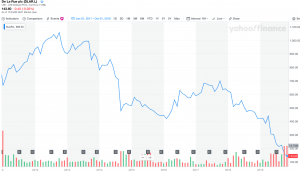
    Today’s share price indicates current value of De La Rue’s equity is just under $200 million. Arguably, management have told the market that there is a real possibility that valuation could fall to zero. Oberthur shareholders in France will no doubt reflect with wry smiles on another example of a disastrous UK decision to go it alone. However, elsewhere the story is much more positive for the UK in the world of fintech and investment capital flows.

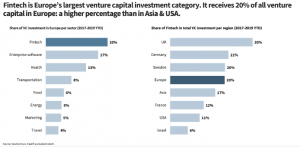
    A new report by Dealroom.co and Finch Capital reveals two very powerful trends in venture capital. Firstly, fintech is now the largest venture capital investment category in Europe. Second, on a global basis the UK has the highest percentage of fintech investment with 30% of its total venture capital funding directed towards fintechs. This is very encouraging for the UK financial sector’s future.

    Clearly, gloomy reports about the potential demise of London as a global financial centre post-Brexit are rather premature. It is also interesting that despite (or maybe inspired by) the parlous state of the region’s banks it is Europe that leads Asia and the US in channeling the largest percentage of investment into fintech. Here’s the chart telling a more positive UK and European fintech story.
    Joseph Schumpeter has written extensively about creative destruction being an essential component of capitalism. One suspects we are living that moment right now in finance and rather than just focus on the death of old franchises we should celebrate life being given to innovation and exciting new companies. In Spanish we might say “Viva La Vida” and at the same time heed the lesson of De La Rue and the destruction of wealth by complacency. Shareholders in traditional financial franchises still enjoying large market shares would do well to read the lyrics in Coldplay’s own ‘Viva La Vida’:


    I used to rule the world,
    Seas would rise when I gave the word.
    Now in the morning I sleep alone,
    Sweep the streets I used to own.
     

    Enjoyed this blog? Then why not check out our other great content by clicking here!
  • ESG: Corporate Health Is Your Wealth!

    Readers may have noticed yet another deal announced in the health technology sector this week. Irish 3D imaging company, 3D4Medical, is about to be bought by Dutch media giant Elsevier for nearly €50m. This newsflow will no doubt keep venture capital (VC) funds focused on current “hot” sectors, health tech and fintech. However, start-up entrepreneurs and retail investors need not despair if they feel they are being excluded from VC activities. There’s another “health” sector which could offer plenty of wealth creation opportunities.

    This writer attends the odd financial conference and was seriously struck by the size of attendance at this week’s Bloomberg ESG Summit in Dublin. The audience was in the hundreds and it had nothing to do with a campaign for the US presidency or a wonderful display of tractors on St Stephen’s Green. The attendees’ focus was ESG investing. In layperson terms, ESG investing describes the application of environmental, social and corporate governance factors into investment selection processes. The corollary to applying ESG investment criteria is a growing awareness by companies that their own response to these considerations, from water management to employee diversity, will be monitored and ultimately “valued” by these investment houses.

    ESG is a term around since 2005 but SRI (Socially Responsible Investing) predates it as an ethical framework. However, latter-day thinking is the assumption that ESG factors have financial as well as ethical relevance. You will often hear the phrase “sustainable investment ” in ESG discussions and this possibly best captures the financial rationale for an ESG focus. Bluntly, if a company culture is not healthy it is at risk of losing fixed assets, customers, quality staff/management, suppliers or investors. None of these potential losses are good for company or investor returns. Financial fundamentals (or health) were always critical to investment decisions but the wider “corporate health” of a company is now a big deal.

    Current estimates suggest up to $30 trillion of assets under institutional management now include ESG considerations in their investment processes. Clearly, corporate health is a growth area and already forcing both investors and companies to spend money on resourcing this analysis with quality people and information. Remember, all this resource is about outcomes. The luxury goods sector has featured in headlines this week with LVMH making a $16 billion swoop for Tiffany. Perhaps more intriguing, and hidden away from the front pages, was the news that Prada has secured a €45 million bank loan with repayment terms/interest rates conditional on meeting “sustainability targets” in its products and operations. Better health means cheaper capital ….Hmmm. For the entrepreneurs out there here’s a few thoughts as to how one could capitalise on this corporate health rush.

    Companies will need guidance as to best ways to integrate ESG on both cultural and operational bases. This requires expert advice, possible internal training/education and periodic audits of companies’ “health” and responses to ESG considerations.

    Audits require metrics or data. Most ESG conferences these days focus on the challenge of “standardising” ESG compliance. There is a huge opportunity for those that can create and gather credible measures for ESG factors as investors and companies are crying out for benchmarks and raw data. Current thinking is that different companies will provide data in different areas ie carbon footprint(CO2e) and health and safety data(EHS) is likely to come from separate providers.

    The combination of performance and people’s money inevitably attracts the attention of regulators. ESG regulation will follow soon and, of course, the legal profession will be getting giddy at the thought of litigation risk and advisory fees. Be under no illusion, finance always pays the middlemen. As for investors, the evidence is more mixed. So, ESG compliance is going to be a very big area.

    Encouragingly, Ireland is taking the lead in some ESG initiatives. There are currently €140 billion of “Green Bonds” listed on the Irish Stock Exchange as part of the wider Euronext group of international exchanges. This feels like Euronext is betting on Dublin as ESG lead, not unlike the aircraft leasing ecosystem successfully built here too. Furthermore, the existence of a “live” asset class of investment securities in Dublin is a good “lab rat” for enquiring minds trying to figure out how they might monetise the ESG revolution.

    No doubt the VCs will move on from mainstream healthcare one day. However, right now there are 30 trillion reasons for curious minds to get a head start in the rapidly expanding area of corporate health.


    Enjoyed this blog? Then why not check out our other great content by clicking here!
  • The Most Important Crowdfunding Chart in Europe

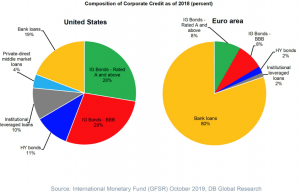
    The market value of The Walt Disney Company is now greater than that of the five largest banks in Europe. If one were impolite you might describe this as a triumph of creativity over destruction. However, the aim of this article to be constructive and recognize the role of Europe’s banks as the primary source of capital for business. That must be a good thing, right? Yes, but there can be too much of a good thing. Here’s a chart from the IMF which should challenge the thinking of all investors and business owners in Europe. It compares the role of US and European banks in funding corporates.

    Wowzers! Banks in Europe provide about 80% of debt capital to businesses. Only 20% of funds are provided by investment markets. In the US the market structure is almost the exact opposite. The graphic above tells us that capital markets are far deeper, more diversified and more sophisticated in the US. It is very apparent, if we consider the US a market leader, that there are opportunities for alternative providers of capital to engage with European corporates. Of course, there are cultural challenges and banking traditions in Europe but the ugly truth is that corporates will have to look elsewhere as ultra-low interest rates (ZIRP) crush banking business models.

    If one were to think further about the market data above it is also clear that European investors have favoured saving in bank deposits rather than investing. In a negative interest rate world that strategy looks a little challenged. It is quite possible decades of traditional saving behaviour will change and seek out new investment opportunities. Many investors will have seen “Dragons’ Den” TV programmes in recent years and wonder can they add a little extra risk/return to their portfolio. The good news is that equity crowdfunding platforms are growing rapidly in size and numbers across Europe to bank the start-up Disneys of the future. The dragons are hunting in size.

    That’s not a fantasy. It’s a current banking reality on Planet ZIRP.


    Enjoyed this blog? Then why not check out our other great content by clicking here!
  • Five Fintech Trends To Watch

    Sesame Street aired its first episode fifty years ago this week but it’s all change these days. Of course, Kermit and Big Bird are still around, Bert And Ernie are still good friends but this childhood staple is now a pay-TV item courtesy of HBO. In the politically correct minefield that is the US today whoodathunk that paying for Sesame Street would attract the least social debate from that summary update. One must get used to change. And if we are going to reference muppets and commerce then it’s not a huge stretch to visit the topic of banking.

    It is no secret the banking sector faces huge technology challenges. Some banks will fail. Some will thrive. The differentiating factor will be their success in ‘fintech’, or more explicitly, the application of technology in financial services. The planet has its first billion customer financial services franchise, Alipay, but this business was built on technology not a traditional bank branch network. The opportunities in fintech are enormous as the arms race continues between old-style banks and new tech-savvy financial platforms. It will be fascinating to see how this battle plays out but here are 5 trends we are keeping a close eye on.

    1. Global fintech funding activity: Funding activity in Q3 2019 reached $12.3 billion according to the latest FT Partners report. That is the most active quarter ever despite the global economy slowing down. This tells us that fintech spend is a structural trend irrespective of economic cycles.
    2. Bank vulnerability: Consultants McKinsey have published a report saying that a significant economic downturn would put 60% of banks in a weakened state which they may not survive. McKinsey have called for the banking sector to “urgently consider a suite of radical organic or inorganic moves before we hit a downturn”. Banks will be making plenty of announcements in the coming months. It won’t be just HSBC and Deutsche Bank.
    3. Mobile meets banking: The partnership between Goldman Sachs and Apple on a payment card has attracted plenty of criticism of its gender-biased credit algorithm. Not a cool start but the trend is set. Mobile ecosystems are perfect for financial services.
    4. Big Tech wants to bank: The aforementioned 1 billion customer financial platform, Alipay, in China has not escaped the attention of other big tech players. It is no surprise to see reports of Google plans to offer checking accounts to consumers in partnership with traditional banks. Amazon are already doing credit cards and business loans so the lines between tech and banking are becoming very fuzzy.
    5. The war on cash: Surveys of consumers’ last 10 purchases reveal that a whopping 60% of payments are now executed without cash. In some countries like Sweden, that percentage can be over 90%. The shift to audit-friendly digital payments is very attractive to governments and regulators so expect further moves in the currency/cash arena. Facebook will struggle for credibility with its Libra cryptocurrency but there will be other players who won’t have to admit they will happily bank profits to publish false information. Banks may not have a great reputation but Facebook appears determined to win the race to the credibility floor. Currencies need credibility. New currencies, crypto or other, have failed that test so far.

    The good news for consumers and businesses is that fintech should deliver better services at lower costs. Consumers and costs are only moving in one direction. On that basis, this writer would actually suggest the McKinsey report is too optimistic. Muppet leadership and poor economics don’t need a recession to kill off more than 60% of banks. The trends are irreversible and the unloved status of banking means there will be no HBOs to save the muppets.


    Enjoyed this blog? Then why not check out our other great content by clicking here!

  • The Most Bullish Equity Chart This Week

    Whisper it quietly but Santa might deliver a nice surprise for equity investors by year-end. The source of our optimism stems from activity in a sector upon which we usually hesitate to lavish affection; the banks. The headline news that US equity markets are touching all-time highs is hardly revelatory fare for even the most casual reader of the business press. Indeed, we are often wary of Mr Market’s delight in generating such gushing headlines to attract the maximum number of enthusiastic investors back into stocks before delivering crushing pain.

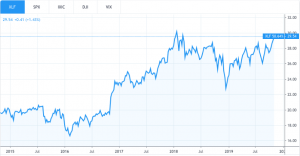
    Our cautious optimism this time is the return of the US banking sector to 12-month performance highs as captured in the following chart:

    What is worth watching over the next few trading days is whether the chart pattern can “break out” and move above previous highs set at the beginning of 2018. It is true that the US earnings season for corporates has been reasonably positive but the market is still very dependent on the technology sector. To put that concern in context we were struck by a stunning recent data point; the combined $2.3 trillion (yes) market value of Apple and Microsoft now exceeds the total value of all publicly traded companies in… Germany. The Teutonic manufacturing monster is just the 3rd largest exporting nation in the world and 4th ranked economy globally.

    The other way of expressing this hope in financial market terms is that the “value” style of investing is due a comeback after years of underperforming “growth” stocks fueled by the technology sector. Typically periods of value outperformance are rather short and very significant so we should find out rather soon if the market driver baton is passed on to the laggard value sectors like energy, mining, banks, etc. Of course, the financial press will quickly create a macro/geopolitical narrative to “explain” the melt-up in equities markets. Take your pick from the following two early favourites:

    • Potential de-escalation of US-China trade tensions.
    • China turning on the credit spigot again and the Yuan stabilizing.

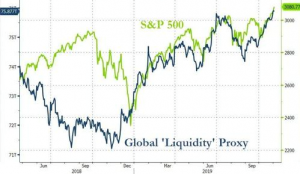
    Of course, these potential macro developments are helpful but let’s be very frank here. There is really only one financial datapoint that counts; how much money(at zero cost) or liquidity is being pumped into markets by the central banks, led by the Fed.

    As a quick reminder, in 2018 central banks tried to remove financial markets from the monetary methadone clinic by phasing out quantitative easing(QE) and actually raising rates. The result was a very large negative bag of performance coal from Santa at the end of 2018.

    Now check out the policy u-turn by central banks in 2019 with the Fed cutting interest rates for the third time in recent days. By some measures global liquidity provided by central banks has passed the $75 trillion mark and it doesn’t look likely to stop for some time. See in the following chart how the S&P 500 is moving in lock-step with central bank largesse in 2019. Note this in sharp contrast to the pattern in 2018 when liquidity was drained and interest rates were hiked by monetary authorities across the globe.

    The consequences of super-easy money in the longer term are for another article but, for now, let’s just say extra liquidity needs to find new investment homes; most likely they will be neglected laggard sectors showing ‘value’. Banks might be just the start…


    Enjoyed this blog? Then why not check out our other great content by clicking here!
  • Debt Works Until It Doesn’t

    WeWork was the IPO that didn’t happen. Now we are about to find out how the combination of excessive debt and a loss of market confidence can obliterate equity valuations. WeWork’s largest shareholder, Softbank, is going to bail out its own original investment of $10.5 billion with an injection of up to $5 billion in new capital.

    The zinger for readers and Softbank’s investors is that the latest ‘survival’ valuation of WeWork will be circa $8 billion; yes, that’s half what Softbank will have invested in total. Wowzers. Was it just a month ago we were told by WeWork’s bankers that the equity was worth $47 billion? Indeed it was. It turns out there was a little flaw in the IPO plans. WeWork had built up liabilities(leases) or long-term debts which amounted to another $47 billion number. Debt or “other people’s money” is perfectly fine to employ in building a business and funding growth but when it’s a very large amount of money then the confidence of those other people is everything.

    Unfortunately, WeWork’s IPO filing documents highlighted a business that was not only losing billions of dollars but was extremely light on detail as to how those losses could be stemmed in expansion mode. Once the IPO failed to happen and raise additional capital, events turned ugly as landlords, banks, service providers etc began to take steps to protect their exposures on concerns about a potential cash crunch just months away. There is a temptation to view the WeWork implosion as an extreme case study in excessive leverage meeting funding realities. The more sobering truth is that WeWork may not be such an extreme example. You see, this debt thing can be quite popular when interest rates are unnaturally low; arguably, capital is almost free until it isn’t. Just ask the IMF.

    In recent days the IMF has been sounding the alarm on the huge rise of debt issuance in an ultra-low interest rate environment. Their concerns were focused on the corporate sector rather than governments who are enjoying negative rates on $15 trillion of debt. The IMF analysis stated that up to 40% of the $19 trillion(!) of debt owed by companies is now at risk of default if there is a global economic downturn. The world’s most powerful banker, JP Morgan’s Jamie Dimon, says there is a recession ahead but not now. This writer does not feel comforted by this stay on calamity and is rather struck by a number of developments which suggest that “confidence” is slipping.

      • Fund Management Liquidity:

    The high profile blow up of Woodford Investments is keeping fund administrators very busy in Dublin, London and Luxembourg as people who should know now realize they haven’t a clue whether investments in funds really are liquid ie the end of day prices reported by these fund administrators are actually achievable. Investors in funds at Woodford, H20, Lime Asset and GAM have found out too late. Other investors are vulnerable too.

      • Bond Fund Liquidity:

    The IMF examined a sample of 1,760 bond funds or 60% of the $10.6 trillion invested globally in these type of assets. They used the worst monthly redemption flows experienced since 2000 to stress test the funds. Alarmingly, the IMF reckons almost one-sixth of these funds would struggle to repay investors at month-end ie liquidity constraints would require more time to sell/realise funds.

      • Corporate Bankruptcies:

    Despite super-low interest rates there has been a marked increase in corporate casualties as banks possibly try to move before Jamie Dimon’s recession prediction materialises. Thomas Cook might be the high profile name of recent weeks but watch out for a more serious situation in the energy sector. Not unlike WeWork’s aborted IPO signaling some pain to come in the real estate sector, the failure of Saudi Arabia’s oil monster IPO, Aramco, to attract sufficient market interest highlights some real stresses in the energy sector. By August this year, there have been 26 bankruptcies in the US oil and gas sector. Expect that number to grow significantly as a massive $240 billion of debt is due to mature in the US oil sector by 2023 according to ratings agency Moodys.

      • Winners and Losers:

    The market is beginning to differentiate its treatment of debt across sectors. Take an example closer to home. Irish franchises built on junk bonds, Ardagh and Digicel, are perceived very differently by global institutions. It is incredible to think that Ardagh in the packaging sector is one of those fortunate companies in Europe which is enjoying negative yields on its debt while Digicel’s bonds in the struggling telco sector are yielding double-digit percentages. Suffice to say double digits is not a good look but can also be a good guide as to the market’s perception of a company or a sector’s prospects of refinancing highly leveraged balance sheets. As mentioned earlier, confidence is everything. Watch the energy sector closely.

      • Macro is Key:

    It is interesting to see what are the key macro drivers for equity markets at the moment. Note these markets are close to all-time highs. If you thought it was fundamentals driving markets you’d be wrong. London macro analytics gurus, Quant Insight, are seeing all the major benchmark indices driven by macro regimes/factors. Dig a little deeper with their analytics and there’s another interesting nugget. The most significant macro factor for developed markets in Europe and the US is corporate credit(bonds) but in emerging markets, the story is more nuanced. Emerging markets are very correlated with central bank support(QE) and inflation. This could suggest leverage is a bigger problem in emerging markets where corporate debt has tripled in 10 years to $2.78 trillion. The repayment profile for emerging market corporates is also a worry; 80% of the debt is due for repayment within five years.

    WeWork didn’t work for many investors in the end. Debt works for lots of businesses as they grow but high levels of debt require high confidence from ‘other people’.  Little things can become quite significant triggers on market confidence. The problem for investors and fund administrators is that a confidence shock can and will generate rapid risk shifts that can destroy equity, wealth and even entire franchises. Current debt levels are too high to ignore and the bond markets will inevitably ‘earn’ respect if not interest.  We write regularly about “other people’s money” for good reason and we always liked the words of former Clinton advisor, James Carville:

    “I used to think that if there was reincarnation, I wanted to come back as the president or the pope or as a .400 baseball hitter. But now I would like to come back as the bond market. You can intimidate everybody.”


    Enjoyed this blog? Then why not check out our other great content by clicking here!

  • 5 Surprising Stats from the Financial World this Week

    President Trump just wished everyone a happy Columbus Day. As the Kurds in Syria reap the murderous whirlwind of another Trump foreign policy screw up, it is a disconcerting experience to see an icon of ignorance celebrating an icon of discovery. However, in the spirit of discovery we thought it appropriate on a Nobel prize-giving day to highlight a few developments in finance which might resonate with the curious.

    Let’s start with Brexit (where else…) and then flag four other statistics which caught our eye on Columbus Day:

      1. Brexit negotiations enter a crunch week. The latest research from the institutional research team at Alliance Bernstein now puts the odds of an extension to the 31st October deadline at 80%. Possibly more interesting is that, if the general election is inconclusive and a referendum ensues, the chances of a win for the Remain vote are put at 70%. Clearly, the general election is now key to how Brexit plays out, with the chances of a no-deal Brexit hovering around 50%. That elevated level of risk is definitely not priced into European share prices.

    There still appears to be a significant amount of hope that Brexit will end with a deal. A deal is possible in a pragmatic informed world. One is less hopeful in a world of populist politics, ignorance of facts and a casual approach to the truth. Furthermore, beware the politicians overly dependent on hope. Perhaps Alfred Nobel himself said it best.

    “Hope is nature’s veil for hiding truth’s nakedness.”

    1. Up until this week there had been only one female winner of the Nobel Prize for the Economic Sciences in the past 50 years. Esther Duflo became the second female winner this week and is also the youngest ever winner at 46 years of age. Her prize-winning work with two colleagues (Banerjee and Kramer) used empirical research to explore the causes of poverty and the policies which actually work. Unsurprisingly, education and gender equality hurdles feature strongly in their research but it could be argued the field of economics also shares similar challenges…
    2. The trials and tribulations experienced by the banking sector are well known to long-suffering shareholders. What is possibly less well known is how quickly some banks are transforming their business models to survive. It might surprise those with pre-conceptions of banking inertia to read that RBS has already closed 56% of its branches in the UK.
    3. We have written quite frequently on the benefits of long term investing and the powerful trifecta of time, volatility and compounding. A YouGov study in the UK found that over 52% of women have never owned an investment. The number for men was 37%. Clearly, those RBS branches missed an education opportunity!
    4. Trade war Twitter headlines continue to drive financial markets. As the Hong Kong protests continue to simmer there is still the possibility of an additional headwind; Capital wars. China, when it isn’t bullying the NBA or Apple, could choose to weaken its currency(Yuan) and exacerbate trade tensions with the US. This will clearly have negative implications for the world’s largest trading bloc, Europe, and its companies. So which companies would be worst affected? Nowadays, thanks to super powerful processing power and modern data crunching techniques, there are analytics available to answer that specific macro question. Surprisingly, it’s not your classic German industrial which is most exposed. The UK macro analytics firm, Quant Insight, see AIB as the most exposed large cap European company to a negative move in the Chinese Yuan(CNH) versus the USD. If ever you wanted confirmation Ireland is very much a barometer of global trade this is it.


    Enjoyed this blog? Then why not check out our other great content by clicking here!

  • Oiling our Fears

    Oiling our Fears

    Crude oil prices are now trading at the same levels as they were on the Friday before the bombing attacks on the Saudi Arabian oil fields. That seems odd. Five decades of Middle East strife has taught market traders that significant cuts to oiling due to war leads to prolonged spikes in prices.

    This is not just a 1970s phenomenon. As recently as 2003 and the second US-Iraqi conflict, the global economy experienced an oil shock of mid-$20 per barrel pricing motoring up to $140 per barrel by 2008.

    Sure, the recent Saudi outage is not quite a war scenario but the precision (too precise?) attack has taken out 5 million barrels or almost 5% of global oil supply. That’s not far off the impact of the 2003 Iraq war, and the initial 20% spike in oil prices on news of the attack did reflect a major event in energy markets. Of course, the Saudis and an election-frazzled Trump administration were quick to reassure markets about adequate reserves, quick restoration of supply etc. However, almost two weeks after the attack there is a growing acceptance by Saudi Arabia’s wannabe IPO, state oil company Aramco, that production facilities will be out of action for many months, possibly a year. That’s before we even mention a ramping up of tensions with alleged attack sponsor, Iran. Bluntly, where has all the fear gone?

    Perhaps it has been replaced by a greater fear.  Donald Trump was so scared of a 16 year old at the UN meeting in New York he chose to skip the Climate Action Summit and instead made a speech at a Religious Freedom meeting. Always important to keep those avangelicals happy. As for the one million Uighur Muslims incarcerated in China, there wasn’t even a mention. Happily, Greta Thunberg’s fear-filled speech garnered far more attention than the Dear Orange Leader’s.

    The teenage wake up call to the world was quickly followed by a rather scary report from Goldman Sachs(hardly a leftie liberal socialist champion) highlighting the significant impact of climate change on urban populations living less than 10 meters above sea level. The numbers are staggering and sadly it might be too late to prevent the consequences of an already warmer world. The warning from this Wall Street leader was stark, “ It might be prudent for some cities to start investing in adaptation now.”

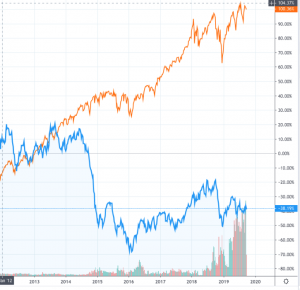
    Clearly, there is a growing consensus that carbon/greenhouse emissions are affecting climate. We have written previously on some leading hedge funds who now factor climate change into ALL their investment decisions. Arguably, the smart money has been selling out of oil for years. Here are a few data points which tell that story. The first is a chart showing how the S&P 500(orange) has diverged dramatically from the downward trajectory of oil prices(blue) since the middle of 2014.  It has been a period of healthy economic growth so that is quite striking.

    It is not just the commodity price which has lagged the market. Exxon Mobile is about to drop out of the S&P 500’s top 10 stocks for the first time in 90 years. Furthermore, the energy sector now accounts for just 4% of the overall US market. One can’t help feeling that actions of economic leaders are being watched very closely. Take, for example, the decision by Amazon to place an order for 100,000 electric delivery vans(yes, that is the correct number of zeros) from a company, Rivian, of which you probably have never even heard.

    Oil services stocks which support the major oil companies on infrastructure, logistics etc have seen their share prices fall more than 50% in 2019. That’s in a year when markets are actually up more than 20%. We have seen commentary on Wall Street puzzling over this wealth evaporation and wailing, “The oil service stocks are trading at prices that imply the entire fossil fuel industry will disappear”. That is an extreme outcome but there is a growing sense that climate change is an extreme challenge. Even Taoiseach Leo Varadkar has decided we will never be called Oiland(or Oirland) as he has told the UN Climate Summit that oil exploration in our waters will end.

    Returning to our own confusion about the lack of fear over the Saudi attacks we must consider that the temporary spike in oil prices was yet another opportunity for professional investors to lower their exposure(sell) to an industry in the cross hairs of a fearful planet and motivated leaders. In a week when the WeWork IPO has revealed itself as a “greater fool” proposition we would note that the Saudis whose entire economy depends on fossil fuels is also trying to IPO/sell you Aramco.

    WeWork didn’t work, its CEO is now out of work and the franchise itself might not see out 2020. In this warming world oil now generates a new set of fears and it doesn’t help the pricing of the product. The greater planetary health fear will win out over old-fashioned energy supply fears and that perennial investor behavioural companion, the fear of missing out. Steer clear of your old fears; the teenagers are the brave ones and will sadly be proven correct.


    Enjoyed this blog? Then why not check out our other great content by clicking here!

  • How Can The Federal Reserve Impact Irish Business?

    How Can The Federal Reserve Impact Irish Business?

    What a difference a year makes! In September 2018 the US Federal Reserve and 15 other central banks across the globe raised interest rates in an attempt to wean markets off a multi-year rehab programme of monetary methadone. Fast forward to August 2019 and 21 central banks from Iceland to Peru were furiously cutting rates.

    A global manufacturing slowdown and growing trade tensions have ostensibly prompted this monetary U-turn by multiple smaller central banks but be in no doubt the critical easing moves have been made by the ECB last week and the Federal Reserve yesterday. The decision of the latter to cut rates is striking as the US economy has been experiencing healthy growth, inflation and full employment.  What’s not to like about that?

    The unfortunate truth for the new Fed Chairman Jay Powell is that the position of the US dollar as the world’s reserve currency means US monetary authorities, unlike the occupant of the White House, must give consideration to the healthy functioning of global financial markets. It would appear that the Fed’s attempts to return interest rates to more normal levels have created problems elsewhere in the world. As an obvious example, higher interest rates in the US would attract buyers of the dollar which in turn causes the dollar to strengthen. That doesn’t seem a bad outcome for non-US companies whose goods and services would become cheaper relative to US-based competitors.

    However, it has not panned out that way. Higher interest rates are good for depositors but not so for borrowers who have loans priced in USD. That challenge is further exacerbated if the borrower’s cash flow to service the loans is earned in a weakening local currency.  Bluntly, the attempt to return to more normal higher interest rates has revealed a problem of excess leverage in the financial system.

    We have touched upon a number of quiet developments in this column in recent weeks which have now crept onto the front pages of financial media.  For Irish businesses, these developments could now start impacting the behaviours of service providers and customers.  Let’s start with the murky world of financial plumbing.

    We had written last week about the slightly bizarre possibility of a “dollar shortage”. Sure enough, over the last three days market observers have been grappling with unusual happenings in a very technical part of the intra-bank funding market; the Repo market. On a daily basis(as a basic guide) banks swap high-quality collateral like US Treasury Bonds for US dollar cash to meet overnight obligations. All works smoothly until it doesn’t, usually a shortage of actual cash or confidence – think 2008. What has commentators worried and confused this time is that the Federal Reserve has been required to pump additional cash into this niche market to avoid a bank, or banks, being unable to meet its obligations overnight. The Fed has not had to intervene in the repo market like this since…. 2008. The sums are not small. In the early hours of Tuesday morning, the Fed had to come to the rescue to the tune of $53 billion. The next day it was $75 billion, and the next day…

    This could be a temporary blip in the money markets but we don’t know which banks needed the cash. There is a suspicion it could be Asian banks whose clients are struggling under a $3.7 trillion mountain of debt which is dollar-denominated. For Irish corporates exporting goods and services to Asian markets, it is probably worth keeping a watch on any significant exposures to single banking entities or corporates.  This may sound Casandra-ish but when confidence begins to waver things can develop quite suddenly and not in a good way.

    Only a few weeks ago we were writing about our concerns on the WeWork IPO proposition. It now turns out the IPO has been delayed after initial valuations of over $40 billion circled the drain at $10 billion for a few days before the bankers gave up. You might think an IPO delay is not too bad an outcome but the knock-on effect has been worrying for the entire WeWork franchise. The company’s bonds(debts) have been weakening significantly subsequent to the pulling of the IPO financing. This, in turn, has raised concerns about the actual WeWork business model. Recall that this “technology” property company has $47 billion worth of lease commitments serviced by a not-so-certain estimated revenue base of $3 billion. Just this week there are reports of property deals in London falling through as WeWork was the key tenant in the buildings. Now consider WeWork is the largest private occupier of office space on Manhattan island and the increasing speculation as to whether WeWork will actually be working by 2021!

    A major dislocation in the office rental market could spell trouble for the global commercial real estate sector but could be helpful for startups struggling with office rental rates. Property companies with large debt obligations can suddenly be quite open to negotiation.

    Ultimately, the level of interest rates or rents is not what kills a franchise.  It’s all about the leverage employed in the business. The Fed knows that too.


    Enjoyed this blog? Then why not check out our other great content by clicking here!

  • Inflating Expectations

    Inflating Expectations

    It’s Groundhog Day again at the European Central Bank. Was it only nine months ago the ECB declared an end to its easy money policy of Quantitative Easing (QE)? Well, trade wars and a manufacturing downturn have raised the imminent spectre of German recession and forced the ECB to embark on a new round of QE purchases and even more negative interest rates. And…we haven’t even mentioned Brexit.

    It all sounds so painfully Japanese and this can easily conjure up images of a lost generation of low-interest rates, large debt mountains and stubbornly low inflation. However, there is a suspicion the central banks already know this new round of QE will be as equally ineffectual as previous monetary interference. The new ingredient in the stimulus mix could be governments willing to initiate fiscal spending programmes and abandon budgetary discipline. Do we dare imagine the return of a long lost financial phenomenon which we touched upon in a previous article “Five Market Risks”? Yes, whisper it here…. Inflation could make a comeback. It’s a possibility rather than a nailed on probability but we see a number of conditions and indicators which suggest business owners and investors should have inflation on their risk radar.

    We are fans of data here and financial markets are excellent real-time indicators of investor expectations. So, let’s start with gold which has traditionally been used as a hedge against the dwindling purchasing power of currency; in other words, inflation. The gold price has been hitting six-year highs in recent times which is interesting as one would have thought the collapse in interest rates and a whopping $16 trillion worth of negatively yielding bond yields would be pointing to a very subdued inflation environment. What is noteworthy is that when bonds were last seen at very negative yields in 2016 the gold price did not break out as they have on this occasion.  Note, inflation kills the value of bonds as well as the purchasing power of cash.

    Another data point from industry also caught our eye. There is no doubt global manufacturing is in quasi-recession so it is somewhat surprising wage inflation in the US is now hitting a 4% cruising speed. There is a growing sense that income inequality needs to be urgently addressed as the rise of nationalist populist politics reflects restless electorates being “left behind” by technology, asset inflation and urbanization. Wage inflation can be expected to pick up as the 1% try to quell a political backlash.

    A less constructive type of inflation can also be expected to raise its profile. Supply chain management and global trade has been the driver of the global economy for decades but messy trade wars and Brexit will introduce new costs into global logistics. These costs will inevitably be put through to consumers/customers and drive inflation statistics.

    A more difficult data point to quantify at this point is the effect of potential fiscal stimulus by governments in dealing with a slower economic cycle. Arguably, the US with its ballooning budget deficit and the UK in Boris-electioneering mode have already embarked on a “bread and circuses” campaign which even Caligula would appreciate. All that’s missing in these campaigns is horses being appointed to senate and cabinet positions, albeit this can’t be ruled out just yet. For a bit of Teutonic sanity and the critical piece in the fiscal pie the world waits for Germany to finally spend. Early soundings from Berlin are encouraging and lead us to our final indicator of  ‘something different this time’.

    As the ECB confirms further cuts in interest rates one would expect European bank share prices to be on a firm downward trajectory this week. We couldn’t be more wrong. The European banks’ index is up almost 10% in September! That is noteworthy and like the gold price was not the experience in 2016 when global interest rates were plunging. The most dangerous words in the investment lexicon are “this time it’s different” and this writer has no doubt central banks acting with monetary policy alone will confirm Einstein’s theory on repetition and insanity. However, governmental interference for good(fiscal stimulus) and bad(trade wars) could change the outcome this time. Gold and bank share prices are already behaving differently but it will take time for political and trade mists to lift and reveal the new world order and change expectations.

    “We changed again, and yet again, and it was now too late and too far to go back, and I went on. And the mists had all solemnly risen now, and the world lay spread before me.” ― Charles Dickens, Great Expectations


    Enjoyed this blog? Then why not check out our other great content by clicking here!