Category: General Financial

  • Night Of The Living Debts

    A former boss of mine used to marvel at the typical information bias of editors and readers of the broadsheet version of the Financial Times (FT). Of the thirty-odd pages in the daily must-read for finance professionals, all bar the back two or three pages were devoted to equities. My boss’s point was that that the debt and currency markets were quantums bigger and ultimately far more influential than stock markets. I was reminded of this overnight as various market commentators and media outlets breathlessly gushed about yet another huge move in stock markets around the world.

    For this writer, last night’s 1000 point upwards move by the Dow Jones share price index was almost irrelevant. What caught the eye was the emerging significance of the asset class usually confined to the back pages of the FT – debt. In a previous article, “Other People’s Money”  back in July 2019, we cautioned readers about business models, and even countries, overly dependent on the daily funding/kindness of strangers. Furthermore,  we specifically warned that “these companies struggle for survival when markets take fright and all providers suddenly decide they would rather hold onto their liquid funds until volatility recedes”.

    Well, this is a “fright” moment for capital markets and that sucking sound you hear is not a gurgling Texan oil well but capital swiftly draining from riskier parts of the markets. Let’s start with oil, or rather shale oil. The dramatic escalation of production in Saudi Arabia and subsequent collapse in oil prices is threatening the survival of many US shale oil players who have borrowed via the high yield (junk) bond markets. More than two-thirds of these companies are now trading at distressed levels in junk bond portfolios. This is not good news for these oil companies or their bankers.

    US banks will be watching high yield indices as nervously as they watched mortgage-backed securities (MBS) indices back in 2008. The mighty Bank of America has seen its share price crater by a third in less than three weeks. That’s worrying but not fatal. However, in Italy, a country now in total shut-down mode, one wonders how an already fragile national banking system will cope with a shock hit to funding flows. Recall that all banks and insurance company business models are dependent on other people’s money to carry out their daily operations. It can become very ugly if daily funders suddenly take fright. Just ask Robinhood.

    Fintech has been receiving great press on these pages and elsewhere but it is not a one-way bet. A real crisis can expose weaker fintech platforms. Robinhood has had a number of trading outages in the past week which has frustrated users wishing to buy or sell shares on its investment platform. If this wasn’t worrying enough for its customers there have been reports that the company maxed out its $200 million credit line in February when market volatility first struck. The company has reassured the market that liquidity has been restored but this will hardly keep its army of 10 million users in “merry men” mood. Expect more news there.

    Of course, the news is already full of stories on airlines struggling to keep empty fleets airborne. Note many airlines use other people’s money when they lease aircraft. This has been a rapidly growing sector of the debt securities market and Ireland is the global leader and IP capital of this funding model. We have written previously about our caution on leasing models predicated on airlines benefitting from a national “backstop” from governments. The rationale is that countries would be unwilling to restrict/shut off their airspace by defaulting on leasing debts. Let’s just say public health systems have just zoomed to the top of most government funding queues in the Covid-19 crisis and difficult choices may lie ahead. The potential impact of Covid-19 at a national level could cause defaults in sovereign debt markets too.

    Lebanon has already defaulted on its bonds over the weekend. Turkey and Brazil worry lots of observers, and Japan had already experienced a GDP decline of 6% BEFORE Covid-19 struck. It’s early days yet but there is no doubt debt stories are migrating towards the front pages of the FT.  As always, when the funding tide goes out naked bad behaviour can reveal itself at the corporate level.

    The hospital operator NMC Health is a blue-chip name in the FTSE 100 but it looks like investors will now be screaming blue murder. The company has kindly informed the market it has discovered it has an extra $2.7 billion of debt its board never even knew about! That more than doubles the debt burden of the company and probably ensures a fraud investigation. Meanwhile, Boeing has had a bad 12 months already but its bankers were happy last month to provide it with a $14 billion credit facility to assist it through production and delivery delays on its troubled 737 Max aircraft model. Those same loan syndicate banks might be a little bit queasy to hear Boeing plans to draw down on the entire $14 billion by Friday…

    None of this is good for creditor confidence. Hence, our caution about companies’ dependent on other people’s money. Those kind people might just take fright when the back pages of the FT become the main story and naked corporate bodies wash up on the shore.
  • Interesting Corporate Activity Despite Covid-19 Fear Fest

    Pandemics are scary and the loss of life is a genuine tragedy. On a more positive note, the decisive actions of authorities in the likes of South Korea, Hong Kong and Singapore will hopefully provide a public health management template for Ireland and its European neighbours. Containment is key and discipline critical. Contagion can also be an unexpected risk in finance and is usually caused by rogue activity. Step forward Mohammed Bin Bonesaw.

    Not content with the murder of a US-based journalist, the Crown Prince of subtle appears to have set his sights on dismembering Texas and North Dakota from the election coffers of the GOP. Currently, markets are experiencing full-blown panic as Saudi and Russian leaders decided at the weekend that a deliberate oil pricing implosion was just what the world needed. Presumably, Agent Orange in the White House might have a different view after a few calls from Wall Street and Houston have set him straight.

    Good news at the gas pumps maybe, but not so good for oil companies and their creditors, the banks and junk bondholders. Once again the global banking system is about to be challenged. It is not news to readers here that financial services companies are already under pressure. The challenge for them is the adoption of technology to survive competition from nimble new entrants and existing players who execute digital transitions swiftly. Not unlike the Covid-19 crisis, swift decisive action rather than words is required.

    The good news is that recent headlines would suggest that there has been an acceleration of corporate activity which provides hard evidence of a renewed urgency in financial services. Take your pick from the following.

    A global crisis like Covid-19 will remain primarily a challenge for humanity with tragic losses. However, it will hopefully run its course like every other pandemic in human history. As financial observers, it will be instructive to see which sectors took decisive strategic action in a period of huge business uncertainty. It is not unreasonable to suggest that the necessity for certain sectors like financial services to act right now tells a bigger story than mere fear. Some business models have no choice; the failure to act will be fatal.


    Enjoyed this blog post? Then why not check out our other great content here!

  • Winning In A Crisis

    Yes, the headlines are scary. And, of course, some commentators are making 2008 comparisons but all this “noise” will pass and those companies who seize opportunities during this Covid-19 crisis will win big time. History is a rather good guide. When the TMT bubble imploded it was Amazon and Google who hoovered up lots of talent fleeing weaker business models. More importantly, this talent was acquired at a less bubbly price.

    When the credit crisis (GFC) hit in 2008 the US banking system wobbled and many famous institutions went to the wall. However, in the aftermath of the GFC, the major US banks aggressively wrote down bad loans and restructured their business models and invested in technology. In contrast, the European banks failed to act in any significant way to address their obvious vulnerabilities and that is the lesson for today.

    The big US banks are now the most robust and profitable financial institutions on the planet. Meanwhile, European banks are teetering on the brink of another financial crisis as the fragile Italian banking system stares down the barrel of a Covid-19 economic shock. The strategic lesson is clear. A crisis can provide opportunities to future proof a franchise. In more pragmatic terms, expectations on profits for 2020 are softening along with share prices which provides useful cover for some very wise investment. Bold strategic action is likely to be rewarded and we can think of a few obvious areas:

    • Digital Transition: In a low inflation world there are many sectors where pricing is under pressure. The winning franchises will be those who successfully excel on two fronts. First cost bases need to be best-in-class which necessitates smart technology and faster cheaper solutions. Second, technology can drive sales with superior marketing, customer engagement, execution, finance interfaces and customer retention. Many of these technology solutions are now residing in “the cloud” and it was fascinating to see leading Irish cloud transition services player, Version1, make its 11th acquisition this week with the purchase of another Irish digital star, Singlepoint. This type of corporate activity/confidence gives you a clue about the pipeline of digital transition work coming down the tracks.
    • ESG: Climate change is the hot topic but that’s only the “E” in ESG. We have repeatedly stated that corporate health is wealth. Environmental, Social and Governance criteria are now being monitored by investors managing over $30 trillion of funds. Many companies will try to “greenwash” this emerging trend by paying lip service to ESG frameworks but this will end up being a costly lack of action. McKinsey in a recent report made it very clear that funding costs, operational costs, regulatory/safety fines, personnel productivity/retention and cash flow are real risks that will ultimately diminish the value of a franchise. As an illustration, banks are now beginning to peg lending rates to a corporate’s ESG rating.
    • Automation & Talent: Imminent research from Loughborough University is about to reveal that the UK is facing the biggest slowdown in productivity in 250 years. Amazingly, Brexit is not the key culprit. In fact, all developed economies have particularly struggled on the productivity front since the GFC crisis. The reasons are complex but the good news is that automation offers huge productivity opportunities for both employees and companies. The implementation of robotic process automation(RPA) is poised to accelerate dramatically and take a huge number of repetitive, low-value manual tasks off employee to-do lists. The powering of employees using AI and RPA will enable them to focus on higher-value activities and enhance creativity. One can expect that companies who fail to embrace automation will struggle to keep quality employees and, more importantly, customers wary of franchises with high staffing turnover and outdated clunky business processes.

    All of the above actions require investment and management focus. The companies which seize the opportunity to strengthen their business models in the increasing likelihood of a challenging 2020 can gain a very valuable head start on distracted competitors. Just think, Yahoo celebrated its 25th anniversary this week. It is safe to say most of the business world didn’t really notice. The choice for companies is simple; DO or YAHOO.

  • Global Trade On The Rocks Or Blocks?

    It is strange to see a tiny fishing village in East Cork provide a global image for a media world currently dominated by Coronavirus cruises, Apple warnings, Love Island tragedies and a Bloomberg presidential charge. Ironically, the ghost freighter ship washed up on the rocks of Ballycotton might represent the watershed event that will endure as the world inevitably moves on to other news stories. Yes, air travel to and from China has collapsed by up to 90% but it will recover. However, the information vacuum surrounding the current state of the Chinese economy and critical supply chains in global trade is certain to raise more fundamental questions about the latter.

    Global trade is not just under attack from a mystery virus. The rise of populism (or anti-globalism), 5G cybersecurity fears and the ESG revolution in investment will find China at the epicentre of all three developments.

    Global trade is critically dependent on China and that may not be sustainable as these three trends develop. The US Chamber of Commerce has stated that more than 60% of its member firms with Chinese manufacturing facilities have no contingency plans for a prolonged shut down of their operations in the Middle Kingdom. This should prompt a serious strategic re-think on concentration risks in supply chains. However, not all the news on trade is gloomy. China, in fact, might be the leading light on the future of trade.

    Think of trade and blocks, not rocks. Specifically, blockchains. Blockchain technology has been associated with crypto-currencies and understandably conjures up images of complexity, volatility and significant risk. However, blockchain technology can deliver significant benefits to global trade in terms of finance and security without ever touching currency units. Blockchain type solutions involve some form of private/secure digital channel to execute a transfer of goods/services in exchange for payment. The slightly more ‘techno-speak’ term is distributed ledger technologies (DLT). Note no mention of currencies or crypto!

    As you can see in the language used above, technology is in effect digitizing a contract. In the context of trade, the creation of a digital contract can be enhanced further by adding additional automated/ functions customized for the contracting parties. Remember Nokia mobile phones. Now think Android or iOS powered smartphones. The former is now “a ghost”, the latter two now control 99% of the market. Step forward “smart contracts” and watch the world of trade transformed. Not yet transformed, but the Chinese are once again blazing a trail on trade. Research firm, IDC, believes 85% of China’s container shipping will be contracted and tracked using blockchain by 2024.  A staggering 50% of these contracts will utilize blockchain-powered cross-border payments.   The key benefits of smart contracts can be summarized as follows:

    • Privacy: Blockchain technology facilitates coded privacy exclusive to the contracting parties.
    • Security: The elimination of 3rd parties reduces cyber-security risks and the irreversible nature of the multi-ledger(evidenced) code in the digital contract prevents fraud/alterations.
    • Environment: The elimination of mountains of paperwork is an obvious digital dividend.
    • Personnel: Staff retention and engagement in higher-value activities deliver financial benefits in their own right as repetitive administration workloads are reduced.
    • Funding: Trade requires funding. Banks are enthusiastic promoters of trade growth as they can earn fees on facilitating funding that growth.
    • Timely Payments: We said the contracts would be smart. Not only are the contracts digitally recording the agreement, but they are also coded to execute performance ie when goods/services are verified as received, payment is triggered automatically. For smaller businesses, this is seriously good news on the cash flow front. Also, it should, in an ESG world, improve the behaviour of larger corporates who have been guilty of delayed payments to fund their own activities. In a more monitored future, it could be considered “suspicious” if a firm was unwilling to sign up to a smart contract…..

    Global trade is temporarily on the rocks but it will bounce back and then face other structural challenges associated with China. Change is inevitable, as is risk and opportunity. For trade sceptics, it might surprise to read this writer’s view that companies who embrace change and smart solutions can still profit from following China. Then again, the view from Ballycotton’s cliffs has always been uplifting.

  • Corona Contagion Or Brexit Lesson?

    There used to be an old trading rule of thumb that if British Airways financial performance started to suffer then it was sensible to sell the shares of global investment banks like Goldman Sachs, Morgan Stanley and Credit Suisse. The trader thinking was that a drop in profitable business bookings on BA signaled a downturn in international financial activity. Today’s news that BA is suspending flights to and from China did prompt some similar thoughts. Clearly, the Corona Virus is a medical story first as medical authorities struggle to contain the outbreak. The good news is Australian scientists have made some progress in recreating the virus and ultimately finding a vaccine. The bad news is possibly more financial.

    Despite the best efforts of Donald Trump, Boris Johnson and other stable geniuses to mislead on trade, the global economy is incredibly connected these days. Just-in-time supply chain management allows companies to efficiently manufacture goods and sell to consumers at ever-cheaper prices. As we digest Apple’s astounding quarterly results from last night, we couldn’t help noting that AirPods alone are on course to exceed $20 billion of sales. This product only launched 4 years ago and is on the cusp of matching the annual global revenues of  Starbucks by 2021. Mind-blowing.

    Apple is Exhibit A in incredible manufacturing/supply chain management;  through 2019 Apple was shipping more than 500,000 iPhones and 150,000 AirPods on a DAILY basis. However, it needs air freight to move high-value parts and finished products around the globe. The BA news today will focus minds. Airfreight moves $6 trillion of goods globally each year which is more than a third of global trade by value. In our previous piece “Charting A Dose Of Flu” we flagged that the real worry for financial authorities is a global halt of the cross border movement of people and goods. One can be hopeful that the medical outcome will be managed but the economic damage could be significant for companies in 2020. Here’s a few headlines which caught the eye:

    Financial markets yesterday recovered from Monday’s swoon but it is difficult to see how the Coronavirus will not inflict financial pain on companies and that is before we start to read headlines about supply chain interruptions for manufacturers all over the world. Bosch has already warned about problems brewing in its own operations which employ 400,000 people globally with 60 factories in China alone. They probably know what they are talking about.

    The above information is just that. It is not a call to panic. Markets encounter external shocks all the time. On the contrary, a little deflation of markets is healthy and allows investors to avail of cheaper opportunities. Perhaps, the more significant lesson is for the anti-globalist delusionists occupying political leadership positions. Disruption to global trade or trade agreements can be incredibly painful. So, take that as our 50 pence worth for Boris and the Big Ben clappers. Sadly, the commemorative tea towels for January 31st won’t be sufficient to clear up the Brexit mess.

  • An All Cash Strategy Is A Very Big Bet

    Winter League tennis is hardly in the glamour league of January sporting events but it still can deliver learning lessons. As my doubles partner whispered to me at the weekend that his back was crocked, we had a rueful giggle recalling the Mike Tyson quote that “Everyone has a plan until they get punched in the mouth”. Indeed, investors might be feeling the same this week as markets take fright at the potential economic impact of a Chinese Coronavirus. The excellent financial commentator, Bill Blain, at The Morning Porridge calls the unexpected punches “no-see-ums”. Of course, regular readers will be less surprised at developments given our words of caution last week in “Charting A Dose of Flu”.

    We’d rather move on and tackle another area of concern. It is striking to us that total Irish household deposits (cash) in the banking system now exceeds €110 billion. That number increased by circa €7 billion alone through 2019 despite every asset class on the planet posting significant gains thanks to the global central banks’ QE methadone clinic. Of course, it is wise to have a healthy skepticism when the crowd gets giddy. Keeping some cash on hand is always prudent. But €110 billion? Over the years when I have been in wealth advisory mode I have often heard individuals claim an agnostic attitude to financial markets and a preference for cash safety by avoiding “any bets”. Sadly, that is a dangerously inaccurate perception of one’s own safety strategy. The truth is holding too much cash is an extremely strong “bet” in its own right. We can think of two “punches” which could throw that safety plan into disarray.

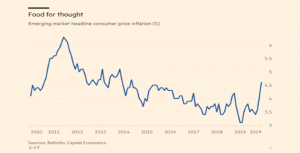
    Firstly, in a low inflation world, holding cash is less punitive because the purchasing power of savers is largely unaffected. One might quibble with that “low inflation” view when you look at health, housing education and insurance costs but let’s just focus on traditional inflation reports. It is true to say at this moment inflation is very subdued in developed markets but inflation is one of those things that can suddenly appear without much advance notice. Hence, our curiosity was tweaked to see an FT report on consumer price inflation in emerging markets hitting a six-year high in recent weeks. Here’s the chart of a significant inflation spike:

    This spike is driven mainly by food inflation which we warned of earlier in 2019 as African Swine Fever decimated the Chinese hog population. However, Coronaviruses and climate change are examples of other potential disruptions to the food supply for a rapidly growing Asian middle class.

    Perhaps inflation spikes will be just a temporary thing, but the meeting of a low-interest rate world and a digital world is also worth thinking about as a second threat to cash savers. Bluntly, banks are losing money by holding deposits for private depositors. Corporates are already being charged for the safe custody of cash in Europe as negative interest rates wreak havoc with traditional deposit/lending banking models. Furthermore, the use of physical cash in payment transactions is more costly than digital equivalents.

    Be prepared for cash payments to incur additional charges and look no further than Sweden for a glimpse of the future. Barely 1% of the value of all payments in Sweden are made using coins or notes. In fact, Sweden is forecast to become an entirely cashless society by 2030. It seems inevitable that banks and governments will encourage/incentivize the use of cash deposits through taxes and fees. Suddenly that “cash safety plan” feels like a very big bet that things are just going to carry on as before. While it is difficult to forecast the future it is safe to say the future and the value of cash are less certain.  As we always say, a strategy allocated to just one asset class, even cash, is a very risky one.

    A balanced investment strategy across residences, property, pensions, cash, alternative assets, wine, fine art and even funding exciting start-ups has its merits. For those interested in looking for cash alternatives it might be worth looking at our recent piece “Good Portfolio Habits Pay Off” to prompt some thought! So, ship those Boris Brexit souvenir 50p’s in. They could be both financial and comedy collectors’ memorabilia items over time. Embrace change. It is happening and we must remember another boxing legend’s words…

    “A man who views the world the same at 50 as he did at 20 has wasted 30 years of his life”  – Muhammad Ali

  • Charting A Dose Of Flu For The Markets

    The old adage that financial markets climb a wall of worry is very well known. However, human beings are particularly poor at identifying in advance exactly which specific worry or risk might spook the markets. Furthermore, the army of 2020 hindsight ‘gurus’ providing post-factum analysis has never been shy of rationalising a market swoon despite this same analysis providing zero commercial value. Risk is a fact of life in capital markets and market fluctuations come and go.

    Indeed, my former colleagues still tease me about a previous analytical role of mine in the early Noughties by mimicking my high pitched squealing about the potential impact of Bird Flu. Not surprisingly I have been on the receiving end of a few playful calls already about the Coronavirus outbreak in Wuhan. Unperturbed by this ribbing, I am going to go out on a limb here and state that markets are at an interesting inflection point where heightened levels of market exuberance are coinciding with the limited risk muscle memory of previous mystery virus outbreaks in China. Here’s a quick reminder of the impact of the SARS outbreak in 2002-2003 and a number of current exuberant data points plus charts.

    First, let’s remind ourselves of the SARS effect on markets in 2003. From November 2002 when the first SARS case was identified in Southern China to March 2003 the S&P 500 index of the largest US stocks fell by 16%. I recall a senior trader at a large Swiss Bank telling me about very anxious risk management meetings and the less-well-known critical significance of the potential global halt of cross border movement of people and goods. Let’s just say the economic worst-case scenarios were not pretty. Ok, that’s the scary reminder bit. What about the exuberance we referenced earlier? Take your pick from the following data points and charts.

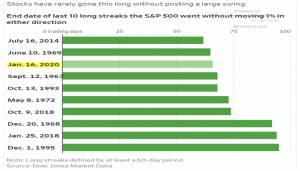
    Markets are rising on a daily basis but in terms of volatility, things have been “quiet”,  i.e. the number of individual big day moves has been non-existent for a long period now. Stocks rarely go this long without a big move. The chart below illustrates where the current period ranks in the league tables of complacency.

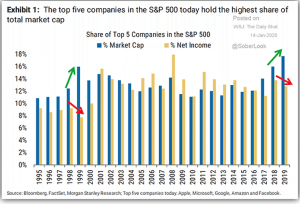
    Individual stocks showing parabolic moves can also be a “tell” of exuberance so we are quite intrigued by Tesla’s recent moves. Its market capitalisation (value) now exceeds that of the entire US auto sector (GM, Ford etc). This prospect was written up in this column previously as a potential 2020 uber-surprise; little did we think it would happen within the first three weeks of the year. It’s possible there is a single stock story there but a quick look at the 5 largest stocks in the US also raises a few eyebrows. The concentration of capital in the US market’s 5 largest companies is at a twenty-year high per this Bloomberg chart below.

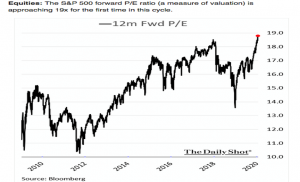
    It’s not just the mega-cap end of the market. The overall market is cruising to record valuation levels as a multiple of future earnings (P/E) for this business cycle. The chart below shows a pronounced spike in recent months courtesy of the excellent Daily Shot blog/newsletter.

    It is fair to say that if the newsflow on the Coronavirus outbreak continues to escalate the chances of investors sitting on 30-40% gains over the past 12 months taking some money off the table is pretty high. On a more positive note, corrections are healthy and the overall picture of the global economy and financial conditions is pretty robust. There is still a wall of central bank monetary support, historically low costs of capital and signs of a pick up in the global manufacturing sector.  Temporary shocks also present cheaper opportunities to revisit great stories missed in the big moves over the past year.  So, it might be time to be greedy when others fearful as Warren would say.

    In the meantime, I will brace myself for ridicule and a round of Coronas on me in a few weeks at a local hostelry with former colleagues. As the great traders know, it’s best to stay humble and liquid….


    Enjoyed this blog? Then why not check out our other great content by clicking here!

  • Banking Facing The Digital Music

    As I flicked through the quarterly results of JP Morgan and Citigroup this week I was reminded that in some ways the whole future of the financial system lies in my brother’s hands. He currently works for another monster bank and there’s a part of me which hopes he will leave banking for all our sakes. Perhaps I’m over-egging this career wish but the previous four banks for which my grim reaper-relative worked all went bust. The world can’t afford a sudden megabank failure. The good news, for now, is that things in the near term big banking world are pretty strong.

    Despite some gloomy predictions for the future of banking, JP Morgan just posted the most profitable year in the history of US banking. This makes it increasingly likely the record total $111 billion profits made by the big 6 US banks in 2018 will be beaten in the next few weeks as 2019 joins the reporting history books. Regular readers are certainly familiar with the challenges to traditional banks posed by technology transitions and even Big Tech competition.  However, it is still possible banks will not disappear but rather change their interface with customers.

    We recently wrote in our article “Are You Ready For Change?” that finance would probably become “a feature” of most products and services but would no longer be accessed as a standalone access point:

    “If we recall the pre-Amazon era, consumer spend and logistics were separate activities. Now, delivery is a feature of consumer spend from Christmas trees to sushi. In the world of finance, it is quite likely payments and financial services will be embedded features of other services rather than standalone banking. Prepare for “location” banking to die.”

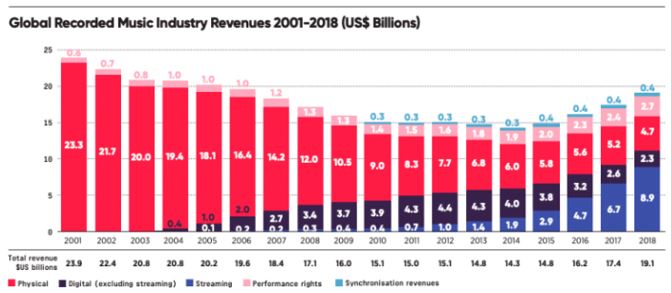
    This prompted some thought as to whether there were any analogous experiences in another industry. Well, it has become mainstream thinking these days that banking is facing a technological music with which it might struggle for relevancy. So, let’s look at the music industry. As recently as 2014 the death knell of the industry was sounded with global recorded music revenues collapsing by 25% from $19.6 billion to $14.3 billion since 2006.

    The revenues from physical music alone in 2006 were worth $16.4 billion. The doomsdayers were correct. Physical music revenues have fallen a further 75% but there was no such thing as “streaming” back in 2006. Now, music streaming revenues account for more than 50% of global music revenues. Here’s the comeback graphic:

    Graphic showing the global recorded music industry revenues 2001-2018 (US) Spark Crowdfunding blog

    So let’s hold that “streaming” thought for the banking industry. It is entirely possible there will be new channels for banks to deliver core services. We should be watching activity in the “plumbing” of financial services for clues to the future. Interestingly, this week we witnessed a very big fintech deal with Visa Inc agreeing to purchase fintech start-up Plaid for…. $5.3 billion.

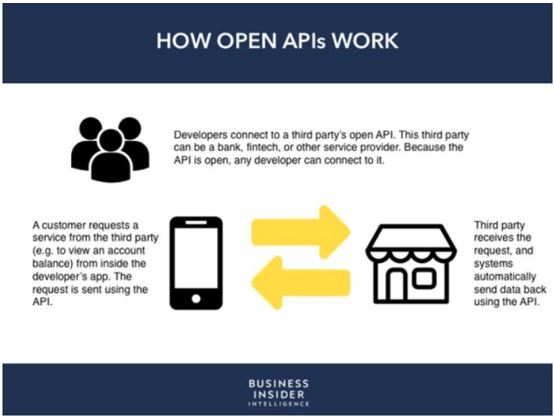
    For perspective, Plaid raised $250m in a Series C funding round barely more than a year ago at a $2.65 billion valuation. Plaid is a “plumbing” or “streaming” play as it allows consumers to connect their bank accounts to various 3rd party services from wealth manager robo-advisors to insurance. The technology which allows this connectivity is Application Programming Interfaces, or APIs. The following graphic shows how APIs work:

    How Open APIs work Spark Crowdfunding blog

    Clearly, Visa Inc sees the value of owning the plumbing which is connecting the latest fintech to traditional bank accounts. Note this deal does not preview a world where bank accounts disappear. Perhaps current thinking is too negative on the future of banking?  Music could be the inspiration, and ironically music featured in our last banking crisis. It was a rather unfortunate quote from a Citigroup CEO in 2007 who insisted “as long as the music (liquidity) is playing, you’ve got to get up and dance”. Well, the music stopped too quickly for Chuck Prince and many other failed banks.

    Technology is the current gloomy soundtrack for banking but “streaming” and APIs provide potential recovery and a future. Now, all we have to do to ensure planetary financial survival is persuade my brother to take up the guitar full time…..

  • Warren Buffett Not Feeling The Love

    It is amazing how a new series of Love Island can prompt such profound existential questions. Were Conor’s teeth stolen from the Fleabag make-up department? Will apprentice Lord, Ollie Williams, confess to predatory trophy hunting of wild animals before the Gale twins entertain his drooling advances? Profound questions indeed but these still couldn’t better contestant Callum Jones’ query as to whether the twins were both 20 years old. Yep, the twins bit was the clue Callum. While we pine for the return of the Teletubbies for intellectual stimulation let’s move on to another more serious question bothering us last night.

    The world’s most famous investor, Warren Buffett, is currently sitting on $128 billion of cash and we are wondering why he isn’t listening to President Trump. The White House is telling us the US economy is in the best shape of its life. Thankfully this observation stands up to data scrutiny better than the medical opinion of the doctors looking after the Orange Toddler. Consumer confidence is high as the US enjoys full employment, record Wall Street highs, low-interest rates, tax tailwinds and energy independence. What’s not to like about that?

    Well, Warren has been doing this investing thing for a very long time and he doesn’t need the instant gratification or performance required of more youthful investment houses. However, we were struck by the fact that Buffett’s last big deal was in 2016. Back then during a ‘socialist’ Obama administration, he splashed out $32 billion on industrial player, Precision Castparts. It must irk Trump that the Sage of Omaha has failed to endorse his presidency with a big deal. An unusual experience as this may be for regular readers, we are reluctant to pin Trump with the blame on this occasion.

    In this particular instance it would seem that very large companies are pretty expensive at the moment. And Buffett needs to do big deals to really move the performance dial. In his most recent annual letter to shareholders the Berkshire Hathaway chairman admitted that “prices are sky high for businesses possessing decent long-term prospects”. A few other things also probably bother Warren.

    Over the years he has been very fond of monitoring the relationship between the total value of the US equities markets and the US economy (GDP). The current measure of that relationship indicates a market valued at 157% of the GDP of the US, according to Wilshere index data. That is high by historical standards and compares to a 137% figure just before the credit crisis in 2007. Buffett is typically uneasy when the market goes over the 100% mark. So, that certainly must be weighing on his mind.

    He will also be noting that the global equivalent stock market value of $88 trillion (record high) amounts to 100% of global GDP. Furthermore, Buffett understands the role of credit/debt. Ultra-low global interest rates are rocket fuel in the short-term but excessive leverage can come back to bite investors very badly. Current IMF estimates of global debt are closer to $260 trillion. A debt pile almost three times the size of equity funding the global economy can certainly be described as ‘leverage’.

    Before we spook the horses it is important to point out that Buffett, due to Berkshire’s size, is nowadays forced to do very large deals. There is a school of thought that excessive valuations are concentrated in the very large market capitalization stocks. As an illustration, just 5 stocks (Apple, Microsoft, Facebook, Google and Amazon) accounted for a quarter of the S&P 500’s 26% gain in 2019! On top of those elevated valuations Buffett would also have to pay a premium to execute a buy-out. Now consider the estimated $2.5 trillion of private equity money sitting on the sidelines competing with Buffett to do deals. Low-interest rates and great tax deals are fueling great exuberance at private equity houses. However, it is worth considering one of Buffett’s more famous pieces of advice, “ Be fearful when others are greedy, and greedy when others are fearful”.  Just recently Buffett was outbid by private equity house, Apollo,  in a relatively small $6 billion deal for Tech Data Corp (TDC).

    Perhaps readers should take encouragement from Buffett’s attempts to take smaller ‘bites’ like TDC. In fact, it is interesting that the US index which tracks smaller companies, the Russell 2000, is at exactly the same levels as it was trading at two years ago. There appears to be more worry and fear in the smaller companies’ world. Now hold that thought and think about Buffett’s patience and requirement for ‘value’ as a margin for error. How heartwarming it would be, as Love Island envelops our consciences and sanity, that smaller companies could begin to feel ‘the love’ of investors in 2020.


    If you enjoyed this blog post, then you should check out our other great content by clicking here!

  • Asset Performances See The Ghost of Christmas Past

    As the UK faces electoral choices filled with Dickensian levels of misery one could be forgiven for approaching Christmas with some trepidation. However, there is better news in the financial world where mendacity and spin is consistently thwarted by an ever-present reality, price. With mere days to go, 2019 is turning into rather a good year for financial markets across asset classes. Here’s a quick menu of performances to cheer the wallet:

    • World equities are up 25% in euro terms year-to-date (YTD).
    • It’s not just the US markets; Germany’s Dax is up 23% and Emerging Markets are up 11%.
    • Bonds have also enjoyed central bank rate cuts with benchmark bond indices up 6-7%.
    • Property markets as bond proxies have generated positive returns in aggregate.
    • QE has been good to commodities with oil, iron and even gold generating returns for investors.
    • And, if that’s not racy enough, Bitcoin as the lead cryptocurrency has almost doubled in value.

    So, all good then? Yes, 2019 has been very good and history suggests subsequent returns can be pretty healthy after a strong year. However, Dickens’ Ghost of Christmas Past visited Scrooge not just to shine a light on kinder days. Scrooge was also forced to visit some less welcome memories and the dangers of CHANGE in intent.

    Let’s jog readers’ memories here and think a little further back to Christmas 2018 when equity markets were nursing their third circa 20% negative correction since 2009. Fear was the prevailing emotion and not just in equities. Deutsche Bank’s investment research team a year ago were highlighting that 90% of the 70 asset classes they tracked globally were on track to post negative annual returns. The last time that breadth of carnage was endured was in 1920!

    We referenced the dangers of change in intent earlier. Specifically, the critical change of intent in global financial markets has been the approach of the world’s central banks led by the Fed. As a quick refresher 2018 was the year when the Fed rapidly raised interest rates back to a more normal historical level. By January this year that tightening path was abandoned and we are now looking at the frothy results of a more accommodative approach from central banks, namely quantitative easing (QE). Think of the central banks as Scrooge. Markets and investors love “kind” central banks. So, here we are enjoying a benevolent central banking utopia of forever rising asset prices, right? Sadly no. There are two other human conditions we should watch for change.

    First, the vast majority of the world’s population is not participating in this asset price inflation. Income inequality now approaches the 1930s extremes. The dangers of a populist backlash are already revealing themselves in trade protectionist campaigns waged by the likes of Boris Johnson and Donald Trump. Global trade is under pressure and could still derail the QE train and the global economy it is fueling.

    Second, interest rates may be very low right now but there is another human behaviour which could cause real problems for a benign monetary environment. Expectation. Specifically, a change in consumers’ expectations of future prices for goods and services. That’s called inflation and that can raise interest rates and erode the value of financial assets very quickly.

    It’s difficult to identify an inflationary catalyst in the current technology revolution. However, it is worth considering a current image in the news which is very far from a Dickens picture of Christmas. Check out the gigantic bush fires suffocating Sydney and the absence of any technology solution so far. One wonders whether climate change and natural catastrophes could ultimately cause dramatic scarcity of certain goods and trigger inflationary panic? At the very least, Sydney is a reminder of our own greed and refusal to change our polluting habits. These words may seem harsh and apocryphal but recall the Ghost’s final words to Scrooge as he begged for no further reminders of the unhappy consequences of his actions…

    “These are the shadows of things that have been. That they are what they are, do not blame me!”


    Enjoyed this blog? Then why not check out our other great content by clicking here!