Category: General Financial

  • Tik Tok …. Time for Europe to Shine

    Tik Tok …. Time for Europe to Shine

    I love Sarah Cooper. Not long ago Sarah was writing articles for the Financial Times. Now she’s a TikTok star. Her hilarious use of the lip-sync video app to ridicule Donald Trump’s daily vomit of gibberish have been social media gold. Needless to say, the Donald has been less impressed and one can only wonder what the true motivation for his most recent executive order.

    The thin skinned Toddler-in-Chief has ordered the Chinese corporate parent of TikTok to sell its US operations citing security concerns. Sarah will be fine – she has just secured a contract for a Netflix series – but there’s a potentially much bigger impact. The Trump administration is also demanding that US firms sever commercial links with another social media platform, WeChat, owned by a Chinese parent.

    WeChat is the Chinese equivalent of Whatsapp, Instagram and Facebook all rolled into the one app. It is commercially critical for any company with Chinese customers. Surveys already confirm iPhone sales in China would evaporate if Apple was unable to support WeChat on its devices. Is this the next phase of the technology decoupling between the planet’s two largest economic powers? If so, what next? Financial markets might already be providing a few clues.

    The currency markets are seeing some interesting moves. Not long ago the Trump regime was all talk about building a wall to keep immigrants out. It turns out, thanks to a spectacularly bad management of the C19 pandemic, that the rest of the world now wants its own wall to curtail the cross-border travel of American citizens. As US infection rates over the past 3 months climbed to the 5 million mark it has been noteworthy to see the euro strengthen by 10% in the same period compared to the US dollar. More striking was this chart below from Bloomberg showing the Chinese now paying for more Russian exports in euros than in dollars.
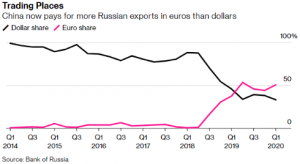
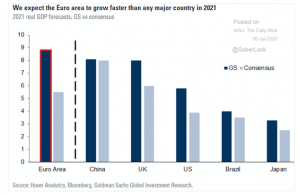
    The new-found enthusiasm for the euro might be a relative vote of confidence in a post-pandemic recovery. Goldman Sachs thinks the Eurozone economy will grow faster than any other major country next year. The next chart tells that story.
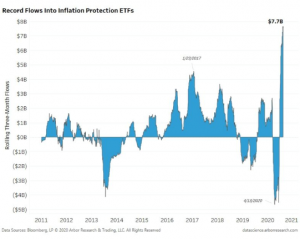
    Of course, growth stocks have dominated the headlines in 2020 as technology sector valuations have rocketed and clocked our first $2 trillion company, Apple. Cheaper, more traditional old economy stocks have struggled to perform for a decade. Europe, with a relatively small technology sector, has lagged too. But whisper it softly, old economy(value) and European stocks could benefit from the “i” which hasn’t really been seen since the iPhone arrived. We are seeing signs of investors protecting themselves from….. inflation. An early vaccine(I’m hearing lots about October) and $10 trillion worth of central bank pandemic pumping is a juicy inflation combo and might explain this chart of record buying levels in inflation protection instruments(ETFs):
    Time will tell on inflation but one thing is almost certain. The unwind of Chinese-US trade and internet connectivity is set to continue. TikTok might have 45 days to comply with Washington’s demands but investment capital can move even quicker. Like right now. The charts above suggest that capital is ready to sync with Europe. Cue Ms. Cooper, Netflix and the theme tune from ‘Curb Your Enthusiasm’ with footage from the White House bunker……


  • Gold Glitters, Money Waits ………….

    Gold Glitters, Money Waits ………….

    It wasn’t just the waters of East Cork glistening last week. Gold prices hit $2,000 per ounce for the first time ever too, but the barbarous relic was not the only financial asset glittering on our trading screens. The technology-rich Nasdaq index touched new record highs and Apple marched towards a staggering $2 trillion valuation. Hot stuff. And yet, the nether regions still shrank in the bracing waters of Ballycotton. Should we be mindful of Twain’s aphorism as we observe all this financial glitter? Let’s take a look at a few headlines which tweaked our curiosity.

    • ‘As dollar slides, investors fret about status as world’s reserve currency’ – Reuters

    • ‘Bitcoin rockets above $11,000 to year highs as dollar weakens’ – Business Insider

    • ‘China’s 800 year old paper money pilot project will be ending soon’ – Forbes

    • ‘Turkish lira hits record low in sharp decline’ – Financial Times

    • ‘US Debt Outlook is Downgraded’ – New York Times

    You will note there are no headlines in this selection above referencing stock markets but readers will already know share prices are flying from previous FAANTAM articles written here. Clearly, this is not the case with many commentators writing on record gold prices in recent days. Most have attributed gold’s recent rush to “nervous investors”. Tell that to the Robinhood investors trading an average 4.3 million times daily and chasing the combined valuation of Apple, Amazon, Google and Microsoft to over $6 trillion. For context, that number would place these four companies as the third largest GDP on the planet after China and the US. There is no fear in those expectations. Yes, there are investors investing in gold for safety but, when one views frothy corners of the stock market, perhaps there is a more nuanced interpretation of gold’s return to favour?

    If we return to our selection of headlines you will note they are all very closely linked to currency markets. Currencies are the most basic store of ‘value’. Indeed, gold is often described in similar terms and historically was often used to “back” a currency. However, after the US abandoned the gold standard and the linkage to the dollar in 1971, central banks have since relied upon interest rates to manage the flow of capital in and out of a currency. Now think about those headlines capturing the emergence of digital currencies, China and soaring government debt as a challenge to the position of the US dollar. Of course, human beings are woeful at forecasting the future but this writer is inclined to wonder whether current moves into gold are driven by investors who are curious and seriously asking the following questions about the future of money…

    1. Will a more insular US foreign policy ripping up international treaties on a monthly basis lead to a commensurate deterioration in the status of the US dollar as the financial system’s reserve currency?

    2. Will China-US geopolitical tensions accelerate Chinese moves into digital currencies and drive capital into same from those countries wishing to trade with 20% of the planet’s population?

    3. Will fiscal spending by governments to support economic recovery from the C-19 pandemic lead to debt defaults and devaluations of currencies more influential than those of Turkey, Argentina, Lebanon etc?

    It is too early to answer those questions but one senses, as always, change is on its way. As the most fundamental financial asset, currency markets and their headlines are worth watching closely. Gold prices are the hint of change, not the answers. The big money must wait…..

  • Biden Our Time For A Market Panic

    Biden Our Time For A Market Panic

    “Daddy, what did YOU do in the Great War?” was the teaser line in a recruitment poster used by the British Army in 1915. Nowadays there are no great wars. No teasing either, as Fawlty Towers fans have recently discovered. Wars are now cultural and the war against racism is finally going mainstream. The scale of street protests across the globe in support of Black Lives Matter have not been seen since 1968. And that year of 1968 did resonate with me as a reference point. On lots of levels actually.

    China in that tumultuous year was in the throes of social and political chaos as Mao Zedong sought to reassert his authority in bloody fashion. The current political crack down in Hong Kong is thankfully less brutal at this point but Western observers should not be so quick to judge. The US in 1968 was horribly divided over the Vietnam War but at least there was bipartisan agreement that the USSR was the enemy.
    The nation needed a unifying belief to overcome the horrors of MLK and Bobby Kennedy assasinations, a rogue Nixon administration and endless body bags returning from Indochina. Not so today.

    These are very different days. Sure, military-style crack downs on the streets of Washington DC and other US cities in recent weeks have highlighted an increasingly polarised political and social environment in the world’s most powerful nation. However, there is an incredible lack of common ground across the US as to how to fight two deadly foes today. The current occupant of the White House and at least 40% of the US electorate seem to think the explosion of the Covid-19 virus in GOP-governed states and Russo-Taliban bounties on the heads of its servicemen in Afghanistan do not merit any protective action. Arguably, both are now the biggest single threats to US democracy.

    Fox News chyrons might even use the “War on…….” headlines but that wouldn’t really fit the current editorial skew. However, this is where it gets interesting. Another war, the war against racism, is starting to impact voter intentions. The Atlantic magazine has been around since 1857 so it has seen plenty but a recent article by David Graham really caught the eye. The opening line expressed a view held not just in Wall Street but in most of the major capitals of the world – “ the only thing more futile than looking for Donald Trump to pivot was expecting the American people to do so”. Depressing, but probably true. Until now.

    In the past few weeks something has changed. Joe Biden is now leading Trump in most polls by double digit percentages. But the driver is neither the economy nor the White House response to the pandemic. Both issues when surveyed by Siena/New York Times generate approval ratings in line or above his overall low approval. Instead, the driver of the Trump poll implosion appears to be race. Both the New York Times and Harris/Harvard surveys show approval ratings on race relations well below overall approval rates. That is stunning because usually Trump exploits racial tension to rally his base support. The “very fine people” tweets, the “white power” videos and the “looting starts, shooting starts” dog whistles are no longer having a positive poll impact, particularly with white females. Dare we hope for a panic of conscience?

    That is not the only area of panic. By all accounts financial advisors on Wall Street are warning wealthy clients of a Biden election win and higher taxes ahead. Whatever about tax evasion strategies, there also seems to be some early evasive moves by the GOP establishment to prepare for a ‘social distancing’ strategy towards the White House. The GOP goal is to protect suddenly vulnerable Senate seats in red states like Texas. Simultaneous leaks to the press on this defensive strategy appear more than a coincidence and one wonders whether the Taliban bounties were the final blow to the charade that Donald Trump puts the US first. A dawning realisation that the very rich, Russia, Trump properties, the energy sector and Saudi, and the domestic Christo-Taliban were the main beneficiaries of Trump’s transactional style of politics could prompt a very severe political and financial backlash.

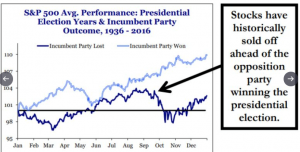
    The problem for stock markets is that, when incumbent parties lose elections, the sell-offs usually happen in the months preceding the election. This chart from the excellent John Authers at Bloomberg captures Wall Street’s fear of change as a well known phenomenon since 1936; note the S&P 500 rolling over in Sept/Oct when the opposition ends up winning in November:

    spark-crowdfunding-blog-post

    It is not all about finance. There is a genuine cultural battle taking place in the US. Too many people who should know better have chosen to turn a blind eye to corruption, trampling of the Constitution, probable treason and, at the very least, culpable homicide on a large scale. So back to that war question at the beginning of this article and a potential distancing by former members of the Trump cult.

    Here’s the five questions every Trump enabler won’t want to hear when interviewing over the next ten years for a position of responsibility – take your pick from board director, educational leader, financial advisor, senior management position, political appointment and practically any other fiduciary position.

    1. When did you speak out about the racist overtones in White House communications?

    2. Is there any written record of your unease about White House relations with the Kremlin and Russian interference with the US democratic process?

    3. Did you share your concerns with anyone in authority about the President’s wilful undermining of the Constitution and the corruption of the Attorney General’s position and the Department of Justice?

    4. Did four years and 18,000 recorded lies cause you to doubt the assurances of the President on public health in the face of the Covid-19 pandemic?

    5. Were you still a member of the GOP in 2020?

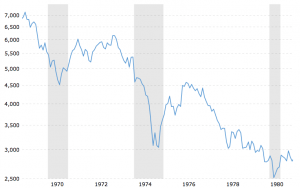
    The difficult question in the 1970’s was did you serve in ‘Nam? Vietnam was an embarassing foreign policy failure with huge human loss, and combined with the exit of Nixon from the White House in disgrace, the US psyche and confidence remained damaged throughout the 1970s. Confidence is key in financial markets. It evaporated and stock markets kept falling for the rest of the decade. This writer’s fear is that a modern day combination of presidential criminality and cultural turmoil will erode confidence once again. Think of 1968 and 1974 as a double whammy of social and political shock. Then check out this chart of the Dow Jones Index from 1968 to 1980:

    spark-crowdfunding-biden-our-time

    A multi-year halving of asset values might sound overly gloomy but there is no doubt the growing prospect of a Biden win, and social backlash, could spook markets. Mark Twain, the great American humourist, was reputed to have given us the maxim about history not repeating itself but certainly rhyming. Look at that chart again and then archive footage of 1968 civil unrest plus an ignominious 1974 Marine One helicopter departure from the White House lawn. Then ask yourself what did YOU do, say or write in 2020….?

  • Charting The Uncharted Territory of Covid-19 Recovery

    Charting The Uncharted Territory of Covid-19 Recovery

    So, this might be the strangest financial quarter of all time. At one point, a third of the planet’s population was in pandemic lock-down plunging economic activity into a deep freeze. And yet, global stock markets are about to post a stunning recovery from pandemic despair with a whopping three month return of 18% for investors. I’m half expecting Monty Python’s limbless Black Knight to appear on CNBC and tell Jim Cramer, “Tis but a scratch…”. Please excuse the effort at dark comedy; rather treat it as a weak effort on my behalf to hide confusion.

    Yep, no point hiding it. It’s all very confusing for me. Rather than blather on about accepted capital markets norms in long paragraphs of text I thought some financial charts might be a better way of explaining my confusion. Don’t get me wrong, I am not saying stock markets and investors are Black Knights of laughable optimism. Quite the contrary, equity markets and investors discount the future (not present challenges) and I have absolutely no evidence to suggest that economic activity will not return to its pre-Covid scenario of Goldilocks growth and low inflation. No, my confusion is that nearly all financial instruments/assets are rising in value. Arguably, these other assets are discounting a less brilliant future.

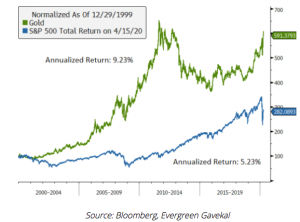
    Traditionally, gold and bonds have been considered “safe havens” to protect wealth in times of turmoil. These two asset classes have not just been flying in recent months, but actually for more than 20 years. Bloomberg and Gavekal illustrate in the chart below that gold has been quietly killing equities on performance over the past two decades.

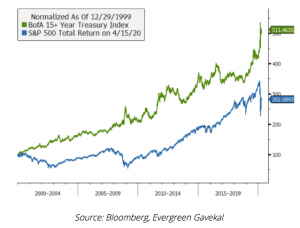
    The stellar performance of bond markets thanks to low interest rates is probably more widely known but it might surprise to see the tech-powered S&P 500 struggle to keep up, even in recent FAANG-tastic years….

    Leaving aside twenty year trends, it is rather strange to see bonds, equities and gold all roaring higher during what we can all agree is a period of significant uncertainty. Of course, there is another explanation for investors buying all asset classes – the enormous monetary stimulus coming from central banks and governments. Current estimates of that funding pulse are as high as $10 trillion. If we assume global GDP has a very painful year-on-year contraction of 5% in 2020 that would equate to a $4 trillon loss. That sounds like a $10 trillion injection to plug a $4 trillion hole leaving a balance of $6 trillion likely to rush into the financial system. What’s not to like about that if you are an investor in risk assets?

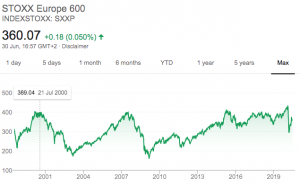
    It is early days yet but an interesting possibility that a massive emergency stimulus response to a pandemic could rip up the sclerotic inflation play book of the past twenty years. In that instance, the “sick man” of financial markets, Europe, could finally attract real interest and performance. I leave you with a chart of European equities still almost 10% lower than two decades ago, and a potential and much needed Covid19 recovery….

  • ESG Goes MEGA: Making Europe Good Again….

    ESG Goes MEGA: Making Europe Good Again….

    The current perceived wisdom of markets is that doing good helps financial performance. Doing good even has its own fancy financial acronym these days – ESG. That covers corporate adherence to Environment, Social and Governance standards. In fact, more than $30 trillion of investment funds are now using ESG metrics/data in their decision making. It would seem the performance debate over ESG is now over which raises an awkward query for this writer. If ESG is a such a big driver of performance why does Europe’s equity markets lag the US so badly?

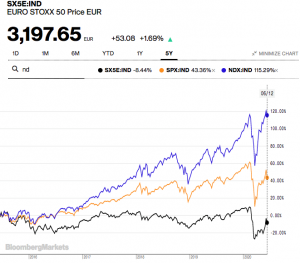
    The data rarely lies. The following chart provides a stark reminder of a European Stoxx50 index going precisely nowhere over the past 5 years while US indices, like the S&P 500 and Nasdaq, roar ahead.

    Spark-crowdfunding-blog

    Of course, there are other macro drivers of equity markets. One of the most topical themes these days is the massive underperformance of the value style of investing. Europe is clearly more exposed to more traditional companies and business models and definitely lacks the turbo boost coming from the US technology titans. A $6 trillion boost no less. Yes, the 5 largest tech companies in the US have a market value equivalent to China’s GDP from just a decade ago. And yet, markets are supposed to discount the future. Technology is certainly the future but what about the future US?

    Recent headlines from the US do not look out of place in a banana republic with ESG alarm bells ringing very loudly. Check out this medley of mayhem:

    Trump demanded 10,000 active-duty troops deploy to streets – CBS News

    Justice Department Reversal “Gross Abuse of Power” – New York Times

    Revolt of The Generals – Washington Post

    Trump Threatens to Invade Seattle – Vice.com

    After Facebook staff walkout, Zuckerberg defends no action on Trump – Reuters

    The media fixation on the unstable non-genius in the White House almost misses the point. The bigger ESG issue is the passive acceptance by half the legislators in the country(Republican party) of the potential corruption of the DOJ, the military and a massive social media company with a user base twice the size of China’s population. Trump is merely a symptom of decades-long social dysfunction. Yes, George Floyd’s death has forced the national address of systemic racism and a wave of corporate PR statements recognizing the issue and a firm commitment to do good, better. ESG box ticked, move along? Ehhh, not so fast. Where is the corporate concern on the following….

    • The US has a prison population of well over 2 million. That is 25% of the global prison population for a country with less than 5% of the planet’s population.

    • More than 300 million guns owned in the US.

    • Thousands of immigrant children held in cages.

    • Toddlers causing death/serious injury with guns annually exceed all Jihadi/Islamic terrorist activity.

    • The top 1% of the population in 2018 held over $25 trillion in wealth which exceeded the wealth of the bottom 80%. With 40 million now out of jobs and the Nasdaq hitting all time highs one shudders to think where the current disparity lies.

    • 1,000 people are killed by US police annually.

    One suspects the most wide-scale street protests seen since 1968 are about far more than George Floyd’s gruesome murder. Europe is not a perfect place but the Covid-19 pandemic has surprisingly revealed a crisis response far more coherent than originally feared. It is early days yet in a hopeful recovery but one wonders if financial markets over time will see Europe through a more atttractive ESG prism. How ironic it would be if European capital markets over the next decade outperform the US due to the comeback of social values rather than financial value…..

  • Back to Work – All is Very Good!

    Back to Work – All is Very Good!

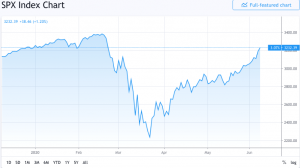
    Well, that was quick. As Main Street tip-toes back to work, Mr. Market has voted with a loud and large V. That’s the ‘V shaped” recovery of financial charts all over the world, particularly in the US. Check out the S&P 500 recovery and its move back into positive territory for 2020. Whooodathunk!

    That is a 40% move since the lows of March. The tech-heavy Nasdaq index has had an even stronger rocket ride; it hit all time highs yesterday and is actually up 10% in 2020. Wall Street is doing its market thing and looking through the current turmoil and “discounting” a better future. Even if a company is “dead”. Rental zombie, Hertz, filed for bankruptcy a few weeks ago but the share price (yes, the equity) gained 115% yesterday. Chesapeake Energy with its $8 billion of Q1 losses and debts in write-off mode went a bit better; just the 181% trip to the stars yesterday. The market is always right, right? Honestly, we just don’t know. Benjamin Graham puts it better – “In the short run, the market is a voting machine, but in the long run, it is a weighing machine.”

    Investors have voted and followed a wall of central bank emergency funding into risk assets. Back on Main Street business owners are weighing up the challenges presented by an ongoing global pandemic, lost revenues, new regulations, new behaviours and their costs. Oh, and Covid-19 is still here – WHO said it recorded its highest daily tally of new infections on Sunday (136,000). Interestingly, for those assuming all will return to pre-Covid exuberance, the National Bureau of Economic Research didn’t quite get the White House ‘Keep-America-Great’ memo. It turns out that the US officially went into recession in February. Yes, the US economy was already contracting before lock-down. Who cares, say investors clocking gains every day. Dare we say exuberance is back? Buckle up, we have a transport dream to sell you.

    Nikola Corp makes hydrogen and battery powered trucks. Not one truck has been produced yet, we don’t know who will make them and the company has zero revenues to date. The Nikola share price doubled on Monday and the value of the company now exceeds $33 billion. That is now $3 billion higher than the value of the 117 year old Ford Motor Company and its annual revenues of $150 billion. Punchy stuff. I think we can agree Wall Street has voted for a big V-shaped recovery. ‘Mission Accomplished” springs to mind.

    There is one tiny flaw in that prognosis. Main Street gets to vote too. Up until now, most business people with US commercial interests would tell you their local contacts/partners are emphatic President Trump will be re-elected. With the most recent CNN poll putting Biden 14 points ahead of Bunker Boy, one wonders is that confidence about to be tested? As Main Street returns to work and polls its pandemic pain through the hot summer months, what are the chances Mr Market reaches for the weighing-scales and reins in its exuberance. Then, we may appreciate “V’ is for volatility too.

  • SME Survival: Three Numbers, Three Truths…

    SME Survival: Three Numbers, Three Truths…

    If it wasn’t so awful you would laugh. The Twitter Toddler is hiding in a bunker in the White House, with the lights off, as fires burn on Lafayette Square. Meanwhile, I keep thinking of those final non-responsive two minutes and 53 seconds of George Floyd’s life. Three police officers watched and did nothing. We should be angry but save some indignation for closer to home. Our SME sector which employs more than 1 million people is struggling to survive and we are watching and waiting for a new government more than 100 days after our election. The SME companies gasping for breath don’t have much time and three numbers indicate a fatal lack of commercial awareness.

    The first number is 11 million. That is the grand total of euros provided to small businesses in the two months since the government launched its SME main support scheme. Eleven million! It gets worse; a tiny number, 400 companies out of 250,000 in the SME sector, have succeeded in accessing a funding lifeline. Apart from the fact that the support is coming in the form of debt capital with unattractive terms, there is the additional problem that our banks are being asked to take on some of the risk too. This introduces our second number. It is bigger than our first number.

    Four billion. Yes, that is the estimate by J.E. Davy and Goodbody Stockbrokers of the euro value of bank loan losses stemming from the Covid-19 crisis. The three banks, AIB, BOI and PTSB, are currently tasked with supporting the government SME support schemes. The truth is they really have too many fires to fight in their existing loan books. The combined loan books of these three domestic banks, outside of mortgages, are in the region of €100 billion. One suspects that 4 billion figure (or 4% of book) from the broker analysts is a little optimistic and you can bet the banks fear the same. So, it is difficult to see how the banks have any incentive to increase their risk at this time of maximum uncertainty. And, here’s the really worrying number. It is much much bigger.

    The Central Bank of Ireland as the oversight authority and regulator of the Irish banking system publishes lots of really good data. In a recent report, “Covid-19 and the transmission of shocks through domestic supply chains”, the authors Samantha Myers and Fergal McCann stated that trade credit activity is ‘relatively large’ in Ireland. For illustration, they stated that as recently as Q3 2019 outstanding trade credit liabilities stood at €250 billion. Ireland currently has entire sectors of the economy shut down. Would 10% or €25 billion be an unreasonable estimate of the true scale of the evaporation of supplier/creditor capital?

    We will soon find out but two months into this crisis there are three very clear truths emerging. They are as follows:

    1. Existing government capital support(not payroll) schemes are not working
    2. The expectation that Irish banks will add to risk books is commercial nonsense.
    3. The cascading effects of a freeze in trade credit chains are much bigger than current estimates of SME support(but not accessed) required.

    The purpose of this article is not meant to be gloom and doom. The creation of awareness is a necessary catalyst to prompt leadership and one can be more hopeful of new thinking from here than from 1600 Pennsylvania Avenue. In fact, very close to home, there are three exciting companies about to raise more than €500,000 on the SparkCrowdfunding platform. Now think, that’s almost 5% of the national total from government in the past 8 weeks! These fund raises are an excellent example of combining a good government incentive (EIIS Tax Scheme), equity capital(not debt), alternative pools of capital(retail investors) and technology(Spark). So, thinking positively, the SME sector can be helped. And, we have more time than two minutes and 53 seconds. But not much more.

  • Value Is Dead, Long Live Value

    Value Is Dead, Long Live Value

    Poor Joe Duffy. After the latest broadcast of the hit college love story, ‘Normal People’, the RTE Liveline radio host was moved to tweet, “I’m phoning in sick”. The TV flesh-fest was guaranteed to trigger an avalanche of outraged radio phone-ins from the 1970’s (or the 1700s) and one could only giggle at Joe’s quip. He could afford to have a laugh. After all, this was just a 6 week TV series. Not so elsewhere in a long-suffering corner of the investment world.

    Spare a thought for portfolio managers who pursue a value investing style. The value style has had many famous disciples, including Warren Buffett, but it has had a miserable decade of performance compared to the overall market. The faith of long-frustrated clients is being sorely tested and more than a few portfolio managers have confessed to this writer a Joe Duffy-fear of the telephone switchboard. However, the contrarian in all value investors was possibly tweaked in recent days by an article in the FT.

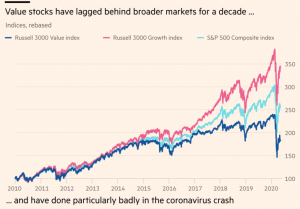
    The piece by the excellent Robin Wigglesworth, “Does value investing still make sense?”, struck a chord with those who have over the years watched the likes of Barron’s, Goldman Sachs and The Wall Street Journal mark an ironic trend reversal within weeks of publishing a headline grabbing pronouncement of a new paradigm in the financial world. When one views the chart in the FT article chronicling a decade of laggardism it probably is worth asking whether value is relevant in an increasingly digital world, with or without pandemics. See for yourself…

    The numbers don’t lie. Since 2010 the Value index above has delivered 80% returns. The snazzier Growth index powered by technology has returned 240%. To refresh memories, value investing attempts to invest in stocks trading at low prices relative to the value of a company’s assets and the cash flows it generates through the business cycle. Many value evangelists hoped a bear market would hammer tech and highlight the quaint attractions of boring old cheap companies. Hold that beer, or Corona.

    The global pandemic has brought no such relief for Value. The CV19 sell off has not been kind to this approach with another leg down in relative performance. The following headlines give a good clue as to where the damage is being inflicted:

    ‘€2.4bn wiped off value of State’s shareholding in two main banks’ – Irish Times, March 16th 2020

    ‘Historic loss in oil prices sends US stocks reeling’ – Washington Post , April 20th 2020

    ‘FTSE 100 groups cut £24bn of dividends’ – Financial Times, 9th May 2020

    My old boss, Terry Smith, is not particularly surprised as his eponymous investment vehicle coasts towards £20 billion of funds under management:

    “Shares in companies that are lowly rated are so mostly for good reasons. Because their businesses are heavily cyclical, highly leveraged, they have poor returns on capital and/or they face other structural or management issues. It doesn’t sound like a combination likely to protect the business and your investment in difficult times, and so it has proven thus far.”

    I have always felt safer on lots of levels when I agree with Terry. In this instance, I agree the CV19 pandemic was never going to be a good launch pad for value outperformance given the sectors impacted. I also have written multiple cautionary pieces on the perils of depending on “Other People’s Money”. However, CV19 is not your classic business cycle slowdown. There are possibly some superb businesses which have now entered value territory and deserve some oppotunistic scrutiny.

    In one of my occasional “counselling” sessions with a traumatised portfolio manager this week he highlighted a dividend growth fund which is currently trading on multiples of earnings below 10x. The dividend yields are likely to be in the 4-5% region and it did prompt some exploratory thoughts for the post CV19 era. I thought of home champions and I thought of travel. Three very strong franchises came to mind.

    First, I thought about restoration of international flights and Ryanair valued at just over €8 billion. This monster “flying Spar” was on its way to an annual passenger count of 150 million souls. Given its recent pre-CV19 valuation of just over €16 billion there’s a reasonable symmetry between passengers and valuation. And this did leave me wondering whether more than 50 million passengers would never return to the skies.

    Second, if you like the idea of captive travellers in “flying Spars” and extortionate retail margins, look no further than WH Smith. The WH Smith share price has fallen by two thirds and this 200 year old franchise is valued at just over £1 billion. More than 60% of its revenues are travel related and you do wonder again.

    My final thought is very much an “Other People’s Money” candidate. Ardagh Group has been a stunning growth story born out of a Dublin glass bottle factory and lots of junk debt financing. Given the owner/architect, Paul Coulson, has seen most macro challenges off over the years and the Ardagh business is focused on packaging food and beverages, one senses a halving of the equity value of the business since March might be only a temporary visit to the value saloon.

    So, perhaps we need to think about Value as part of the economic recovery period. As a serial advocate of diversification, I think a portfolio should always contain an allocation to the value style. I recall my former colleagues at the quants research unit, Quest, seeing value presenting positive signals in November 2008. The market took off a few months later, in March 2009. Guess which quants team were making similar sounds on value in the past week?

    And a final final thought…. Value investing will always have its leader sectors. The past might have featured oil, banking and retail leaders. A global pandemic might just have accelerated the future. And, this writer’s sense is that, like monarchies, we are going through a succession period. There are new leaders and curiosity could be richly rewarded.

  • Small Businesses Need Big Aid Fast!

    Oh dear. Those heroes of the credit crisis, the credit ratings agencies, are back. Excuse the sarcasm, but did we really need to read this week that the S&P ratings agency gurus have put the three big Irish banks on negative watch? Think it best we save our gratitude and equate this post-factum analysis to a service scenario where the Red Cross returns to the battlefield to shoot the wounded.

    There is no doubt a global pandemic and recession will inflict wounds on our banks. The good news for taxpayers is the banks are in much better shape than 2008. The bad news for small businesses is that the banks will be so busy firefighting there will be no time to build new banking relationships and source funding capital. In an Irish context, the reality is our corporate banking network is sub-scale and our small business sector (SME) is massive. That ‘massive’ adjective might surprise but the numbers don’t lie and come straight from the Central Bank.  See for yourself…

    • More than two-thirds of private-sector jobs (1 million) are in SMEs.
    • Trade credit in the Irish economy is unusually large as a percentage of overall economy. Outstanding trade credit liabilities amount to a whopping €250 billion.

    But there’s a problem……

    • Trade credit is used by up to 80% of Irish firms as a source of financing. This compares to 40-50% levels in the average European country.
    • Undrawn credit/bank facilities amount to just €2.7 billion.
    • Currently 60% of SMEs have NO debt.

    Clearly, interruptions to the normal flow of €250 billion worth of trade and payments are going to be significant multiples of the €2.7 billion of funds/facilities currently set-up by the banks. The fact that 60% of firms have no previous lending relationship with a bank is another challenge. For illustration, check out one of the working capital support schemes set up by the government, with the banks as chosen administrator. Press reports this week show just €17m drawn down from a potential €250m pot, and only 100 borrowers actually being accepted on the scheme. The experience is somewhat similar in the UK where approval rates in the CBIL scheme are just over 2%!

    While funding and vaccines are scarce there is no shortage of opinions as to what is the best form of funding (loans, grants, equity) or the appropriate risk sharing between SME, bank and taxpayer. In this writer’s opinion any funding detail is moot without an appropriate execution plan and platform. These pages have never been particularly kind to the banking sector but in the midst of a global pandemic there is clearly no point in shooting the corporate wounded.  What would be helpful would be an honest communication from our banks that they do not have the resources on their own to execute an aid programme for the SME sector.  Just like the Revenue was cleverly employed to administer payroll/cash flow relief in the early stages of this crisis there now needs further innovative and original thinking.

    Would it be too bold to ask the fintech sector and their speedy execution platforms to assist? In pandemic parlance, SMEs are effectively already in the ICU unit. Speed of action is now critical. And there are 250 billion reasons to warn this is a very very big problem for the Irish economy. Just thinking, and hoping.


    Enjoyed this blog? Then why not check out our other great content by clicking here!

  • We Are All Start-Ups Now!

    So, it’s The Great Lockdown then. That’s the name given to this crisis period by the IMF and I’m hoping there’s another Isaac Newton out there. Well, not quite. Newton famously developed humanity’s knowledge of calculus, light refraction and gravity while quarantined during the Great Plague of 1665. Right now, behind the global public health priority of a CV-19 vaccine, the world is in urgent need of a gravity-defying economic plan. Newton’s falling apple suggested what goes up must come down. The task today is to figure out how a Lock-Down transitions to, hopefully, an Open-Up in the coming months. The laws of gravity and economics are challenging to say the least.

    Let’s start with a few numbers. How much are we really down? The IMF reckons global GDP in 2020 will shrink by a higher percentage (3 %) than any period since the Great Depression. That’s even more than the nadir of the credit crisis in 2009. In dollar terms, January IMF forecasts of 3% growth this year have in a matter of weeks seen $5.2 trillion worth of activity evaporate from those 2020 expectations. The IMF think the ultimate cost through 2021 could be closer to $9 trillion – that is the equivalent of Japan and Germany’s economies disappearing. Here are a few other numbers which hint at the scale of the gravitational pull on economic recovery:

    • Commodities: The IEA is forecasting oil demand for 2020 to fall by more than 9 million barrels per day (!). In April alone that number will fall by 29 million barrels per day. In effect, global economic activity/consumption has returned to 1995 levels. Good news for the climate but catastrophic for nations dependent on exporting commodities.
    • Banks: Ireland might escape the worst GDP implosions likely to hit Italy and Spain but a quick check of bank share prices in Ireland gives some clues as to the scale of capital destruction. The combined market valuations of AIB, BOI and IPTSB amount to just over €4 billion, or just over 20% of the combined book value of these banks ie the market is discounting €16 billion of capital at risk of wipe-out. Then, factor in a 2020 Irish government budget surplus of €2 billion vaporizing into an estimated €19 billion deficit. That’s another €21 billion we might not have in 2021.
    • Corporate Debt: Back in 2009 a critical factor in capital destruction was the amount of leverage in the banking system. We have written frequently about the risks of being dependent on “other people’s money”. Fast forward to 2020, and it is clear companies across the globe have feasted on ultra-low interest rates and loaded their balance sheets with debt. The Institute of International Finance estimated corporate debt levels among non-banks had rocketed to $75 trillion by the end of 2019. That figure was $48 trillion at the end of 2009.

    Yes, the numbers are quite scary. However, the intention of this article is not to frighten but rather to highlight the difference between two competing emergencies. Governments and central banks everywhere have moved swiftly to address the immediate cash flow issues of citizens and companies experiencing a collapse in income and revenues. The longer term issue is how creditors and debtors deal with damaged balance sheets and the need for additional capital to “Open-Up”.

    The Lockdown is a cash flow emergency. The Open-Up phase will probably be phased and slow. The entire world from universities to airlines will need capital buffers to navigate a possibly very changed world. Bluntly, the capital destruction estimated/discounted in the forecasts summarized above suggests too many capital-hungry mouths to feed. Previous years’ financial performances by established corporates may not be a helpful guide to the future. Companies will have to be realistic with their projections and tell their story very well. The risk profile for many sectors has endured a meteor strike and, in a sense, business models will have to be rebuilt, or in start-up terminology, pivot.

    Yes, the Great Open-Up will be a capital event without precedent.  We are all start-ups now.