Category: General

  • A Short History Of Investor Panic

    So, do I wear a face mask on my weekly Ryanair run to London? Will I eat Italian for lunch? Not sure. Will it matter in the long run? Probably not. Welcome to the world of human emotions, fear and temporary loss of reason. Sadly the human cost of the Coronavirus is very permanent just like measles, malaria and the flu. However, in the context of financial markets, a new virus and an understandably fast-moving learning curve can generate real fear and uncertainty. And that is a markets killer.

    More than a month ago we tried to warn and quantify that very impact in “Charting a Dose of Flu” and we are already halfway there in terms of wealth destruction on US equity markets. Now, it’s time to move ahead of the CNBC “Markets in Turmoil” chyrons and apply a bit of historical perspective. This wide-angle history lens should calm investor nerves as financial headlines scream “Panic”. Firstly, investors are correct to interpret the quasi-shut down of the master cog in the global supply chain, China, as financially damaging for companies.

    However, the likelihood is that depressed economic activity will catch up on lost production/demand in later months in the year. What is less rational from an investor perspective is that the valuations of major companies with multi-decade cash flows ahead of them have suddenly changed. That makes no sense as equities discount the long-run cash flow returns of a company. In a nutshell, the financial impact, unlike the human impact, is temporary, not permanent. Fear is the driver and markets almost every year experience the same. We thought the following data points, many from the excellent Charlie Bilello on Twitter, would provide some interesting context:

    • The S&P 500 is down 6.28% over the past 2 days. That’s the 109th largest 2-day decline going back to 1928
    •  The S&P 500 is now down 7.6% from its recent all-time high. Now consider the average intra-year drop for the S&P since 1928 is 16.3%.
    •  Volatility has been very low in recent times thanks to central bank support. In fact, there had not been a 5% pullback for a whopping 8 months. Have we become spoilt by zero volatility?
    •  1000 point declines for the Dow Jones Index sound scary but consider inflation and the growth of capital markets over the past 40 years. A daily 1000 point decline in percentage terms(3.56%) ranks as merely the 229th worst day since 1900.
    •  Since 2009 markets have experienced 5% plus declines on 26 occasions. We’ve been here before, many times.
    •  Investors are not quite abandoning capital markets. Bonds are hitting all-time highs, Zoom the video conferencing app is flying so business and capital markets will adjust to current conditions.
    •  Remember in a previous article we highlighted the research from Fidelity that its clients with the best returns were dead ones ie those that can’t react to headlines and emotions. Non-professional traders should try to avoid emotional reflex actions or panic selling.

    If one were to be slightly constructive on serious economic disruption there a number of less obvious positives that could emerge. First, ultra low-interest rates have kept zombie companies alive and stifled productivity and investment in better companies. A short sharp shock might force some franchises (or their bankers) to finally call time on their activities. Second, an uncomfortable concentration of global manufacturing capacity in China needs to be reviewed. With ESG investment criteria coming down the tracks it might force some real conversations/negotiations on China’s track record on human rights.

    Of course, Warren Buffett will also tell you time is your greatest investment tailwind and that the time to be greedy is when others are fearful. It will be interesting to see what he does with his $128 billion cash pile sitting on Berkshire Hathaway’s balance sheet.  So, buckle up, things are moving fast but keep an eye on financial history and you’ll avoid the fearful holes others will fall into.

    One slip, and down the hole we fall/

    It seems to take no time at all

                                             –   ‘One Slip’ from Pink Floyd’s  Momentary Lapse of Reason
  • Ireland Is Hot Right Now

    No, this is not a climate change observation. Let’s ignore the “soft” February days soaking Dublin commuters on a daily basis and highlight a significant heating up of Ireland Inc. Despite domestic electoral demands for change (we can’t recall a democratic election being any different) and genuine Covid-19 virus fears, Ireland’s economy could actually be picking up speed. Whoodathunk! Readers can judge for themselves but here’s a selection of stories we’ve been reading with interest….

    • Global Tech Giants Building: It looks like Google, Amazon, LinkedIn, Facebook and Salesforce have plans to add 3.6m square feet of office space to their Dublin campuses. Based on those plans that translates into space for 36,000 workers.
    • Job Numbers Hit Record: The CSO has reported a record 2.36 million people had jobs in Q4 of 2019. Despite more sclerotic growth elsewhere in the world, particularly Europe, employment grew by 3.5% in 2019 with the addition of 80,000 new jobs. Tech added 12,300 new roles but growth was seen in 13 of 14 sectors tracked.
    • Modern Ireland: CSO report also highlights the total number of non-nationals living in Ireland now accounts for 12.7% of the population. The tech sector now employs more people than the agriculture sector.
    • FT Awards: The Financial Times FDI Magazine has awarded Ireland South East the number 1 ranking as “Small EU Region of the Future for FDI Strategy”. Well done to the Crystal Valley – love the name!
    • High Profile Buy-Outs: The recent big-money exits by the founders of Pointy ($160 million) and Decawave ($400 million) is sure to inspire a few more entrepreneurial spirits.
    • Great Future For Irish Start-ups in Next Decade: Finn Murphy of VC firm, Frontline, penned an interesting article this week highlighting a shift in the tech ecosystem. Ireland is no longer a sales & operations centre for tech. It has now moved into the product/engineering space. Witness Amazon quietly building a 1200-strong engineering team in Dublin. Murphy’s view is that in the past decade only one venture-backed domestic firm, Intercom, has reached a billion-dollar valuation. He expects that number to be higher in the next decade and name-checks the following prospects: Evervault, Inscribe, Workvivo, Teachkloud, WarDucks, Modulz, Sweepr, Manna, Flipdish and 17 other names. Between them, the 26 start-ups have raised $125m over the past 18 months.
    • UK To Close Door To Unskilled Workers: The UK as our closest English speaking neighbour competes with us for capital and talent. While Ireland Inc hurts when the UK economy falters there is no reason to fear our growth prospects outstripping those of our larger neighbour. It has been a difficult week for the UK government to discover from its EU negotiating counterparties that it is not “Canada”. Number 10 is also about to discover that taking back “full control” of UK borders and an overhaul of immigration laws might not appeal to sharper minds(talent) who understand the importance of a functioning service sector, particularly the health and food industries.

    Possibly the most positive development from the stories above is the culture shift in Ireland from a large sales/operations base to a rapidly growing engineering/building gene pool. It does feel like there is more activity and a sense that the tech community has seen successes like Stripe and Intercom and wants more. Don’t forget a lot of these start-ups are driven by founders who have already experienced success.

    This also brings another new important player to the table. Global venture capital houses. Clearly, the previous track records of the current generation of start-up founders have attracted heavy-hitting overseas capital. Check out the arrival of the likes of Sequoia, Greylock Partners, Kleiner Perkins, Blossom and Index Ventures. Success does indeed breed success.

  • Crowdfunding The ESG Revolution

    ESG might strike some as a larger company fad to keep investors comfortable that the C-suite are good corporate citizens on environmental, social and governance issues. Wrong. We often say actions speak louder than words, particularly investment. Check out Spark Crowdfunding’s platform whose last three campaigns raised an eye-catching €1 million for companies providing solutions to real environmental challenges. Accucolour is the latest start-up company to successfully raise funds for innovative products allowing fast-track recycling of plastic bottles. Pardon the pun but an ESG ‘ecosystem’ is emerging.

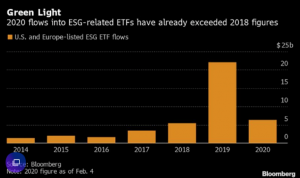
    ESG is here to stay and companies who can help larger companies meet ESG benchmarks/standards are going to do rather well. The flow of funds into investment products that track ESG friendly corporates is striking and provides further incentive for laggard companies to up their game or face valuation discounts in public markets or M&A discussions.  Already, fund flows 6 weeks into 2020 have surpassed total flows for all of 2018 as this graphic from Bloomberg illustrates:

    To get a flavour of the punishment inflicted on less ESG friendly companies, consider the case of Exxon Mobile whose valuation has crumbled by $184 billion since its peak in 2014. Clearly, an excess supply of oil, consequent lower prices and the growth of renewable energy have hurt cash flows. However, that doesn’t explain all of Exxon’s collapse from being the world’s most valuable company as recently as 2012. Climate change is the elephant in the room which is applying an ESG discount to those still-enormous cash flows.

    The opportunity for smaller companies is to help these monster enterprises join the ESG-friendly club. There is no shortage of cash to throw at this challenge and no shortage of opportunities for innovative solutions. Just yesterday BP, under a new Irish CEO, announced plans to “reinvent” the oil giant by setting a net-zero carbon footprint target by 2050. Whether BP meets those targets or not is up for debate but it is absolutely certain they are going to spend BIG to reposition the firm.

    That’s a double whammy of good news for entrepreneurial spirits. It’s always good to know there are some very rich and desperate ESG customers out there, as well as an informed and active investor base consistently funding great startups at Spark Crowdfunding. These investors are not alone. Currently, $30 trillion of investment funds use ESG criteria in their securities selection process.  So, as the political world grapples with daily Watergate flashbacks and worse, it would seem prudent once again to take the sage advice of that era to follow the money…..

    Interested in learning more about ESG? Then check our previous blog on the topic “ESG: Corporate Health Is Your Wealth“!

  • Voting Trust Over Wealth

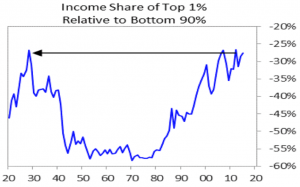
    Admit it. You are a bit surprised. The fastest-growing economy in Europe with almost full employment has just voted for a very significant change of direction. Leaving aside the gymnastics involved in actually forming a government, Ireland has become a useful illustration of a very significant macro-economic risk looming over most developed economies.  Back in April 2019 we had written “Use it Or Lose It” after the Spanish elections to highlight rising income inequality as potentially the biggest threat to the global economy over the next few years. To coin an unfortunate phrasing, it hasn’t gone away……

    The fear-mongering electoral shifts to the right in the US and the UK, or the social rebellion to the left in Ireland are merely symptoms of the same disease. Too many people have been left behind as global wealth has raced ahead. This is not a shock election snap reflex. The World Economic Forum (WEF) has already warned on the threat posed by income inequality. Ray Dalio of the world’s largest hedge fund, Bridgewater,  says capitalism “is not working for the majority of people”.

    And for those horrified at the potential return of Sinn Fein to democratic power after 100 years, take a look at the chart below highlighting today’s inequality reaching levels not seen since the 1930s. Students of history might recall that decade as a rather turbulent one when massive left (Communism) and right (Fascism) wing political movements promised solutions to the forgotten masses.

    Voting Trust Over Wealth graphic for Spark Crowdfunding blog post

    Clearly, the 1930s didn’t end well as capital was poured into war plans rather than people and social infrastructure. The signs are more encouraging this time but inevitably there are policy concerns.  Dalio puts it rather well when he states that “capitalists don’t know how to divide the economic pie well and most socialists don’t know how to grow it well”. Ultimately, all citizens and taxpayers, in particular, would like capital to be deployed in a smarter way. Sure, some of the economic policies of Elizabeth Warren, Mary Lou McDonald and Bernie Sanders do not survive serious scrutiny but nearly all surveys of the uber-wealthy recognize that action must be taken quickly or a more violent backlash could destroy wealth on a serious scale. Indeed, action may not be as dramatic as feared. Take a look at Ireland and Sinn Fein.

    Who would have thought that Sinn Fein’s manifesto would be bottom of the individual party rankings in terms of tax cuts and public spending? The world is truly upside down but we have often written on the irony that the Trump presidency is the most socialist in decades as agriculture, the military, energy industries and country-sized prison populations are effectively state-supported and do not reflect market realities. Perhaps the policy solutions to Ireland’s housing and health debacles are more “smart capital” rather than additional capital. How hard is it to build higher buildings in urban areas?  As for the health service, let’s sip a Corona and put things in perspective.

    Yesterday, the day of Ireland’s election results, and a Monday, would have seen more than 5,000 of the country’s 100,000 health workers absent. Yep, the 5%-plus absenteeism rate is more than twice the levels experienced in the private sector and, intriguingly,  the patient-facing personnel are not the ones missing in action. In a digital age, more than 50% of health workers are involved in administration but amazingly they appear to fall sick more frequently than the front line troops actually dealing with sick people. Smart capital deployed to bring the health service into an automated/digital age would be money very well spent and save our sick from the additional risk of coming into contact with even sicker personnel. Wuhan can’t even compete with some of those Monday absentee statistics….

    As a former colleague and excellent market economist, Alan McQuaid, wrote quite recently, societies could do with a bit more honesty.  Recent insurance headlines certainly resonate when reading McQuaid’s analysis, “In my view, the real socio-economic divide should be honest versus dishonest. We need to reward the honest and punish the dishonest. Now if there was a party called Honesty Before Dishonesty (HBD) I would definitely vote for it.” Well, the people have voted and clearly didn’t trust that the incumbent leaders cared enough. Indeed, it is not too revolutionary to state that honesty would be a smart start for the new government and probably save plenty of capital.

  • The Price Of Certainty

    I attended a meeting last year which was memorable for only one reason. Certainty. The pretext for the meeting was the potential use of innovative data analytics to monitor modeling risks in the field of aircraft leasing. The aircraft leasing industry is rightly considered a genuine Irish success story that has ridden many challenges. So, I was a tiny bit struck by the confidence of the lead analyst in that 2019 meeting declaring his absolute confidence that its sovereign customers were unlikely to ever default and therefore he didn’t need any additional macro analytics on government credit or currencies. His certainty was based on a conviction that the last thing any government would want was a suspension of air travel to and from its national territory. Ehh, hold my Corona….

    All financial models try to account for risk but there are occasional “black swans” which can blindside the brightest. That’s why most investors look for some valuation comfort or a margin of risk. We do not mean to pick on aircraft leasing per se but it has certainly triggered a wry recollection while the Coronavirus threatens to shut China’s airspace from the rest of the world. Yep, the world’s second-largest economy is on lock-down and oil consumption is already estimated to have fallen by a quarter.

    Ecowarriors will be thrilled; OPEC and central bankers are extremely anxious. This virus can’t even be considered a “black swan” given previous SARS outbreaks in 2002-2003 so let’s hope aircraft leasing models have factored in significant economic damage at the sovereign level. It’s not necessarily China we are talking about. It will be poorer Asian and Latin American nations dependent on Chinese trade. This is already causing the Brazilian real and other emerging market currencies to hit new lows. Meanwhile, “certainty” is evident elsewhere across a number of financial markets. Here are a few high profile examples:

    • Apple is now worth more than Germany’s entire stock market. It is incredible that the future of Apple (all equities discount the future) outstrips the entire corporate prospects of the leading exporting nation on the planet.
    • Bonds continue to hit new valuation highs as yields go lower. Again, a multi-year perspective would hesitate in declaring inflation effectively dead. Black swans and all that…..
    • US stock markets continue to roar to new valuation highs oblivious to the fact that China is a vastly more significant player in the global economy than it was during SARS time when the S&P 500 dropped 16% in a 5 month period.


    Returning to aircraft leasing one can’t help noticing that other trends are less than helpful. Take your pick from climate change, carbon/gas emissions targets, ESG investing criteria and populist (anti-globalism) electoral trends. In some ways the Coronavirus is already a global carbon tax, killing off 3 million barrels of oil demand in a matter of weeks. It’s possible the first significant financial impact of the Coronavirus will be a commodity or oil-producing nation defaulting on debt payments. This will test my aircraft leasing friend’s assumptions.

    It is true that a country would be loath to destroy its credit rating in the aerospace market. However, Greece is the word these days for credit doomsdayers. Remember how Greece was “certain” to take decades to return to the bond market. Take a sip of that Corona and note that Greek 10 year bond yields have traded as low as 1.15% in recent days. That’s a 0.45% cheaper rate of borrowing than the U.S. of A!

    The price of certainty can sometimes be rather embarrassing and painful…


    Enjoyed this blog? Then why not check out our other great content by clicking here!

  • Good Portfolio Habits Pay Off

    Nobody ever told me the Great South Wall was that long! As the muscles screamed and the expletives flowed on my not-so-little run yesterday there was a fleeting moment when I almost quit. I wouldn’t have been alone on January 19thResearch conducted by Strava based on 800 million user-logged activities predicts this date as the day most people are likely to give up on their New Year’s resolutions. In fact, approximately 80% of resolutions are abandoned by the second week of February. Thankfully, the sun was shining and the brain cajoled me into accepting that this run was just one of a series of good habits to deliver a very productive 2020. Of course, the outcome is not a certainty but good habits vastly increase my chances. The same goes for investment goals.

    Investment can be made to sound very complex. The professionals love complexity as it’s a perfect environment to sell expensive products and services to the least sophisticated clients.  Whoodathunk there are more investment funds (75,000  at last count) to choose from than individual stocks globally? Yes, financial markets are complex but simple good financial habits can greatly increase investors’ chances of meeting their goals over time. We have previously written about the advantages of a portfolio approach versus the “lucky dip” dreamer derby so a portfolio of multiple investments is a sensible start.  But what’s your goal?

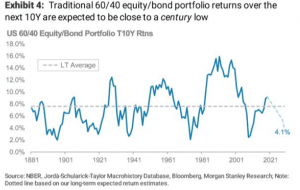
    The answer to this is entirely dependent on your age and your tolerance/capacity to suffer loss (even permanently). We shall assume for the purposes of this article the time horizon is 10 years and that the capital in this portfolio can incur some losses along the way and won’t be needed to fund living expenses over the period. No doubt readers are aware financial markets have had a good run over the past decade. It is entirely sensible to take the view that we must rein in our expectations for the next decade. Wall Street giant, Morgan Stanley, has already tried to manage expectations with its strategists suggesting a standard mix of bonds and equities in a portfolio would earn just 4.1% each year over the next ten years. Low-interest rates, low growth and commensurate low inflation are the familiar returns killers.  Here’s the chart to anchor our goal expectations:

    Now, let’s shift our attention away from the expensive large listed companies and all those bonds yielding zero or even less. In a previous thought piece, we wondered if smaller companies have some performance catch up to do on their much bigger listed peers. Holding that thought, we reckoned it might be helpful to illustrate the relative possibilities of assembling a portfolio of crowdfunding start-up opportunities over a four year period. So, here’s a suggested approach with plenty of good habits:

    1. Invest €100 in an equity crowdfunding campaign every month for 48 months (4 years). This good monthly habit avoids trying to “time” your entry into markets which will fluctuate over a long period.
    2. The portfolio goal is to own 48 equity opportunities in equal amounts of €100 by the end of year 4. This good habit of multiple holdings diversifies the portfolio across industries and geographies.
    3. A portfolio with multiple holdings also allows an investor to collect financial data across those companies and monitor various key metrics like sales, growth, cash flow/burn, margins, debt etc. Like all resolutions/habits – they are only sustainable if measured. This habit of measuring will ensure discipline and selection of opportunities which are consistent with the metrics/averages being observed. More on that again.

    Good habits now in place, will the portfolio deliver? There are no guarantees in finance but here are a few suggestions as to outcomes and the understanding that the professionals think 4% per annum might be the best on offer over the next 10 years. We are suggesting a €4,800 investment of capital. We will assume that all target investments (48) benefit from a 40% tax refund under the EIIS investment scheme.  After refunds of €1,920, investors’ are risking €2,880 in real terms. So that’s the capital at risk. We need to look at where the returns come from.

    Readers will recall our previous references to the famous Arizona University research showing just 4% of all the listed stocks in US history have delivered the entire returns of the S&P 500 since 1926. In theory, and the sample size is small, it is possible as few as 2 holdings in a 48 constituent portfolio will account for the majority of returns. Now, remember Morgan Stanley is telling us a 4 year period might deliver a return on our capital of just over 16%.  Here’s a table to suggest potential outcomes. We are going to assume the rest of the portfolio loses the equivalent of the tax refund(40%) ie 46 of the companies which received €4,600 in capital will lose €1,920 between them. Admittedly, this is probably too harsh an outcome but it will help illustrate what is required by just a few successes to beat a 16% portfolio return forecast on Wall Street. The following table lists a few scenarios and the impact of two companies achieving significant valuation growth:

    Please note in the “2 Winners”  column we are using €200 (€100 in each company) as the initial invested capital. Therefore a gain of €500 in the Match Wall Street scenario requires both companies to increase their value by just 1.5x. This is not a significant hurdle in the world of smaller companies and start-ups. The Run Wall Street scenario might sound fanciful equating to a 20x gain (or 2,000%) on the initial capital invested in the two companies. However, this is very possible in the world of private equity and startups. Yes, there is the risk of losing all your capital when betting on single winners but portfolio diversification is a very good strategy in a high-risk asset class.

    Returns are inextricably linked with risk. That’s a fact and don’t ever buy any product which claims no risk involved. In the worked example above your total capital at risk was €2,880. For perspective, that equates to €15 per week of spend where the loss of capital is permanent – think almond cappuccinos, cars/taxis and mobile data usage on a weekly basis. Maybe take a walk with a bottle of H2O? What productivity goals wouldn’t prosper by ditching the screens, exercising and hydration…..

    Finally, in the spirit of fresher thinking, it is worth noting the most unlikely companies can be the big winners so keep an open mind and spread the risk when building an investment portfolio. As an illustration and a little quiz, what’s the best performing listed stock in the US over the last 20 years? The clues would be that it features in a previous article and it delivers energy, but not the carbon-based kind!  A real Monster which has delivered 87,000% returns over two decades. Wowzers!  Good habits can really energize……

  • Are You Ready For Change?

    Any year featuring a new business, a new home, a 50th birthday and a divorce probably qualifies as a year of change. However, as I ran by the Poolbeg towers in the early days of 2020 my initial anxiety as to the pace of change in my life last year receded with the calming effect of a healthy dose of fresh air, endorphins and perspective. Maybe it’s an age thing, rather than my running speed, but it feels like the pace of change in the world is also picking up rapidly. In fact, on more considered reflection as I skirted Dublin Bay, my gut feeling was bolstered by the hard evidence of recent events.

    Let’s start with location. Location, location, location is the perennial property mantra. Indeed, investment in Irish commercial property in 2019 set a new record of €7.2 billion in sales value. That reflects a healthy business environment and, given 74% of the investment came from overseas investors, an external vote of confidence in Ireland’s future. However, striking as those sales statistics may be, the most stunning location figure for me in 2019 was the discovery of the largest live music venue in history. It wasn’t even on planet Earth.  The online gaming platform, Fortnite, hosted a 10 minute Marshmello performance which was witnessed by 10.7 million gamers at the same time. Now think about  Mass Open Online Courses (MOOC) in the world of education and one begins to realise the most valuable locations in the next decade are more likely digital than physical.

    Of course, many people spend the vast majority of their waking hours in the office place. The five day 40 hour week is undergoing serious review as productivity growth has ground to a halt in many developed economies. This puzzles many economists in a digital world but ignores the behavioural aspects of human endeavour. Four day weeks are increasingly common and “hot desks”  have become a major feature of office life but is it helping productivity? The evidence from Microsoft is thought-provoking. Having briefly regained its crown (pre-Aramco IPO) as the most valuable company in the world the business community is keen to learn from the Seattle brains trust. So, when Microsoft tested a 4 day work week in Japan the business world was jolted by a whopping productivity jump of 40% during the summer trial period.

    Companies may not have a choice in changing the conditions of employment. Japan now sells more adult diapers than infant diapers as demographic change bites. Japan now supports an over-65 demographic which accounts for 26% of the population! A shrinking labour force supporting a growing retirement population is not sustainable unless productivity grows sharply. China and Europe face similar problems this decade so expect major change to employment practices.

    Fortunately, AI (Artificial intelligence) is going mainstream. The value creation associated with AI in the next decade is estimated to be in the region of $15 trillion by the likes of McKinsey and Accenture. The numbers might not materialise but there is no doubt the workers of this decade will need to embrace the reality of working with technology, automation and even robot supervisors. The option for businesses to wait and see, do nothing or just hope is a death strategy.

    Financial services and banks are a good example of businesses that must change, quickly. Recent announcements from Apple, Facebook, Google and a plethora of Chinese players is confirming a major move by Big Tech into payments and financial services. If we recall the pre-Amazon era, consumer spend and logistics were separate activities. Now, delivery is a feature of consumer spend from Christmas trees to sushi. In the world of finance it is quite likely payments and financial services will be embedded features of other services rather than standalone banking. Prepare for “location” banking to die.

    Clearly, as human beings, our DNA has strong survival instincts despite our collective best efforts to kill our planet over the last industrial revolution. It would seem climate change will be an accepted part of our lives over the next decade. The last decade was the hottest on record with July last year documented as the hottest month in human history. The catastrophic fires in Australia are a further reminder that climate science denial is not a survival strategy.

    It would be wrong to conclude this piece with a negative change and it is wholly appropriate that the most prominent climate neanderthals are leaders elected on election platforms railing falsely against the woes of the world and warning how everything is taking a turn for the worst. The facts do not support fanning those fears. A recent fascinating article by Pulitzer Prize winner, Nicholas Kristof, in the New York Times posited the view that 2019 was actually the greatest ever year to be alive:

    “If you’re depressed by the state of the world, let me toss out an idea: In the long arc of human history, 2019 has been the best year ever … since modern humans emerged about 200,000 years ago, 2019 was probably the year in which children were least likely to die, adults were least likely to be illiterate and people were least likely to suffer excruciating and disfiguring diseases.”

    Furthermore, some of the statistics of recent years are truly remarkable. Every day in the past few years 325,000 got their first access to electricity and an amazing 650,000 people went online for the first time, every single day! Child mortality before the age of 15 has dropped from 27% in 1950 to less than 4% today and extreme poverty globally has halved since 1990.

    So it’s all change. A lot of it good. There will be challenges ahead but without sounding like Mel Gibson in Braveheart if, as a business or a human being, one runs away from change you might live. At least for a while. To really survive, the time to prepare for change is now and accept there will be failure along the way. That’s life.

    Enjoyed this blog? Then why not check out our other great content by clicking here!

  • 2020 Vision or 10 More Surprises?

    I had a great rugby coach in school who used to always say “expect the unexpected”. The original quote has been attributed to Heraclitus in about 500 BC but Oscar Wilde a bit later tweaked the phrase with a conclusion that it “shows a thoroughly modern intellect”. Certainly, as a species, we are brutal at making forecasts so perhaps knowing one’s weaknesses does illustrate some intellect.

    Anyway, as 2020 approaches prepare to be bombarded with forecasts but then cast your minds back to 12 months ago. Did anyone forecast $15 trillion worth of bonds yielding negative rates of interest, a WeWork near-death experience or a Boris Johnson-led government to achieve the greatest Conservative electoral win since 1987?  Yep, whoodathunk. Financial and geopolitical developments will continue to surprise so it is probably good risk management to entertain the possibility of plenty more surprises in 2020. Here are 10 more potential surprises the team at Spark Crowdfunding have put together for those of a curious persuasion.

    1. Donald Trump resigns from the US Presidency for health reasons and global financial markets experience the best single-day advance in a decade.
    2. Softbank as WeWork’s largest shareholder and the world’s second-largest non-financial corporate debtor endures its own near-death experience and enters into credit restructuring talks with its bankers.
    3. Tesla’s market value exceeds $100 billion which is more than the combined value of General Motors and Ford.
    4. US 10 Year Treasury Bonds join their European peers in the negative rates yielding club.
    5. Deutsche Bank collapses and enters state ownership.
    6. Fianna Fail is the big winner in the 2020 general election and forms a coalition government.
    7. Kim Jong-Un dies in a horse-riding accident. South Korea and North Korea enter into peace/reunification talks 3 weeks later.
    8. Los Angeles is evacuated as multiple mega fires burn out of control fueled by unusually high wind speeds.
    9. Russian hackers cripple JP Morgan’s payment technology systems for 2 weeks. Republican party leaders insist the attackers could be Ukrainian.
    10. A coup in Saudi Arabia topples the House of Saud and Prince MBS. Brent crude prices rocket 30% in the first 24 hours after the coup. Two weeks later oil prices have retreated back to pre-coup levels.

    Happy Christmas everyone and best wishes for 2020.

  • Brexit Border Opportunity

    We have done our best to avoid mentioning the “B” word for a few weeks now but the coronation of Boris as King of the Little Englanders has forced our hand. A whopping victory for the Conservatives on a very effective “Get Brexit Done” message had initially led to hopes of a stable Johnson government having more flexibility to pursue a softer Brexit. As with most hopes associated with Boris Johnson, that didn’t last long.

    The new UK government has announced in its first week of power that it will push through legislation making it illegal to extend the 2020 extension period beyond 11 months. Clearly, this move is designed to pressure European negotiators to agree on a trade framework by 31st December 2020 or face the potential chaos of the UK automatically moving to a WTO-type trading relationship. The UK as a WTO trading counterparty would require the imposition of higher tariffs and more draconian regulatory restrictions on cross-border trade and services. This is not good news and currency markets have responded emphatically by paring back all the gains made by the GBP currency since the election last Thursday. However, the UK elections have presented a more optimistic scenario in one corner of the kingdom.

    Arlene Foster’s DUP, representing the 17th Century, suffered a fairly traumatic election. Its leader in the House of Commons, Nigel Dodds, lost his North Belfast seat to Sinn Fein and delivered a first time Nationalist representative for a constituency steeped in Unionist traditions and memories of Edward Carson as its most famous parliamentarian. Seismic stuff. But there’s more as the other Belfast Carson, Frank, used to say.

    Thanks to the win of the North Belfast seat by Sinn Fein there is now a majority of Westminster seats held by Nationalists. Furthermore, with the centrist Alliance party and the SDLP winning 3 seats there is a majority representation for parties who are politically opposed to Brexit. Not only has the DUP and Unionism lost its leverage with the Conservative government, it has lost its majority in Northern Ireland too. Demographics and social trends are unlikely to reverse this situation any time soon.

    Whisper it softly but there’s a chance of reviving the local Stormont government with a chastened DUP and then potentially some progress for the people of Northern Ireland. The requirement under international law and the Good Friday Agreement (GFA) to keep the border open with the Republic of Ireland presents an interesting opportunity. In the financial world, we might term this “regulatory arbitrage” but in the language of main street Northern Ireland has a unique status being simultaneously in the post-Brexit UK and in the EU. Think Hong Kong and its “gateway” status into mainland China and a completely different set of laws and political systems. Irrespective of current unrest in Hong Kong, its unique status has generated enormous wealth for investors and businesses in the territory.

    A more inclusive Northern Ireland (NI) with a functioning local government could become a very attractive location for UK and EU businesses wishing to capitalise (arbitrage) on its unique status. While tariffs and regulations are usually considered non-business friendly there will no doubt be smart management who will sniff out an opportunity to gain an advantage over their competitors. Companies in the following four industries/activities will probably take a close look at NI developments:

    1. Logistics: Could Belfast port return to previous glories as a significant EU gateway?
    2. Finance: The challenges faced by financial services companies would suggest any small tax or regulatory advantage is worth investigation.
    3. Food Processing: The food sector is reliant on time-sensitive supply chain systems. The potential use of an EU “badge” could be very interesting to companies engaged in value-added food manufacturing.
    4. High-Value Manufacturing: The Republic of Ireland is already considered the number one high value manufacturing location in the world. Businesses that can straddle the different UK and EU regulatory and tax regimes will be very interested to explore the possibilities of locating to NI.

    Of course, the opportunities don’t just lie with business owners. Investors would do well to think about the potential increases in income (lowest in UK) and the likely positive impact on asset values in the commercial real estate, hotels and consumer services sectors.

    Perhaps this all sounds a bit fanciful. Edward Carson’s former Trinity College acquaintance, Oscar Wilde once said, “A dreamer is one who can only find his way by moonlight, and his punishment is that he sees the dawn before the rest of the world”. Certainly, the North of Ireland’s unique status and dual identity will continue to confound the outside world but there’s a sense we are moving from the darkness into the light. How wonderfully ironic it would be if the North Belfast political fortress of Edward Carson, a Dubliner, could be the catalyst for a different union with exciting wealth creation possibilities!

    Enjoyed this blog? Then why not check out our other great content by clicking here!

  • A Letter To Santa From Christine Lagarde and The ECB…

    There’s a new boss in town. Christine Lagarde chairs her first ECB monetary policy meeting this week and will then face the press. One can only hope that there are no nearby fridges to stand in the way of hearing the new ECB President’s vision of monetary life after Super Mario (Draghi). Her predecessor is credited with saving the euro but President Lagarde might have to save the world.

    There are early hopes among environmental activists that the ECB will bring its considerable financial weight to bear on fighting the global climate emergency. However, the reality is that the nascent “green bond” market is too small to really make a significant impact on climate change. The environment is one of many items likely to appear on the Lagarde wish list. As a former head of the IMF, she will be well aware of the challenges facing Europe and the planet. Many of those challenges are long-standing, almost hopeless causes, but it is the season of hope ahead of a brand new decade so we thought a little letter to Santa might be in order. Here’s a guide to what we think the ECB would like Santa to deliver.

    • Inflation: The world’s largest trading bloc has been crippled with very low inflation. Ultra-low, even negative interest rates have utterly failed to deliver higher inflation to stimulate consumer spending of cash which remains hoarded in banks across the region. The phrase “Japanification” is being increasingly employed to describe Europe’s predicament of using a failed monetary tactic but unable to change course for fear of strangling economic growth in the region. A gift of higher inflation from Santa would hugely help the ECB and allow it to address its other intractable problem.
    • Healthy Banking System: It is no secret Europe’s banking system is in a parlous state. Burdened with massive bad debts like the Japanese banks of the late ‘80s, there has been a lack of political will to mandate the ECB to cease the can-kicking and call time on some serious banking franchises. The standout banking patient in Europe is Deutsche Bank but it is arguable that the entire Italian banking system is equally in need of tough structural medicine. Santa’s gift of a banking “solution” will need to be very innovative as any concerted ECB policy effort to shrink the banking system could push the region’s economy into recession. So…
    • Structural Growth: Europe is often described as being in structural decline and destined to be a low growth economy for decades to come. Demographics are certainly not helpful as the workforce ages and dictates a smaller pool of labour is required to support the pension draw downs of a rapidly increasing retired population. Poor industrial policies of many European governments have also been guilty of protecting older industries at the expense of faster growing sectors, primarily technology. European industrial policy is a classic case study in misallocation of capital. Bloated public(government) sectors and the protection of older industries like utilities, coal, steel and autos have consumed huge amounts of capital and starved structural growth sectors of capital. We are thinking information technology, health, education and materials technology(energy storage) as areas with very strong structural growth stories. Santa needs to deliver a new European growth story soon.
    • Brexit: Get it done, says Boris. Good luck, says Santa. Europe really needs to move on. Brexit uncertainty is killing investment and confidence. Sadly, a letter to Santa is really the only hope for Boris as current thinking on trade negotiations and timings are the stuff of Lapland fantasy.
    • Climate: Of course, Santa has not enough room in his sack to deliver an entire planet but maybe just maybe Santa could help? We were thinking he could give inspirational guidance to Europe which could address not just the climate challenge but deliver on most of the gift requests listed above. What if the ECB rather than trying to cajole the European consumer to spend, declared that many goods and services would over time be only available in a finite amount. Think water, food, forestry, plastic, buildings, travel and broadband spectrum and then think about a race to consume and acquire before scarcity. This would instantly not only generate inflation but also dramatically change humanity’s rate of consumption of the planet’s precious resources. This writer had often thought the best way to change consumer inflation expectations was to “tell” people there was significant increasing inflation ie fake inflation news. It doesn’t seem so much a sin of spin these days given the daily dose of delusion being visited on the UK and US electorates. One way, or the other, inflation is really what Europe needs to free itself from its stagnancy straitjacket. Ironically, the planet’s climate could be, over time, the disciplinary Santa which delivers resource scarcity plus inflation rather than a sack of “beautiful clean coal”. A very Trumpian irony indeed.

    Anyway, in a few hours we shall see what Christine Lagarde thinks is possible. And, where Santa really is needed…

    Enjoyed this blog? Then why not check out our other great content by clicking here!