Category: General Financial

  • Daft Junk Government Might Not Get Lucky

    Daft Junk Government Might Not Get Lucky

    In the London office of KPMG they might tell you to “stop moaning”. Perhaps we should. Vaccinations are coming, efficacy rates are great, schools are opening up again and spring is in the warmer brighter air. And yet, frustration is growing with a perceived lack of government urgency in returning the country to a more normal level of social and economic activity. I never thought I’d write this but my sense is a major driver of governmental sclerosis is money. No surprise there. But what if I said it was easy access to money rather than the lack of money? First, let us confirm the perception as a data reality in the following graphic (Source: Oxford Coronovirus Government Tracker) showing Ireland topping the European charts in the number of days in lockdown:
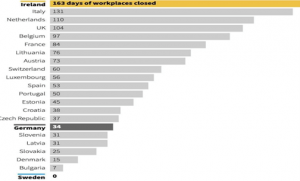
    Lockdowns cost money, lots of it. Last week we mentioned that high-risk companies were raising debt (junk bonds) at all-time low interest rates. Governments, thanks to central bank support, are even luckier with borrowing costs close to zero or better(negative rates). In fact, Ireland is doubly blessed as the only European country to actually achieve positive GDP growth in 2020. Very large multi-national tech and health sectors do help. Lucky us.

    But, I’m not so sure of luck over the long run. This may sound odd, but one wonders would our government show a bit more urgency and innovation if funding was a little tighter? The government is tasked with dealing with both a public health and an economic crisis. Very difficult but in recent days I am reminded of those famous words of Ronald Reagan – “The nine most terrifying words in the English language are, ‘I’m from the government, and I’m here to help’. ” The following government actions or inactions could come back to haunt us.

    1. The government has announced an extension of social and economic lockdown until April 5th but has assured us “the end is truly in sight”. There was specific mention of new virus variants as additional reason for caution but no mention of shutting airports and borders. Is it just easier to lock us up?

    2. As we approach one year anniversaries of pandemic lockdowns recent reports suggest NPHET have told the government additional lockdown periods are necessary until hospitals begin to reduce record patient waiting lists. Despite a wall of debt funding available to government, it would seem the Department of Health and the HSE has failed to upgrade our hospital capacity or staffing levels. Back in October our “No Funding Limits As Lockdown Bites” article made pointed reference to the lack of HSE planning for a “consistent spike in non-Covid hospitalizations through the winter months…EVERY year”. Is the government calculation that business owners are more capable of shutting businesses than the HSE is capable of delivering a public health system which is fit for purpose?

    3. The SME sector employs one million people. It is the crippled arm of our K-shaped economic recovery but the government seems incapable of articulating an effective capital support strategy for SMEs. There are lots of supportive words, even credit guarantee schemes, but the dogs in the empty streets know there is no real urgency to bring new thinking to the crisis. The draw down statistics on the SME Credit Guarantee Scheme are damning; in the last update, just over 10% of the €2.5 billion of “available” funding had been taken by SME companies. Where is the government curiosity on this disfunctional support scheme?

    4. The government is a significant shareholder in two of our three pillar banks, AIB and PTSB. And a fourth big SME player, Ulster Bank, has just thrown in the towel. Competition is now a quaint concept for business customers. Recall those Reagan words and wonder why Irish mortgage rates are double the European average. It is even worse for SME customers. A Central Bank report in October showed Irish businesses were lumbered with borrowing costs more than two and a half times the euro area average (5.03% vs 1.90%). After Ulster finally says “NO” what price will businesses pay for a government-owned “Yes”?

    The Ulster Bank exit also provides a window into the out-dated thinking being applied to business banking. Latest reports suggest government owned AIB will buy/take over the €4 billion Ulster Bank commercial lending portfolio. Think of a world embracing the efficiencies of digital platforms, artificial intelligence(AI), remote/cloud computing and data science. Now think about the number of staff it is suggested are needed to accompany that portfolio of loans to AIB……. 300. The mind boggles. Yes, government is scarred by the 2008 financial/banking crisis but it is possible to re-invent our banking sector. A fresh(no legacy loans) well-capitalised national digital business bank operated by the best tech-savvy banking experience would be a really good start in breaking our customer-crushing image. It can be done.

    Check out France, the home of recently split dance duo, Daft Punk. Some might not even know they were French. Here’s a few other things we may have missed about France in recent years. For most of my financial services life French stocks have failed to excite most fund managers – 30 hour work weeks, state-intervention and tight relationships between the national champion firms are often cited. Sounds like Reagan’s most feared form of government help. But look again, as Bill Blain at Shard Capital has done, and you’ll find there are more top 500 global companies in France than any other country in Europe. Blain thinks fund managers are missing a trick; “France could be on a roll. It has reasons to be. There are over 1 million trained engineers, 13,000 AI researchers and almost 60,000 French PhDs – all of them as dedicated to beating les Rostbifs in business.”

    France has a plan. We don’t and there’s a growing sense that difficult government decisions are being put on the long finger as a hope strategy. Hope is not a strategy. And there’s some cautionary signals coming from global debt markets. Government needs to move quickly as the “Get Lucky” period of low interest rates won’t last forever. The FT headline today highlights growing debt market concerns – ‘Bond investors suffer worst start to year since 2015”. Let’s hope bond markets this time inspire some constructive urgency rather than 2008 destruction. The government need to remove the pandemic helmets and apply modern solutions to our healthcare system and SME funding. Pandemic excuses and easy money will probably end. Public anger will not.

  • Great Expectations

    Great Expectations

    Sometimes I wish NPHET’s body of experts and medical chiefs would collectively do the ‘Freezebury Challenge’. As each day of February goes by, those hardy souls counting the extra minute each day in the frigid Dublin Bay waters understand the battle waged between fear of the next day’s incremental pain and the motivation of a charity challenge completed with a firm finish date; March is the fun swim focus. However, NPHET don’t do fun. Dates are fuzzy and the focus remains fear. The good news is human beings are resilient. It’s in our nature to look ahead, despite the challenges, and financial markets are currently providing a remarkable case study in expectations.

    If anything, economic conditions have worsened in recent weeks as businesses in Q1 deal with second and third wave pandemic lockdowns. Main Street is struggling. Yet, Wall Street is flying to record highs on an almost daily basis. The headlines would suggest “meme stocks” like Tesla are the drivers of this market excitement but that is not even close to the full picture. The truth is that it is not just “stories” which are generating investor enthusiasm. It is real stuff; dirty, old, fundamental stuff. And a little bit of digital dreaming. Here are a few data points which caught the eye:

    • Lumber prices in the US are up 170% over the past 10 months.

    • Oil prices above $60 per barrel are at 13 month highs.

    • Prices of natural gas in Asia almost reached $30 per MMBtu compared to just $2.60 in the US.

    • Tin prices at $30,000/tonne hit a 10 year high.

    • Copper prices at $8,400 per tonne have not been seen since 2012.

    • Soybean prices are up 60% in the past year.

    • Investor confidence in riskier companies’ debt hits record highs(price) as junk bond yields go below 4%.

    • Share prices in emerging markets are at record highs, finally eclipsing the previous peak achieved in 2007.

    • Japanese investors in the Nikkei 225 index have had to wait a little longer. The Nikkei is back at the 30,000 level it last achieved 30 years ago!

    And now for the dreamy stuff…..

    Investors can’t get enough of thematic blank cheque investment vehicles. Known as SPACs (Special Purpose Acquisition Companies) these vehicles are being listed on public markets at an unprecedented rate of almost $1 billion raised per day. In 2020 the total SPAC investment universe raised $83.4 billion dollars. We are only in mid-February and funds raised are already at $46 billion. Please note investors don’t even know where these funds will be spent in terms of acquisitions, geographies, valuations etc. You know, the fundamental stuff, right?

    Of course, we can’t ignore cryptocurrencies. Elon Musk and Tesla made a big splash in recent weeks buying $1.5 billion of Bitcoin and now this digital “store of value” has passed through the $50,000 price mark. Now there are commentators excitedly talking about Bitcoin as a more efficient substitute for gold which is an asset class ten times the size of Bitcoin’s market cap. So, next stop is $500,000 for Bitcoin!

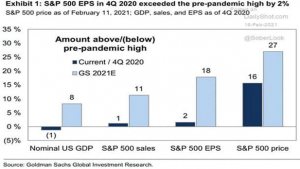
    Yes, this writer is a little concerned. However, confidence is critical to economic recovery. There will be fun and tears along the way(ask the Gamestop bandwagon victims) with pockets of irrational exuberance, particularly in a super-low interest rate environment. However, we leave you with one final fundamental data point which suggests better times ahead. There is a school of thought that Wall Street has detached itself from Main Street reality but check out the latest analysis by Goldman Sachs below. It would appear that profits from companies in the S&P 500 in Q4 2020 were actually higher than those achieved pre-pandemic….

    Clearly, things are getting better in the corporate world and the roll out of vaccines can only add to optimism. However, expectations must be managed. There is a danger some investors will chase the shiny baubles of Wall Street as a panacea for pandemic loss. Fear of missing out, FOMO, is a powerful emotion but there will always be fundamentals….. and hopefully fun. Indeed, Dickens himself told us Pip would rather have missed the glitz of wealth:

    “I used to think, with a weariness on my spirits, that I should have been happier and better if I had never seen Mrs. Havisham’s face, and had risen to manhood content to be partners with Joe in the honest old forge.” ‘Great Expectations ’

  • To Be Or Not To Be?  The Game Stopping Social Media Question

    To Be Or Not To Be? The Game Stopping Social Media Question

    Dear Minister Donnelly, can you please impose more restrictions? I won’t take an emoji for an answer. Then again, which emoji could come even close to the sensory onslaught unleashed in the past few days? Without even stepping foot outside the door we have been treated to a bizarro ensemble of events on our screens.

    Who would have thought the DUP, representing the 17th Century , is now positioned in voter polls as a centrist Unionist party to the left of Jim Allister’s TUV with 10% support? Did an army of retail traders almost take down Wall Street last week? In our last article we did say, “Let’s be careful out there” but we weren’t quite expecting manic nostalgia trading in late-millennial names like Gamestop, Nokia and Blackberry to crush the hedge fund wizards.

    Not exactly the stuff of ‘Bonfire of the Vanities’ but if we are talking fires how do we top first-term Congress Representative, Marjorie Taylor Greene, who suggested that Californian wild fires may not have been due to climate change. This is where the GOP would have liked their latest Qanon fruitcake to leave the climate debate but no such luck; Marjorie has been vocal on social media advancing the theory that a “space laser” funded by Jewish banking families created a solar beam to set California ablaze. We would be veering into comedy teritory if it weren’t so serious. Public health and safety is at risk and it all boils down to misinformation.

    Boris and the Brexiteers were always going to shaft the DUP and its wish for a stronger Union. One by one, all those misleading Brexit campaign messages have been thrown under a very large red bus. Now, council staff at Larne port have been withdrawn due to threats to their safety. Meanwhile over on Wall Street, the staff at retail trading platform, Robinhood, won’t want to read the online Reddit vitriol aimed at them; the keyboard warriors are blaming Robinhood(and other brokers) trading restrictions in Gamestop shares for a 65% downward return to reality yesterday. Conspiracy theories abound and leave little room for the most basic of trading constants; more sellers than buyers and a share price will fall. Yes, last week’s meteoric Gamestop share price rise was a complicated mix of short sellers, borrowed stock, margin/debt trading, options instruments and liquidity but, in truth, it was just a lot more buyers than sellers. We probably don’t need to tackle the “space laser” conspiracy theory but we will confront the major contributing cause.

    Social media platforms are the dominant source of public misinformation in the digital era. Kim Kardashian hit our screens in 2007 but governments and regulators have failed to Keep Up With the consequences of influencers communicating via social media platforms. There are now 4.2 billion social media users around the world according to a just-published report by Hootsuite. This writer is old enough to remember broadcasters had standards authorities, financial advisors had regulators and politicians had credibility. The power of Reddit, Twitter, Facebook etc to promote influencers to billions of people has been a game changer and raises three fundamental questions:

    Should social media platforms be regulated like traditional media broadcasters? The fact that millions believed Brexit lies or US election misinformation has massive implications for modern democracies.

    Should social media platforms be regulated like financial advisory businesses? The Reddit account, r/WallStreetBets, built an audience of over 4 million people last week and convinced many of those that Gamestop was not hurtling towards retail obsolescence. Hundreds of thousands of retail investors followed influencers like Davey Day Trader and Roaring Kitty and invested in Gamestop. Many will lose money they can’t afford to lose in inappropriate single-stock investments.

    Should social media platforms be regulated like critical national infrastructure? The national security risk here is not that a social media platform ceases to function. Rather, it falls into the wrong hands and is used as an instrument of chaos, as destructive as a failed electricity power grid. Malign messaging can threaten, even overthrow democracy. Only this week we are reading about a challenged election result in a far away land, the imprisonment of senior political leaders and the attempted restoration of a disgraced party to power. And that’s only the briefing papers for the upcoming US Senate impeachment trial of Donald Trump. Meanwhile in Myanmar the military has taken power and shut down the internet. The tragic irony of that action will not be lost on the Rohingyan minority in Myanmar. As recently as 2013 the military used a Facebook campaign to incite genocidal violence against the Rohingya population. These events did prompt US Congress scrutiny and Facebook has admitted it was “too slow to prevent misinformation and hate”. But doesn’t it all sound too familiar?

    The most advanced nation on the planet experienced a societal near-miss when Capitol Hill and Wall Street faced down a social media insurrection. It seems inevitable we might not be so lucky next time. Action is urgently required. Social media platforms must state what they want to be, and what they don’t want to be. Then they must act, or governments will. There are now more than 4 billion reasons why they will and every Minister of Health on the planet is anxiously watching the steady rise of the Anti-Vax movement. Over to you Minister Donnelly……

  • No Sign Of Wall Street Blues

    No Sign Of Wall Street Blues

    Happy Blue Monday but crikey! It’s tough enough these days without Father Time slapping you with a big number. Was it really 40 years ago this week when the TV crime series, Hill Street Blues, first hit our screens? Think back to Mike Post’s instrumental theme music, grimy urban scenes, innovative shaky hand-held cameras, multiple storylines and the steady din of background noise.

    The Hill Street precinct was breaking new ground in TV-land but who can remember Wall Street almost breaking the economy? More specifically, the cost of money for business was approaching nose-bleed levels of 20% interest rates. Grim days. Not so these days. Despite a global pandemic and ‘a real and present danger’ sitting in the Oval Office, financial markets are experiencing pockets of euphoria. Let’s take a look at three headlines over the last week.

    Affirm Stock Rockets More Than 90% After IPO – MarketWatch

    Bank share prices still wallow at historic low valuations but it seems that Affirm’s buy now/pay later financing facility is ground-breaking. Hmmm. Lots to think about here on top of the $24 billion valuation attributed to a financing option which has been around since 1157, according to the history of Venice.

    Signal Advance Has Soared 11,708% Since An Elon Musk Tweet – Business Insider

    A personal favourite this one. The world’s richest man, Elon Musk, tweeted “use Signal” to his 42 million followers last week. The background to this was a privacy revolt against Facebook’s WhatsApp messaging service. Sure enough, the Signal messaging app signed up millions of new users and the valuation of Signal Advance soared from a tiny $6 million to $300 million in just a few days. As Captain Blackadder might say, there was a tiny flaw in that investment strategy. Signal Advance has zero commercial connection to Signal, the encrypted messaging platform. Thousands of investors have bought the wrong stock.

    SPAC Mania Gives Early Investors Steady Returns With Little Risk – Wall Street Journal

    It is difficult to believe this is a WSJ headline. “Early” and “Mania” might be the operative words in this gem. As a brief explainer, a SPAC is a “blank cheque” investment vehicle which raises money via IPO on a promise to acquire companies in a specific(usually) sector or with an identifiable theme eg. Start-ups, hydrogen fuel, social media etc. In 2020 there were 248 SPAC IPOs. In the first 2 weeks of 2021 there have already been 40 listings on the public markets. SPACs are not new. They come into vogue when multiple “hot” sectors appear and investors look for swift access to these themes. Previous incarnations have included shipping, banking and energy exploration. The track record of these is mixed to put it mildly. Anyway, this is the early giddy expectation bit – enjoy the IPO excitement before the funds are spent and often wasted.

    Please do not take this as a blanket statement that financial markets are in a bubble. In fact, there are large parts of the market which are only just breaking out of multi-year slumps. Think smaller companies, European equities, banks and emerging markets which have all had a very tough decade. However, it would be remiss of us not to take on board the iconic daily cautionary words of Sergeant Esterhaus at the Hill Street precinct – “Let’s be careful out there”.

  • Media Sector: Call for the Dead

    Media Sector: Call for the Dead

    I think the greatest single enemy is the misuse of information, the perversion of truth in the hands of terribly skillful people. Not my words. That is a direct quote from the greatly missed John Le Carre. He should know, a former spy who went on to become the greatest espionage storyteller ever. His very first book, “Call For The Dead”, was on the cusp of being published sixty years ago and how that title seems to resonate today. The battleground is different – a viral threat has replaced hydrogen bombs in the narrative – but information is still critical to self-defense in a global public health crisis. However, there’s a big problem.

    Information socialism has arrived. Thanks to social media everyone is now a broadcaster – the ‘elitist’ barriers of licenses and legal responsibilities have been torn down. Like a 1950s Soviet collective farm, accountability and positive incentives die. Of course, this is fertile territory for bad actors wishing to manipulate the truth. Sadly, truth is not the only victim of these actions. The US is breaking records in a bad way every day in its battle with Covid-19. More than 300,000 dead and a death toll run-rate approaching 25,000 per week has been a tragic result of chronically poor information. Criminal even.

    The undermining of the US election result has been all too easy for the Trump campaign. There are now more than 50 million Americans who believe the election was rigged thanks to the malign efforts of campaign lawyers and enabling media personalities at Fox, OANN and Newsmax. The echo chamber of social media and the targeted sharing of misinformation has merely completed the trust destruction cycle. It’s frustrating and …….deadly. Who knows how many lives could have been saved if US government messaging had represented the truth? We now know truth was not the goal thanks to the staggering New York Times’ reports of White House interference in the communications of the CDC, the very institution tasked with protecting the health of US citizens in a pandemic.

    The protective benefits of social distancing, masks and reduced social contact was lost in a toxic political environment fueled by the social and traditional media all too willing to please their target audience bases. The consequences have been tragic in human terms but there is an even bigger challenge ahead. The arrival of a Covid-19 vaccine is a huge positive but the corrosive media influence on trust remains a huge threat. Providing individual broadcasting rights to conspiracy theorists and anti-vaccine campaigners could undo the benefits of a vaccine. One suspects a Biden administration will demand more responsible media behavior. Already, we are seeing some interesting moves.

    Fox News was forced to broadcast explicit 3 minute clips during various top-rated shows debunking the false accusations that Dominion vote counting machines were manipulated. Furthermore, both Google and Facebook are now facing commercial anti-trust litigation. Facebook, as we predicted a year ago, is actually fighting federal initiatives to break up the company. The fight for truth might be staging a comeback but more fundamental cultural shifts are probably required. Traditional media has strayed from its original role to provide information. Today’s traditional broadcasters compete in a consumer market where information socialism and ‘infotainment’ are inextricably linked. The following are probably the four most truth damaging trends:
    1. Broadcasters now strive to deliver messages which their customer bases expect, irrespective of accuracy.

    2. The arrival of Fox News in 1996 promised to give traditional middle America a voice. In effect, Fox successfully broadcast “the other side” to challenge mainstream media messaging.

    3. Competitive pressures forced mainstream media to provide ‘balance’ and air the other side to every issue. But not every issue merits this balancing and has resulted in rampant “false equivalence” in almost all media. Think Hilary Clinton emails ahead of the 2016 election.

    4. Finally, the disastrous evolution of “both side-ism”, “ balance” and “false equivalence” has produced an army of opportunistic broadcasting personalities who command huge air-time irrespective of their relationship with reality. Historically, broadcasters took responsibility and vetted contributors based on their qualifications, credibility and independence. That barrier to broadcast has been obliterated – welcome to information socialism.

    Who knows what will be the tragic wake up call for traditional media but one senses there will be an event and a truth commission which will leave its mark. The consequences of the Iraq war and Trumpian complicity in pandemic deaths and Russian cyber intrusion are still up for potential debate but a failed vaccination program could be the ultimate Call For The Dead.

  • ‘Tis The Season For Some Folly

    ‘Tis The Season For Some Folly

    This week has been a bit of a head wreck. Pandemic deaths in America are now at a daily 9/11 toll level but the GOP and its cult leader wants citizens to focus on delusional vote rigging conspiracies. Worse still, it seems to be working as upwards of 50 million voters don’t believe there could be 81 million of their compatriots who hold a less worshipping view of the President. This mass cognitive dissonnance is not exclusive to the US.

    Closer to home we are witnessing millions of Brexit supporters in total denial that in every multi-party trade deal ever concluded in history there existed a compromise on sovereignty. Any chance they’d check the not-so-small print in the WTO trade frameworks or even the cuddly Koala version presented as an “Australia – style” deal? No chance now to calmly point out that single (multi-party) markets and total sovereign control are utterly incompatible and devoid of any logic. Head scratching stuff but dare we suggest these flights of folly are not confined to politics. Financial markets, IPO activity in particular, are potentially veering into irrational territory.

    Let’s start with DoorDash which made its market debut on Wednesday. This seven year old company is the top food delivery app in the US so Wall Street’s analysts had initially proposed a valuation in the $30 billion region. By Wednesday night that valuation, after the first day of public trading, had rocketed closer to $70 billion. That’s pretty close to the valuation of the fifty year old global logistics giant, FedEx. Need to lie down? Try an AirBNB, or should we say try its IPO.

    Yep, AirBNB having stared global pandemic calamity in the face was anticipating an IPO debut valuation of around $50 billion yesterday. Silly analysts. Investors swooped on the shares and the stock soared to a the $100 billion valuation. Yep, the online vacation rental platform is now worth the same as Marriott, Hyatt, Expedia and Hilton combined. Or…. More than six Ryanairs and its annual 150 million passengers. These two IPOs might benefit from strong retail profiles/brands but investor euphoria is not confined to the headline grabbing monster issues.

    Consider the AI software play, C3.ai. Its IPO was expected to deliver a valuation in the $5 billion region. Try $12.5 billion! That equates to 40 years of sales….. not income. That’s a lot of growth, modelling, guessing and whatever you fancy for Christmas. AirBNB will hardly blush, trading at a sales multiple of 20x its forecasts for 2021 and DoorDash is on a 16x sales promise. Even the most demanding of Santa letters would struggle to match this innocent optimism.

    Indeed, we have written many times here that human beings are awful at forecasters but let’s just say there’s a staggering level of future forecasting and certainty in these valuations. Did Covid-19 and a global economic shutdown really just happen in the past 12 months? Clearly, the return of investor confidence is a good thing but markets are partying pretty hard right now. As we all know, Doctor Tony doesn’t approve of partying at the moment and we can even agree with Boris on this occasion – “Be jolly careful!”

  • Banking on Digital Destruction?

    Banking on Digital Destruction?

    Crikey, that was an awful dose of George (g)Lee on the radio this morning. The intrepid RTE correspondent for Science is building quite the reputation for gleeful gloom. Yes, the pandemic data is stubbornly flatlining but to opine that the critical R-rate “must be over 1.0” ventures into emotional bias territory rather than the realm of science and analysis. Perhaps he will be right but the more immediate benefit of George’s latest BULLetin was to prompt some self-reflection. Do I exhibit similar emotional bias in certain areas? I often wonder if I am too gloomy on the prospects of the banking industry so this might be a good week to introduce some balance. And, it has been a good week for banks.

    Banking is about the provision of debt capital – more on that later – but it was other areas of the capital markets where the good news was to be found. Thanks to positive vaccine news bank share prices have been on a tear. AIB’s share price has rocketed up over 50% in the last 8 weeks. However, that 8 week period referenced hints at more than just vaccine relief. Whisper it quietly but inflation or reflation is working its way into market forecasts and that helps the banks.

    It also helps when there is a general rotation into VALUE stocks which is typical when investor confidence in economic growth picks up rapidly. Investors have not been too picky and a basic trading strategy of buying the most depressed share prices has worked very well. Oil and banking shares are very much in that depressed cohort and are enjoying much needed buying activity. Like George, investors could be correct but such affirmation could depend on one’s time horizon. You have read about a “Great Rotation” out of the pandemic stars in technology and healthcare. The less polite might refer to the investor switch as a “flight to sh*te”. Both descriptions tend to suggest investor enthusiasm is brief and lacking any real fundamental conviction. However, there is market activity elsewhere which illustrates greater conviction.

    Spanish banking giant, BBVA, has just announced the sale of its US franchise to the top 5 US player, PNC. The American purchaser is making an interesting strategic move and the value of the deal at $11.6 billion is the largest banking transaction since Lehmans collapsed. Particularly striking is that PNC have funded the deal with the sale of their stake in fund management behemoth, Blackrock. Please note strategic shifts out of fund management into traditional banking are as rare as evidence of fraudulent voting in the US these days. Other merger activity is happening in Spain with Bankia/Caixa and BBVA/Sabadell tie-ups plus the intriguing rumours of a monster Swiss deal between UBS and Credit Suisse. These are not short-term ‘rotations’ or trades. They are big long-term management calls which require confidence. However, they could also be described as “defensive” moves and news closer to home does trigger a bit of George in me.

    Ulster Bank’s Dublin HQ not only sits on George’s Quay but could in a matter of years be empty. Ulster’s parent, Nat West, has acknowledged the future of the bank is “under review”. One of the less desired options is that the bank is put in run-off mode if it fails to attract a buyer for its Irish operations. Just to remind readers, run-off is the modus operandi of a “bad bank” like the IBRC successor to the Anglo-Irish casino. What is remarkable is that Ulster Bank is not a bad bank and currently sits on €22 billion of deposits and a loan book of more than €20 billion. I have read wise commentators elsewhere describe this as the biggest banking news in Europe for years. In effect, it is a bank deciding its traditional banking business model is capital destructive ie its cost of capital exceeds its returns on that capital. You do wonder what was the straw that broke the camel’s back?

    Banking is tough these days. Even tougher with a pandemic setting your loan book on fire but that’s a cyclical/one-off(?) challenge. The triple whammy of structural challenges from ultra-low interest rates, soaring regulatory costs and technology catch-up/competition are well documented and long-term. This writer’s personal view is that technology is the big one, the asteroid. These banking beasts are manifestly ill-equipped to develop technologies and compete with digital platforms unburdened by legacy businesses and IT infrastructure.
    The truth is that, even if the banks catch up on current technologies, the pace of change is too hot and remains a potential extinction event if capital is exhausted to merely survive the first hit. First, you ask? Well, we are not great as a species on the forecasting front but it might be worth noting the words of Bank Of England’s chief economist, Andy Haldane, this week. Whether you are looking for an Ulster Bank final straw or straws in the wind, the Bank of England has floated the prospect of ditching cash and replacing it with a digital currency. Haldane sees it as a necessary tool to facilitate negative interest rates; and feasible thanks to the emergence of blockchain technologies and cryptocurrencies.

    So, no surprise to see Bitcoin’s price roar past $18,000 this week , a three year high. Joy for crypto traders but no such glee for bank executives still pouring billions into digital transition projects. Imagine throwing a digital currency into the technology mix!! Now, what are the chances Nat West’s management got wind of Bank of England thinking and moved into extreme defence mode? We just don’t know… which is what we wish George would say more often.

  • 10 Popcorn Pointers For US Election Watch

    10 Popcorn Pointers For US Election Watch

    It’s not over until the fat fella swings. It is probably too optimistic to hope that the Mango Mussolini’s demise mirrors one of his tyrant heroes but the TV viewing will still be brutal. Yes, this writer has cast off the scars of 2016 and is pretty certain Biden wins. But….the ‘how’ is where the popcorn comes in and we might need more than a one night supply. Let’s start with the boring stuff.

    Polling since June has shown Biden winning by a rock steady 8-10 point margin. This is not the 4 point gap Hilary enjoyed before actual voting and the under-polling of non-college white voters. Guess what? Biden is polling much better with white voters than Hillary in 2016. Nate Cohn of the New York Times reckons the Trump white voter advantage has shrunk from 13 points to just 5 points. The indications are even worse for Trump in the seniors(>65) vote.

    Exit polls in 2016 showed Trump winning that cohort -18% of the electorate – by 7 points. This time, CNN and…. FFFF..Fox, are finding double digit leads for Biden. Amazing how a senior-killer like Covid-19 can shift priorities from medieval wall building. Anyway, enough of the obvious. Here are 10 things to watch which are far less certain over the coming days:

    1. Pennsylvania: This could end up as the ‘firewall’ state. It is conceivable that Trump clocks up early wins in Florida, Georgia, Ohio and North Carolina. None are a sure thing but one can imagine the momentum it would create for a Trump campaign eager to sow doubt and demonstrate a route to victory. If Pennsylvania exit polls can support polling indications of a 5 point Biden win then Trump’s electoral college tally hopes take a major hit.

    2. Legal Challenges: As a rough guide it is expected that the early voting total of 95 million votes is running 2:1 for Biden. Conversely, the expectation is that the 60-70 million votes on voting day will possibly run 2:1 for Trump. The scary thing is the early votes(mail-in) might not be known on the night and present a desperate Trump campaign with an opportunity to claim victory and try to stop later counting of mail-in votes. Florida completes all vote counting early so it could become critical in preventing GOP malfeasance.

    3. Turnout: The total vote is heading for 160 million thanks to staggering levels of early voting. It will be interesting to see how big the turnout is for independent and first time voters as they could tip the balance in ‘swing’ states and even GOP strongholds like Texas.

    4. Youth Vote: Texas saw early voting in the young population increase seven-fold. This voter bloc could be the equivalent of the 2016 under-polling of non-college educated whites. And possibly lethal for the GOP with its dinosaur policies on healthcare, female health, the climate and immigration.

    5. The Senate: There are 35 Senate seats on the polling cards this week. The GOP holds 23 and currently control the Senate 53-47. If Biden wins, the Democrats need to win 3 extra seats to flip the Senate. Maine and Arizona look likely wins for Democrats against GOP incumbents so the tight races in Georgia, South Carolina, Iowa and North Carolina could be very spicy.

    6. Social Media: Big Tech and social media is under huge pressure to vet information/distribution carefully in a highly charged environment. One can only hope because…..

    7. Civil Unrest: Boarded up streets, fences at the White House and terrifying levels of gun and ammunition sales speak to a society stoked with fear. The cult-like certainty of a “win” held by sizeable portions of the US population is real. How people react to a shock is difficult to predict but record gun sales do not augur well for a calm election aftermath.

    8. Fox News: Fox and other conservative media platforms like Breitbart and OANN could be faced with an awkward reality if polls enter landslide teritory. The temptation to play the conspiracy card will be strong. So, it be will be both fascinating and unnerving to watch the key Trump cheerleaders like Hannity, Tucker Carlson, Maria Bartiromo and Lou Dobbs try to weasel more “winning”.

    9. Markets: The short term bets are already placed on a Biden win. Potential long tail events which would massively increase volatility would be legal challenges/uncertainty over the result and civil unrest.

    10. Hope: A clear victory for Biden and a peaceful transition of power would help restore US leadership on the global stage. It is needed. The Covid pandemic, climate change, income inequality and fundamentalism(home and abroad) are global challenges needing measured leadership, not Agolf Twittler.

    Stock up on the popcorn!

  • Are Markets Focused On The Wrong Second Wave?

    Are Markets Focused On The Wrong Second Wave?

    Being bashed by big swells at the Forty Foot seemed more than appropriate this morning. Brief chats in the water touched on further domestic pandemic restrictions and breaking news of a Presidential infection in Washington. The virus apparently doesn’t do white supremacy or mask-free immunity. We are thinking karma, but undoubtedly more chaos.

    Already, governments in many Western economies are battling a second wave of C-19 infections and increased pressure on public health systems. Indeed, financial market concern has been reflected in declining equity markets and, more recently, oil prices through September. But… is this resurgence in infection the “second wave” we should fear? Of course, on a public health level fears are justifiable but there are early hopeful indications we will not revisit the awful mortality and ICU hospitalizations experienced earlier in the year. One can only hope our worst fears do not materialize. And, there is economic precedent. Our own Department of Finance is now forecasting a 2020 GDP decline of 2.5% which compares to an initial April forecast of a 10.5% collapse. In hindsight, there were a couple of good reasons for such resilience.

    First, our multi-national sector is heavily weighted to health and technology. Both sectors are experiencing a boom in demand as economies and companies moved to protect populations and migrate staff (and customers) online. Second, incomes were replaced or subsidized by government funding. This income protection strategy has been a major driver of spending in the economy and avoided further consumptions shocks. Yes, there has been severe damage in sectors like hospitality and travel but it could have been so much worse. It could still be.

    Many businesses have limped through the first 6 months of Covid-19. The latest public health restrictions in Dublin are beginning to prompt realistic fears of a full year of pandemic pressures out to Easter 2021. Every small business survey highlights the very small cash reserves available to the SME sector – a tiny percentage can survive a 12 month cash flow shock. More worrying, the government is scaling back wage support subsidies. One senses we are on the cusp of many managements about to make extremely difficult decisions about keeping businesses and staff afloat.

    Rationalisation has already started at the larger company level. Ryanair might be threatening Cork and Shannon this week but in the UK the dole queue drum beat is growing very loud. Royal Dutch Shell and TSB Bank announced over 10,000 job cuts yesterday. British Airways, Rolls Royce, John Lewis, H&M, M&S and easyjet have already announced their own staffing cuts with the UK events industry also warning of 90,000 job losses. Dare we even mention Brexit? Smaller businesses in Ireland will go quietly into insolvency. There won’t be big headlines but mass unemployment is the second wave we should truly fear. The social and economic damage will be huge and certainly not revived by a vaccine or multi-national corporate success.

    Leaving Cert screw ups and risky student revelry are currently grabbing the headlines but in the generational scheme of things they are mere side-shows. The true generational threat is the lack of political alarm about the future of Ireland’s SME sector and its more than one million jobs. They are the growth, they are the future. Surely, the youth and their futures deserve a voice and urgent protection from that second wave too?

  • Banks To SME Sector: It Is What It Is

    Banks To SME Sector: It Is What It Is

    Michelle Obama killed Donald Trump. No, this is not another QAnon far-right conspiracy theory. It’s just a turn of phrase. Here’s another turn of phrase which I usually hate – “it is what it is”. But when the former First Lady used that phrase after a brief critique of Trump’s leadership qualities at this week’s Democratic National Convention, it was perfect.

    It was a brutal reality check which not only trolled Trump, but also ridiculed his recent use of the same phrase to explain the horrendous US Covid-19 death toll. The contrast between reality check and abdication of responsibility could not have been made more stark. Closer to home, economic reality is beginning to bite but only at a micro level. Thousands of businesses are in survival mode, some are already dead. At a leadership level, the coalition government and the banks are promising SME support through credit guarantee funding worth more than €2 billion. Well, almost.

    The reality is that this ‘guarantee’ applies to 80% of the funding amount. The domestic banks are on the hook for the other 20%. Now step into the parallel universe of banking reality. Imagine a bank credit officer with a very large existing loan book exposure to say….. the tourism/hospitality sector. In what universe will a bank be looking to increase its lending exposure to a new customer in that sector? If you believe the banks have appetite for even a single euro extra of risk – 20%, 30%, 95% guarantee, whatever – I have a large bucket of bleach to sell you as a global Covid-19 vaccine. The brutal reality is that the very sectors and companies in urgent need of support come from the exact same sectors which are already killing our banks.

    The banker reality is that our banks are already fighting fires on multiple fronts as new business income dries up, costs rise and existing customers struggle to service loans. Banks are under obvious political and social pressure to play along with the proposed government support schemes. However, back in the real world, the daily headlines are quoting the banks and the challenges they already face. The phrases may be different but the indirect messaging is pretty stark. Check out the following selection of challenges:

    • ‘Scars from the crash give Irish banks 2.6 billion reasons for Covid caution” – Irish Times

    • ‘FSU refers Bank of Ireland proposed redundancies to Workplace Relations Commission” – RTE

    • ‘AIB swings to half year loss on €1.2 billion bad loans’ – Morningstar

    The €2.6 billion of loss provisions referenced in the first headline was about twice as big as market analysts expected. These are ‘expected’ losses which regulators now require to be quantified in market communications. Call it a window into the thinking of bank managements about the future. Clearly, the banks are messaging strongly that the chances of increasing risk exposures in already-challenged loan books are slim.

    Discussions between banks and struggling SME companies will employ different words and phrases but the end result will be the same – no support. The SME sector urgently needs new thinking and new funding solutions. And, some honesty.

    I do not choose the following words lightly. Perpetuating the current myth of government and banking SME support is a dangerous abdication of responsibility. The banks can’t help. It is what it is.